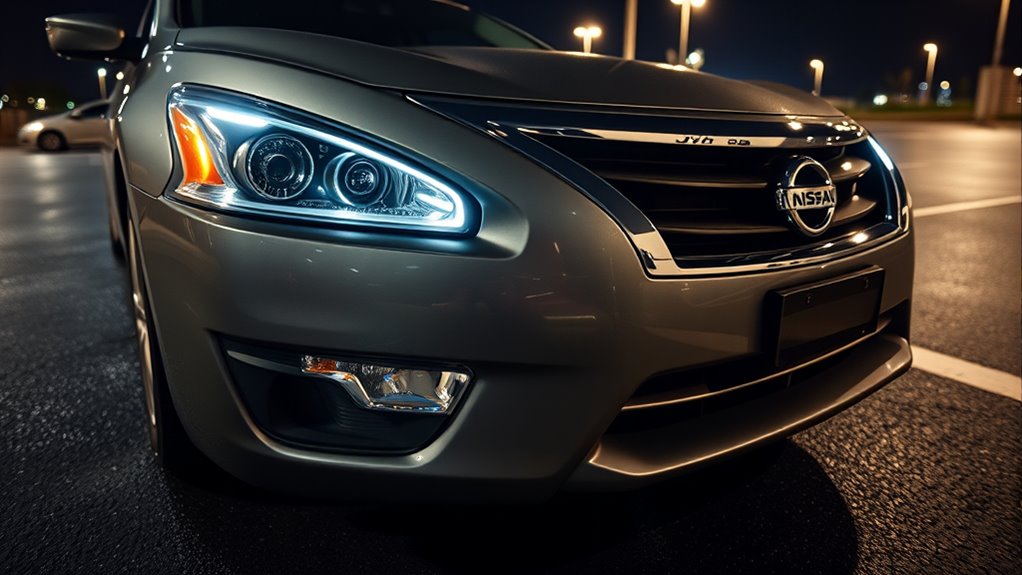
The 2014 Nissan Altima SV uses H11 bulbs for low beams and 9005 bulbs for high beams. Factory headlights can feel dim as reflector surfaces age and lenses yellow, reducing forward illumination and beam quality. LED replacements usually provide the best brightness if the housing is still clear and aligned correctly. Full assembly replacement is better when clouding, moisture, or internal wear is present. Proper fitment, aiming, and compatibility matter, and more details follow below.
Key Takeaways
- The 2014 Altima SV uses H11 low-beam bulbs and 9005 high-beam bulbs, so replacements must match those sizes.
- Factory headlights can seem dim because reflector surfaces age, reducing brightness and beam quality over time.
- LED headlights usually provide the best brightness upgrade if the housing is clean, clear, and properly aligned.
- Yellowed, cloudy, or moisture-damaged headlight assemblies should be replaced to restore safe nighttime visibility.
- Proper aim is important because even bright headlights perform poorly if the beams are misaligned.
Why 2014 Altima Headlights Feel Dim
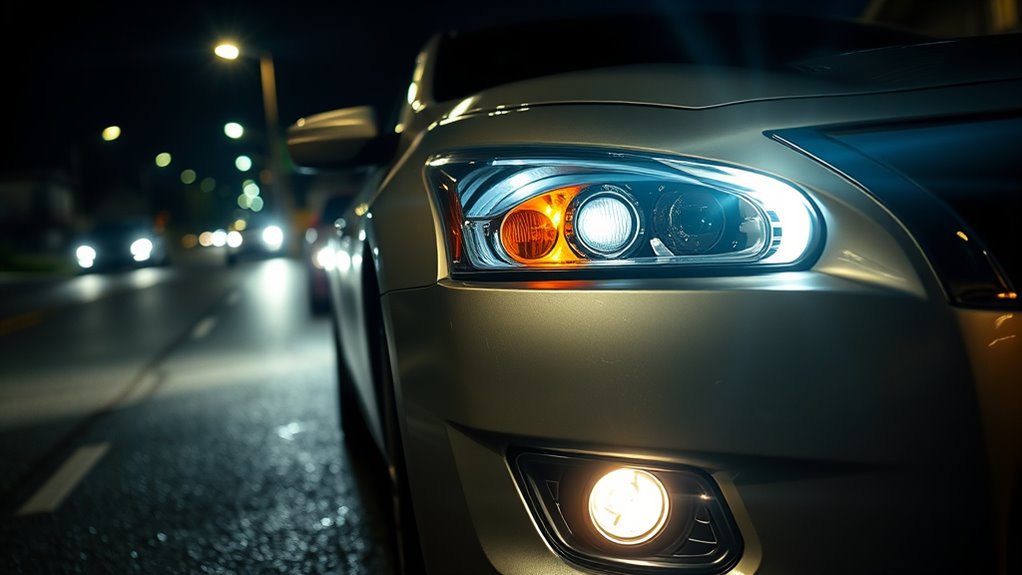
Many 2014 Altima owners report that the factory headlights feel dim because the headlight assembly itself often limits light output, especially at longer distances. This reduction in headlight brightness is often traced to aging reflector surfaces, which lose efficiency as the coating degrades.
As a result, the beam pattern becomes weaker and less controlled, creating visibility concerns on unlit roads and in adverse weather. In many cases, bulb changes alone do not correct the problem, since the assembly remains the primary bottleneck.
Reports from multiple owners suggest the issue is not isolated but widespread, pointing to a systemic quality limitation rather than a simple wear item. For drivers seeking greater autonomy from poor factory performance, the technical path toward improvement generally involves restoring optical efficiency at the source.
Better beam delivery can improve road definition, reduce strain, and support safer travel.
What Headlights Fit a 2014 Altima SV?
For a 2014 Nissan Altima SV, the standard bulb fitment is typically H11 for the low beams and 9005 for the high beams. Replacement headlights should match those specifications unless the entire assembly is being changed. This fitment governs compatibility, installation ease, and electrical function.
Owners seeking improved headlight brightness often evaluate higher-output halogen options or approved LED replacements, provided the housing and connectors remain compatible with the vehicle. A worn assembly can reduce light output, distort beam pattern, and undermine safety, making full replacement relevant when lenses, reflectors, or seals have degraded.
Owners often upgrade to brighter halogen or approved LED bulbs, but compatibility and housing condition remain essential.
Bulb longevity also matters, since inferior parts may fail early and require repeated service. Before purchase, part numbers, connector style, and beam designation should be verified against the Altima SV.
Recall checks are prudent, because documented defects in assemblies may qualify for free replacement and restore performance without added cost.
LED Bulbs Vs. Full Headlight Replacement
LED bulb upgrades can improve brightness and efficiency in a 2014 Altima SV, but they do not always correct poor beam projection if the headlight assembly itself has worn reflective surfaces, haze, or internal degradation.
LED Advantages include lower power draw, reduced heat output, and stronger light output when the housing is structurally sound. However, if the projector or reflector has aged, the beam may remain scattered, dim, or uneven despite newer bulbs.
Full headlight replacement often delivers better real-world results because it restores the optical path and can eliminate losses caused by degraded materials. Many users report clearer cutoff lines and broader usable light after installing complete assemblies.
Assembly Costs are higher than bulb-only upgrades, yet the investment may be justified when performance and reliability matter more than minimal spending. Compatibility with the 2014 Altima SV remains essential, and product quality should be verified through technical specifications and user reviews before any purchase.
Best LED Bulbs for the 2014 Altima SV
A quality LED upgrade can materially improve the 2014 Altima SV’s low-beam output, especially when the original halogen bulbs no longer provide sufficient intensity or road coverage. For drivers seeking clearer night travel, the most practical options are LED replacements engineered for this specific headlight assembly. LasFit units are frequently praised for fitment and consistent LED bulb performance, while generic bulbs may create compatibility problems.
| Option | Assessment |
|---|---|
| LasFit LED | Strong compatibility; bright output |
| Vehicle-specific LED | Reduced fitment risk |
| High-output noname LED | Variable performance |
| Halogen replacement | Least improvement |
Installation tips favor checking bulb base type, connector alignment, and thermal clearance before purchase. A properly matched LED can reduce the common dim-light complaint reported by many Altima owners and produce a noticeable gain in visibility and perceived safety. Selection should remain focused on purpose-built bulbs rather than universal claims, since liberation on the road begins with reliable illumination, not guesswork.
Why Headlight Assemblies Wear Out
Headlight assemblies wear out as the reflector coating gradually degrades, reducing the efficiency of light projection.
Over time, the lens can yellow from UV exposure and environmental aging, which lowers transmission and scatters output.
Heat cycling and moisture intrusion can also damage internal components, accelerating performance loss and visibility decline.
Reflector Coating Degradation
Over time, the reflective coating inside a headlight assembly can deteriorate, reducing the unit’s ability to direct light efficiently onto the road. This decline in coating lifespan is a common complaint among 2015 Altima owners, where both low and high beams lose intensity. Even with new bulbs, degraded reflectors limit forward illumination and constrain safe, liberated nighttime driving. Poor manufacturing quality may accelerate wear, making reflector maintenance and timely inspection important.
| Condition | Effect | Response |
|---|---|---|
| New coating | Full output | Monitor |
| Mild wear | Reduced beam focus | Inspect |
| Severe wear | Poor visibility | Replace |
Regular reflector maintenance cannot restore damaged surfaces, but prompt headlight assembly replacement can recover performance, improve visibility, and support safer travel.
Lens Yellowing Over Time
Years of UV exposure can cause the 2014 Altima SV headlight lens to yellow, haze, and lose transparency, which reduces the assembly’s ability to transmit light effectively.
As the polymer surface ages, lens maintenance becomes more important because yellowing scatters emitted beams and shortens usable illumination distance, especially at night.
Road debris, weathering, and abrasive contamination accelerate surface wear, compounding the loss of optical clarity.
In parallel, the weakened reflector system cannot fully compensate for the diminished lens performance, so overall output declines.
Applying UV protection measures and inspecting the lenses regularly can slow this process.
When discoloration becomes advanced, timely replacement restores safer visibility and supports a more autonomous driving experience through improved forward lighting and reduced visual strain.
Heat And Moisture Damage
Beyond lens yellowing, the 2014 Altima SV headlight assembly also deteriorates from sustained heat and moisture exposure. Prolonged thermal cycling can embrittle plastic housings, warp seals, and reduce structural integrity.
Inside the unit, reflective surfaces may oxidize or flake, lowering light output and weakening beam projection. Moisture intrusion adds another failure mode: condensation forms fogging on lenses, corrosion on connectors, and premature wear on internal components.
These combined effects diminish visibility and shorten service life. For drivers seeking dependable road illumination and autonomy in nighttime travel, headlight maintenance should include inspection for cracks, seal failure, and internal haze.
Timely replacement preserves optical efficiency, limits further damage, and helps guarantee the assembly continues to deliver consistent, controlled light.
How the Altima Headlight Recall Helps
The recall coverage for the 2014 Altima SV addresses inadequate headlight performance tied to manufacturing quality, with eligibility defined by Nissan and documented through NHTSA records.
Affected owners may receive free replacement headlight assemblies, reducing the cost burden associated with visibility-related failures.
This assistance can improve night-time illumination while resolving the standard setup’s reported performance limitations.
Recall Coverage Details
Coverage under the headlight recall for the 2014 Altima SV addresses inadequate illumination caused by manufacturing defects in the headlight assemblies, specifically the degradation of reflective materials over time.
The recall process verifies whether the vehicle’s lamps fall within the affected production range and whether assembly eligibility is confirmed through the manufacturer’s records. Once eligibility is established, the owner can proceed with inspection and corrective action under the recall terms.
This coverage targets the root fault rather than cosmetic concerns, restoring designed light output and safer forward visibility. For drivers seeking autonomy on the road, the recall functions as a practical correction to a systemic quality failure.
Free Replacement Benefits
Receiving a free replacement through the 2014 Altima SV headlight recall gives owners a direct remedy for defective assemblies linked to poor manufacturing quality.
The recall process allows eligible vehicles to receive new headlight units at no charge, reducing repair expense and removing reliance on compromised components.
Because the campaign was launched after repeated complaints of weak illumination, the replacement program functions as a practical correction, not a discretionary upgrade.
Improved output can restore forward visibility and deliver measurable safety enhancements during night driving and adverse weather.
Owners should verify VIN status, review recall instructions, and act without delay so the benefit is secured before the program conditions change.
This intervention helps reclaim dependable lighting performance.
Signs Your Headlight Assembly Is Failing
Reduced forward illumination is often the first sign that a 2014 Altima SV headlight assembly is failing, especially when the beam no longer projects far enough to provide clear visibility at speed. In headlight troubleshooting, this symptom should be treated as a functional warning, not a minor annoyance.
A driver may also notice that high beams offer little additional reach, suggesting degradation of the reflector surface or internal optical components. Clouding or yellowing of the lens further reduces output by scattering light and restricting beam control.
Intermittent flicker, delayed startup, or complete failure to illuminate points to electrical instability inside the assembly. Another reliable indicator is repeated bulb replacement without lasting improvement, which often means the assembly itself is no longer sustaining proper performance.
Effective assembly maintenance requires attention to these patterns, because persistent decline limits safe travel and keeps the vehicle from delivering the clear, liberated roadway vision it was built to provide.
How To Choose Compatible Bulbs and Assemblies
Selecting compatible bulbs and assemblies for a 2014 Altima SV begins with verifying the factory specifications in the owner’s manual, since the correct fitment is typically H11 for the low beams and 9005 for the high beams.
Verify the owner’s manual first—2014 Altima SV bulbs are typically H11 low beams and 9005 high beams.
From there, a careful bulb brightness comparison helps distinguish standard halogen output from LED alternatives such as LasFit LED, which may deliver stronger illumination and longer service life.
Compatibility also extends to the housing itself: reputable assemblies are preferred because reflective surfaces can lose efficiency with age, reducing optical control.
Before purchase, check whether an active recall exists, as manufacturer coverage may secure a replacement without added cost. Community reviews can further clarify real-world performance and fitment consistency.
Assembly installation tips should emphasize clean connectors, secure mounting, and precise alignment so the lighting system functions as designed.
Careful selection preserves visibility, supports self-directed maintenance, and reduces dependence on uncertain aftermarket claims.
What To Expect After the Upgrade
After the upgrade, the 2014 Altima SV is expected to show improved road visibility, with brighter output and greater forward reach in low-light conditions.
Beam pattern changes may also be apparent, as upgraded bulbs or assemblies can produce more controlled projection and reduced glare when compared with degraded stock components.
In cases where the full assembly is replaced, restored reflector performance can return the lighting system closer to its original operational standard.
Improved Road Visibility
A properly upgraded headlight assembly can restore the Altima SV’s light projection to its intended pattern, producing a clearer and more extended beam on the road ahead.
Such restoration typically yields measurable headlight brightness and visibility enhancement, especially when aged housings or worn bulbs had reduced output. Many owners report better detection of lane markings, roadside objects, and distant traffic signs in low-light conditions after replacement.
LED options, including LasFit units, may further increase luminous intensity and color clarity relative to standard halogen lamps, delivering more usable illumination without unnecessary strain.
This improved road visibility supports more confident nighttime driving and reduces exposure to preventable hazards. For drivers seeking practical freedom on less lit routes, proactive headlight renewal can materially improve the overall safety profile of the vehicle.
Beam Pattern Changes
Beyond stronger road visibility, a headlight upgrade also changes how the Altima SV projects light onto the roadway. New assemblies often deliver beam pattern adjustments that concentrate output more effectively, creating visibility enhancements without excessive scatter.
- Wider, cleaner illumination across lane edges
- Fewer dark spots from aged reflectors
- Better sign and obstacle definition at distance
- Reduced glare when alignment is correct
LED replacements commonly broaden reach while preserving a focused cutoff, helping road users see farther with less visual strain.
When reflective surfaces are renewed, the light spread becomes more uniform and technically controlled. Proper calibration remains critical, since precise aiming supports safer nighttime driving and limits glare for oncoming traffic.
The result is a more disciplined beam pattern that serves confident, unobstructed movement.
Assembly Replacement Results
New headlight assemblies on a 2014 Altima SV typically restore the light output that many owners find lacking in aged units, producing a noticeably brighter and more focused beam.
Replacement commonly improves assembly performance by recovering reflective efficiency and correcting degraded light projection. Drivers often report stronger low-beam reach, reduced glare, and a more uniform illumination pattern across the road surface.
High-quality assemblies compatible with the Nissan Altima can return lost optical effectiveness that accumulates over time, especially when original units have faded or clouded.
The result is more reliable distance visibility and a steadier cutoff, which supports safer nighttime travel. For motorists seeking greater control and less dependence on compromised factory parts, the upgrade generally delivers measurable, practical gains.
Tips for Safer Night Driving
Safer night driving begins with proper headlight performance, since alignment has a direct effect on both road illumination and glare control for oncoming traffic.
Accurate aim improves nighttime visibility and supports driving safety by reducing wasted light and eye strain.
Accurate headlight aim improves nighttime visibility, reduces wasted light, and helps lessen eye strain for safer driving.
- Headlights should be checked regularly; misalignment can cut usable forward lighting and increase glare.
- Lenses should be cleaned and replaced when yellowed or cloudy, because contamination can reduce output sharply.
- LED bulbs may be considered for a whiter beam and greater illumination than standard halogen units.
- High beams are appropriate on empty roads, but low beams should resume near other vehicles; speed and following distance should also be adjusted in fog, rain, or darkness.
Frequently Asked Questions
What Headlights Does a 2014 Nissan Altima Take?
A 2014 Nissan Altima typically takes H11 halogen bulbs for low beams and 9005 bulbs for high beams. These headlight types offer standard bulb options, though compatible LED replacements are commonly chosen for improved visibility.
What Kind of Headlight Does a Nissan Altima Take?
A Nissan Altima generally accepts halogen headlight types, typically H11 low beams and 9005 high beams, with bulb compatibility varying by model year. Upgraded LED units or replacement assemblies may improve illumination without unnecessary dimming.
What Kind of LED Headlights Are Compatible With a 2014 Nissan Altima?
Compatible LED headlights for a 2014 Nissan Altima usually require H11 low-beam and 9005 high-beam conversions; projector-safe, CAN-bus-ready bulbs maximize LED brightness. Installation tips include checking fitment, polarity, and heat dissipation to guarantee reliable performance.
Was 2014 a Good Year for Nissan Altima?
Yes, 2014 was a strong year for the Altima. 2014 Altima performance was efficient and composed, while Nissan reliability ratings were favorable. Safety, cabin quality, and technology made it a technically competent midsize sedan.
Conclusion
For the 2014 Altima SV, the choice narrows between a simple LED bulb swap and a complete headlight assembly replacement. The former offers sharper light within the original housing; the latter restores clarity where wear has turned lenses cloudy and output weak. Brightness on one side, aging plastic on the other. Compatibility, beam pattern, and road safety determine the better result. After the upgrade, night driving shifts from strained visibility to controlled, measured illumination.

