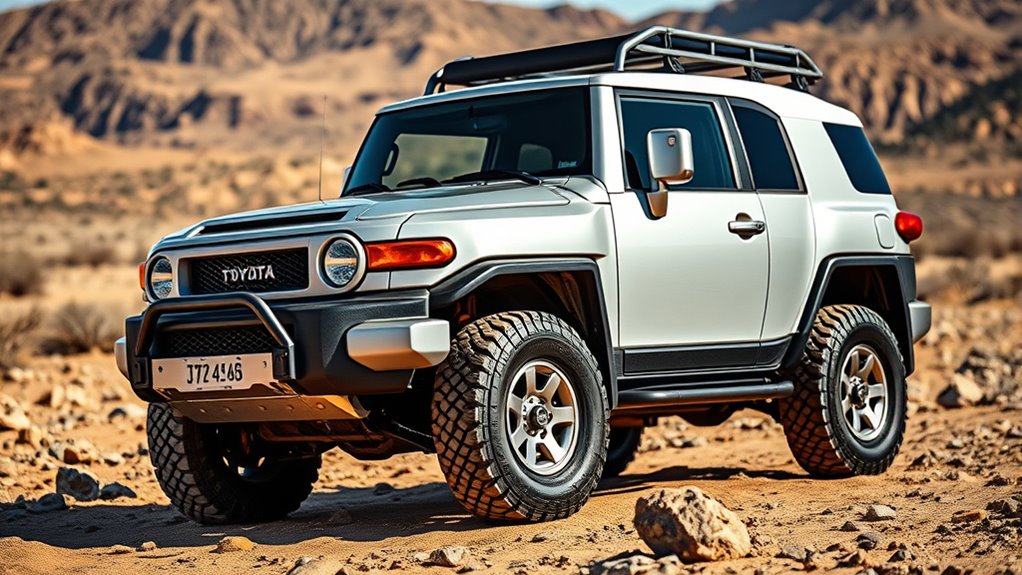
The FJ Cruiser’s above-wheel elevation came from a 3-inch lift kit paired with a body mount chop. The lift increased ground clearance, approach angle, and suspension articulation while keeping the center of gravity manageable. The body mount chop removed interference for 285/70 R17 Tread R Guard Dogs tires, preventing rub at full lock and under compression. The result was cleaner tracking, sharper steering, and better trail clearance, with more details available below.
Key Takeaways
- A 3-inch lift kit significantly increases FJ Cruiser ground clearance and improves obstacle and uneven terrain handling.
- The lift improves approach, departure, and breakover angles while maintaining predictable suspension stability.
- 285/70 R17 Tread R Guard Dogs tires fit well with the lift and enhance off-road traction.
- Taller tires may require a body mount chop to prevent rubbing during turns and articulation.
- After installation, the FJ Cruiser tracks cleanly at speed with improved steering, lane control, and overall drivability.
How the FJ Cruiser Lift Affects Clearance
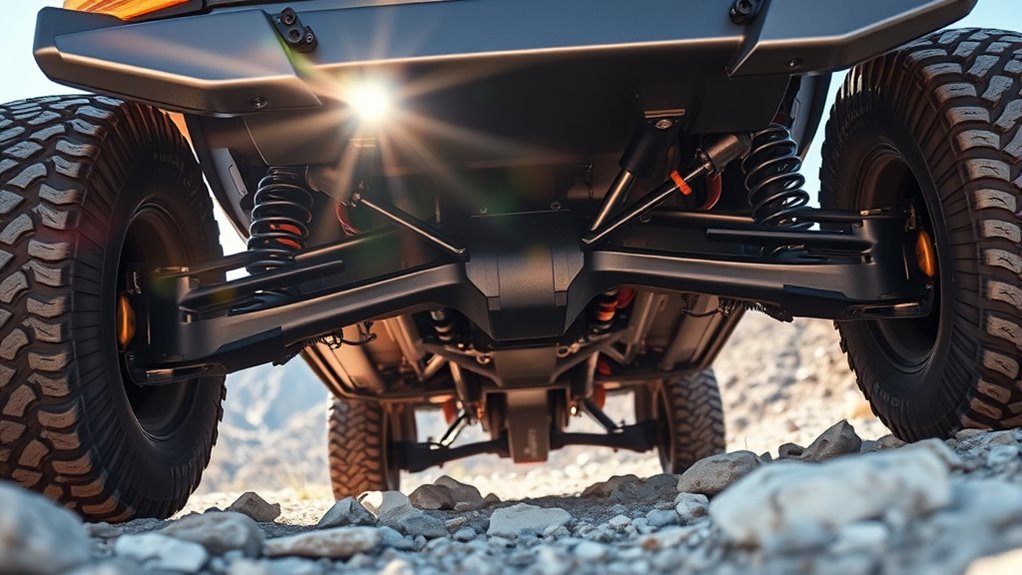
The FJ Cruiser’s lift kit, originally intended to provide 3 inches of additional height, materially increases ground clearance and improves the vehicle’s ability to pass over obstacles and uneven terrain.
This elevation reduces the likelihood of underbody contact, supports greater suspension articulation, and expands usable travel across rough surfaces. Every time the chassis sits higher, approach and departure angles improve, allowing the vehicle to negotiate ledges, ruts, and washouts with less interference.
The installed 285/70 R17 Tread R Guard Dogs tires further raise effective ride height, their 33 to 35 inch overall diameter adding measurable clearance at contact points.
The 285/70 R17 Tread R Guard Dogs add effective ride height, increasing clearance where it matters most.
During steering articulation, clearance issues emerged at the body mount, requiring a chop to preserve space without weakening structural integrity. Such geometry serves liberation through capability: the platform moves with fewer constraints, more control, and less vulnerability.
Last thing, the combined modifications improve function and appearance in demanding environments.
Why a 3-Inch Lift Fit This Build
A 3-inch lift proved to be the ideal compromise for this FJ Cruiser build, adding usable clearance without unduly raising the center of gravity or degrading off-road stability.
This height delivered measured lift performance by supporting 285/70 R17 Tread R Guard Dogs while preserving predictable suspension stability on uneven terrain. The chassis retained a controlled stance, limiting body roll and maintaining composure during articulation, braking, and cornering.
Installation remained efficient because the system avoided extensive suspension alterations, reducing complexity and keeping the build within practical limits for a street-legal platform.
For drivers pursuing liberation from factory constraints, the result was an assertive posture with tangible capability rather than cosmetic excess. The lift also provided aesthetic enhancement, giving the FJ Cruiser a more aggressive profile without sacrificing daily drivability or mechanical balance.
How the Body Mount Chop Clears Bigger Tires
Because taller tires push closer to the FJ Cruiser’s body structure, a body mount chop becomes a practical clearance solution. By removing excess material from the mount, the chassis gains the space needed for larger tires to rotate cleanly, avoiding tire rubbing at full turn and under compression.
This matters with 285/70 R17 Tread R Guard Dogs, where added diameter improves off-road capability but also demands precision. The chop is engineered to preserve body integrity while restoring articulation and reducing the chance of sidewall damage during turns.
It is typically done outdoors because vehicle height limits access, so the work must be completed efficiently, especially in cold weather.
- Clearance is created without altering the suspension geometry.
- Modification safety depends on accurate cutting and controlled finishing.
- Proper execution facilitates fitment freedom and improves overall stance.
FJ Cruiser Wheel and Tire Install Details
Once the Tread R Guard Dogs in 285/70 R17 size were selected for the FJ Cruiser, each tire was mounted at a Portland tire shop for about $15 per wheel, with the full set completed in roughly an hour.
This tire selection guide choice yields a 33 to 35 inch diameter range, supporting off road performance without excessive compromise. Cedg grip technology, using walnut shells and glass, is embedded in the tread compound to maintain traction as the tires wear, an important detail for continued utility under liberated driving conditions.
After installation, a body mount chop was required to preserve clearance at steering lock and avoid interference from the turning wheels. All four wheel and tire assemblies were installed successfully, and aftermarket fender flares were identified as the next step to improve coverage, fitment, and function.
Practical installation tips include verifying clearance before final torque and confirming suspension articulation.
How the FJ Cruiser Drove After the Install
After the wheel and tire installation, the FJ Cruiser tracked cleanly at speed with no detectable wobble or shake, indicating that the fitment and balance were correct. Test drives showed crisp steering response, steadier lane control, and improved composure over imperfect pavement.
The 285/70 R17 setup, paired with the lift kit, increased ground clearance and supported more confident trail articulation without compromising highway stability.
- Suspension tuning remained controlled, preserving predictable weight transfer and steering feedback.
- Traction improvement from the Tread R Guard Dogs tires reduced slip on loose surfaces and wet asphalt.
- Off road performance advanced through added clearance, allowing freer passage over ruts, rocks, and uneven terrain.
The vehicle also presented a more assertive stance, matching the owner’s customization goals while delivering measurable functional gains.
In practical terms, the modifications liberated the chassis from prior limitations, enabling a smoother, more responsive drive in daily use and in demanding conditions.
Frequently Asked Questions
Which Years of the Toyota FJ Cruiser Are Considered the Worst?
The worst FJ Cruiser years are generally 2007-2011, especially 2007-2008 transmissions, 2009 electrical faults, 2010 rear differential noise, and 2011 interior quality dips, according to FJ Cruiser reliability, FJ Cruiser reviews, and FJ Cruiser maintenance data.
Will the FJ Cruiser Become a Collectible?
Yes, the FJ Cruiser appears likely to enter the collector market, with stronger FJ Cruiser value emerging from limited production, reliability, and distinctive design; its investment potential increases as enthusiasts seek capable, liberated off-road classics.
What Is the Rarest Toyota FJ Cruiser?
The rarest Toyota FJ Cruiser appears to be the 2014 Trail Teams Ultimate Edition; its scarcity is like a desert mirage. FJ Cruiser history, specifications, and limited FJ Cruiser modifications make it exceptionally collectible.
What Is the Common Problem of a FJ Cruiser?
The FJ Cruiser commonly suffers from suspension system weaknesses, causing poor wheel clearance, alignment drift, and tire rub. FJ Cruiser reliability issues and off road performance concerns also arise from rust, corrosion, and factory lift limitations.
Conclusion
In the end, the FJ Cruiser’s elevated stance transformed the build like a bridge raised above a floodplain, creating the clearance needed for larger tires without sacrificing control. The 3-inch lift, body mount chop, and wheel-and-tire package worked together with measured precision, allowing articulation to improve while rubbing was reduced. On the road, the truck settled into its new geometry with steady composure, proving the installation was not merely cosmetic, but structurally functional.