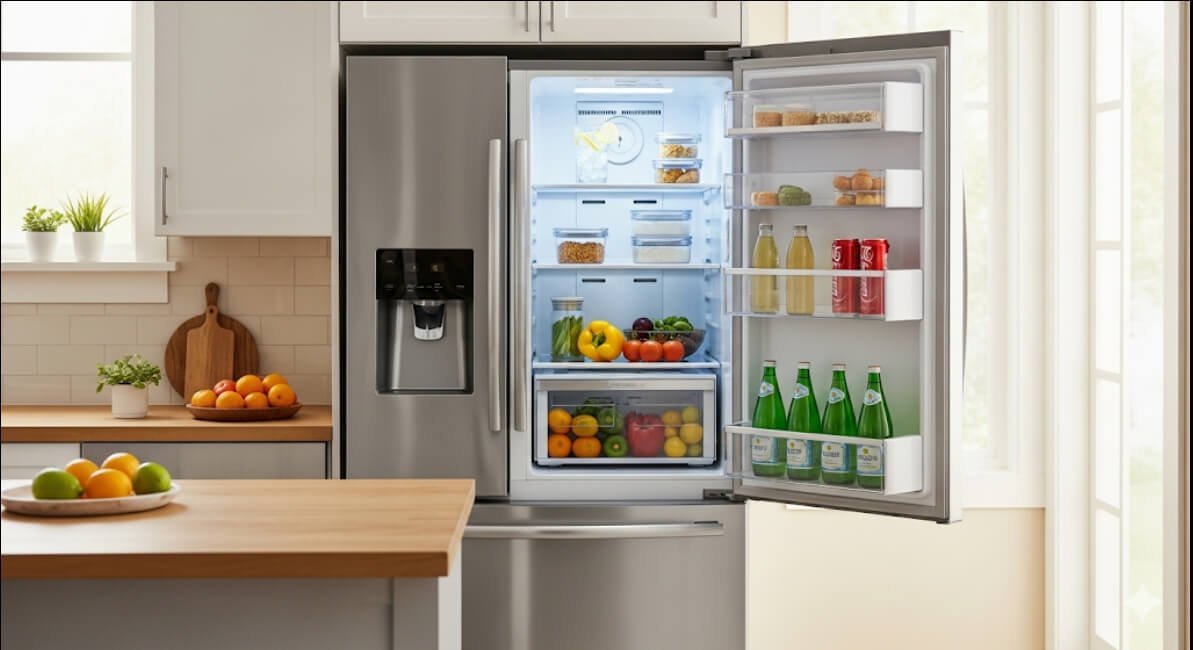
Good refrigerators for food inventory management make it easier to see what you have, separate chilled and frozen food, and avoid buying duplicates. Your best choice depends mainly on storage volume and available space.
For most small-space buyers, the Electactic BCD-87 3.1 Cu.Ft Mini Fridge with Freezer is the most practical overall pick because it combines separate fresh and frozen storage in a compact footprint. For commercial-scale inventory, the ORIKOOL ST54BR 54-Inch Commercial Reach-In Refrigerator offers far more chilled capacity.
We checked the current Amazon listings, available manufacturer specifications, food-safety guidance, and recall records before updating these picks.
Refrigerators for Food Inventory Management Compared
| Product | Best for | Capacity | Defrost |
|---|---|---|---|
|
Budget
|
Dorms, offices and secondary storage | 3.1 cu.ft total | Manual |
|
Premium
|
Commercial and bulk chilled inventory | 49 cu.ft | Automatic |
Refrigerators for Food Inventory Management: Our Top Picks
[Amazon Products Picked for You]

Spacious 23 Cu Ft Large‑Capacity Commercial Refrigerator: ICECASA 27‑inch wide single door reach‑in commercial refrigerator delivers 23 cubic feet of ample interior storage space. Designed for high‑volume cold food storage, it holds large quantities of fresh ingredients, dairy and pre‑prepared food. Ideal for busy back‑of‑house kitchen environments to support daily foodservice operation.Perfect refrigeration solution for restaurants, cafes, delis, convenience stores, bakeries and catering operations. 3 flexible adjustable shelves support customized storage layouts for sheet pans, large pots and assorted food containers .27-inch inner depth makes this unit fit full size sheet pans.

Efficient Cooling: This commercial refrigerator combines high-performance cooling with digital temperature display to keep food fresh while saving energy. With a 32℉ to 50℉ (0℃ to 10℃) range and smart digital control, it easily adapts to diverse storage needs

[49.6 Cu. Ft. Mega Capacity Commercial Storage] InnerCalm double door commercial refrigerator provides 49.6 cu. ft. of reach-in cold storage for restaurants, bars, cafés, grocery stores, bakeries, catering kitchens, food trucks, and prep areas. It is ideal for storing dairy, meat, produce, beverages, sauces, prepared ingredients, meal containers, and ready-to-serve foods.
1. Electactic BCD-87 3.1 Cu.Ft Mini Fridge with Freezer

Bottom line: The Electactic BCD-87 3.1 Cu.Ft Mini Fridge with Freezer is the better fit for dorms, offices, bedrooms, apartments and secondary food storage. Its separate freezer gives you more flexibility than a refrigerator-only compact model.
Key Specs
- Capacity: 3.1 cu.ft total, including 0.85 cu.ft freezer space.
- Dimensions: 18.9″D × 18.11″W × 33.46″H, compact for tight spaces.
- Defrost: Manual, so periodic hands-on defrosting is required.
- Temperature control: Adjustable thermostat, verify safe temperatures with a thermometer.
- Storage layout: Two doors and removable glass shelves, separating chilled and frozen food.
The total capacity is split between a 2.2 cu.ft fresh-food compartment and a 0.85 cu.ft freezer. That makes it useful for drinks, leftovers, meal-prep containers, frozen basics and personal groceries without taking over a room.
Its reversible-door design gives you more placement flexibility, while removable glass shelves let you change the interior layout for taller containers. The trade-off is capacity: this is supplemental or personal storage, not a full-family refrigerator.
The unit uses manual defrost rather than automatic defrost. If you want the lowest-maintenance setup possible, that is an important difference to consider before buying.
- Separate fresh-food and freezer compartments
- Compact 18.11-inch-wide footprint
- Removable glass shelves provide flexible organization
- Reversible doors help with placement
- Too small for most full-family grocery loads
- Manual defrost requires more maintenance
- An appliance thermometer is still important for perishable food
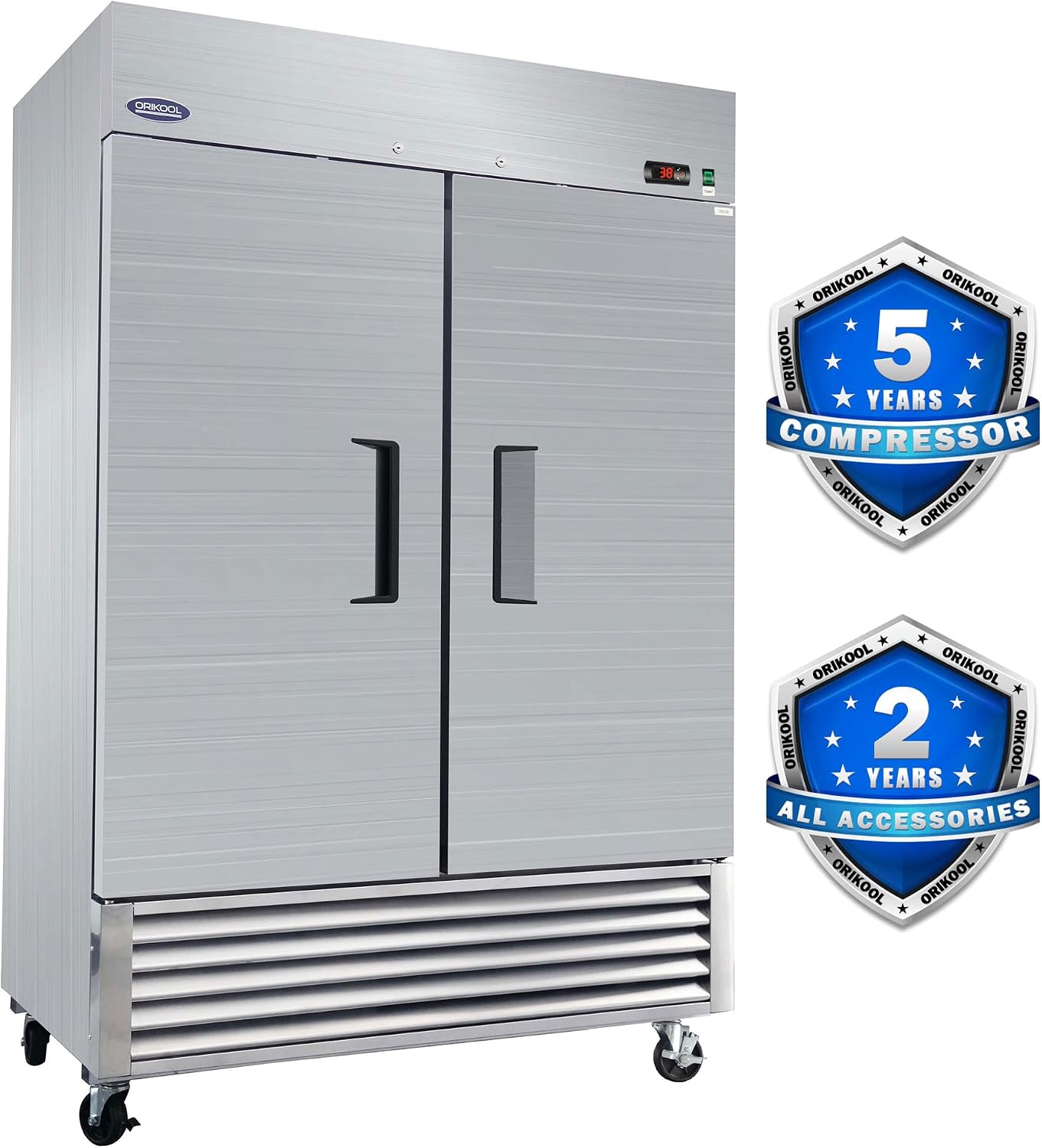
2. ORIKOOL ST54BR 54-Inch Commercial Reach-In Refrigerator

Bottom line: The ORIKOOL ST54BR 54-Inch Commercial Reach-In Refrigerator is built for restaurants, catering prep, shops and other spaces that need organized bulk chilled storage. Its 49 cu.ft capacity is far beyond a compact household unit.
Key Specs
- Capacity: 49 cu.ft fresh-food storage, designed for bulk inventory.
- Dimensions: 32.09″D × 54.13″W × 83.11″H, requiring substantial space.
- Defrost: Automatic, reducing routine frost-management work.
- Temperature control: Digital thermostat with a stated 33–40°F range.
- Storage layout: Two solid doors and six adjustable shelves, organizing large loads.
The ST54BR uses two solid doors and six adjustable shelves to divide large quantities of ingredients, prepared foods and beverages. Its digital thermostat gives you a direct way to monitor and adjust the cabinet temperature.
ORIKOOL specifies a 33–40°F operating range and automatic defrosting. The manufacturer also lists R290 refrigerant, ETL certification and DOE compliance for this commercial reach-in.
The biggest catch is physical size. At more than 54 inches wide and 83 inches tall, it needs careful measurement of the final installation area, ventilation space and the complete delivery path.
- 49 cu.ft capacity for high-volume chilled storage
- Six adjustable shelves support organized inventory
- Automatic defrost reduces manual maintenance
- Digital thermostat provides direct temperature control
- ETL listed and DOE compliant
- Large footprint requires significant installation space
- Refrigerator-only design does not replace a freezer
- Commercial construction puts it in a premium price tier
Electactic BCD-87 vs ORIKOOL ST54BR: Is the Upgrade Worth It?
These refrigerators solve very different storage problems. The Electactic makes sense for personal or secondary storage, while the ORIKOOL is a commercial-scale reach-in for much larger chilled inventories.
- Capacity: Electactic provides 3.1 cu.ft; ORIKOOL provides 49 cu.ft.
- Frozen storage: Electactic includes a separate freezer; ORIKOOL is refrigerator-only.
- Defrost: Electactic uses manual defrost; ORIKOOL uses automatic defrost.
- Installation: ORIKOOL needs much more floor space and delivery clearance.
[Amazon Products Picked for You]

Efficient Cooling: This commercial refrigerator combines high-performance cooling with digital temperature display to keep food fresh while saving energy. With a 32℉ to 50℉ (0℃ to 10℃) range and smart digital control, it easily adapts to diverse storage needs

Spacious 36 Cu Ft Large‑Capacity 48‑Inch Wide Commercial Refrigerator: ICECASA 48‑inch wide double‑door reach‑in commercial refrigerator delivers 36 cubic feet of ample interior storage space. Designed for high‑volume cold food storage, it holds large quantities of fresh ingredients, dairy and pre‑prepared food. Ideal for busy back‑of‑house kitchen environments to support daily foodservice operation.Perfect refrigeration solution for restaurants, cafes, delis, convenience stores, bakeries and catering operations. 6 flexible adjustable shelves support customized storage layouts for sheet pans, large pots and assorted food containers ,maximizing the use of every inch.

Spacious 21.4 cu. ft. Capacity: Offers ample storage space with three adjustable shelves to organize various items.
Which Refrigerator Should You Buy?
- Small apartment or dorm: get the Electactic BCD-87.
- Fresh and frozen personal storage: get the Electactic BCD-87.
- Restaurant or catering inventory: get the ORIKOOL ST54BR.
- Large chilled-only inventory: get the ORIKOOL ST54BR.
- Automatic defrost: get the ORIKOOL ST54BR.
[Amazon Products Picked for You]

Manage Maintenance Seamlessly: With a Wi-Fi connection, only a simple operation is needed on-site to complete the IoT access of the device. Then, refrigeration equipment and food can be remotely monitored and managed from computers, tablets, mobile phones, etc. It provides remote monitoring and fault alarm functions, which can detect equipment failures in time and avoid increased maintenance costs caused by the expansion of faults

[Fast Cooling & Energy-Saving] BODEGACOOLER commercial merchandiser refrigerator uses R600a eco-friendly refrigerant and a high-efficiency compressor. This commercial beverage cooler adopts a powerful air-cooled frost-free direct cooling system with a 20 cm airflow fan, ensuring precise airflow distribution, accelerating cold air circulation, and enabling automatic defrosting.

ENSURE FOOD SAFETY: Thermometer displays true appliance temperature instantly to ensure safe food storage
How We Chose
- Storage usefulness: We prioritized capacity and layouts that help you separate and see food inventory.
- Exact specifications: We checked capacity, dimensions, defrost method, temperature controls and storage layouts against current product information.
- Use-case fit: Each refrigerator had to suit a clear inventory need rather than simply being a general appliance.
- Safety: We reviewed current product availability and searched official recall records before keeping a product as a recommendation.
- Food storage guidance: We also checked FDA and USDA refrigerator-temperature and airflow recommendations.
Food storage tip: Keep perishable food at 40°F or below and use an appliance thermometer to verify the actual cabinet temperature. The FDA also recommends avoiding overpacking because cold air needs room to circulate. Read the FDA refrigerator safety guide.
How to Choose a Refrigerator for Food Inventory Management
Capacity and Storage Layout
Start with the amount of food you normally keep cold, not the largest capacity you can fit. A compact model works for personal groceries, drinks and leftovers. Commercial kitchens need enough shelf area to separate ingredients and prepared food while keeping everything visible.
The Electactic BCD-87 suits small loads, while the ORIKOOL ST54BR is built for bulk chilled inventory.
Fresh Food vs Frozen Storage
Decide whether you actually need a freezer. The Electactic has separate fresh-food and freezer compartments, so one appliance can handle both. The ORIKOOL ST54BR is a refrigerator-only reach-in, making it better when your frozen inventory is already handled by a separate freezer.
Temperature Control
Do not depend only on the setting printed on a thermostat dial. The FDA recommends keeping refrigerators at 40°F or below and freezers at 0°F. An appliance thermometer lets you check the real temperature where your food is stored.
Defrost Method
Manual-defrost appliances periodically need you to remove frost yourself. Automatic-defrost systems reduce that work. If low maintenance matters more than compact size, the ORIKOOL’s automatic-defrost system has an advantage over the manually defrosted Electactic.
Space, Door Swing and Delivery
Measure width, height and depth before ordering, but also measure doorways, halls, turns and the final door swing. Large commercial appliances can fit the final space yet still fail to fit through the delivery path. Good planning also helps you use your available kitchen space more efficiently.
Inventory Organization
Adjustable shelves make it easier to create zones for produce, dairy, leftovers, drinks and prepared ingredients. Labels and clear containers can further reduce forgotten food. Put older items toward the front so they are easier to use first.
Mistakes to Avoid When Buying a Refrigerator
- Buying on capacity alone: Make sure the shelf layout actually suits the food you store.
- Ignoring the delivery path: Measure doors, halls and turns before ordering a large appliance.
- Assuming the thermostat is exact: Use an appliance thermometer to verify food-safe temperatures.
- Overpacking shelves: Leave enough room for cold air to circulate around food.
- Forgetting freezer needs: A refrigerator-only commercial unit cannot replace separate frozen storage.
FAQs
What Should I Consider When Buying a Refrigerator for Food Inventory?
Start with the amount of food you store, the available installation space and whether you need frozen storage. Then compare shelf flexibility, defrost method, temperature control and delivery requirements. A compact fridge-freezer works well for personal inventory, while a commercial reach-in is more appropriate for high-volume chilled storage.
What Temperature Should a Refrigerator Be for Safe Food Storage?
A refrigerator should stay at 40°F or below for safe perishable-food storage. The FDA and USDA recommend checking the actual cabinet temperature with an appliance thermometer rather than relying only on the control setting. Freezers should be kept at 0°F for normal frozen-food storage.
Can a Mini Fridge Safely Store Perishable Food?
Yes, a mini fridge can store perishable food if it consistently maintains 40°F or below. Use an appliance thermometer, avoid blocking internal airflow and make sure the door closes properly. Capacity is the bigger limitation: a compact refrigerator may work well for one person but not for a large weekly grocery load.
How Can I Manage Food Inventory Inside a Refrigerator?
Group similar foods together, label prepared items and place older food toward the front. Clear containers can make contents easier to identify without opening everything. Check the refrigerator before shopping so you know what needs replacing, and avoid packing shelves so tightly that cold air cannot circulate.
When Should I Choose a Commercial Refrigerator?
Choose a commercial refrigerator when you need large, organized chilled storage for a restaurant, catering operation, shop or other high-volume use. Commercial reach-ins also make sense when frequent access and adjustable shelving matter. Measure the installation area and complete delivery path carefully because these units are much larger than residential refrigerators.
Should I Buy a Refrigerator With Automatic Defrost?
Automatic defrost is useful if you want to reduce routine frost-management work. Manual-defrost appliances can still be practical, especially in smaller and less expensive units, but they require periodic attention. Compare maintenance convenience with capacity, footprint and your actual storage needs instead of treating one defrost system as automatically better.
Can a Refrigerator Be Packed Completely Full?
A refrigerator should not be packed so tightly that cold air cannot circulate. FDA guidance specifically advises against overpacking refrigerated food. Organize items in groups and leave airflow paths around them. If you regularly run out of room, moving overflow to a second refrigerator is better than continually crowding the main unit.
Final Verdict
For most readers comparing refrigerators for food inventory management, the Electactic BCD-87 is the more practical everyday option because it combines compact dimensions with separate fresh and frozen storage. The ORIKOOL ST54BR is the better fit when your needs move into commercial-scale chilled inventory.
For high-volume chilled storage, compare the ORIKOOL ST54BR 54-Inch Commercial Reach-In Refrigerator.
| Product | Image | Best For | Highlights | Pros | Cons | Check Price |
|---|---|---|---|---|---|---|
| Electactic 3.1 Cu.Ft Mini Fridge with Freezer |
|
Small spaces, dorms, offices, bedrooms, apartments, and secondary food storage. | 3.1 cu.ft capacity, two-door layout, freezer section, adjustable removable glass shelves. | Compact footprint, separated fresh/frozen storage, flexible shelves, useful for snacks and leftovers. | Not large enough for full-family groceries; some users report initial odor or condensation. | Check Product Details |
| 54″ W Commercial Refrigerator |
 |
Commercial kitchens, catering prep, shops, bulk storage, and high-volume food inventory. | 49 cu.ft capacity, double doors, six adjustable shelves, auto defrost, digital thermostat. | Very spacious, commercial-style access, adjustable organization, stainless steel construction. | Large and heavy; requires significant space, delivery planning, and proper clearance. | Check Availability |
