Winter garage welding for auto-body work and paint-ready metal prep demands attention to safety, visibility, and comfort. You need a welding hood that helps you see the weld pool and panel edges clearly, protects your eyes and face from welding hazards, and stays comfortable when you are working in a cold or dim shop.
This guide focuses on auto-darkening welding helmets suited to bodywork, small fabrication, panel repair, restoration, tack welding, and metal prep before paint. The strongest picks combine true-color optics, useful shade ranges, practical controls, adequate sensor coverage, and comfortable headgear for longer garage sessions.
Affiliate disclosure: This roundup is reader-supported. When you click through Amazon links, we may earn a referral commission on qualifying purchases. Prices, ratings, included accessories, and availability can change, so confirm the current Amazon listing before buying.
Quick Verdict
Best overall for most garage welders: YESWELDER LYG-M800H, because it combines a large 3.93 x 3.66 in viewing area, four sensors, true-color optics, and convenient external adjustments.
Best for low-light garage work: ARCCAPTAIN XK-LY800H, because its large viewing window and helmet-mounted light can help during fit-up and inspection in a dim winter shop.
Best for wider workspace awareness: YESWELDER LYG-Q800D, because its panoramic side-view design can make clamps, body panels, and awkward fabrication angles easier to monitor.
Top Picks
|
Category |
Product |
Best For |
|---|---|---|
|
🏆 Best Overall |
Large-window garage welding |
|
|
💡 Best for Low-Light Work |
Dim winter garages and fit-up |
|
|
🎯 Beginner-Friendly Pick |
Broad features and simple setup |
|
|
🚀 Best Panoramic View |
Wider peripheral awareness |
|
|
⭐ Best Compact Clarity |
Clear optics without an extra-tall lens |
|
|
🔦 Best Compact Light Pick |
Small jobs and low-light setup |
|
|
🛠️ Best for Occasional Use |
DIY repair and light garage work |
|
|
🎨 Best Graphic Style |
Wide view with a distinctive shell |
|
|
🔰 Best Simple Pick |
Basic auto-darkening garage work |
How We Picked These Welding Hoods
You want a helmet that protects your eyes and face while also letting you see enough detail to make controlled tack welds and cleaner repairs before paint. We therefore focused on four practical areas: optical visibility, shade and sensor controls, comfort, and overall suitability for garage fabrication.
Large viewing areas and true-color lenses can make panel edges, joint gaps, clamps, and the weld pool easier to see. Four-sensor helmets may also provide more sensor coverage when your hands, fixtures, tubing, or body panels partly block the arc from one direction.
Winter-friendly details include controls that are reachable while wearing gloves, replaceable lens covers, battery backup, and optional work lights. A helmet-mounted light can help with setup or inspection, but it should not replace proper shop lighting.
Exact Amazon prices, ratings, review counts, and discounts were not used as permanent ranking factors because they can change frequently.
Before You Buy
- Verify the safety marking: Check the helmet, filter, manual, packaging, and current manufacturer documentation for the eye and face protection standard required in your region.
- Choose the correct shade for the process: TIG, MIG, stick welding, plasma cutting, and other processes may require different filter shades depending on arc current and other variables. Follow the helmet manual and applicable welding-safety guidance.
- Do not select a shade only because it looks comfortable: A lighter setting must never go below the minimum protective shade required for the welding process and amperage.
- Use appropriate backup eye protection: Wear suitable safety glasses or goggles under the helmet when sparks, grinding fragments, or other impact hazards are present.
- Remember that a welding hood is not complete PPE: Grinding, welding, sanding, and paint preparation may also require gloves, hearing protection, protective clothing, and task-appropriate respiratory protection.
- Test the helmet before welding: Inspect the lens covers, sensors, battery condition, headgear, and auto-darkening operation before starting a long job.
- Plan for winter conditions: Cold garages can increase condensation and battery-related problems. Store the helmet dry, keep lens covers clean, and let equipment acclimate when moving between very different temperatures.
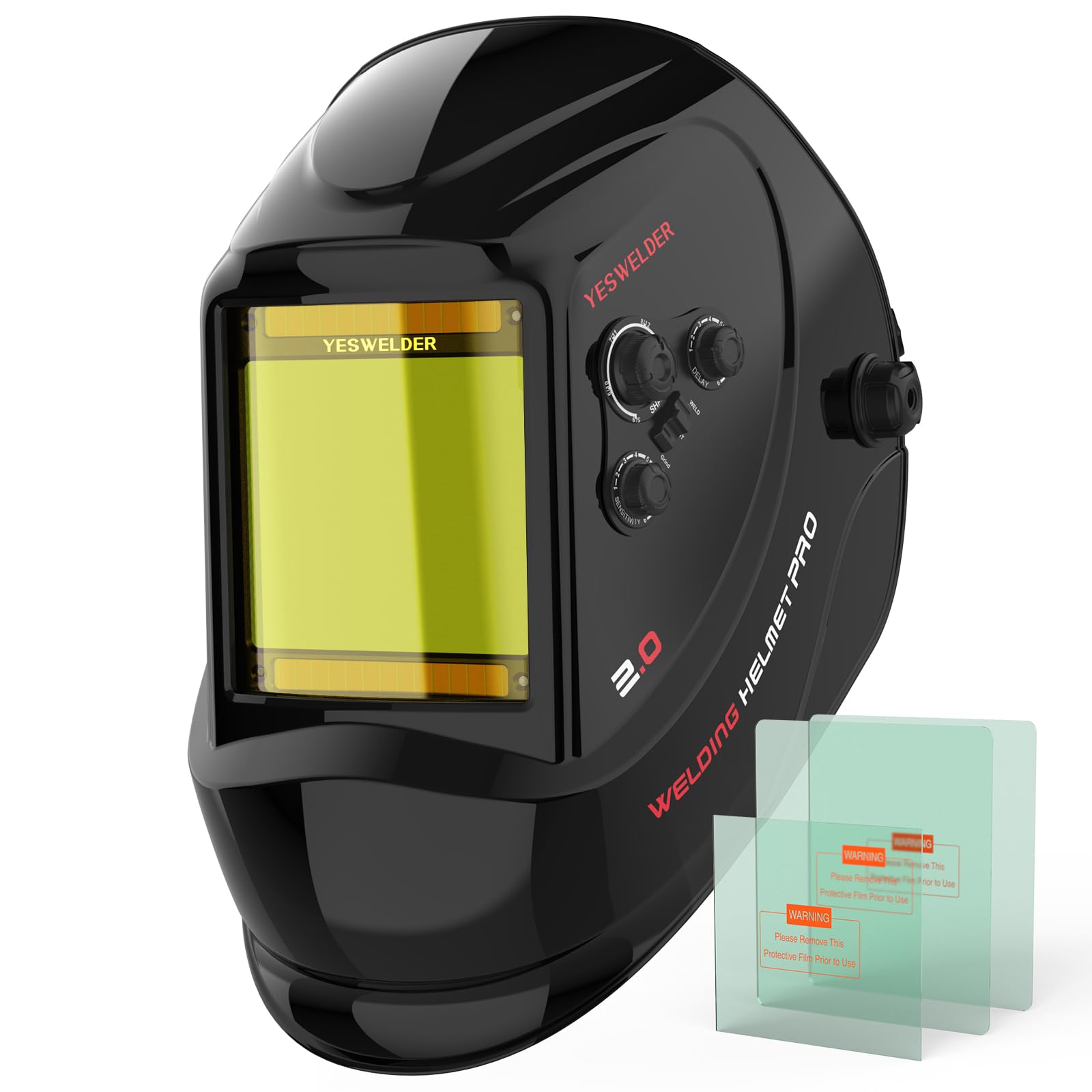
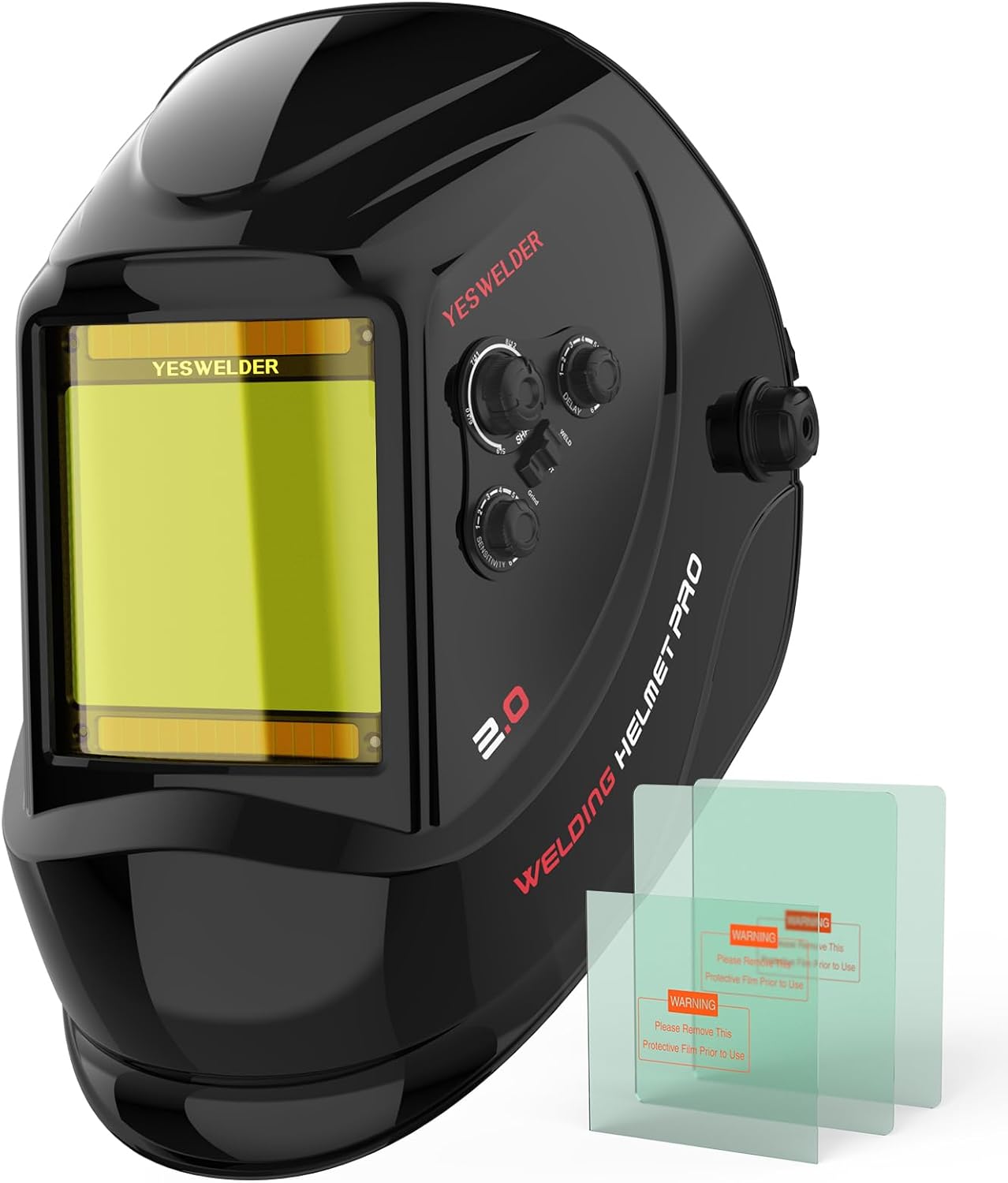
If you spend time prepping metal or doing auto-body fabrication before custom paint, the LYG-M800H gives you a broad front view that can make tack points, seams, and surrounding panel edges easier to monitor. Its large 3.93 x 3.66 in viewing area is one of the main reasons it stands out.
Four arc sensors give the auto-darkening system more opportunities to detect an arc when you are working around fixtures or body panels. External controls are also useful when moving between welding, cutting, and grinding tasks.
Buyer Check
Prioritize headgear fit as well as optical performance. Before a long project, adjust the ratchet system, confirm the hood stays in the position you want, and make sure replacement inner and outer lens covers are readily available.
Looks
The black shell and wide viewing window have a clean, practical workshop appearance without adding unnecessary decoration.
Adjustable Features
|
Feature |
Customization Level |
|---|---|
|
Shade Range |
3 / 5-9 / 9-13 |
|
Operating Modes |
Weld, Cut, Grind |
|
Sensor Count |
4 arc sensors |
|
Headgear Fit |
Adjustable ratchet-style headgear |
|
Lens Protection |
Replaceable inner and outer lens covers |
Why You’ll Like It
- Large true-color viewing window for easier seam and bead visibility
- Four arc sensors for better sensor coverage around awkward work
- Solar-assisted power with battery backup
- External shade, sensitivity, and delay controls
- Useful balance of visibility and features for hobby and light shop welding
Who Should Buy This
Choose this if you want one versatile helmet for MIG, TIG, stick, cutting, grinding, body-panel repair, and general garage fabrication.
Who Should Avoid This
Consider another helmet if compact size or premium headgear is more important to you than a very large front viewing area.
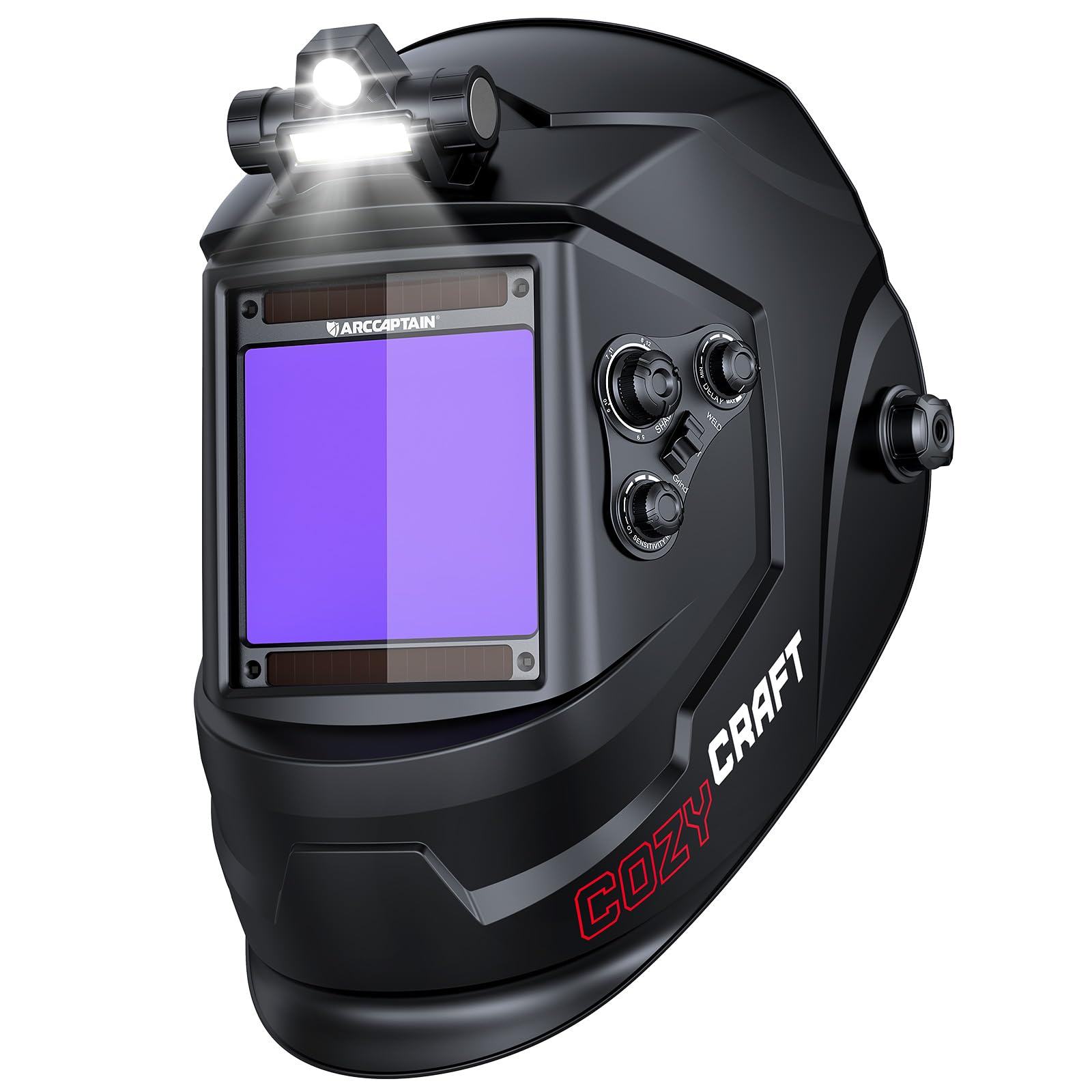
When you are fitting sheet metal or repairing panels in a darker winter garage, the XK-LY800H gives you a broad front viewing area plus a small work light that can help before the arc starts. That is useful for positioning clamps, checking gaps, and inspecting a tack weld.
The four-sensor arrangement and external controls also make it a practical choice when switching between common garage welding processes. Use the light as a convenience feature rather than a substitute for bright, even workshop lighting.
Buyer Check
Confirm which light, replacement lenses, batteries, and accessories are included with the current ASIN before ordering because package contents can change. Also test the light mount and headgear adjustment before beginning a long project.
Looks
The oversized window and straightforward shell give it a modern workshop appearance without making the design overly complicated.
Adjustable Features
|
Feature |
Customization Level |
|---|---|
|
Shade Range |
4 / 5-9 / 9-13 |
|
Operating Modes |
Weld, Cut, Grind |
|
Sensor Count |
4 arc sensors |
|
Headgear Fit |
Adjustable ratchet-style headgear |
|
Lighting |
Helmet-mounted light; confirm current included configuration |
Why You’ll Like It
- Large true-color viewing area for weld-pool and panel visibility
- Four sensors for useful arc-detection coverage
- Helmet light helps during setup and inspection
- External controls are convenient when wearing gloves
- Well suited to dim garages, restorations, and body-panel repairs
Who Should Buy This
Choose this if weak garage lighting is a regular problem and you want a large-view helmet with an extra light for setup work.
Who Should Avoid This
Skip it if your shop already has excellent lighting and you prefer a simpler helmet without another mounted accessory.
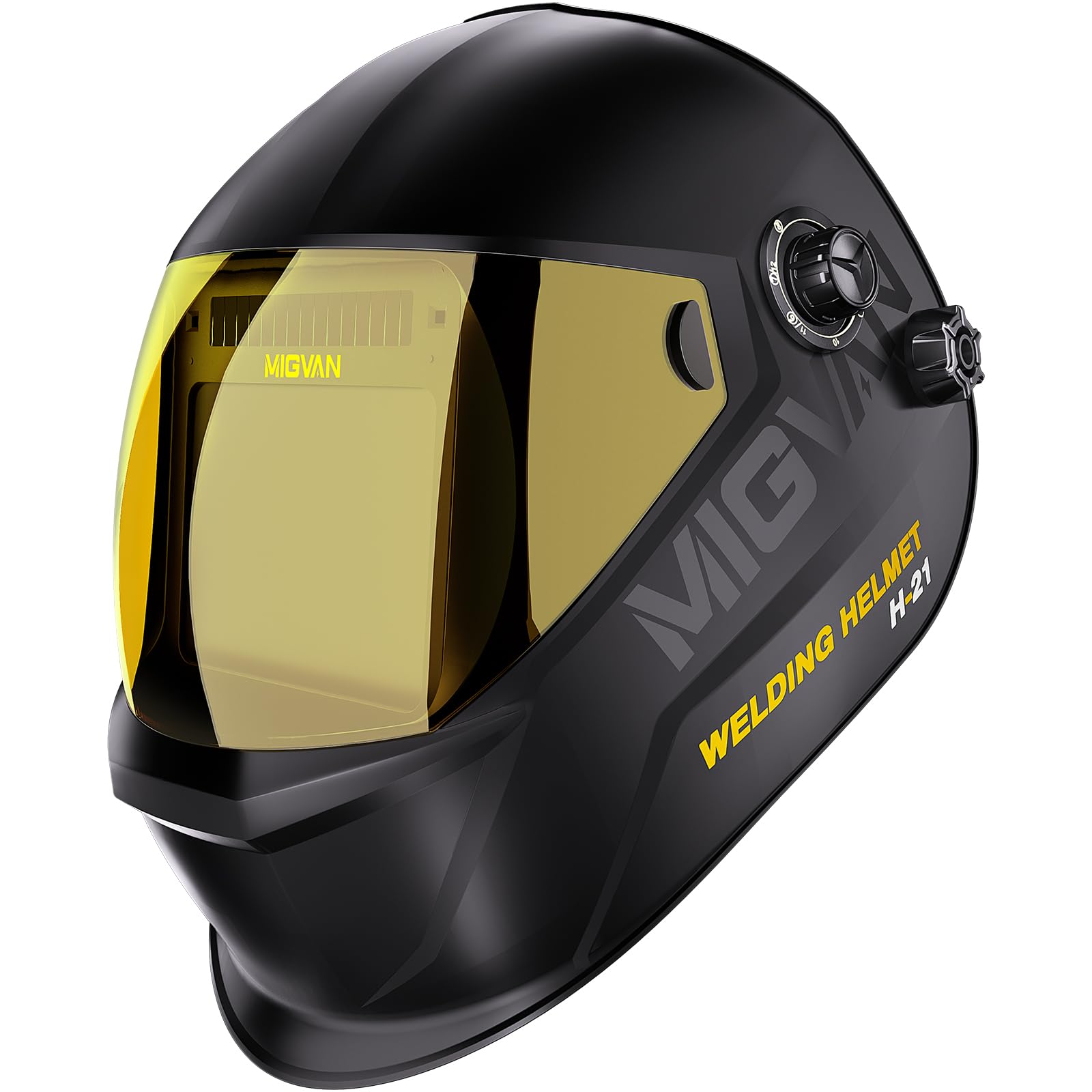
The MIGVAN H-21 suits newer welders who want the major features of a modern auto-darkening hood without stepping down to a tiny viewing screen or two-sensor design. Its true-color lens and four sensors are useful for learning to read the weld pool and joint line more clearly.
The listing identifies a large viewing area, DIN 4 light state, DIN 5-9 and DIN 9-13 dark ranges, and weld, cut, and grind capability. That makes it flexible for weekend restorations and common hobby fabrication.
Buyer Check
Battery descriptions can vary across reseller listings, so confirm the exact battery arrangement, charging method, and replacement procedure shown on the current Amazon page and in the supplied manual.
Looks
The matte black shell is simple and understated, which fits a garage or fabrication bench without drawing unnecessary attention.
Adjustable Features
|
Feature |
Customization Level |
|---|---|
|
Shade Range |
Light DIN 4; dark DIN 5-9 / 9-13 |
|
Operating Modes |
Weld, Cut, Grind |
|
Viewing Area |
Approximately 3.94 x 3.22 in |
|
Sensor Count |
4 arc sensors |
|
Power |
Solar-assisted battery system; verify current battery configuration |
Why You’ll Like It
- True-color lens for a more natural view of the work area
- Large viewing screen helps with fit-up and bead control
- Four sensors provide useful coverage for common garage positions
- Adjustable settings suit several common welding processes
- Good feature mix for learning, hobby work, and occasional repairs
Who Should Buy This
Choose this if you are learning or welding occasionally and want a large-view four-sensor helmet with several adjustment options.
Who Should Avoid This
Skip it if you need proven heavy-industrial durability, specialized respiratory integration, or premium professional headgear.
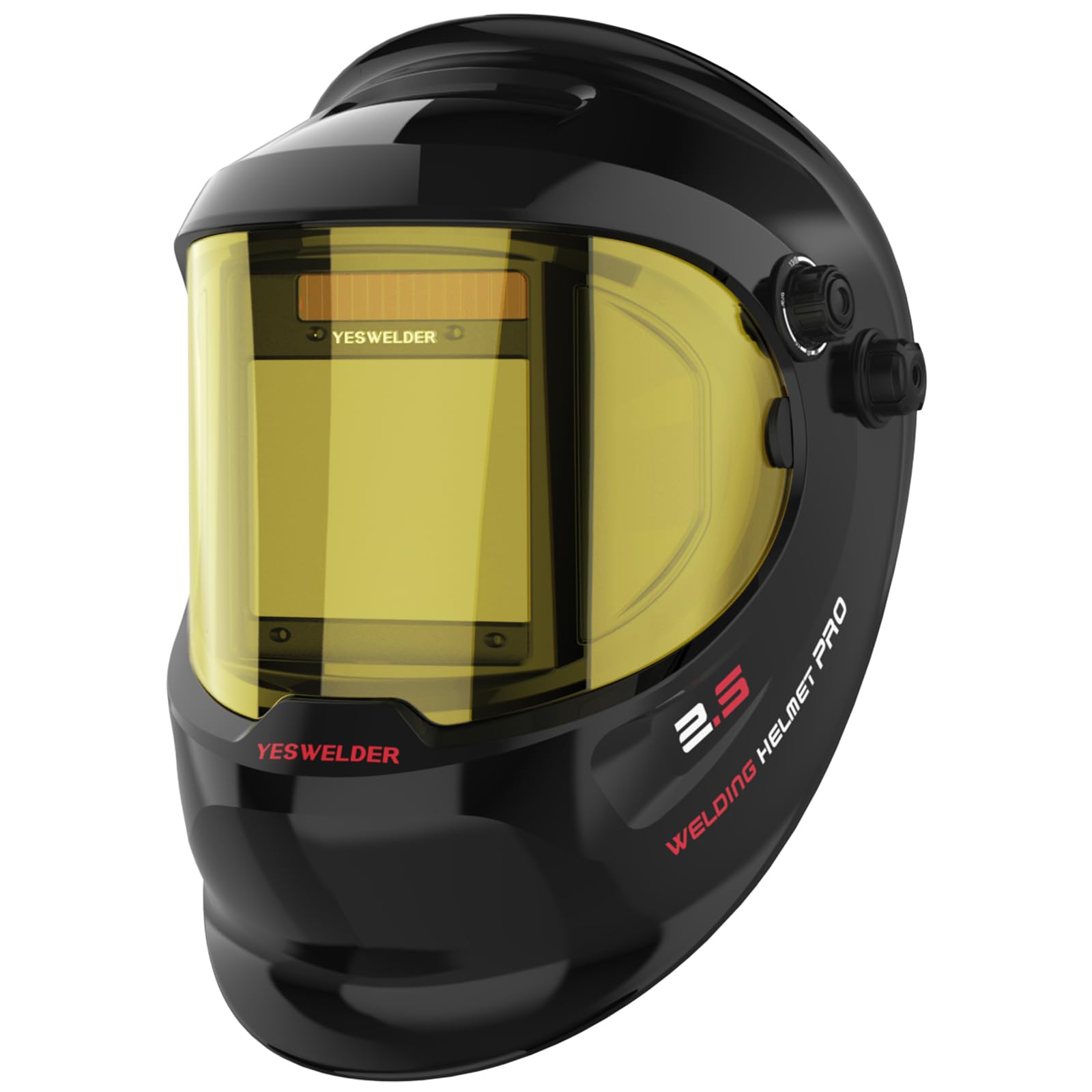
If you frequently reposition your head just to see clamps, a panel edge, or nearby tools, the Q800D is the most distinctive visibility-focused option in this group. Its side-view design expands peripheral awareness beyond a conventional front-only hood.
You still get true-color optics, four sensors, adjustable settings, and solar-assisted battery power. The main trade-off is that a panoramic shell can feel bulkier than a basic front-window helmet.
Buyer Check
Decide whether the side panels solve a real problem for your work. They are most useful around awkward fabrication setups; if you mostly weld straight ahead at a bench, a simpler large-front-window helmet may be enough.
Looks
The side-view panels give the Q800D a more technical appearance than a conventional welding hood.
Adjustable Features
|
Feature |
Customization Level |
|---|---|
|
Shade Range |
3 / 5-9 / 9-13 |
|
Operating Modes |
Weld, Cut, Grind |
|
Main Viewing Area |
Approximately 3.94 x 3.23 in plus side-view panels |
|
Sensor Count |
4 arc sensors |
|
Headgear Fit |
Adjustable ratchet-style headgear |
Why You’ll Like It
- Panoramic side panels increase peripheral workspace awareness
- True-color optics improve visibility compared with traditional green-tinted views
- Four sensors support auto-darkening from several arc angles
- Wide shade adjustment covers common garage welding and cutting tasks
- Useful around body panels, clamps, tubing, and restoration fixtures
Who Should Buy This
Choose this if peripheral awareness matters when you work around sheet metal, clamps, tubing, or awkward panel angles.
Who Should Avoid This
Skip it if you want the simplest, smallest shell and rarely need to see outside the main front window.

The HSH-S800 FL is worth considering if optical clarity matters more to you than having the tallest viewing window. Its 3.86 x 1.69 in lens is shorter than the large square-style windows in several other picks, but it still gives you a broad horizontal view.
Four sensors and true-color optics make it suitable for tack welding, panel work, and routine garage fabrication. Replaceable cover lenses are especially useful in a shop where grinding dust and spatter can quickly scratch the outer surface.
Buyer Check
The key trade-off is viewing-window height. If you often look down or up without moving your head, compare its 1.69-inch lens height with the taller M800H, H-21, or XK-LY800H before deciding.
Looks
The Flower graphic is more decorative than most welding helmets while keeping a conventional working shape.
Adjustable Features
|
Feature |
Customization Level |
|---|---|
|
Shade Range |
Light state 4; welding range up to 9-13 |
|
Viewing Area |
3.86 x 1.69 in |
|
Sensor Count |
4 arc sensors |
|
Optical Classification |
Listed as 1/1/1/1 |
|
Lens Protection |
Replaceable inner and outer covers |
Why You’ll Like It
- True-color optics for clearer seam and puddle visibility
- Four sensors support a broad range of common welding positions
- Wide horizontal viewing area without an extra-tall cartridge
- Replaceable lens covers simplify maintenance
- Useful for bodywork, hobby welding, and light shop fabrication
Who Should Buy This
Choose this if you prioritize optical clarity and four-sensor performance but do not need the tallest possible viewing window.
Who Should Avoid This
Skip it if you specifically want a large square lens or panoramic side windows.
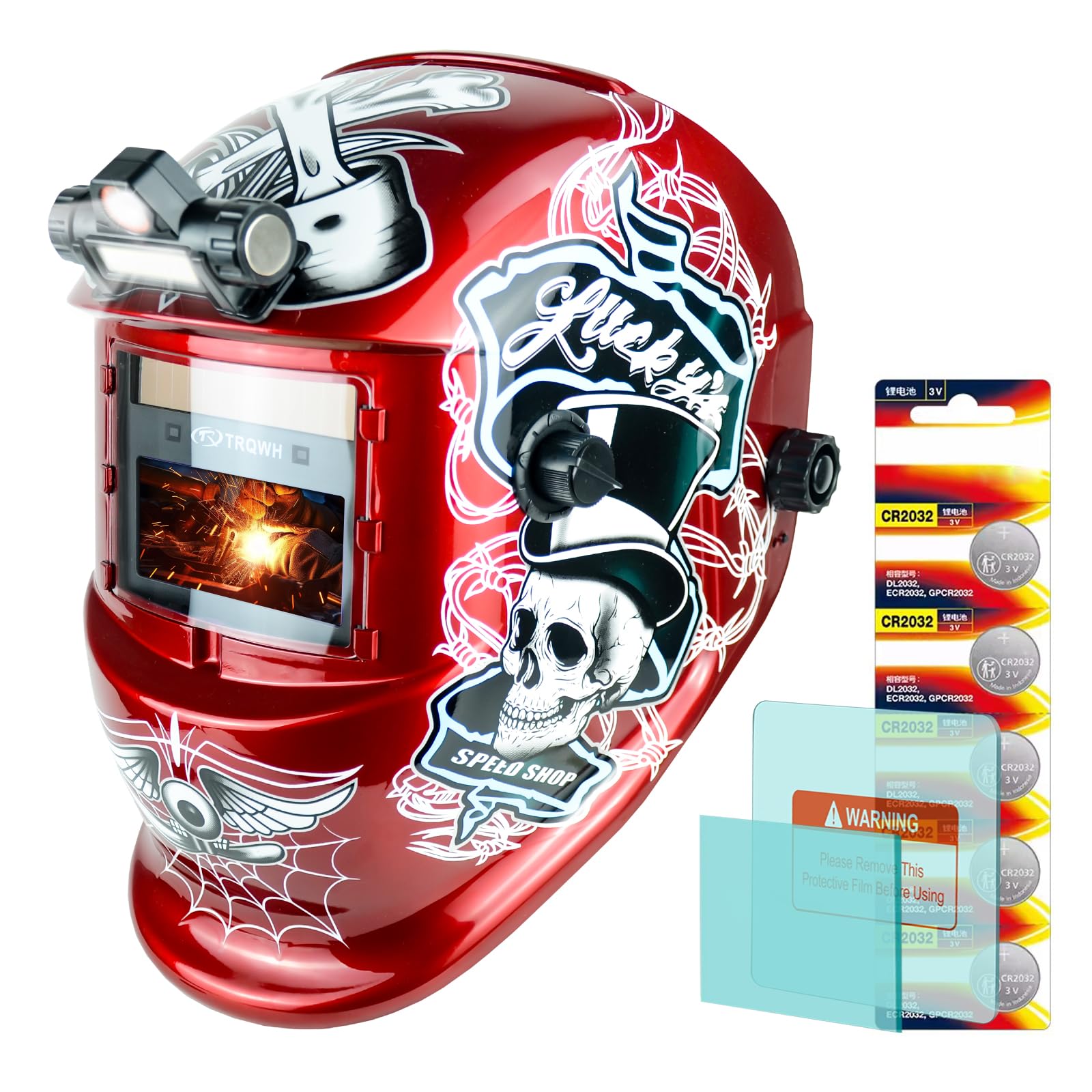
The TRQWH TRQ-HD12 is a straightforward choice if you want true-color visibility plus a small work light for fit-up and inspection. It suits occasional repairs, small welds, and hobby projects where you do not necessarily need a very large lens.
Its main trade-off is the two-sensor design. Two sensors can work well when they have a clear view of the arc, but clamps, body panels, tubing, or tight angles can block them more easily than a four-sensor layout.
Buyer Check
Think about your normal welding position. If you frequently weld under a panel or around fixtures that can block the front of the hood, a four-sensor model may provide more sensor coverage.
Looks
The compact helmet-mounted lamp gives the shell a functional modern appearance without the size of a panoramic helmet.
Adjustable Features
|
Feature |
Customization Level |
|---|---|
|
Shade Range |
Light DIN 4; adjustable dark DIN 9-13 |
|
Sensor Count |
2 arc sensors |
|
Optical Classification |
Listed as 1/1/1/2 |
|
Lighting |
Rechargeable helmet-mounted LED light |
|
Power |
Solar-assisted with replaceable CR2032 battery |
Why You’ll Like It
- True-color lens for clearer work-area visibility
- Helmet-mounted light helps during setup and fit-up
- Replaceable battery supports easier long-term maintenance
- Adjustable headgear suits occasional garage sessions
- Useful for hobby welding, cutting, grinding, and small bodywork
Who Should Buy This
Choose this if you want a straightforward two-sensor helmet with a small rechargeable work light for occasional garage projects.
Who Should Avoid This
Skip it if you routinely weld in obstructed positions where four sensors would give you better arc-detection coverage.
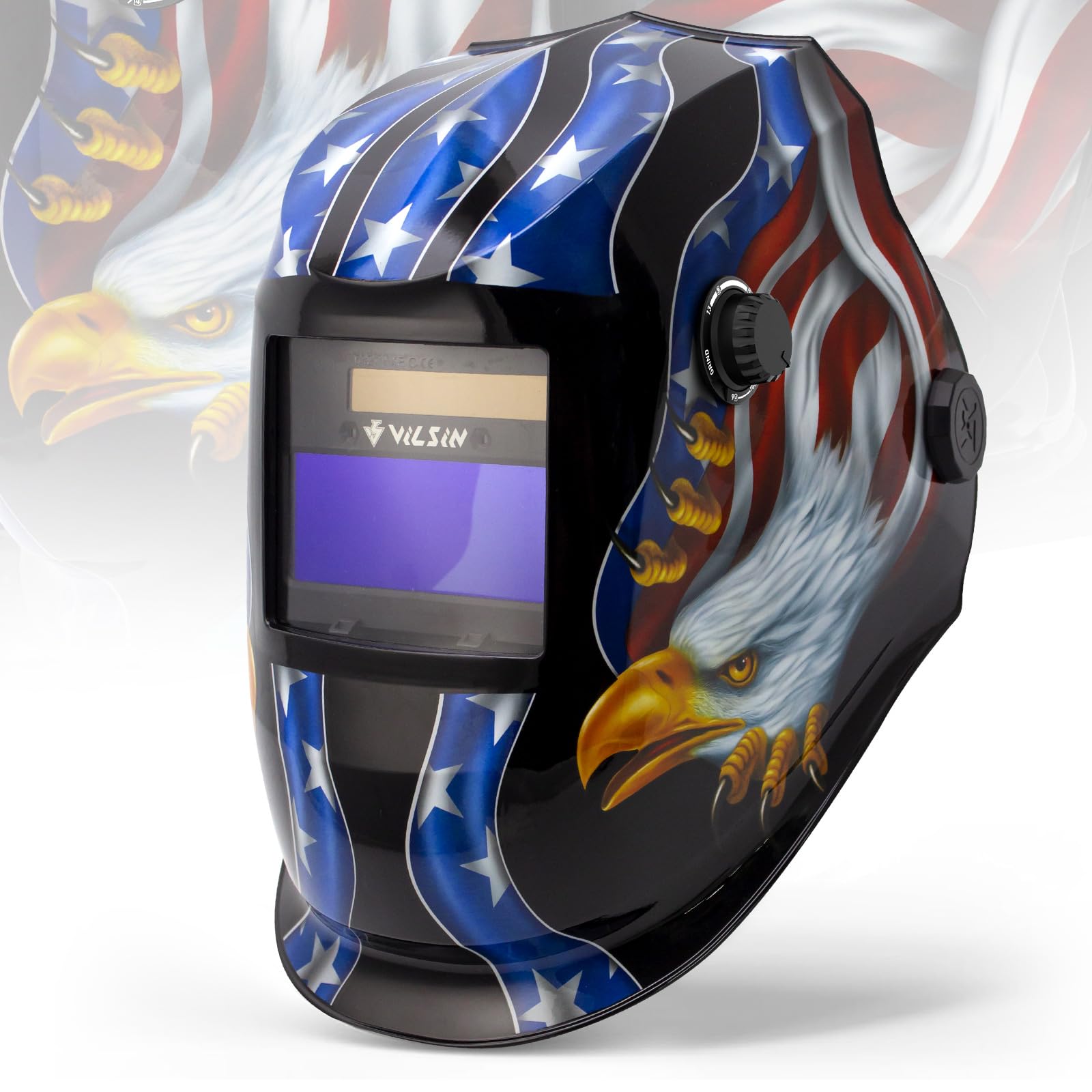
The VILSIN Eagle is suitable for readers who need an auto-darkening true-color helmet for occasional repairs, light fabrication, and paint-prep welding rather than daily production work.
Its 3.78 x 1.58 in viewing area is smaller vertically than several large-view picks, and it uses two arc sensors. The benefit is a relatively simple feature set with replaceable battery power and replaceable lens covers.
Buyer Check
Make sure two sensors suit the positions in which you normally weld. Also confirm replacement lens-cover sizes and current package contents before ordering so maintenance parts are easy to source later.
Looks
The Eagle graphic is bolder than the plain-black helmets in this guide and may appeal to buyers who want more visual personality.
Adjustable Features
|
Feature |
Customization Level |
|---|---|
|
Shade Range |
Light DIN 4; dark DIN 5-9 / 9-13 |
|
Viewing Area |
3.78 x 1.58 in |
|
Sensor Count |
2 arc sensors |
|
Optical Classification |
Listed as 1/1/1/2 |
|
Power |
Solar-assisted with replaceable CR2032 battery |
Why You’ll Like It
- True-color auto-darkening lens for hobby welding
- Adjustable cutting and welding shade ranges
- Replaceable CR2032 battery
- Replaceable lens covers support routine maintenance
- Useful for repairs, DIY fabrication, and occasional bodywork
Who Should Buy This
Choose this if you weld occasionally and want a straightforward true-color helmet with adjustable shade controls.
Who Should Avoid This
Skip it if you want four sensors, a very large viewing window, or a helmet designed around frequent professional production use.
The Cyber version is primarily worth considering if you like ARCCAPTAIN’s large-view XK-LY800H platform but prefer a more distinctive shell. The core attraction is still its broad 3.94 x 3.66 in viewing area, true-color lens, and four-sensor arrangement.
Because several XK-LY800H styles exist, do not assume every graphic variant includes exactly the same lamp, battery, shade-range, or accessory package. Use the specific ASIN page to verify those details before purchase.
Buyer Check
Compare this Cyber ASIN directly with the black XK-LY800H listing above. If appearance is not important to you, focus on the exact controls, included accessories, safety documentation, and package configuration rather than the graphic shell.
Looks
The Cyber design is one of the more distinctive choices in the roundup and gives the helmet more personality than a conventional plain-black shell.
Customization Options
|
Feature |
Customization Level |
|---|---|
|
Viewing Area |
3.94 x 3.66 in |
|
Optical Classification |
Listed as 1/1/1/1 |
|
Sensor Count |
4 arc sensors |
|
Shade Settings |
Variable shade configuration; verify the current Cyber listing |
|
Style |
Cyber graphic shell |
Why You’ll Like It
- Large front viewing area for bodywork and fabrication
- True-color optics for a more natural view of the work area
- Four sensors provide useful sensor coverage
- Distinctive graphic shell separates it from plain shop helmets
- Suitable for users who value both visibility and styling
Who Should Buy This
Choose this if you want a large-view four-sensor ARCCAPTAIN helmet and specifically prefer the Cyber graphic style.
Who Should Avoid This
Skip it if shell graphics do not matter to you and you would rather compare models strictly by controls, included equipment, and headgear.

The LYG-L600A-VM is the straightforward YESWELDER option in this roundup. It does not offer the four-sensor coverage or very large viewing window of the M800H, but it covers the core needs of common TIG, MIG, ARC, and grinding work.
That simpler layout can make sense for occasional garage welding where you do not need panoramic side panels, a helmet light, or a large square viewing cartridge.
Buyer Check
The two-sensor configuration is the main trade-off. Keep the sensors exposed to the arc, particularly when welding around fixtures, tubing, or body panels that can block direct line of sight.
Looks
The VM finish is clean and workshop-friendly without relying on a large graphic shell.
Customization Options
|
Feature |
Customization Level |
|---|---|
|
Shade Range |
3.5 light state / 9-13 welding |
|
Power |
Solar-assisted with replaceable battery backup |
|
Sensors |
2 arc sensors |
|
Headgear |
Adjustable pivot-style headgear |
|
Modes |
Welding and grinding functions |
Why You’ll Like It
- Simple true-color auto-darkening setup
- Adjustable welding shade for common garage processes
- Solar-assisted power with replaceable battery backup
- Less complex than panoramic or light-equipped options
- Suitable for occasional fabrication and paint-prep repairs
Who Should Buy This
Choose this if you want a simpler YESWELDER auto-darkening helmet and do not need four sensors, panoramic panels, or a built-in work light.
Who Should Avoid This
Skip it if you frequently weld at awkward angles where extra sensors and a larger field of view would be more useful.
Customer Favorites
For most auto-body and winter-garage buyers, the choice comes down to field of view and working conditions. Pick the YESWELDER LYG-M800H if you want a large front window and four-sensor layout. Choose the ARCCAPTAIN XK-LY800H if low-light fit-up is a recurring problem. Consider the MIGVAN H-21 if you want a beginner-friendly large-view option with four sensors.
FAQ
How do you choose the right welding hood for auto-body and paint-prep work in winter?
Start with protection, then compare visibility and comfort. Look for a helmet with clearly documented safety markings, a shade range appropriate for your welding process and amperage, and controls you can adjust without difficulty.
For detailed bodywork, a large true-color viewing area can make joint gaps, tack points, clamps, and panel edges easier to see. If fixtures or sheet metal often block the front of the helmet, a four-sensor design may also be useful.
Does true-color technology make a welding helmet safer?
True-color optics primarily affect how naturally you see the work area. They do not replace the need for the correct protective shade, functioning auto-darkening filter, proper safety marking, or suitable eye protection underneath the helmet.
Can you use an auto-darkening welding helmet for grinding and paint-prep work?
Many helmets include a grind mode, but the helmet is only one part of your PPE. When grinding produces flying fragments, wear suitable safety glasses or goggles underneath and use the face protection recommended for the task.
Paint and surface preparation can also create dust, fumes, noise, and chemical exposure that a welding helmet does not address. Use task-appropriate respiratory, hearing, skin, and hand protection where required.
How should you choose a welding shade?
Do not choose the shade only by personal preference. The correct minimum shade depends on factors such as the welding or cutting process, arc current, electrode size, and material or plate thickness.
When selecting a comfortable setting, begin darker and move lighter only as necessary to see the weld zone while staying at or above the minimum protective shade required for the job.
Are two arc sensors enough, or should you choose four?
Two sensors can work well for straightforward welding when both have a clear line of sight to the arc. Four sensors provide more detection points, which can be helpful when clamps, tubing, sheet metal, your hands, or an awkward welding position partially blocks the front of the helmet.
Is a helmet-mounted LED light worth it for winter garage work?
It can be useful for fit-up, positioning, finding a seam, changing settings, or inspecting a repair before and after welding. However, it should be treated as a convenience feature rather than a substitute for bright, stable shop lighting.
What helps prevent fogging and battery trouble in a cold garage?
Store the helmet in a clean, dry place and avoid unnecessary condensation from sudden temperature changes. Keep the sensors and lens covers clean, replace badly scratched covers, and check the battery and auto-darkening function before a long welding session.
Should you wear safety glasses under a welding helmet?
Yes when the work exposes you to flying particles or similar impact hazards. Welding helmets protect the face and eyes from welding hazards, but suitable safety spectacles or goggles underneath provide important additional protection during tasks such as grinding and chipping.
Wrapping Up
The best welding hood for auto-body and paint-prep work is the one that combines proper protection with a field of view and control layout that suit how you actually weld. A large true-color lens can help you follow seams and panel edges, while extra sensors are useful when fixtures or sheet metal partly block the arc.
For the strongest all-around feature mix, start with the YESWELDER LYG-M800H. Choose the ARCCAPTAIN XK-LY800H if a helmet-mounted light would help in your winter garage. Consider the YESWELDER LYG-Q800D when peripheral visibility around panels and clamps is your priority.
Final Recommendation
Most buyers: YESWELDER LYG-M800H for its large viewing area and four-sensor setup.
Dim garage: ARCCAPTAIN XK-LY800H for its large view plus work-light convenience.
Awkward body panels: YESWELDER LYG-Q800D for its panoramic side-view design.
Before ordering: Confirm current safety markings, shade specifications, included accessories, replacement lenses, and battery arrangement on the specific Amazon listing.
| Product | Image | Best For | Viewing Area | Shade Range | Sensor Count | Check Details |
|---|---|---|---|---|---|---|
| YESWELDER LYG-M800H |
 |
Best overall | 3.93 x 3.66 in | 3 / 5-9 / 9-13 | 4 | Check Product Details |
| ARCCAPTAIN XK-LY800H |
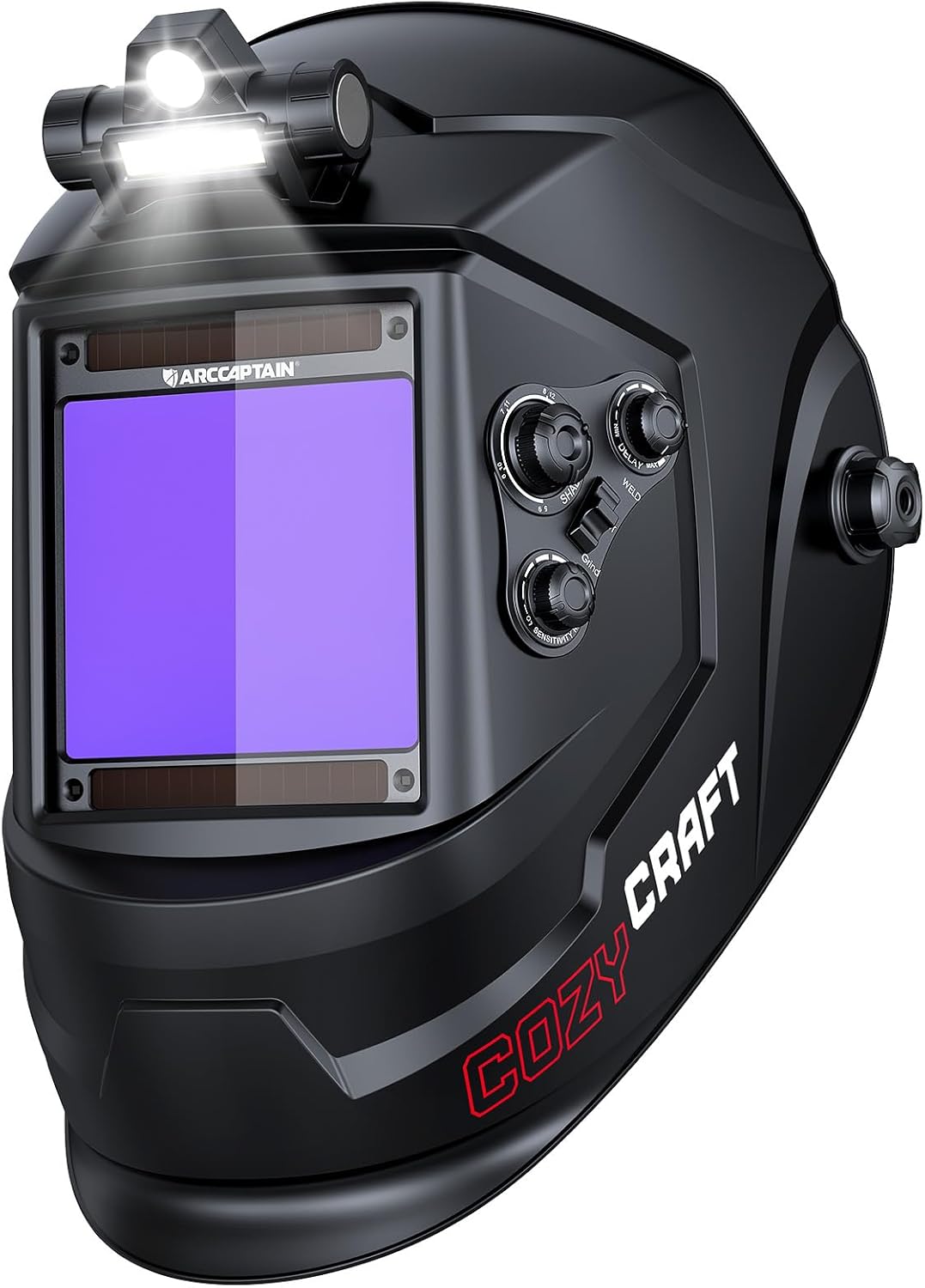 |
Best for low-light work | 3.94 x 3.66 in | 4 / 5-9 / 9-13 | 4 | Check Product Details |
| MIGVAN H-21 |
 |
Beginner-friendly pick | Approx. 3.94 x 3.22 in | 4 / 5-9 / 9-13 | 4 | Check Product Details |
| YESWELDER LYG-Q800D |
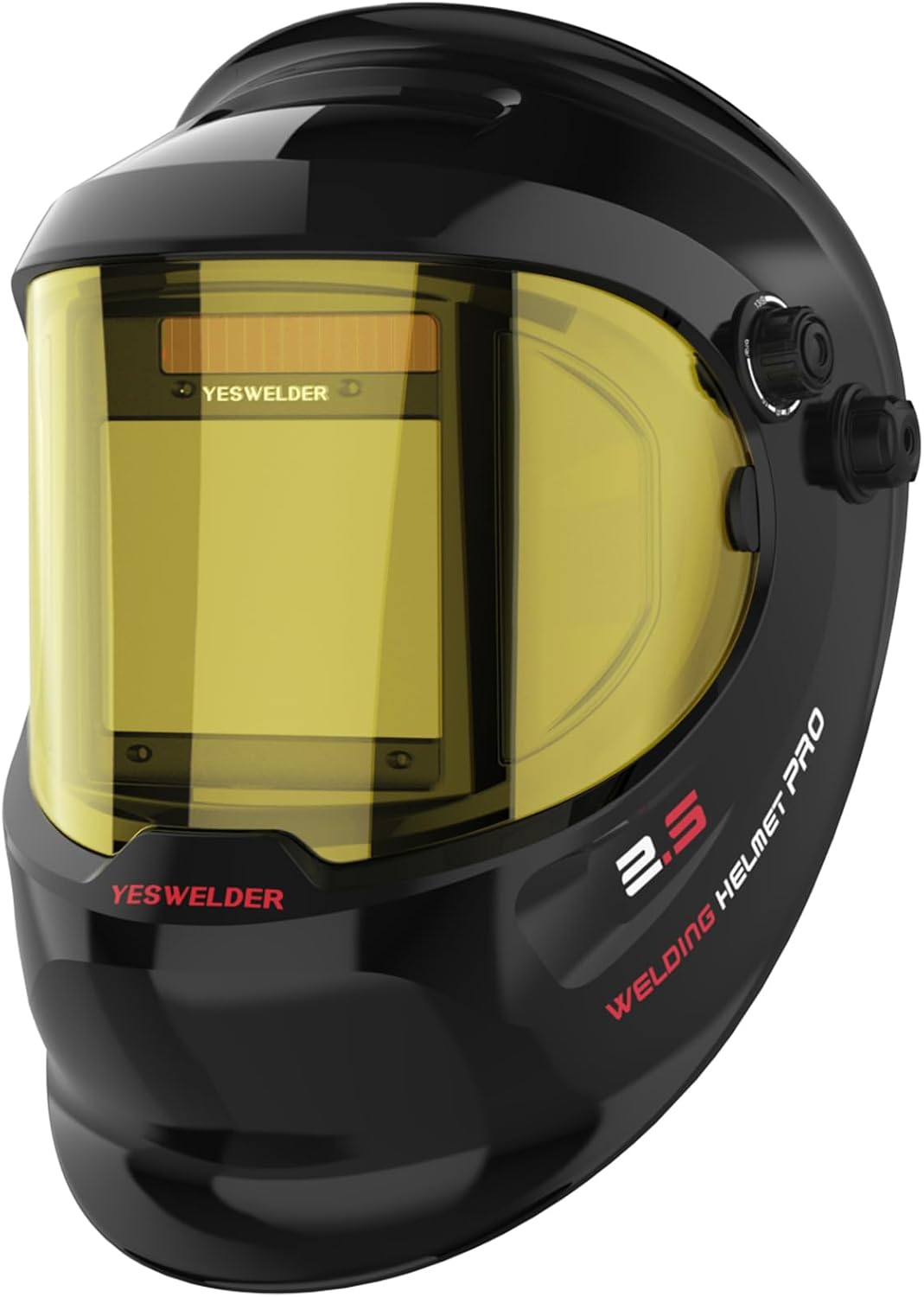 |
Best panoramic view | 3.94 x 3.23 in plus side view | 3 / 5-9 / 9-13 | 4 | Check Product Details |
| ARCCAPTAIN HSH-S800 FL |
 |
Best compact clarity | 3.86 x 1.69 in | 4 / up to 9-13 | 4 | Check Product Details |
| TRQWH TRQ-HD12 |
 |
Best compact light pick | Check current listing | 4 / 9-13 | 2 | Check Product Details |
| VILSIN K23-5022-LY |
 |
Best for occasional use | 3.78 x 1.58 in | 4 / 5-9 / 9-13 | 2 | Check Product Details |
| ARCCAPTAIN XK-LY800H Cyber |
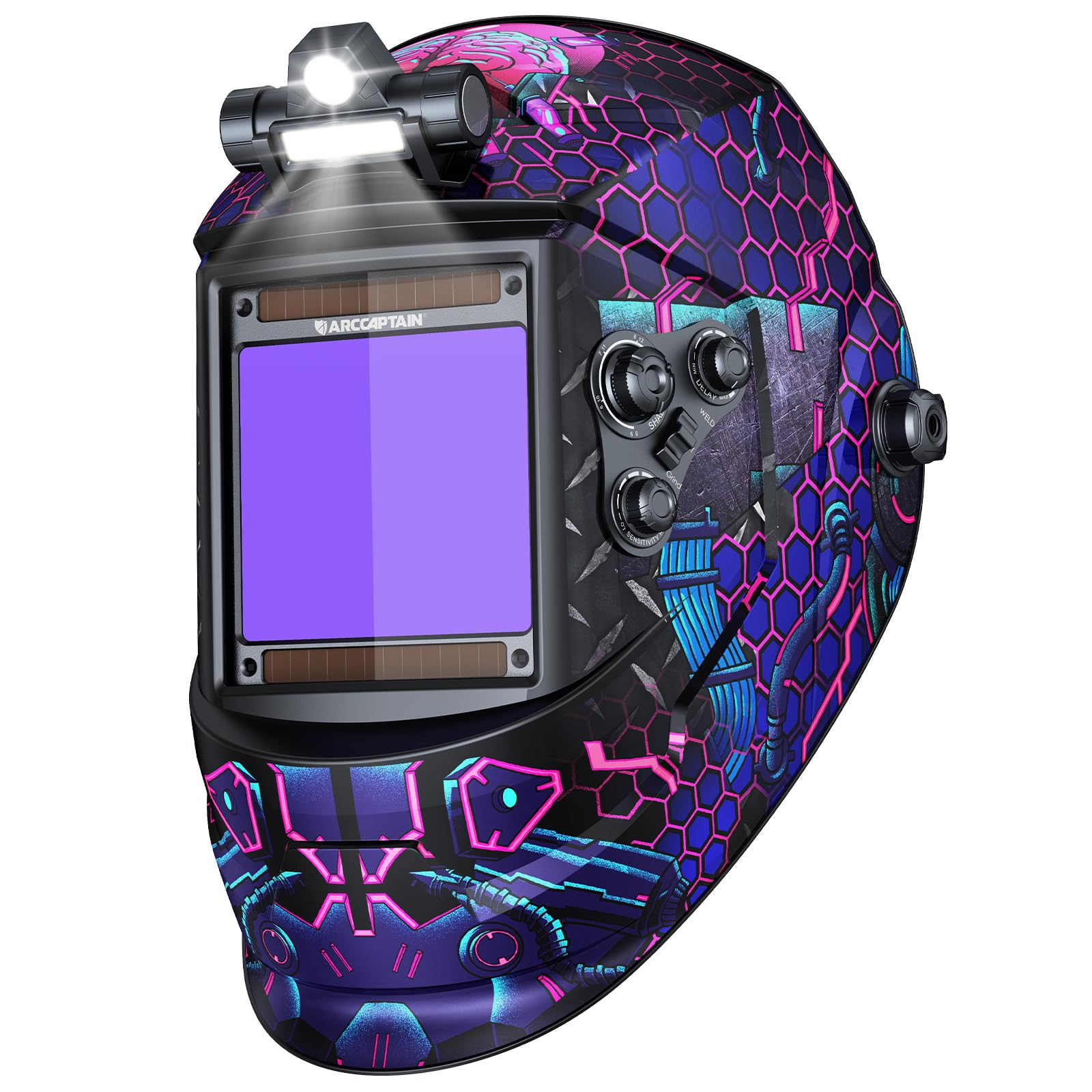 |
Best graphic style | 3.94 x 3.66 in | Verify current variant | 4 | Check Product Details |
| YESWELDER LYG-L600A-VM |
 |
Best simple pick | Standard view; check listing | 3.5 / 9-13 | 2 | Check Product Details |