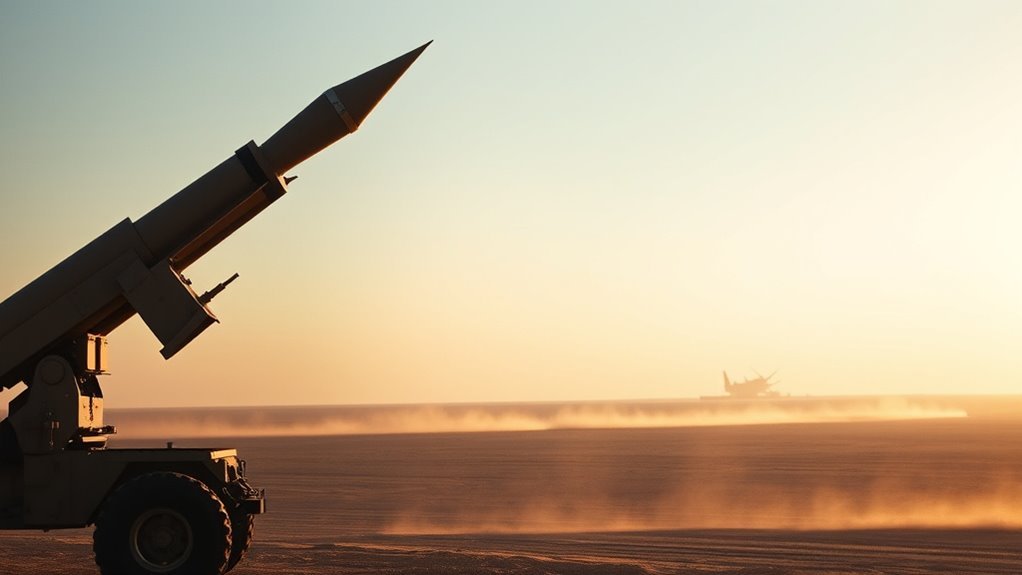
The maximum effective range of a weapon system is the greatest distance at which it can reasonably be expected to achieve its intended result. It differs from maximum range, which describes how far a projectile or missile can travel regardless of accuracy. Understanding that distinction helps you compare missiles, air-defense systems, drones, and strategic aircraft without confusing their very different capabilities.
Quick Answer
Maximum effective range is the farthest distance at which a weapon can be expected to hit its target and produce the intended effect. It depends on the weapon, target, and operating conditions. Maximum range measures physical reach, while effective range accounts for accuracy and results. Aircraft range and radar detection range are different measurements.
Last checked: September 28, 2026. Key dates and specifications were checked against official military publications and manufacturer sources.
Key Takeaways
- Maximum range and effective range are different: A weapon reaching a distance does not mean it can reliably engage a target there.
- The S-400 has a reported maximum engagement range of 400 km with its longest-range interceptor, subject to important limitations.
- Strategic missiles such as the DF-41 have reported ranges measured in thousands of kilometers.
- Aircraft range describes how far a platform can fly, not how far its weapons can strike.
- Sensor performance, guidance, target behavior, terrain, and countermeasures affect practical engagement range.
- Published maximum figures cannot establish a universal probability of successful engagement.
What Does “Greatest Distance” Mean in Weapons?
)
In military terminology, the greatest distance at which a weapon can be expected to work effectively is its maximum effective range. The term considers whether the weapon can achieve its intended result, rather than simply whether it can reach a particular distance.
The distinction appears in the U.S. military’s Operational Terms and Graphics definitions, which distinguish maximum effective range from maximum range.
For a gun, effective range concerns expected accuracy and target effect. For a guided missile, it also depends on guidance, target characteristics, and operating conditions.
For an aircraft, the equivalent question is different: how far can it fly while completing its mission and meeting fuel requirements?
Maximum Range vs. Maximum Effective Range
These terms describe different limits. They should not be treated as interchangeable in technical comparisons.
| Measurement | What it means | Typical application |
|---|---|---|
| Maximum range | The greatest distance a weapon can physically travel or fire. | Missiles, rockets, and artillery. |
| Maximum effective range | The farthest distance at which the intended result can reasonably be expected. | Firearms and guided weapons. |
| Detection range | The distance at which a sensor can detect an object under specified conditions. | Radar and surveillance systems. |
| Engagement range | The distance within which a system can attempt to engage a target. | Air-defense and air-to-air missile systems. |
| Aircraft range | The distance an aircraft can fly under specified conditions. | Bombers, reconnaissance aircraft, and UAVs. |
Consider an air-defense missile with a published reach of 400 km. That number alone does not establish whether it can detect, track, and intercept every type of aircraft at that distance.
A weapon’s maximum range describes physical reach; its effective range describes expected performance.
This distinction is essential when comparing military systems, evaluating public specifications, or interpreting claims about defensive coverage.
The Longest-Range Missile Systems
Intercontinental ballistic missiles have some of the greatest publicly reported ranges of any conventional missile category. Their reach is measured in thousands of kilometers, while tactical and air-defense missiles generally operate over much shorter distances.
However, missile categories serve different purposes. An intercontinental missile’s range cannot be directly compared with an interceptor’s engagement range or an aircraft’s flight distance.
For example, China’s DF-41 has a reported range of 12,000–15,000 km, according to the Center for Strategic and International Studies (CSIS).
Russia’s RS-28 Sarmat has an even higher claimed upper limit, although development status and publicly demonstrated performance remain important qualifications.
| Missile system | Reported range | Primary role |
|---|---|---|
| DF-41 | 12,000–15,000 km | Intercontinental ballistic missile |
| RS-28 Sarmat | 10,000–18,000 km, depending on configuration and estimates | Intercontinental ballistic missile |
| S-400 with 40N6 interceptor | Up to 400 km | Long-range air defense |
| BrahMos extended-range variant | Beyond 400 km | Supersonic cruise missile |
| ATACMS | Up to 300 km | Tactical surface-to-surface missile |
The Sarmat’s reported upper range comes from CSIS Missile Threat specifications. The figure describes a reported design capability, not a universally demonstrated operational result.
For BrahMos, the original production system had a published range of about 290 km. A later extended-range BrahMos test demonstrated a capability beyond 400 km.
The U.S. Army Tactical Missile System, or ATACMS, has a manufacturer-published maximum range of 300 km.
These figures describe different weapon types and should not be read as a ranking of overall effectiveness.
How Far Air-Defense Systems Can Reach
Air-defense range depends on the interceptor, target, radar, and overall control system. A system’s longest-range missile does not automatically establish its effective coverage against every airborne threat.
The Russian S-400 illustrates this distinction. Its different interceptor families provide several engagement ranges, with the longest-range 40N6 associated with a published maximum of approximately 400 km.
However, CSIS notes important uncertainties about the S-400’s maximum-range capability, including whether radar performance allows the longest-range interceptor to use its full published reach.
That means a 400 km figure should be treated as a stated maximum capability, not a guarantee of interception at that distance.
Why Detection Range Is Not Engagement Range
A radar may detect an aircraft without immediately providing the tracking information needed for an engagement. Detection, classification, tracking, and interception are related but separate functions.
Modern naval systems illustrate this relationship.
The U.S. Navy’s AN/SPY-6 radar provides surveillance, tracking, and target-discrimination information for integrated air and missile defense.
Its ability to support an engagement depends on the wider combat system and available interceptors.
Against small drones, additional challenges arise because a low-signature target can be harder to detect and track than a larger aircraft.
Russia’s Pantsir-SMD-E is an example of a short-range system designed for protection against drone attacks. Its published configuration includes smaller interceptors intended for this role.
The practical lesson is that defensive coverage involves more than drawing a circle around a missile’s advertised maximum range.
The Longest-Range UAVs and Bombers
Long-endurance unmanned aerial vehicles and strategic bombers can fly thousands of kilometers, but their range figures measure aircraft performance rather than weapon engagement distance.
Aircraft specifications may also use different measurements, including total unrefueled range, operational range, and combat radius.
A long-distance flight figure therefore needs context before it can be compared with another aircraft’s capabilities.
Long-Endurance UAV Reach
Unmanned aerial vehicles, or UAVs, can support extended surveillance and, in some configurations, strike missions. Their operational reach depends on fuel, payload, endurance, communications, and mission requirements.
The RQ-4 Global Hawk is a high-altitude reconnaissance aircraft designed for intelligence, surveillance, and reconnaissance rather than direct weapons employment.
The U.S. Air Force’s Global Hawk fact sheet lists a range of 12,300 nautical miles and endurance exceeding 34 hours.
That distance is approximately 22,780 km, or 14,155 statute miles. The aircraft is listed as unarmed.
The MQ-9 Reaper serves a different role. It supports reconnaissance and can carry guided weapons.
The U.S. Air Force MQ-9 specifications list a standard range of 1,150 miles and an extended-range version reaching 1,611 miles.
Iran’s Mohajer-10 has a reported operational range of approximately 2,000 km, endurance of up to 24 hours, and an operating altitude around 7,000 meters.
These are Iranian-reported capabilities, and the published figures should not be mistaken for independently established performance under every operating condition.
| UAV | Published range | Main distinction |
|---|---|---|
| RQ-4 Global Hawk | 12,300 nautical miles | Unarmed, high-altitude reconnaissance |
| MQ-9 Reaper | 1,150 miles; extended-range version 1,611 miles | Reconnaissance and strike support |
| Mohajer-10 | Approximately 2,000 km, manufacturer-reported | Long-endurance surveillance and strike capability |
These figures are not directly interchangeable because each platform has different mission requirements, equipment, and fuel arrangements.
Intercontinental Bomber Range
Strategic bombers are designed to carry weapons over long distances. Their reach depends on aircraft fuel capacity, payload, flight conditions, and whether aerial refueling is available.
The B-52 Stratofortress and B-2 Spirit provide useful examples of how published range figures differ between aircraft.
The U.S. Air Force lists the B-52’s unrefueled combat range as exceeding 8,800 miles, or approximately 14,080 km.
The B-2 Spirit’s unrefueled range is approximately 6,000 nautical miles. It also uses low-observable design features intended to make detection and tracking more difficult.
The B-1B Lancer is another intercontinental-range bomber, combining substantial payload capacity with high-speed flight.
Russia’s Tu-160 is a long-range strategic bomber. Commonly reported unrefueled range figures are around 7,500 miles, although performance varies by configuration and operating conditions.
The B-21 Raider represents a newer generation of long-range bomber design. Its precise operational range has not been publicly established in the same way as the older aircraft.
The official U.S. Air Force B-21 fact sheet describes its long-range strike role without publishing a definitive unrefueled range figure.
Aircraft range also should not be confused with combat radius. A combat-radius measurement accounts for a mission that includes departure, mission activity, and return.
Aerial refueling can extend an aircraft’s overall flight distance substantially, but it does not change the published maximum range of an individual weapon carried aboard it.
What Actually Limits Engagement Range
Maximum effective range is affected by the interaction of the weapon, target, environment, and supporting systems. Even when a weapon can physically travel the required distance, the intended result may remain uncertain.
The most important limitations involve sensors, propulsion, guidance, target movement, and countermeasures.
Sensor Detection Limits
Sensors help a system find and track objects, but their performance changes with target characteristics and environmental conditions.
Radar, infrared, and electro-optical sensors use different methods to detect targets. Their capabilities cannot be represented accurately by one universal distance figure.
- Target characteristics: Size, shape, materials, and signature influence detection.
- Terrain: Mountains, buildings, and the Earth’s curvature can obstruct a sensor’s view.
- Weather: Rain, clouds, and atmospheric conditions affect different sensor types in different ways.
- Electronic interference: Jamming and other interference can reduce the quality of available information.
Detection alone is not proof that a target can be engaged successfully. Reliable identification and tracking are separate requirements.
Missile Fuel And Guidance
Missile propulsion, guidance, airframe design, and payload all influence range. No single propulsion type automatically provides the longest reach across every missile category.
Solid-propellant and liquid-propellant systems have different engineering and operational characteristics. Their performance depends on the complete design rather than fuel type alone.
| Factor | Effect | Range impact |
|---|---|---|
| Solid propellant advantages | Stored fuel and oxidizer support rapid readiness and relatively simple handling. | Actual reach depends on motor design and the complete missile. |
| Liquid fuel limitations | Some systems require more complex fuel storage, handling, or engine arrangements. | Liquid propulsion can still support very long-range missile designs. |
| Guidance technology impacts | Navigation and correction systems influence accuracy and the ability to reach the intended destination. | Guidance performance affects usable range but does not determine maximum distance by itself. |
Solid propellants offer practical storage and readiness advantages for many military applications. Liquid propulsion can provide different performance characteristics and is also used in long-range missile systems.
Guidance systems may combine inertial navigation with satellite-based corrections or other navigation methods.
These systems improve navigation accuracy, but it is incorrect to assume that frequent electronic guidance updates necessarily consume enough propulsion energy to reduce missile range.
Instead, range reflects the combined effects of propulsion, vehicle mass, aerodynamic resistance, flight conditions, and the mission profile.
Target Maneuver And Countermeasures
A moving target creates a different engagement problem from a stationary target. Changes in target speed or direction affect whether a weapon can achieve its intended result.
Electronic interference, decoys, and reduced target signatures can also influence tracking and guidance performance.
- Target movement changes the conditions under which an engagement occurs.
- Low-observable designs may make detection and tracking more difficult.
- Jamming and decoys can interfere with sensor or guidance information.
- Environmental conditions can affect both the weapon and its supporting systems.
Advanced seekers, navigation systems, and communication networks can improve system performance. However, none removes every limitation associated with long-distance engagement.
What’s Extending Weapon Range Next
Weapon-system development continues to focus on propulsion, sensors, communication networks, and aircraft endurance. These technologies can expand published reach or improve performance within an existing range.
Several developments illustrate how range and effectiveness are changing across different military systems.
Longer-Range Air-to-Air Missiles
The U.S. Navy’s AIM-174B Gunslinger is an air-launched configuration of the Standard Missile-6. It is designed to provide long-range air-to-air capability.
The Navy’s AIM-174B fact sheet lists its range as classified.
Another development is the AIM-424 Long Range Air-to-Air Missile, also known as Malice.
The Navy’s August 2026 AIM-424 fact sheet reports a range exceeding 250 nautical miles, approximately 463 km.
The distinction matters: the AIM-174B is publicly identified as deployed, while the AIM-424 is described as a developing system.
Neither figure should be interpreted as a guaranteed effective engagement distance against every target.
Hypersonic Weapons and Missile Defense
Hypersonic flight generally refers to speeds above Mach 5. However, speed alone does not establish a weapon’s range, accuracy, or ability to avoid interception.
Long-range ballistic missiles can reach hypersonic speeds, while newer hypersonic glide and cruise systems may follow different flight profiles.
These characteristics create challenges for missile defense, particularly where tracking and interception must account for changing flight conditions.
The U.S. Missile Defense Agency continues testing defenses against these threats.
During its March 2025 hypersonic defense exercise, the agency and U.S. Navy demonstrated detection, tracking, and a simulated engagement against an advanced maneuvering target.
That test demonstrated progress in the defensive system, but a simulated engagement is not proof that every hypersonic weapon can be intercepted successfully.
Better Sensors and Network Integration
Improved radar, sensor fusion, and communication systems can help platforms maintain a more complete picture of airborne threats.
Sensor fusion combines information from different detection systems. Network integration allows that information to support other components of a defensive system.
These developments can improve the use of existing weapons without necessarily increasing their physical maximum range.
Long-endurance UAVs, improved propulsion, and aerial refueling also extend aircraft mission possibilities. However, such advances must still be evaluated against their specific mission requirements and demonstrated capabilities.
Frequently Asked Questions
What Is the Longest Distance a Missile Can Travel?
Some intercontinental ballistic missiles have reported ranges approaching 18,000 km. Russia’s RS-28 Sarmat has a claimed upper range of approximately 18,000 km, but that figure does not establish universally demonstrated operational performance. Actual range depends on the missile design, payload, and flight conditions.
How Long Would It Take a Hypersonic Missile to Reach the US From China?
There is no single reliable flight-time figure for every hypersonic missile. Intercontinental ballistic missile flight times are commonly discussed in terms of roughly 30 minutes, but the actual duration depends on the system and flight path. Hypersonic speed alone cannot establish arrival time.
What Is the Longest Range Air to Air Missile the US Has?
A definitive public comparison is not possible because some missile ranges remain classified. The deployed AIM-174B is a long-range air-to-air missile with an undisclosed official range. The developing AIM-424 has a Navy-published range exceeding 250 nautical miles, or approximately 463 km.
Can the US Shoot Down a Hypersonic Missile?
The United States has demonstrated capabilities against certain high-speed missile threats, but interception depends on the weapon and circumstances. The Missile Defense Agency continues testing systems against maneuvering hypersonic targets. No publicly demonstrated system provides a guarantee against every type of hypersonic threat.
Conclusion
The maximum effective range of a weapon system describes the distance at which it can reasonably achieve its intended result, not simply how far it can travel.
Missile propulsion, guidance, sensor quality, aircraft endurance, target behavior, and environmental conditions all influence real-world performance.
When comparing published specifications, identify the exact measurement being used and distinguish claimed maximums from demonstrated capabilities. This provides a more accurate understanding of weapon reach than relying on headline range figures alone.
Sources
- U.S. Army Operational Terms and Graphics: Definitions of maximum range and maximum effective range.
- CSIS Missile Threat: DF-41: Reported intercontinental missile range and specifications.
- CSIS Missile Threat: RS-28 Sarmat: Reported missile capabilities and development information.
- BrahMos Aerospace: Extended-range missile test and published range information.
- Lockheed Martin: ATACMS: Official maximum range and product specifications.
- CSIS Missile Threat: S-400: Interceptor ranges and limitations.
- U.S. Navy: AN/SPY-6 Radar: Surveillance, tracking, and integrated missile-defense capabilities.
- U.S. Air Force: RQ-4 Global Hawk: Range, endurance, and reconnaissance role.
- U.S. Air Force: MQ-9 Reaper: Standard and extended-range specifications.
- U.S. Air Force: B-52 Stratofortress: Unrefueled combat range.
- U.S. Air Force: B-2 Spirit: Unrefueled range and aircraft characteristics.
- U.S. Navy: AIM-174B Gunslinger: Deployment and official range classification.
- U.S. Navy: AIM-424 Malice: Published range and development information.
- U.S. Air Force: B-21 Raider: Official aircraft description and publicly available specifications.
- Missile Defense Agency: March 2025 hypersonic defense test results.
