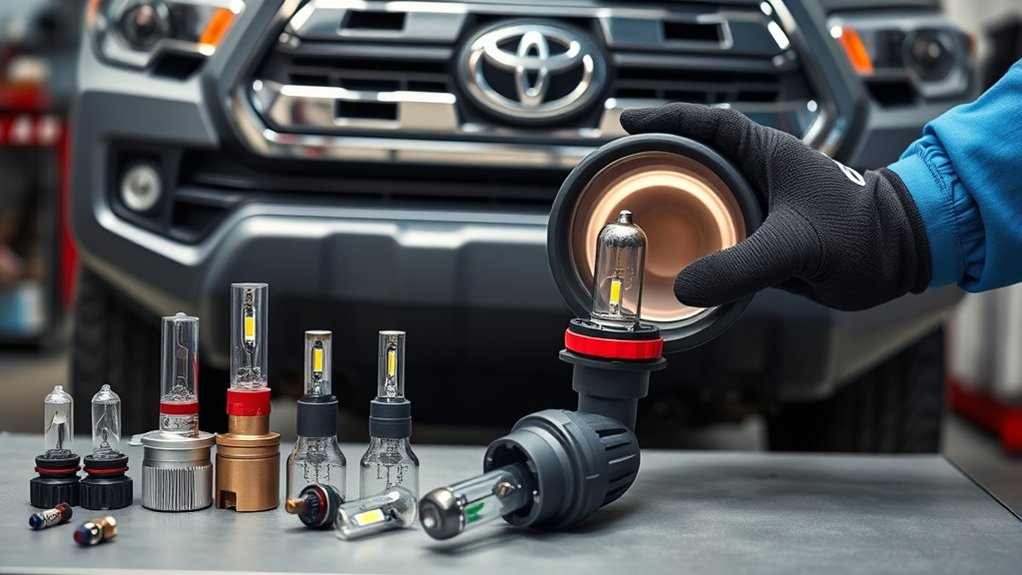
The correct Toyota Tacoma fog light bulb size depends on the model year and the exact fog-lamp type. Toyota owner-manual specifications support 9145/H10 for 2005–2011 and H11 for 2012–2015. For 2016–2023 trucks with serviceable halogen fog lamps, Toyota lists H16 for the normal-type fog lamp and H11 for the wide-angle fog lamp; factory LED-equipped trucks use an integrated fog-lamp assembly instead. For 2001–2004, the owner-manual bulb tables reviewed do not identify one standard front-fog bulb, so verify the installed lamp or VIN-specific parts listing before ordering.
Last updated: September 22, 2026 — third-generation H16/H11 fitment, TRD Pro LED exceptions, source links, FAQ answers, and schema were rechecked.
Quick Answer
For factory U.S.-market fitment, 2005–2011 Tacomas use 9145/H10 and 2012–2015 trucks use H11 where equipped. On 2016–2023 trucks, Toyota lists H16 for normal-type fog lamps and H11 for wide-angle fog lamps; some factory LED-equipped trucks, including TRD Pro applications, do not have a conventional replaceable fog bulb. For 2001–2004, verify the installed lamp because the owner-manual bulb tables reviewed do not identify one standard fog-bulb size.
Key Takeaways
- For 2016–2023 Tacomas, distinguish the normal-type H16 fog lamp from the wide-angle H11 fog lamp before ordering.
- A factory LED fog lamp is normally serviced as an assembly rather than with an H11, H16, or 9145 bulb.
- H8, H11, H16, 9145/H10, and 9006/HB4 bulbs have different bases, ratings, or both. Do not force one into another socket.
- Choose an LED upgrade for its beam pattern, thermal control, sealing, and housing compatibility, not its advertised lumen number alone.
- After installation, test both lamps, check for moisture or flicker, and confirm that the beam stays low and does not create glare.
At a Glance
| Time Required | About 20–45 minutes for a bulb pair; longer if splash shields, seized clips, or complete assemblies require removal |
| Difficulty | Easy to moderate |
| Tools Needed | Gloves, flashlight, trim-clip tool or flat screwdriver, and a 10 mm socket if the liner or shield requires removal; multimeter optional |
| Cost | Varies by halogen bulb, drop-in LED bulb, or complete LED fog-lamp assembly |
Toyota Tacoma Fog Light Bulb Sizes: 2001–2023 Quick Table
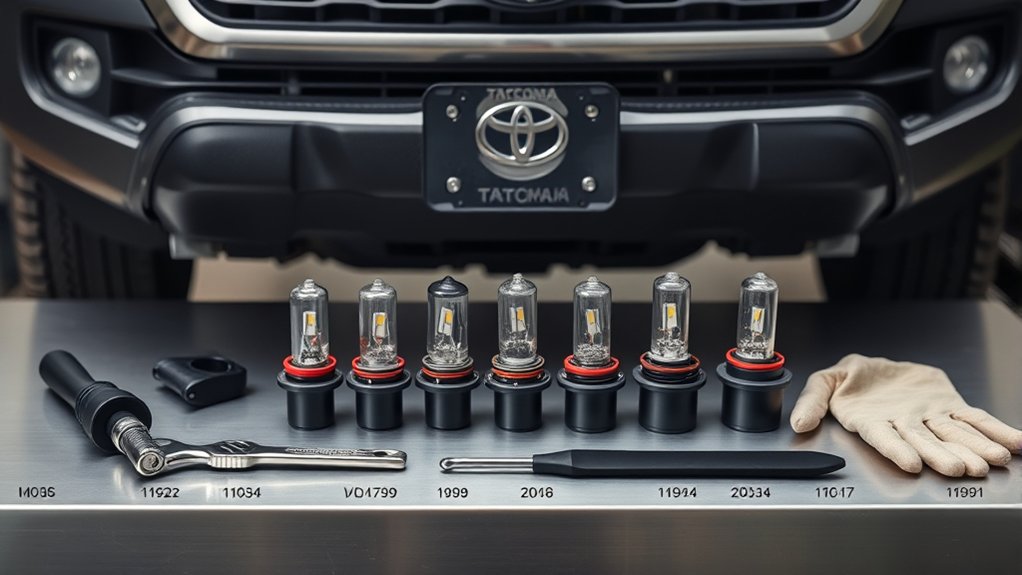
The table below prioritizes Toyota owner-manual bulb specifications and Toyota trim/equipment documentation for U.S.-market trucks. Model year alone is not enough on third-generation Tacomas because Toyota used normal-type, wide-angle, and factory LED fog lamps. A previous owner may also have installed a different bumper or fog-light kit.
| Tacoma model year | Common fog-light type | Important notes |
|---|---|---|
| 2001–2004 | [VERIFY] Installed/optional assembly | The Toyota owner-manual bulb tables reviewed for these years do not identify one standard front fog-light bulb. Verify the installed lamp, accessory-kit documentation, or VIN-specific Toyota parts listing before ordering. |
| 2005–2011 | 9145 / H10 | Toyota owner-manual bulb tables list a 9145 42-watt front fog bulb where equipped. |
| 2012–2015 | H11 | Toyota owner-manual bulb tables list an H11 55-watt front fog bulb where equipped. |
| 2016–2023 | H16 normal type / H11 wide-angle type | Toyota owner-manual specifications list H16 at 19 watts for the normal fog lamp and H11 at 55 watts for the wide-angle fog lamp. Trim and equipment determine which serviceable lamp is fitted. |
| 2017–2023 TRD Pro | Factory Rigid Industries LED fog-lamp assembly | Toyota documents factory Rigid Industries LED fog lights on third-generation TRD Pro models. Treat the factory lamp as an LED assembly, not a normal H11/H16 bulb swap. |
Why Do 2016–2023 Tacoma Fog-Bulb Charts Show Both H16 and H11?
Toyota’s third-generation owner-manual bulb tables separate the front fog lamp into two serviceable types: H16 at 19 watts for the normal-type lamp and H11 at 55 watts for the wide-angle lamp. Toyota’s 2023 Tacoma feature matrix also distinguishes standard integrated fog lights from integrated wide-angle fog lights, while TRD Pro uses Rigid Industries LED fog lights. That is why a single “2016–2023 = H11” chart is incomplete: identify the truck’s actual fog-lamp type before buying a bulb.
Note: This chart ends with the 2023 model year. Do not use it for a redesigned 2024 or newer Tacoma. Check the newer truck’s manual, VIN-specific parts listing, or installed lamp assembly.
For the strongest confirmation, use Toyota’s official owner-manual lookup and Toyota Genuine Parts catalog. Then compare that information with the bulb or assembly physically installed on your truck.
Fitment method: This guide gives Toyota owner-manual specifications priority over generic bulb catalogs. Trim/equipment documentation is used to distinguish normal, wide-angle, and factory LED fog-lamp configurations; aftermarket housings must be matched to the housing manufacturer’s specification.
How to Check Your Tacoma’s Fog Bulb Type
You can often identify the lamp without dismantling the front bumper. Work on a cool truck parked on a level surface with the ignition and exterior lights switched off.
- Check whether the lamp has a removable bulb. Look behind the fog housing. A removable bulb normally has a twist-lock base and electrical plug. A factory LED unit may have an integrated module and no normal bulb socket.
- Read the markings. Look for 9006, HB4, 9145, H10, H11, or another designation stamped on the bulb base, housing, or connector area.
- Compare the physical base. Check the number and location of locking tabs, the flange shape, the gasket, and the connector.
- Confirm through Toyota information. Use the owner’s manual and VIN-specific parts catalog before placing an order.
Inspect the Bulb Base and Housing
Access is normally available from behind the front bumper or through the lower splash shield. Use a flashlight to identify the connector and rear of the housing. An H11 bulb has a keyed plastic flange, multiple locking tabs, an O-ring seal, and a two-terminal electrical connection. Do not identify it by appearance alone because H8 and H16 bulbs can look similar.
If the truck has an integrated LED fog lamp, you may see a lamp-specific connector entering the assembly without a separate twist-out halogen bulb. In that case, shop for the correct assembly or service component rather than an H11 replacement.
Check the Owner’s Manual and VIN Catalog
Open the lighting, bulb-replacement, or maintenance section in the truck’s manual. If the manual does not list a serviceable fog bulb, the truck may use a complete LED assembly. Toyota’s online manual portal lets you choose the vehicle and model year, while the official parts catalog helps narrow components by vehicle information.
Use this verification order:
- VIN-specific Toyota parts listing
- Owner’s manual for the correct model year
- Part number or designation on the installed housing
- Code and base shape on the removed bulb
Warning: Do not force a bulb into a socket, shave its locating tabs, splice an unknown connector, or install a higher-wattage bulb merely because the base looks similar. An incorrect part can fit loosely, damage the seal, overheat wiring, or create an unsafe beam.
H8, H11, 9145, H16, and 9006 Compatibility
These bulb names are not interchangeable labels. Some share a related physical design, but their keyed bases and electrical ratings differ. The safest replacement matches the original designation and the complete lamp’s requirements.
| Bulb | Typical 12-volt halogen rating | Compatibility point |
|---|---|---|
| 9006 / HB4 | About 51–55 watts, depending on the applicable specification | Uses a different base family from H8, H11, H16, and 9145. |
| 9145 / H10 | 42 watts | 9145 is the ANSI designation commonly associated with H10. |
| H8 | 35 watts | Related in appearance to H11 but uses different keying and a lower nominal wattage. |
| H11 | 55 watts | Toyota lists H11 for 2012–2015 front fog lamps and for the 2016–2023 wide-angle fog-lamp type. |
| H16 | 19 watts | Toyota lists H16 for the 2016–2023 normal-type fog lamp. Its 19-watt rating and keying mean it should not be treated as an H11 equivalent. |
Fitment and Socket Types
A correct bulb should enter the housing without cutting or bending any tab. It should rotate into its locked position, sit flat against the housing, and compress the O-ring evenly. The connector should click into place without stretched wires or an adapter hanging against a hot component.
Aftermarket bumper kits may use a different housing and bulb from the factory setup. In that case, follow the housing manufacturer’s specification instead of the Tacoma year chart.
Voltage, Polarity, and Flicker
Standard automotive replacement bulbs are designed for a nominal 12-volt vehicle system, but an LED bulb includes electronic drivers that can behave differently from a filament. If an LED fails to illuminate, switch the fog lights off and check the connector orientation, ground, and lamp instructions. Never reverse or alter wires while the circuit is energized.
Do not assume that every Tacoma needs a CAN-bus decoder. Install the exact-base product first and test it. Consider a manufacturer-specified compatibility module only if the lamp flickers, shuts down, or causes a documented electrical issue.
Warning: External load resistors can become hot enough to damage plastic or wiring. Mount one only as its manufacturer directs, away from the lamp housing, harness, splash shield, and painted surfaces.
Light Output Versus Housing Optics
Advertised lumens do not tell you how much useful light reaches the road. The reflector or projector was designed around a particular filament or LED position. If a replacement places its emitters in the wrong location, the housing may produce glare, dark patches, or a short and uneven beam even when the bulb appears brighter up close.
Evaluate an upgrade by checking:
- Emitter position relative to the original filament
- A low, wide fog-light pattern without excessive upward scatter
- Stable output after the lamp has warmed up
- Adequate space for a heat sink, fan, driver, and connector
- Weather sealing and strain relief
- Road-use suitability under applicable federal, state, and local requirements
U.S. vehicle-lighting requirements are addressed by Federal Motor Vehicle Safety Standard No. 108. A marketing phrase on a bulb package does not guarantee that every bulb and housing combination will produce a compliant or safe beam.
Choosing an LED Upgrade for Tacoma Fog Lights
The best upgrade depends on whether you want the lowest installation risk, a longer-lasting integrated lamp, or a simple color and output change.
- Model-specific complete LED assembly: This is often the strongest option when the assembly has a documented beam pattern, secure mounts, weather sealing, and a Tacoma-specific connector or harness.
- Exact-base LED replacement bulb: Choose one that matches the original socket and places its emitters close to the halogen filament position. Confirm rear clearance and cooling space before installation.
- Quality replacement halogen: This provides the simplest electrical match and preserves the housing’s original optical design.
For any LED product, look for a realistic thermal design, sealed electronics, a secure connector, clear warranty terms, and vehicle-specific installation information. Avoid relying on enormous lumen claims, vague “universal” compatibility, or color temperature alone.
A controlled beam that stays low and wide is more useful than a brighter-looking lamp that scatters light above the road.
How to Replace a Tacoma Fog-Light Bulb
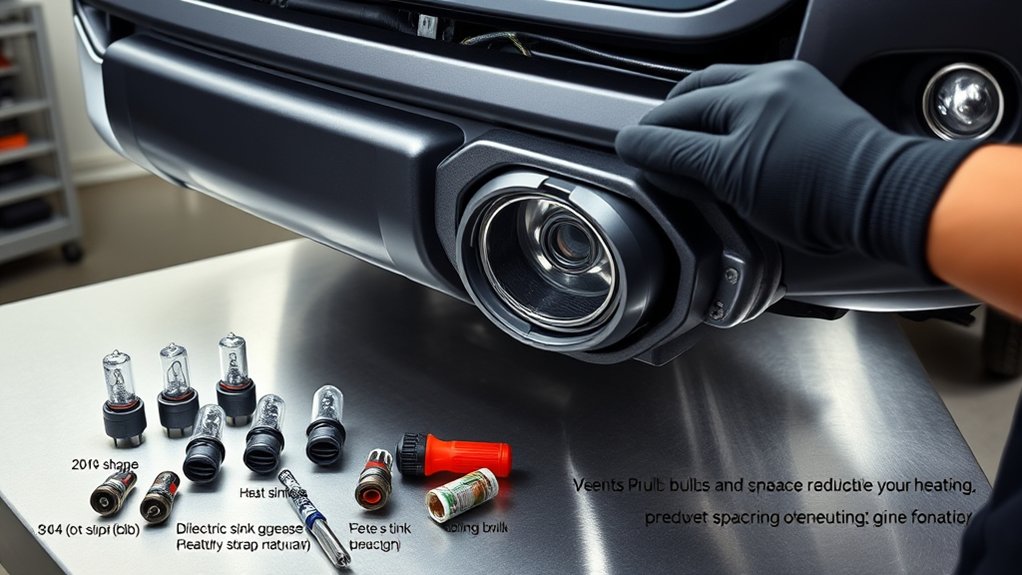
The exact access path varies by generation and bumper design. Some trucks allow access from below, while others require moving a wheel-well liner or lower splash shield.
- Park and cool the truck. Use a level surface, set the parking brake, turn off the ignition and lights, and allow the lamp to cool.
- Reach the rear of the fog housing. Turn the front wheel for additional liner clearance if helpful. Remove only the clips or fasteners needed for safe access.
- Disconnect the plug. Press the connector lock and pull on the connector body, not the wires.
- Remove the old bulb. Rotate the base in the unlocking direction and withdraw it straight from the housing. Note the tab orientation.
- Inspect the housing. Check the connector for heat damage or corrosion and inspect the housing for moisture, cracks, or a damaged sealing surface.
- Install the replacement. Keep the bulb and O-ring clean. Align the tabs, insert the bulb fully, and rotate it until securely locked.
- Reconnect and test. Reattach the connector, switch on the fog lights, and verify steady operation on both sides.
- Reassemble and check the beam. Refit every clip and shield. Confirm that the beam remains low, even, and free from excessive upward glare.
Warning: Never crawl beneath a vehicle supported only by a jack. Use approved support points and properly rated jack stands if the truck must be raised. If you cannot reach the lamp safely from the ground, have a qualified technician perform the work.
Pro Tip: Replace aging halogen fog bulbs as a pair. Their output and color can change over time, so a matched pair usually provides a more even appearance.
Handle the New Bulb Correctly
Wear clean gloves when handling a halogen bulb. Avoid touching its glass because oil and dirt can create hot spots and shorten service life. If you touch the glass, clean it according to the bulb manufacturer’s directions before installation.
With an LED replacement, keep the heat sink or cooling fan unobstructed. Position any separate driver where it will not rattle, stretch the wires, block a vent, or sit in standing water.
Check Alignment and Glare
A simple bulb replacement should not require major aiming changes if the bulb seats correctly. However, a complete replacement housing may require adjustment. Park on level ground facing a wall and compare both beams. They should remain low and broadly distributed rather than rising into other drivers’ sight lines.
If one beam looks tilted or scattered, switch the lamps off and reseat the bulb. Do not compensate for a badly seated or optically incompatible bulb by aiming the entire lamp sharply downward.
Troubleshooting Tacoma Fog Lights
Begin with the simplest shared cause, then move toward individual lamps and wiring. A multimeter or test light can confirm power and ground, but avoid piercing sealed wires unless a proper repair procedure requires it.
| Symptom | Likely checks | Recommended action |
|---|---|---|
| One fog light is out | Bulb, connector, local ground, corrosion, or damaged housing | Swap in a known-good correct bulb when practical, then check for power and ground at that connector. |
| Both fog lights are out | Fuse, relay or control circuit, switch conditions, harness connection, or shared ground | Review the manual’s operating conditions and fuse location, then test the shared circuit before replacing both lamps. |
| Fuse blows again | Shorted wiring, water intrusion, damaged connector, incorrect wattage, or failed lamp electronics | Stop replacing fuses and locate the fault. Never install a higher-amperage fuse. |
| LED flickers or shuts off | Loose connection, poor ground, driver failure, polarity issue, voltage instability, or incompatible electronics | Reseat the connector, verify voltage and ground, and follow the lamp maker’s vehicle-specific compatibility guidance. |
| Moisture inside the housing | Pinched O-ring, loose bulb, blocked vent, cracked lens, or failed housing seam | Correct the seal or replace the damaged assembly. Do not leave corroded terminals untreated. |
| Beam is scattered or too high | Bulb not fully locked, incorrect base, poor LED emitter position, damaged reflector, or misadjusted assembly | Reseat the correct bulb and inspect the pattern. Replace an incompatible bulb rather than accepting glare. |
When checking a fuse, use the location and rating listed for your exact truck. Replace it only with the same specified amperage. A fuse that fails repeatedly indicates a circuit problem rather than a need for a larger fuse.
Related Guides
Frequently Asked Questions
What size are Toyota Tacoma fog lights?
For factory U.S.-market fitment, 2005–2011 Tacomas use 9145/H10 and 2012–2015 use H11 where equipped. Toyota lists H16 for 2016–2023 normal-type fog lamps and H11 for wide-angle fog lamps; factory LED assemblies are also used on some trims. For 2001–2004, verify the installed lamp because the owner-manual bulb tables reviewed do not identify one standard fog-bulb size.
What fog-light bulb does a 2019 Toyota Tacoma use?
Toyota’s 2019 owner’s manual lists H16 at 19 watts for the normal-type fog lamp and H11 at 55 watts for the wide-angle fog lamp. The 2019 TRD Pro uses factory Rigid Industries LED fog lights rather than a conventional H11/H16 service bulb. Verify the installed lamp and trim before ordering.
What are the 2016 Toyota Tacoma headlight and fog-light bulb numbers?
Toyota’s 2016 owner’s manual lists H11 at 55 watts for the low beam and H9 at 65 watts for the high beam. For the fog light, it lists H16 at 19 watts for the normal type and H11 at 55 watts for the wide-angle type. Match the fog-lamp type on the truck before purchasing.
Why do 2016–2023 Tacoma fog-light charts list both H16 and H11?
Toyota’s owner-manual specifications distinguish two serviceable fog-lamp types on these trucks: H16 for the normal-type lamp and H11 for the wide-angle lamp. Trim and equipment determine which one is installed, while some factory LED configurations use a complete LED assembly instead.
Are 9145 and H10 the same bulb?
9145 is the ANSI designation commonly associated with the H10 automotive bulb. Product listings may show either name. Match the complete designation, base, connector, and rating before installation.
Can an H8 bulb replace an H11 fog-light bulb?
Do not assume so. H8 and H11 bulbs have related-looking bases but different keying and nominal wattage. Use the bulb specified for the housing instead of trimming tabs or forcing a mismatched bulb into place.
Does a Tacoma need a CAN-bus decoder for LED fog bulbs?
Not automatically. Install a correct, vehicle-compatible LED bulb and test it first. Use a decoder, anti-flicker module, or resistor only when the product manufacturer documents that requirement for the truck and provides safe mounting instructions.
Are LED replacement bulbs legal in Tacoma fog-light housings?
Legality and inspection treatment can depend on the complete lamp, its certification, beam performance, and state or local rules. A package claim does not guarantee that a bulb is suitable for every halogen housing. Choose a road-use product intended for the application and confirm that it produces a controlled, non-glaring beam.
Conclusion
For a factory U.S.-market Tacoma, start with the verified pattern: 2005–2011 uses 9145/H10 where equipped, 2012–2015 uses H11, and 2016–2023 serviceable halogen fog lamps use H16 for the normal type or H11 for the wide-angle type. Factory LED-equipped trucks require the correct LED assembly or approved service component. For 2001–2004, verify the installed lamp or VIN-specific parts listing before buying.
During installation, keep the bulb clean, secure every connector and splash shield, use only the specified fuse rating, and test the beam after dark. A properly fitted lamp should provide a low, wide pattern without flicker, moisture, excessive heat, or glare.
Sources
- Toyota Manuals and Warranties — official model-year owner-manual lookup and vehicle documentation.
- Toyota Technical Information System: Tacoma Owner’s Manual — official operating, maintenance, and lighting information for the applicable vehicle.
- Toyota Genuine Parts — vehicle-specific and VIN-assisted component verification.
- 2023 Toyota Tacoma eBrochure — Toyota trim/equipment matrix distinguishing integrated fog lights, wide-angle fog lights, and Rigid Industries LED fog lights.
- 49 CFR 571.108, Lamps and Reflective Devices — U.S. federal motor-vehicle lighting requirements.
- 49 CFR Part 564, Replaceable Light Source Information — standardized replaceable automotive light-source information.
