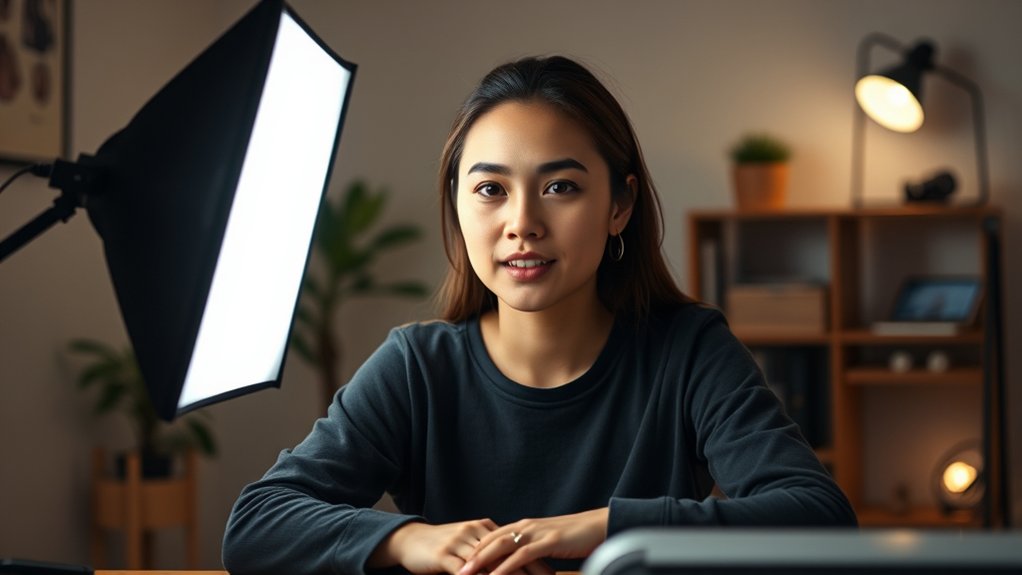
A good softbox for talking head videos at close range is a 24- to 36-inch (60–90 cm) softbox or octabox with a front diffusion panel, placed about 2–3 feet from your face at roughly 45 degrees and slightly above eye level. At that distance a mid-size softbox is already large relative to your face, so it gives soft, flattering light without flooding a small room.
Go bigger (around 39 inches / 100 cm) only if you have the floor space and want an even softer wrap. Below: how to choose the size, setup diagrams in words, and example lights to look at.
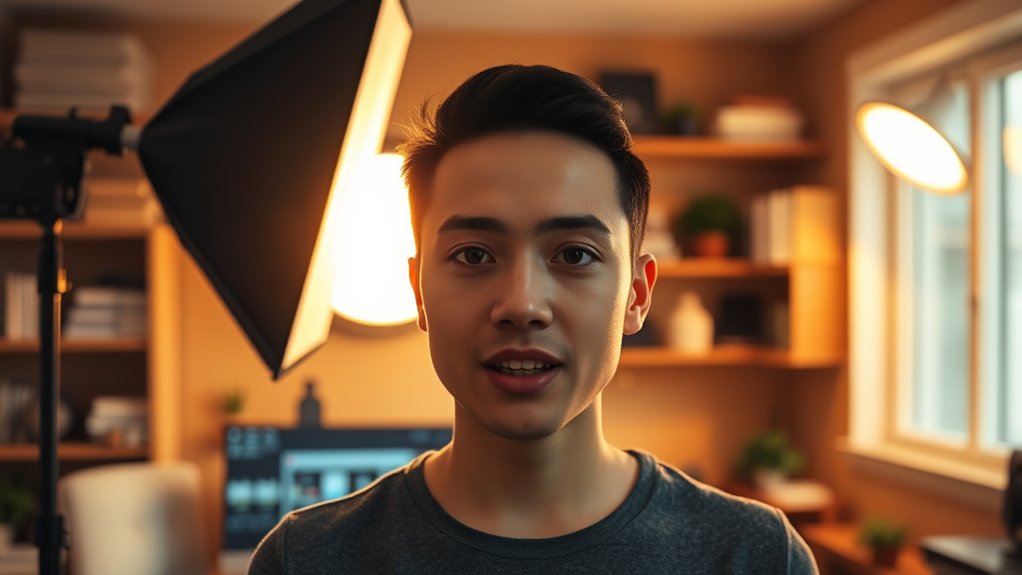
Why Distance Matters More Than Softbox Size
Softness depends on how big the light looks from the subject’s position, not just its absolute size. Moving a softbox closer makes it effectively larger, which softens shadows and wraps light around the face.
- Closer = softer light, faster falloff (background gets darker).
- Farther = harder shadows, more even light across the room.
That’s why a modest 24-inch softbox at arm’s length can look softer than a 39-inch box placed across the room.
Best Softbox Size for Talking Head Videos
| Softbox size | Best for | Typical distance | Trade-offs |
|---|---|---|---|
| 24 in (60 cm) | Small offices, desk setups, tight framing | 2–3 ft | Slightly firmer shadow edges if pulled back |
| 32–36 in (80–90 cm) | Most home studios; the all-round choice | 2.5–4 ft | Needs a sturdier stand |
| 39 in (100 cm) octabox | Very soft, beauty-style light; roomier spaces | 3–4 ft | Takes floor space; can spill onto walls in small rooms |
| 2×2 ft LED mat with softbox | Low-profile, light-weight setups | 2–3 ft | Typically costs more than a bulb + softbox kit |
What to Look For in a Softbox for Close-Up Video
- Double diffusion: an inner baffle plus a front panel for even light with no hotspot.
- Mount compatibility: most continuous LED lights use a Bowens mount; check your light before buying.
- Grid (egg crate): keeps light off the background and walls in a small room.
- Quick-open design: umbrella-style frames make setup and storage faster.
- Light output and color: a bi-color LED lets you match window light or room bulbs; aim for a high CRI/TLCI rating for accurate skin tones.
Example Lights and Modifiers to Consider
These are widely sold options that fit the sizes above. Check current specs and pricing with the retailer.
- Elinchrom Rotalux Deep Octa 100 cm (39 in): a deep octabox for very soft, controlled light if you have the space. Note it uses Elinchrom’s mount, so you may need an adapter for other lights.
- Aputure amaran F22x: a 2×2 ft, 200W bi-color flexible LED mat that is sold with a softbox and grid, handy where a deep softbox won’t fit.
- Generic 24–36 in Bowens-mount softboxes (from brands like Godox, Neewer and Aputure) paired with a COB LED light: the most budget-friendly route.
Skip very large panels (4×4 ft mats and similar) for a small office; they are designed for bigger sets.
Setup for a Small (6×6 ft) Office
- Key light: a 24–36 in softbox about 45 degrees to one side, slightly above eye level, 2–3 ft from your face.
- Grid on: attach the grid to stop spill onto nearby walls.
- Window: either face the window (use it as fill) or block it, so the light doesn’t change mid-recording. Don’t keep it behind you unless it’s covered.
- Fill: a white wall, reflector or a second dim light on the opposite side to lift shadows.
- Background or hair light (optional): a small LED behind you adds separation.
- Stand choice: a C-stand or boom arm lets you push the light close without the stand appearing in frame.
Softbox vs Ring Light for Talking Heads
| Softbox | Ring light | |
|---|---|---|
| Look | Soft, directional, adds depth to the face | Flat, frontal, even |
| Eye reflections | Square or octagonal catchlight | Circular catchlight; visible ring in glasses |
| Space | Needs more room | Very compact |
| Setup | Slower | Fast |
For longer-form talking head videos, a softbox generally looks more natural. A ring light is fine for quick, phone-based clips.
Pros and Limitations of Using a Softbox
Pros: soft, flattering light; controllable direction; affordable kits; works with most LED lights.
Limitations: takes floor space; needs a sturdy stand; larger boxes can spill light in small rooms without a grid.
More Creator Gear Guides
Shooting your own footage hands-free? See what comes in the Ray-Ban Meta Wayfarer box, or our DJI Neo 2 explainer for selfie-drone video.
FAQ
What size softbox is best for talking head videos?
A 24- to 36-inch softbox suits most talking head setups. Placed 2 to 3 feet from the presenter, it gives soft light without taking over a small room. A 39-inch octabox is softer still but needs more space.
How far should a softbox be from my face?
Start around 2 to 3 feet. Moving it closer makes the light softer and the background darker; moving it back makes the light harder and more even across the room.
Where should I place the softbox?
Put it about 45 degrees to one side of the camera and slightly above eye level, angled down toward your face. Add a reflector or white wall on the other side as fill.
Is a softbox better than a ring light?
For most talking head videos, yes. A softbox gives more natural shape to the face and avoids ring-shaped reflections in the eyes and glasses. A ring light is quicker and more compact.
Do I need a grid on my softbox?
In a small room it helps. A grid narrows the beam so less light bounces off walls and the background, which keeps contrast and separation.

