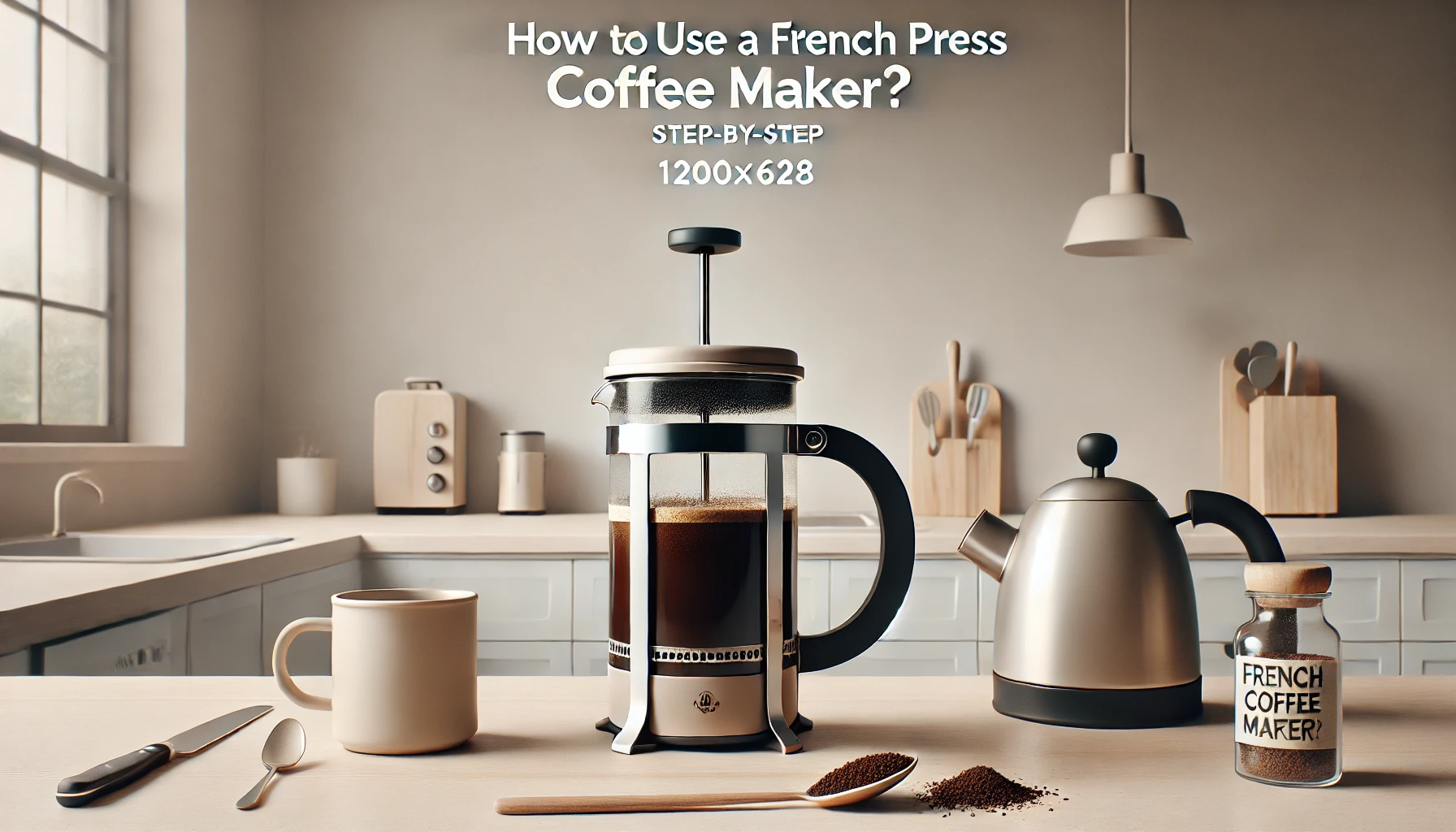
A French press coffee maker is simple to use: add coarse coffee, pour in hot water, let it brew for about 4 minutes, plunge gently, and pour the coffee out right away. For a repeatable starting recipe, use a 1:15 coffee-to-water ratio by weight, such as 30 grams of coffee with 450 grams of water, and aim for water around 195°F to 205°F.
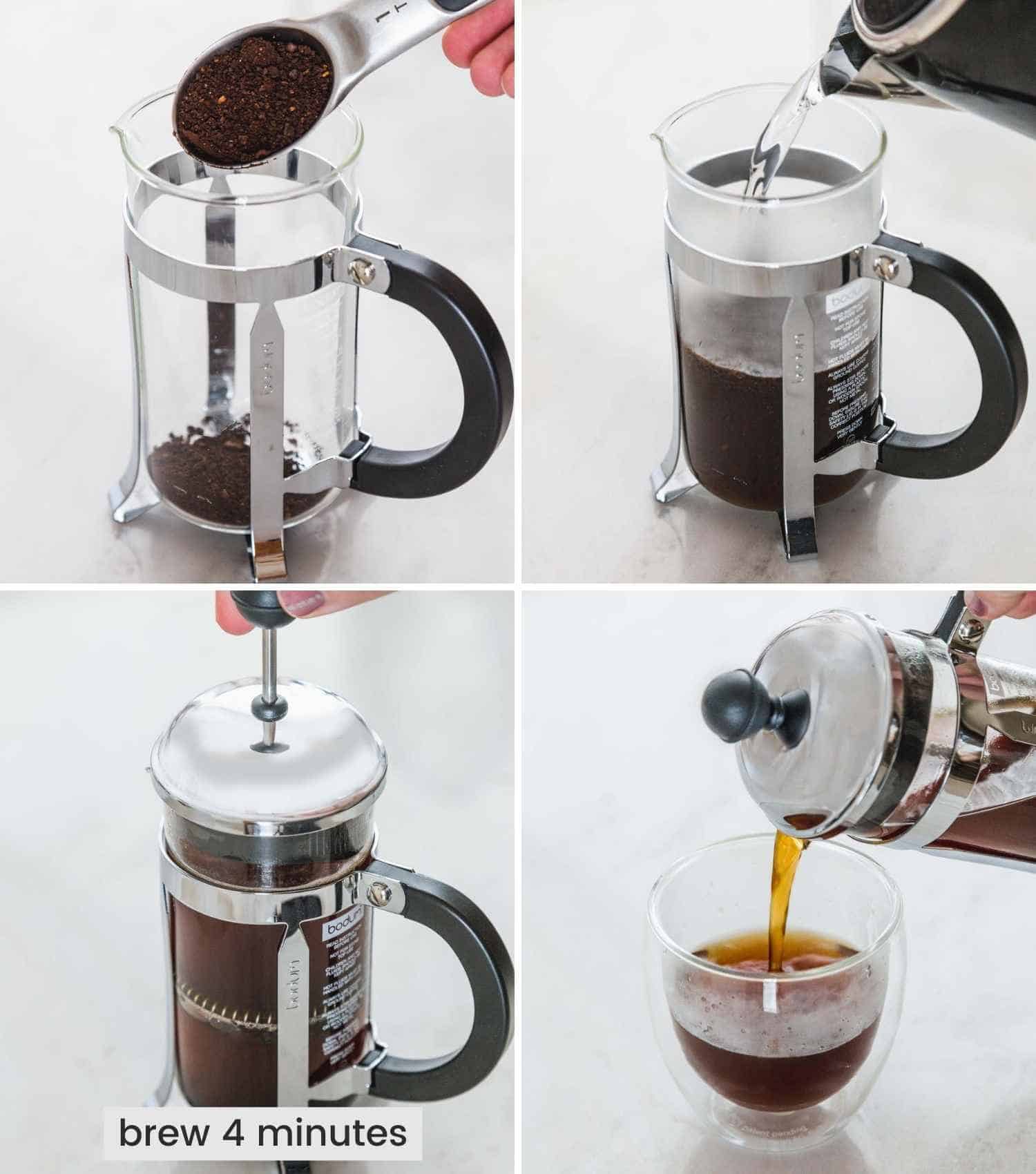
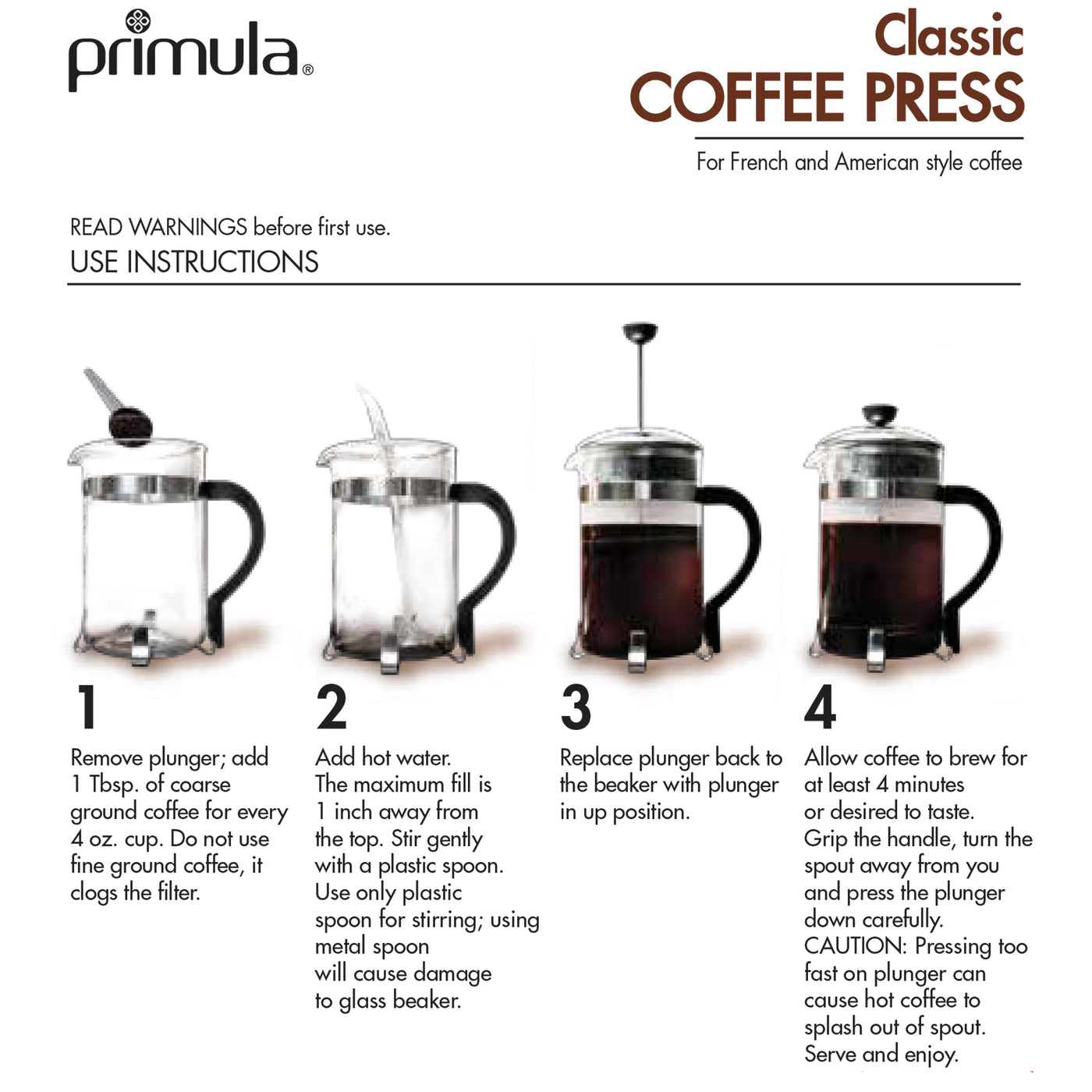
For the standard method, pour all the water over the grounds and start your timer. At about 1 minute, gently stir or break the floating crust so all the grounds are wet. Replace the lid with the plunger raised, continue brewing until about 4 minutes total, then plunge slowly and serve immediately.
Last updated: September 22, 2026. What changed: Brewing ratios, temperature guidance, stirring steps, troubleshooting, cleaning guidance, source links, FAQs, internal links, and schema were reviewed and updated.
Quick Answer
To use a French press, add coarse coffee grounds at about a 1:15 coffee-to-water ratio, pour water around 195°F to 205°F over the grounds, and start your timer. At about 1 minute, gently stir the floating crust. Replace the lid, let the coffee reach about 4 minutes of total brewing time, then press the plunger down slowly and pour the coffee immediately.
Key Takeaways
- Start with a coarse grind, similar to rock salt or coarse sea salt, then adjust if the coffee tastes too bitter, weak, or gritty.
- Aim for water around 195°F to 205°F as a practical starting range.
- A 1:15 coffee-to-water ratio is a useful starting point, not a universal rule; adjust the dose to match your coffee and taste.
- Use about 4 minutes of total coffee-to-water contact time for a simple baseline recipe.
- Plunge gently and pour the coffee immediately so it does not continue sitting on the grounds.
- Clean the carafe, plunger, and filter after each use so old grounds and coffee oils do not affect the next brew.
At a Glance
| Time Required | About 8 to 10 minutes, including heating water, brewing, plunging, and pouring |
| Difficulty | Easy |
| Tools Needed | French press, coarse coffee grounds, kettle, spoon, timer, and preferably a digital scale |
| Starting Recipe | 30 g coarse coffee + 450 g water, about 195°F to 205°F, about 4 minutes total brew time |
| Cost | Low after buying the French press; no paper filters or electricity are required for the press itself |
How to Use a French Press Coffee Maker Step by Step
- Prepare the press. Start with a clean French press. If you want better heat stability, rinse the empty carafe with hot water and discard that water before brewing.
- Measure and grind the coffee. For a simple starting recipe, use 30 grams of coffee and grind it coarse, roughly like coarse sea salt or rock salt.
- Heat and measure the water. Use 450 grams of fresh water at roughly 195°F to 205°F.
- Pour and start the timer. Add all the water, making sure the grounds become saturated. At about 1 minute, gently stir or break the crust of grounds floating on top.
- Finish the brew. Put the lid on with the plunger raised and continue brewing until about 4 minutes of total coffee-to-water contact time has passed.
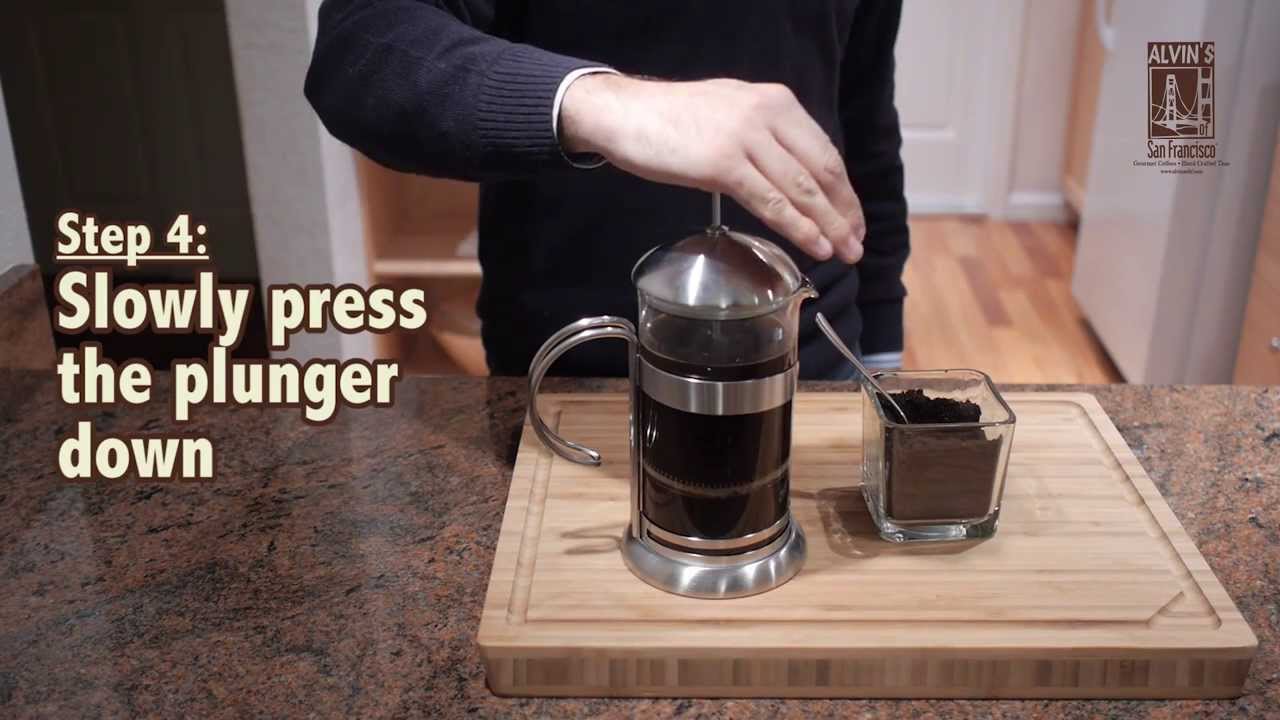
- Plunge and serve. Press the plunger down gently and evenly. Pour the coffee into cups or a separate server immediately instead of leaving it sitting on the grounds.
Verified baseline: The National Coffee Association recommends starting with a coarse grind, about 93 ± 3°C water, a 1:10 to 1:16 coffee-to-water range, and roughly 4 minutes of contact time. Stumptown Coffee Roasters also uses a coarse grind, water around 205°F, a crust-breaking stir, and about a 4-minute brew.
French Press Coffee Ratio Chart
A scale is the easiest way to make French press coffee repeatable. The table below uses a 1:15 starting ratio. Water and coffee can both be weighed in grams.
| Water | Coffee at 1:15 |
|---|---|
| 240 g | 16 g |
| 350 g | 23 g |
| 450 g | 30 g |
| 500 g | 33 g |
| 750 g | 50 g |
| 1,000 g | 67 g |
If you do not have a scale, tablespoons can provide a rough starting point, but they are less precise because coffee density changes with roast level and grind size. Once you find a recipe you like, weighing both coffee and water makes it much easier to repeat.
Introduction To French Press
The French press is a manual immersion brewer. Coffee grounds remain in direct contact with hot water during brewing, then a plunger and mesh filter separate most of the grounds from the finished drink. Because a metal mesh filter allows more oils and fine particles through than many paper filters, French press coffee commonly has a heavier body and texture.
Brief History
Press-style coffee makers have a long European history. An early French patent was filed by Mayer and Delforge in 1852, while designs that more closely resemble the modern French press were developed and patented in Europe during the late 1920s and 1930s. The history is more international than the name “French press” suggests. For a detailed patent history, see Barista Hustle’s history of the French press.
Why Choose French Press?
The French press is easy to use and does not require electricity. You control the brewing time, coffee amount, grind size, and water temperature, making it easy to adjust the finished cup to your taste.
Another reason people like it is texture. The metal mesh filter allows natural coffee oils and some fine particles to remain in the drink, creating the fuller body associated with French press coffee. It also does not require disposable paper filters.
Credit: littlesunnykitchen.com
Essential Equipment
To make a consistent cup of French press coffee, you need only a few basic tools. The press, coffee, water, and kettle are essential; a grinder, scale, and timer improve repeatability.
[Amazon Products Picked for You]

No Plastic Touching Food: Made with 304 stainless steel and food-grade silicone, our French press keeps all brewing surfaces plastic-free— no odor and no plastic particle into your coffee. Safe and worry-free

Superior Filtration: A solid filtration system in a coffee maker ensures a refined taste and robust flavor mouthfeel. Our 4-filter sieve system has an improved piston plate and 80 mesh filter that extracts the earthy, rich taste of residue-free coffee. This 1000 ml/34 Oz beaker makes 4 cups of creamier & tastier coffee.

No Plastic Touching Food: Made with 304 stainless steel and food-grade silicone, our French press keeps all brewing surfaces plastic-free—no BPA, no odor, and no plastic particle into your coffee. Safe and worry-free
French Press Components
The French press itself is the main tool. It usually has a glass, plastic, stoneware, or stainless steel carafe, a lid, and a plunger with a mesh filter. The carafe holds the coffee and water while the plunger separates most grounds from the brewed coffee.
Before brewing, check that the plunger fits securely and moves smoothly. A bent, loose, torn, or damaged filter can allow more grounds into the cup.
Additional Tools Needed
A coffee grinder is useful because grinding shortly before brewing gives you more control over freshness and grind size. A burr grinder is preferable when available because it generally produces a more consistent grind than a blade grinder. A digital scale makes measuring coffee and water more repeatable.
You will also need a kettle and timer. A wooden, silicone, or plastic spoon is a practical choice for stirring in a glass carafe because it reduces the chance of striking the glass with a hard metal utensil.
Note: You can make French press coffee without a scale, but weighing the coffee and water makes it much easier to repeat a cup you like.
Selecting Coffee Beans
Bean choice changes the aroma, acidity, body, and roast flavor of French press coffee. Fresh coffee that you enjoy in other brewing methods is a sensible place to start, then you can adjust the brewing variables around it.
Best Beans For French Press
Medium and dark roasts are common French press choices because their fuller roast flavors pair well with the brewer’s heavier body. Light roasts can also work and may emphasize brighter or more delicate flavors. There is no single roast level required for French press.
Coffees from Colombia, Ethiopia, Brazil, Guatemala, Sumatra, and many other origins can all be brewed successfully in a French press. Instead of choosing solely by country, use the roaster’s tasting notes and roast level to find flavors you already enjoy.
Grinding Tips
Start with a coarse grind, approximately the texture of coarse sea salt or rock salt. If the grind is excessively fine, plunging can become difficult and more fine sediment may pass through the mesh. If the coffee tastes weak with an extremely coarse grind, move slightly finer while keeping the other variables the same.
Grind your beans shortly before brewing when practical. If you use pre-ground coffee intended for drip machines, it may be finer than the usual French press grind. You can still brew with it, but expect more sediment and avoid forcing the plunger if you feel strong resistance.
Credit: primulaproducts.com
What Water Temperature Should You Use for French Press?
Water has a major effect on coffee flavor. Start with fresh, clean water that tastes good on its own. Filtered water can be useful when your tap water has noticeable odors or flavors; avoid assuming that distilled or heavily softened water will automatically produce better coffee.
Best Water Temperature
A practical starting range for French press coffee is about 195°F to 205°F, or roughly 91°C to 96°C. The National Coffee Association gives a target of about 93 ± 3°C for French press brewing.
If you have a temperature-control kettle or kitchen thermometer, use it for repeatability. Otherwise, bring the water to a boil, remove it from the heat, and let it rest briefly before pouring. A short rest of around 30 seconds is a practical starting method, but actual cooling depends on your kettle, room temperature, water volume, and altitude.
What Coffee-to-Water Ratio Should You Use?
There is no single universal French press ratio. The National Coffee Association gives a broad range of about 1 gram of coffee to 10–16 grams of water. For a balanced beginner recipe, 1:15 is an easy starting point: 30 grams of coffee with 450 grams of water.
If you want a more concentrated cup, increase the coffee dose rather than simply extending the brew indefinitely. If the cup tastes too strong for you, use more water or less coffee. Change one variable at a time so you can tell which adjustment helped.
A 1:15 coffee-to-water ratio is a practical starting point, not a universal rule. Use it as a baseline and adjust to your taste.
Detailed French Press Brewing Process
The main goal during French press brewing is consistency. Measure the coffee and water, keep the temperature and total contact time reasonably consistent, then change only one variable when you want to adjust the cup.
Adding Coffee Grounds
Begin by weighing your coffee. For the baseline recipe in this guide, use 30 grams of coarse coffee for 450 grams of water. Measuring by weight is more reliable than using tablespoons because coffee density varies.
Add the coffee to the empty French press. Gently level the grounds across the bottom so they are ready for even wetting.
If you are experimenting with flavor, keep the ratio, temperature, and timing consistent for the first few brews. That lets you judge the coffee itself before changing several variables at once.
Pouring Water
Heat the water to roughly 195°F to 205°F. Start your timer as you begin pouring.
Pour the measured water over the grounds and make sure the coffee becomes thoroughly wet. You do not need a complicated pouring pattern for this immersion method.
At about 1 minute, gently stir or break the crust of grounds floating at the surface. Do not whisk or stir aggressively. Place the lid on the French press with the plunger raised.
Continue brewing until about 4 minutes of total coffee-to-water contact time has passed. Then move directly to plunging and serving.
Pro Tip: Start the timer when the first water reaches the grounds. Consistent timing makes it much easier to compare one brew with the next.
How Long Should French Press Coffee Steep?
About 4 minutes of total contact time is a useful baseline for a traditional French press method. It is not the only possible recipe, but it gives beginners a repeatable place to start.
Ideal Starting Duration
Start with about 4 minutes. If the finished cup is not to your taste, check the ratio, grind, water temperature, roast level, and whether the coffee sat on the grounds after brewing before assuming brew time is the only problem.
When experimenting, make small changes and keep notes. Changing the dose, grind, temperature, and time all at once makes it difficult to identify what improved or hurt the result.
Should You Stir French Press Coffee?
A gentle stir can help ensure that floating or dry grounds become saturated. One simple method is to pour all the water, wait about 1 minute for a crust to form, then gently break or stir that crust before replacing the lid.
There is no need to stir continuously. Excessive agitation can keep more fine particles suspended in the drink and makes your brewing process harder to repeat.
How Should You Plunge a French Press?
Plunging separates most of the coffee grounds from the brewed liquid. The goal is controlled filtration, not force.
Proper Plunging Method
Set the plunger straight on top of the coffee and press down gently with steady pressure. If it moves smoothly, continue until the filter reaches the coffee bed.
If the plunger is extremely difficult to press, stop instead of forcing it. Raise it slightly and try again gently. Strong resistance can indicate that the grind is too fine or that the filter is clogged.
Avoiding Common Mistakes
Do not ram the plunger downward. Excessive force can cause hot coffee to spill and can be especially risky with a glass carafe.
Keep the plunger straight as you press. Clean the filter after every use because trapped grounds and coffee oils can affect both filtration and flavor.
Warning: Never force a stuck plunger. Hot coffee can splash, and excessive pressure can damage a glass carafe.
How Should You Serve French Press Coffee?
Once brewing and plunging are complete, pour the coffee promptly. The mesh filter separates the grounds but does not remove them from the carafe, so leaving finished coffee sitting with the grounds changes the cup over time.
Pouring Tips
After plunging gently, pour the coffee into your cup or a separate server. If you are making more than you will drink immediately, transferring the entire batch to another carafe prevents it from continuing to sit on the coffee bed.
If you are serving several people, you can divide the first pour between the cups and then top them off. This can help distribute any small differences between the beginning and end of the pour.
Enhancing Flavor
For better consistency, focus first on four variables: coffee-to-water ratio, grind size, water temperature, and brew time. Adjust one variable at a time and record the recipe when you find a combination you like.
Different coffee origins and roast levels can produce very different cups with the same French press recipe. Once your technique is consistent, experimenting with beans is often more useful than continuously changing every brewing step.
Troubleshooting French Press Coffee
If your French press coffee does not taste right, diagnose one variable at a time. The table below gives you a practical starting point.
| Problem | Check First | First Adjustment |
|---|---|---|
| Bitter or harsh | Fine grind, long contact time, dark roast, coffee left on grounds | Decant immediately; then try a slightly coarser grind |
| Weak or watery | Coffee dose, very coarse grind, cool water, short brew | Confirm your ratio and 4-minute baseline first |
| Too much sediment | Fine particles, aggressive stirring, damaged filter | Use a coarser, more consistent grind and plunge gently |
| Plunger hard to press | Fine grind or clogged filter | Do not force it; use a coarser grind next time |
[Amazon Products Picked for You]

Precision grind control: The visual timing knob is marked in seconds so you can set a consistent grind for espresso, drip, or French press. Stop the cycle when the texture looks right; no more mixed boulders and dust from random pulsing.

Fast & Consistent Grinding:Powered by a 180W motor (30,000 RPM) with sharp stainless steel blades, Aromvel coffee grinder grinds coffee beans quickly and evenly. The 2.3 oz (65 g) capacity is ideal for brewing 1–2 cups at a time. For best results, do not operate continuously for more than 40 seconds.
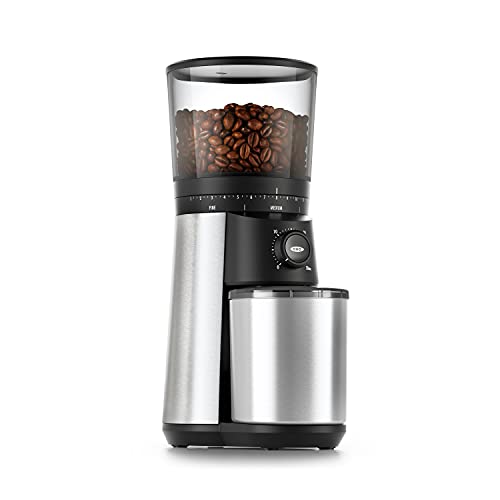
40mm stainless steel conical burrs: Precision grinding system produces uniform coffee grounds to ensure even extraction for rich, balanced flavor in every cup.
If Your Coffee Tastes Bitter
Bitterness can come from several sources, including a fine grind, excessive extraction, a dark roast, or leaving brewed coffee in contact with the grounds after plunging. Start by pouring the coffee out immediately. If the problem remains, try a slightly coarser grind while keeping the other variables unchanged.
If Your Coffee Tastes Weak
Weak coffee can result from too little coffee, an extremely coarse grind, water that is too cool, or insufficient extraction. Confirm your coffee-to-water ratio first. Then make one adjustment at a time rather than simultaneously adding more coffee, grinding finer, and extending the brew.
If Your Coffee Has Too Much Sediment
Some sediment is normal because the French press uses a mesh filter rather than a fine paper filter. If the cup is excessively gritty, use a coarser and more consistent grind, stir gently rather than aggressively, plunge slowly, and inspect the filter for damage.
Cleaning And Maintenance
Cleaning your French press after every use helps keep old coffee grounds and oils from affecting later brews. The filter assembly deserves particular attention because fine particles can collect between its layers.
[Amazon Products Picked for You]

Long-Lasting Durability: Made of premium 304 stainless steel fine mesh, rust-resistant and corrosion-resistant for long-term reuse.

【Wide Compatibility】Our replacement filter screen is designed to fit most 8-Cup (34 Oz/1000ml) French presses. For ideal compatibility, measure your existing filter—it should be 4 inches (100mm) in diameter.
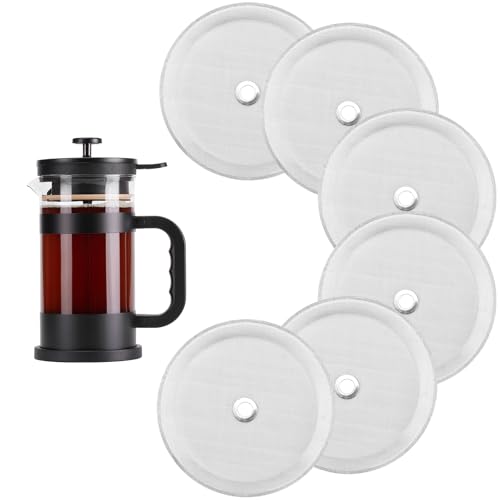
【Superior Material】Our french press filter is crafted from food grade 304 (18/8) stainless steel, rust-resistant, durable and built for long-term daily use. ensures you always have a fresh filter ready for daily brewing, perfect for coffee and tea lovers
Cleaning Steps
Allow the brewer to become safe to handle, then remove the plunger and discard or compost the used coffee grounds. Avoid forcing utensils against a glass carafe.
If your model allows it, disassemble the filter screens. Wash the carafe, plunger, and filter components with warm water, mild dish soap, and a soft sponge or brush. Rinse thoroughly so no soap residue remains.
Let the parts dry before reassembling and storing the French press. Always follow any material-specific cleaning instructions supplied by the manufacturer.
Maintenance Tips
Regularly inspect the filter screens and seals for wear, bending, tears, or damage. Replace damaged parts that no longer filter correctly.
For mineral deposits or a deeper clean, follow the manufacturer’s instructions and use a method compatible with your specific carafe, metal parts, seals, coatings, and dishwasher rating. The National Coffee Association’s French press guide also recommends cleaning the entire press after each use, including the filter.
Handle a glass carafe carefully. If durability or heat retention matters more than seeing the coffee while it brews, a stainless steel press is another common design option.
Credit: www.youtube.com
Related Guides
Frequently Asked Questions
How do you make coffee in a French press coffee maker?
Add coarse coffee to the French press and pour in hot water. A useful starting recipe is 30 grams of coffee with 450 grams of water around 195°F to 205°F. At about 1 minute, gently stir or break the floating crust. Continue brewing until about 4 minutes total, plunge gently, and pour immediately.
How many scoops of coffee do you put in a French press?
Measuring by weight is more accurate than counting scoops because coffee density varies. Start around a 1:15 coffee-to-water ratio, such as 30 grams of coffee with 450 grams of water. If you use tablespoons, treat them as an approximate measurement and adjust to taste.
Can you use regular ground coffee in a French press?
Yes. Regular pre-ground coffee can work, but coffee ground for a drip machine is often finer than the coarse grind normally used for French press. A finer grind can produce more sediment and more resistance when plunging. Never force a plunger that feels stuck.
What is the best coffee-to-water ratio for a French press?
There is no single universal ratio. A 1:15 coffee-to-water ratio is a practical starting point, such as 30 grams of coffee with 450 grams of water. The National Coffee Association gives a broader French press range of about 1:10 to 1:16, so adjust the dose to suit your coffee and preferred strength.
How long should French press coffee steep?
About 4 minutes of total coffee-to-water contact time is a useful starting point for a standard French press method. If the cup tastes wrong, also check the ratio, grind size, water temperature, roast, and whether the coffee remained on the grounds after brewing.
Should you stir French press coffee?
A gentle stir is useful when grounds remain dry or form a floating crust. One simple method is to pour all the water, wait about 1 minute, then gently break or stir the crust before replacing the lid. Continuous or aggressive stirring is unnecessary.
Do you need to bloom coffee in a French press?
A separate bloom is optional rather than required for a standard French press recipe. You can pour the full amount of water, then gently break the crust at about 1 minute. If you prefer a bloom-style technique, keep the rest of your recipe consistent so you can judge whether it improves the cup.
Should you pour French press coffee immediately?
Yes. Pour the coffee into cups or a separate server after plunging. The grounds remain inside the French press, so leaving the finished coffee in the carafe keeps it in contact with the coffee bed and can change the flavor.
Conclusion
For a dependable French press starting recipe, use coarse coffee, about a 1:15 coffee-to-water ratio, water around 195°F to 205°F, and roughly 4 minutes of total contact time. Gently break the crust around the 1-minute mark, plunge with controlled pressure, and pour the coffee immediately.
Once the baseline tastes consistent, adjust one variable at a time. A little more or less coffee, a slightly different grind, or a different roast can change the result significantly. Clean the press and filter after each use, record the recipes you like, and use those notes to dial in future brews.
