
Winter camping in a tipi hot tent comes down to three questions: does the shell shed wind and snow, is there room left once a stove is inside, and can you actually carry it to where you camp?
For most people the answer is the OneTigris Rock Fortress Hot Tent. It raises on a single pole, its ten-sided cut tensions evenly in wind, and it pairs a 3,000 mm coating with a full snow skirt and two mesh roof vents. If you want to spend less, the Zoring Hot Tent gives you 8.2 ft of standing room and the highest waterproof rating in this roundup.
We checked all nine against manufacturer spec sheets, CPSC recall records and owner reports on non-retailer forums.
Tipi Hot Tents Compared
| Product | Best for | Sleeps (advertised) | Peak height | Packed weight |
|---|---|---|---|---|
 Mid-range
|
All-round winter basecamps | Up to 6 | 7.8 ft | 9.2 lb |
 |
Family and hunting camps | 4-6 | 8 ft 6 in | 11 lb |
 |
Solo, pairs and short carries | 4 | 7 ft 3 in | 5.6 lb |
 Mid-range
|
Group vehicle basecamps | 4-8 | 7.9 ft | 10.1 lb |
 Budget
|
Roomy vehicle camping on a budget | 4-6 | 8 ft 6 in | 9.7 lb |
 |
Couples and small mixed-season camps | 2-4 | 6 ft 11 in | 7 lb |
 Mid-range
|
Flexible stove-centred layouts | 2-4 (bare shell) | 8 ft 6 in | 10.3 lb |
 |
Vehicle-side living space | 2-3, or 1-2 with a stove | Not published | 12.5 lb |
 Budget
|
Roomy camps in sustained wet weather | 3-4 | 8.2 ft | 17.4 lb |
Tipi Hot Tents: Our Top Picks
Hot-Tent Safety: Read This First
1. OneTigris Rock Fortress Hot Tent
Bottom line: A ten-sided tipi that pitches on one pole, takes a stove and holds its shape in wind. Buy it if you want one shelter that handles most cold-weather trips without moving up to canvas.
Key specs
- Peak height: 7.8 ft, enough to stand near the centre pole
- Footprint: 12.4 ft decagonal, fits two cots and a stove zone
- Packed weight: 9.2 lb, fine for short carries from a vehicle
- Waterproof rating: 3,000 mm, copes with sustained winter rain
- Stove jack: One 3.3 x 3.3 in panel, sized for the brand’s own stove
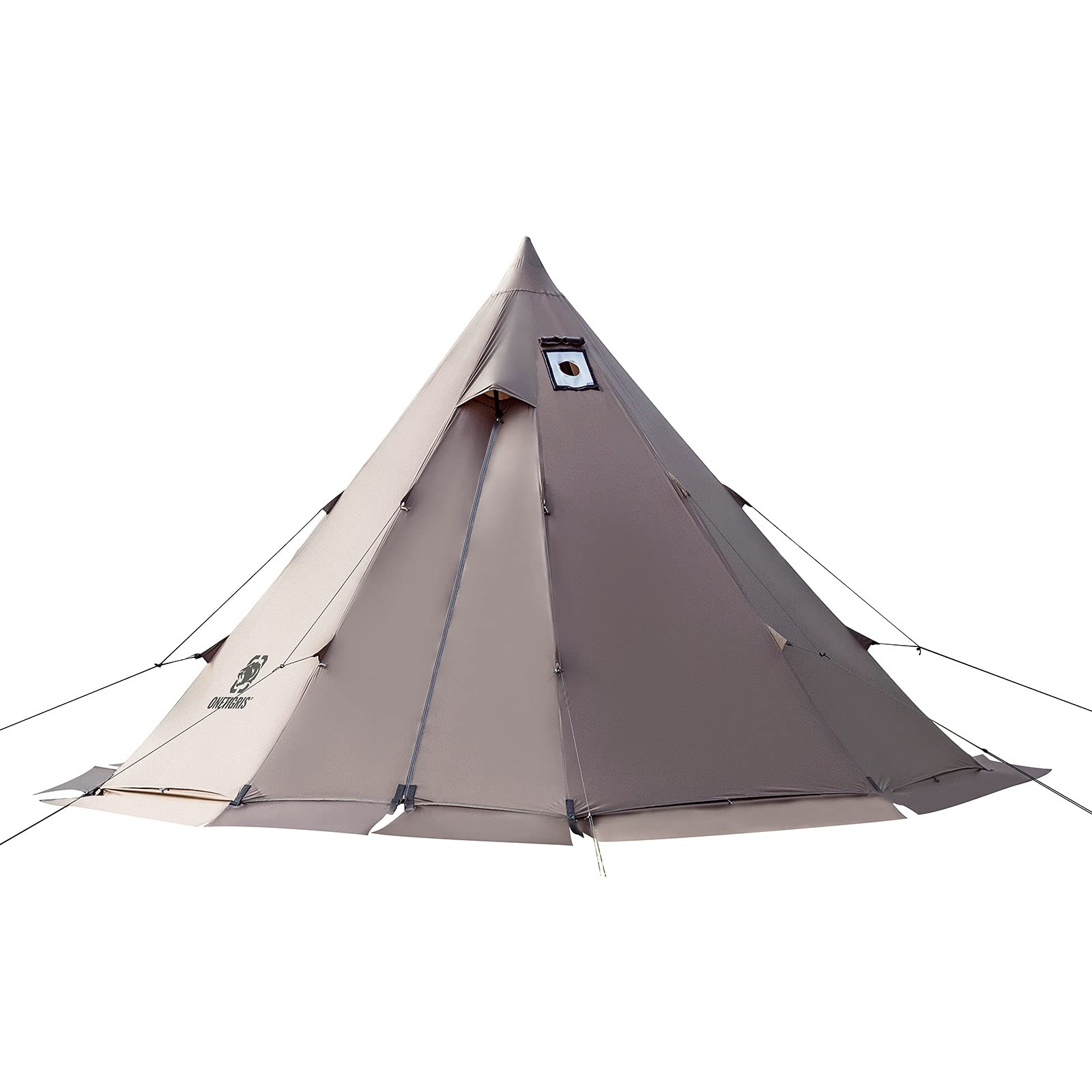
The Rock Fortress is the most balanced option here for campers who want a proper winter shelter without moving into heavy canvas. One telescopic pole raises the whole thing, and the decagonal cut gives the fabric ten short panels instead of four long ones, so the wall tensions evenly and there is less for a gust to push against.
Inside, the 12.4 ft floor takes two cots along one side with the stove clear of them and a path to either door. Two mesh roof vents and a full-perimeter snow skirt let you trade draught for warmth, and the 3,000 mm coating with taped seams suits wet snow rather than dry powder. It is floorless, which is deliberate on a stove-ready tent: nothing flammable sits under the firebox.
- Raises on a single telescopic centre pole
- Ten-sided shape tensions evenly in wind
- Full-perimeter snow skirt and two mesh roof vents
- Two doors on opposite sides
- 3,000 mm coating with taped seams
- Floorless, with the mesh inner and footprint sold separately
- The quoted fabric weight varies between sellers
- Too heavy for long backpacking approaches
2. Preself T3 XL Hot Tent
Bottom line: The most floor per pound here: a 15 ft circle and an 8 ft 6 in centre for 11 lb. Buy it if the tent travels by vehicle and several people need to move around inside.
Key specs
- Peak height: 8 ft 6 in, the tallest centre in this list
- Footprint: 15 ft diameter, room for cots and bulky gear
- Packed weight: 11 lb, light for a shelter this size
- Waterproof rating: 3,000 mm PU with taped seams
- Stove jack: Included with a heavy Velcro seal; size not published
The T3 XL trades pack weight for room, and the numbers back it up. A 15 ft circle with an 8 ft 6 in centre is a genuinely different experience from a compact tipi: you can stand up in the middle, walk a loop around a stove and still leave cots along the wall.
What makes it work for families is that all that volume only costs 11 lb, which is lighter than several smaller shelters in this roundup. The screen window keeps it usable outside deep winter, and the 3,000 mm PU coating with taped seams handles long wet spells.
- 15 ft floor with an 8 ft 6 in centre
- 11 lb is light for a shelter this large
- Screen window keeps it usable outside deep winter
- 3,000 mm PU with taped seams
- Aircraft-grade aluminium centre pole
- No published stove-jack size, vent count or snow skirt
- Inner mesh and footprint are separate purchases
- A 15 ft perimeter needs a lot of anchoring
3. Preself 4-Person Lightweight Tipi Hot Tent
Bottom line: A 5.6 lb tipi with a 13 ft floor and enough height to stand hunched at the pole. Buy it if you are carrying the shelter yourself and still want a stove jack.
Key specs
- Peak height: 7 ft 3 in, sit-up and stoop-around room at the pole
- Footprint: 13 ft octagonal, about 169 sq ft of floor
- Packed weight: 5.6 lb, the lightest shelter in this roundup
- Waterproof rating: 2,000 mm PU, the lowest coating here
- Stove jack: One fire-retardant jack; stove pipe not included
This is the shelter to pick when you are carrying it. At 5.6 lb it is roughly half the weight of the large basecamp tipis here, yet the 13 ft octagonal floor still gives about 169 sq ft, and 7 ft 3 in at the pole is enough to stand hunched while you sort gear.
The floorless build is what makes a stove workable at this weight: the jack sits in the wall, the ground stays bare under the firebox, and you can pitch straight onto packed snow. Two vents and a window give you something to open when the stove is running hard.
Two things to plan for. The base version has no snow skirt, so spindrift will find the perimeter unless you bank snow against it. And the 2,000 mm coating is the lowest here, which matters more in coastal drizzle than in dry cold.
- 5.6 lb, the lightest shelter here
- 7 ft 3 in of standing room at the pole
- 13 ft octagonal floor, about 169 sq ft
- Double-door access
- Two vents plus a window for stove nights
- No snow skirt on this version
- 2,000 mm is the lowest coating in this roundup
- Supplied stakes and guy-line hardware are weak
4. FireHiking LEVA Plus Hot Tent
Bottom line: The biggest shell in this roundup at 16.4 ft across, with four vents and two opposite doors. Buy it if a group shares one heated space beside the vehicle.
Key specs
- Peak height: 7.9 ft, standing room across a wide centre
- Footprint: 16.4 ft diameter, the largest floor in this list
- Packed weight: 10.1 lb packed, light for its footprint
- Waterproof rating: 3,000 mm PU on 70D polyester
- Stove jack: One 11.8 x 11.8 in panel with a rain flap
The LEVA Plus is built around shared space. At 16.4 ft across with a 7.9 ft centre it is the largest shell in this roundup, and the two doors sit on opposite sides so people are not climbing over each other or over the stove to get out.
Ventilation is the quiet strength here: four vents, two mesh ones high up and two larger closable ones at the bottom, which gives you a proper low-to-high airflow path when a stove is burning. The snow skirt runs the full perimeter and the kit includes 16 stakes and 8 guy ropes, which is more anchoring hardware than most shells in this list ship with.
- 16.4 ft floor, the largest in this roundup
- Four vents, two high mesh and two closable low
- Two doors on opposite sides
- Full snow skirt and 3,000 mm PU coating
- Ships with 16 stakes and 8 guy ropes
- No floor, and the half inner tent is a paid extra
- Too large to carry any real distance
- The big canopy needs careful staking and guy tension
5. VEVOR Tipi Hot Tent (Size L)
Bottom line: A 15.1 ft, 8 ft 6 in shell for 9.7 lb with YKK zips and welded seams. Buy it if you want maximum room per dollar and you camp in settled winter weather.
Key specs
- Peak height: 8 ft 6 in, full standing room near the pole
- Footprint: 15.1 ft, ten-sided pyramid shape
- Packed weight: 9.7 lb, the lightest of the large shells here
- Waterproof rating: 2,500 mm PU with welded seams
- Stove jack: One, set high on the wall away from the firebox
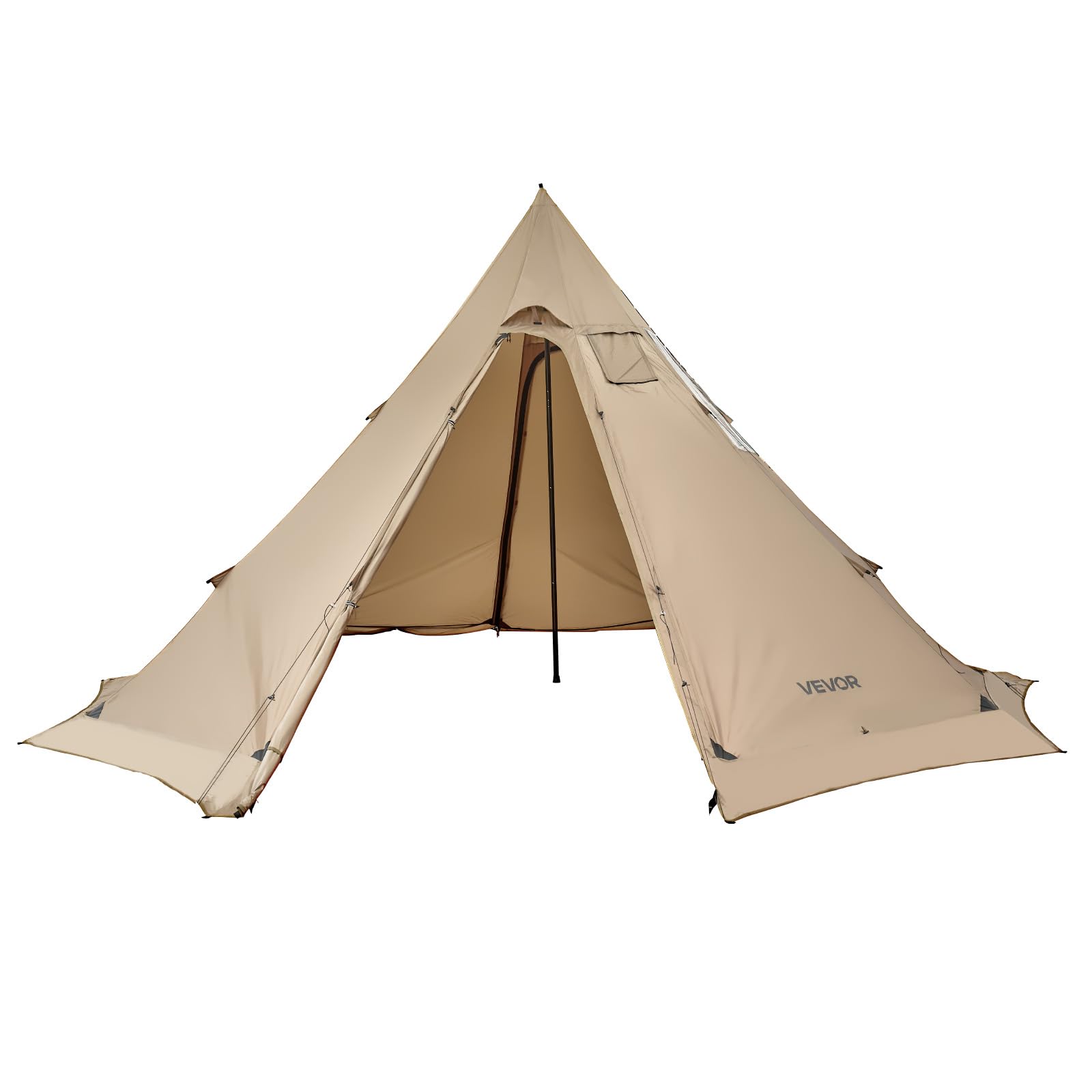
The VEVOR keeps things simple. One 28 mm aluminium pole raises a ten-sided pyramid with a 15.1 ft footprint and an 8 ft 6 in peak, and the whole shell packs to 9.7 lb, which is lighter than several smaller tents here. YKK zips and welded seams are better hardware than the price suggests.
For settled winter camping beside a vehicle it gives you more covered floor per dollar than anything else here, and the snow skirt and high jack placement show it is aimed at cold weather.
The caveat is important and it comes from VEVOR itself. The company states that the fabric is not spark-resistant and can be burned through by embers, and that the tent is not intended for heavy snow, torrential rain or strong winds. Take that at face value: run a spark arrestor, and do not plan a storm-season trip around this shell.
- 15.1 ft floor for only 9.7 lb
- YKK zips and welded seams
- Snow skirt and a high stove-jack position
- 20 stakes and 10 guy ropes included
- Single 28 mm aluminium pole keeps the pitch simple
- VEVOR states the fabric is not spark-resistant
- VEVOR states it is not intended for heavy snow or strong winds
- No floor, no inner mesh, and no published door or vent count
6. WaldWander Tipi Hot Tent
Bottom line: A 7 lb tipi with a foldable snow skirt and two roof vents. Buy it if two to four people want a light traditional shape rather than a large basecamp shell.
Key specs
- Peak height: 6 ft 11 in advertised, standing room for most adults
- Footprint: 13.1 ft advertised diameter, a two-cot layout
- Packed weight: 7 lb, light enough for a short approach
- Waterproof rating: 3,000 mm advertised on 68D ripstop
- Stove jack: One roof-mounted jack; diameter not published
The WaldWander sits between a cramped solo tipi and a full basecamp shell. Seven pounds is light enough to carry from a trailhead, and a 13.1 ft floor with a 6 ft 11 in peak is enough for two people, a stove and gear without anyone crawling.
The useful details are the foldable snow skirt and the two roof vents, which together let you tune the same tent for a mild autumn weekend or a cold, still night with the stove lit. The shell is a 68D 210T ripstop polyester with a PU coating.
One thing to know before you buy. WaldWander is an Amazon-only brand with no manufacturer site, and every published figure for this tent traces back to the listing itself, with no independent measurement anywhere. Sellers also disagree on whether it has one door or two, and on whether a floor is included.
- 7 lb, easy to carry from a trailhead
- 13.1 ft floor with standing room at the pole
- Foldable snow skirt for colder nights
- Two roof vents
- 68D 210T ripstop shell
- Every published figure traces back to the listing alone
- Sellers disagree on the door count and on whether a floor is included
- Amazon-only brand with no manufacturer support site
7. POMOLY Bromance 70 Tipi Hot Tent
Bottom line: Three stove jacks and four doors on one adjustable pole, so you decide where the stove and the walkway go. Buy it if the stove layout drives your camp.
Key specs
- Peak height: 8 ft 6 in on a nine-position adjustable pole
- Footprint: About 158 sq ft, an irregular octagon
- Packed weight: 10.3 lb with the centre pole included
- Waterproof rating: 2,000 mm with heat-taped seams
- Stove jack: Three, two upper plus one low for elbow pipe
The Bromance 70 earns its place on stove layout. Three jacks, not one: two set high for running a stove on either side, and one set low that accepts a 45 or 90 degree elbow, so the chimney can leave the wall instead of climbing through the middle of your living space. Chimneys up to 3.5 in fit.
Four doors in a cross arrangement mean you can always step out on the downwind side, and the five-section pole has nine height positions, which is genuinely useful when you are pitching on uneven or frozen ground. The snow skirt runs all eight sides.
Two things shape how it camps. Every vent is at the base, with nothing high to let warm moist air out, so condensation is the recurring theme among owners. And this listing is the bare shell: POMOLY markets 4 to 6 people for the version fitted with two inner tents, while the configuration sold here is rated 2 to 4 with no inner tent and no floor.
- Three stove jacks, including a low one for elbow pipe
- Four doors in a cross layout
- Nine-position adjustable centre pole
- Eight-sided snow skirt
- 70D ripstop with heat-taped seams
- This listing is the bare shell: no inner tent, no floor
- Vents are all at the base, so condensation collects
- 2,000 mm is on the low side for long wet spells
8. Preself 4-Season Tipi Hot Tent with Canopy
Bottom line: A tipi with zip-open canopy wings that turn into a porch or a big vent. Buy it if you spend long days at a vehicle camp and want covered outdoor space.
Key specs
- Peak height: Not published; Preself states 7+ ft of headroom
- Footprint: 13 ft wide, plus the canopy wings outside
- Packed weight: 12.5 lb including seven poles
- Stove jack: Included; count and diameter not published
The canopy is the whole point of this one. The wings unzip to make a covered porch you can cook or boot up under, or open the same panels to dump heat and moisture on a mild day, which gives you far more range than a sealed tipi.
Preself is unusually honest about the space: it rates the tent at 2 to 3 people, or 1 to 2 once a stove is inside. Treat it as a shelter for a couple with room for their gear, not a family tent. Seven poles also make it slower to pitch than a single-pole tipi, and Preself publishes neither a peak height nor a waterproof rating for this model.
- Canopy wings make a porch or a large vent
- Snow skirt and flame-retardant fabric
- Screened window for airflow and light
- 7075 aluminium centre pole
- Honest published capacity, stove included
- Peak height and waterproof rating are not published
- Seven poles make it slower to pitch than a single-pole tipi
- No footprint, stove or stove pipe included
9. Zoring Hot Tent
Bottom line: A 5,000 mm coated square tipi with 8.2 ft of standing room, at a budget-friendly price. Buy it if wet weather and interior room matter more than pack weight.
Key specs
- Peak height: 8.2 ft, comfortable standing room for adults
- Footprint: 13.1 x 13.1 ft square, easy to lay cots along
- Packed weight: 17.4 lb, the heaviest shelter in this list
- Waterproof rating: 5,000 mm PU, the highest rating here
- Stove jack: Included; count and diameter not published
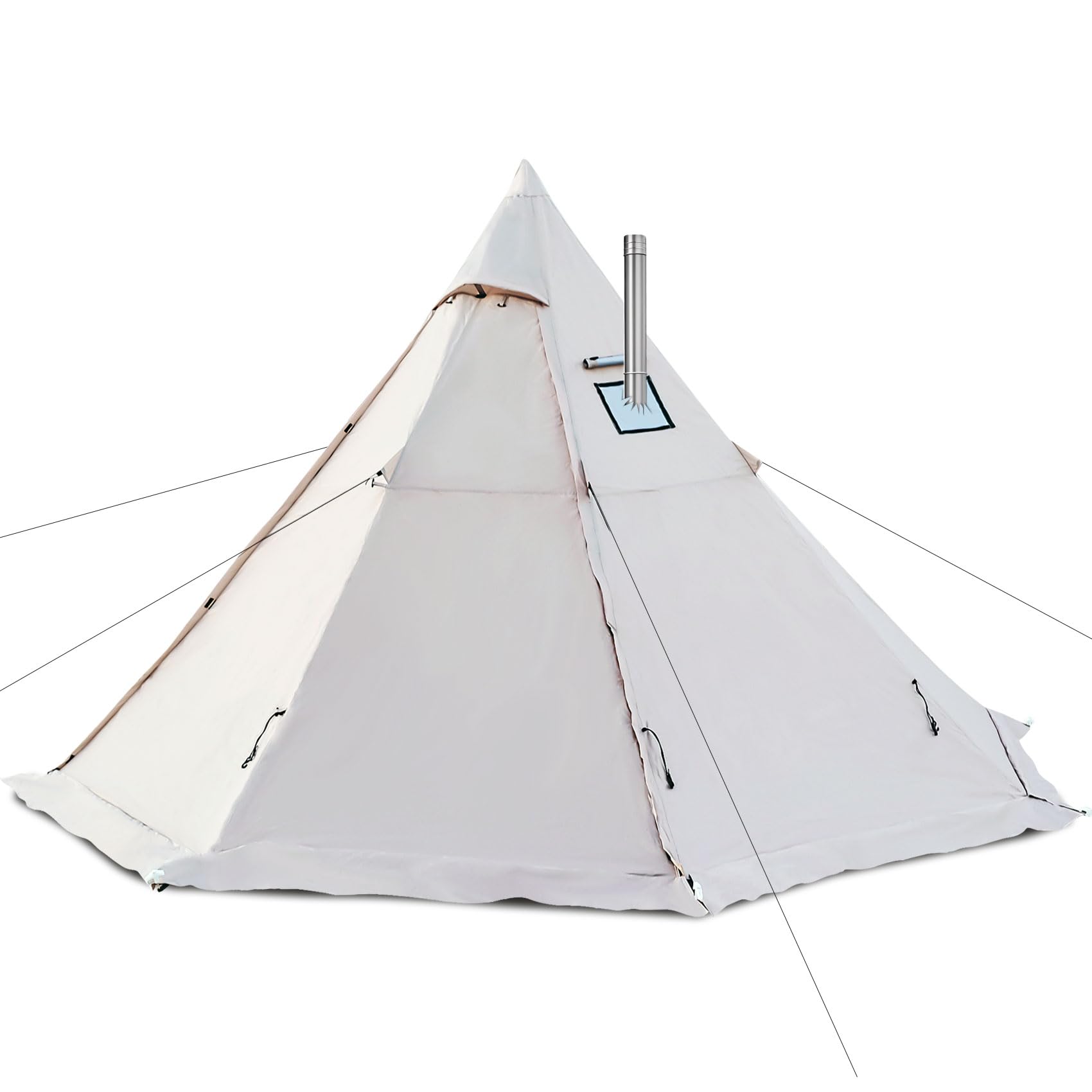
The Zoring is the wet-weather pick. Its 5,000 mm PU coating is the highest rating in this roundup by a wide margin, and that is the number that matters when you are camping in days of rain, sleet and thaw rather than dry cold.
The square 13.1 x 13.1 ft floor is easier to lay out than a circle: cots and gear go along the walls without wasted corners, and 8.2 ft at the pole gives adults real standing room. A snow skirt and dual vents complete an unusually full cold-weather spec for a budget-friendly tent.
The costs are weight and track record. At 17.4 lb it is the heaviest shelter here and strictly a vehicle-camping tent. Zoring also has no independent owner coverage at all outside marketplace listings, so nothing about it has been tested in public the way the OneTigris and POMOLY shells have.
- 5,000 mm coating, the highest here
- Square 13.1 ft floor is easy to lay out
- 8.2 ft of standing room
- Snow skirt and dual vents
- 210T tear-resistant shell
- 17.4 lb, the heaviest shelter here
- Inner tent is a separate purchase
- No independent owner track record outside marketplace listings
OneTigris Rock Fortress vs Zoring Hot Tent: Is the Upgrade Worth It?
These two solve the same problem from opposite ends. The OneTigris is the lighter, better-documented shelter with a shape built to handle wind; the Zoring is the bigger, drier, much heavier one that costs less.
- Wind versus water: the OneTigris decagon spreads load across ten short panels, while the Zoring answers with a 5,000 mm coating against the OneTigris 3,000 mm.
- Weight: 9.2 lb against 17.4 lb, which is the difference between a short carry and a strictly vehicle-side tent.
- Room: the Zoring gives you a square 13.1 ft floor and 8.2 ft of height; the OneTigris is 12.4 ft across and 7.8 ft at the pole.
- Track record: the OneTigris has years of owner reports on hunting and bushcraft forums; Zoring has none outside marketplace listings.
Which Tipi Hot Tent Should You Buy?
- One tent for most winter trips: get the OneTigris Rock Fortress Hot Tent.
- Camping with the family: get the Preself T3 XL Hot Tent.
- Carrying it yourself: get the Preself 4-Person Lightweight Tipi Hot Tent.
- A group sharing one shelter: get the FireHiking LEVA Plus Hot Tent.
- Spending as little as possible: get the VEVOR Tipi Hot Tent (Size L).
- Running two stoves or an elbow chimney: get the POMOLY Bromance 70 Tipi Hot Tent.
How We Chose
- Stove system first: we looked at jack count, placement and published dimensions, and whether the maker names a compatible stove, rather than treating a jack as proof of compatibility.
- Room that survives a stove: advertised occupancy is a maximum layout figure, so we judged each floor against cots, a clearance zone and a walkway to the door.
- Cold-weather detail: snow skirt, vent count and placement, waterproof coating, seam sealing and the amount of anchoring hardware in the box.
- Transport: packed weight and pitch complexity, split between shelters you can carry and shelters that belong beside a vehicle.
- Sources: manufacturer spec sheets and manuals first, then major retailers, plus CPSC recall records and owner discussion on forums outside the retail sites. No claim here comes from a hands-on test we did not do.
What to Look for in a Tipi Hot Tent
Stove Jack Size and Placement
Measure your chimney before you shop. Jacks in this class range from a small 3.3 in square panel to an 11.8 in panel, and POMOLY is the only maker here that publishes a maximum pipe diameter, at 3.5 in. Placement matters as much as size: a high jack keeps the hottest section of pipe away from the wall, while a low jack lets you run an elbow so the chimney leaves the shelter without crossing your living space. If you want that flexibility, the POMOLY Bromance 70 is the one built for it.
Ventilation and Carbon Monoxide
A wood stove burns the air inside the tent and produces carbon monoxide, so ventilation is a safety system, not a comfort feature. Look for a low inlet and a high outlet so air moves through rather than pooling. The FireHiking LEVA Plus is the clearest example here, with two closable low vents and two mesh vents up high. Shelters whose vents all sit at the base, like the Bromance 70, rely on you propping a door. Carry a carbon-monoxide alarm whatever you buy.
Real Capacity Once the Stove Is In
Take every person count as a maximum sleeping layout with no stove. Subtract the firebox, the clearance the maker specifies around it, a path to the door and your winter gear, and a four to six person tent usually becomes a comfortable two or three. Preself is unusually straight about this on the canopy model, rating it at two to three people or one to two once a stove is inside. Use that ratio as a rule of thumb for the rest.
Waterproof Rating, Snow Skirt and Seams
Coatings here run from 2,000 mm to 5,000 mm. For dry cold, 2,000 mm with taped seams is usually enough; for sleet, thaw and long coastal rain, the higher numbers earn their keep, which is why the Zoring stands out at 5,000 mm. A snow skirt cuts the draught around the hem and holds banked snow, but it is a draught control, not a substitute for the vents you need with a stove burning.
Weight and How Far You Are Carrying It
The spread in this roundup is wide: 5.6 lb for the Preself lightweight tipi against 17.4 lb for the Zoring. Anything under about 8 lb is realistic to carry a few miles with a stove. Past roughly 10 lb, treat the shelter as vehicle-based and spend the saved effort on cots, a proper stove and better anchors instead.
Anchoring for Snow and Frozen Ground
A tipi holds its shape through tension, so the anchors are structural rather than optional. Stock stakes are the first thing owners replace, and short pegs in particular let guy lines slip off under load. On snow, use deadman anchors, buried stuff sacks or snow stakes; on frozen soil, use longer steel pegs. Count the guy points on the shelter you buy and make sure you have hardware for all of them.
What Is Actually in the Box
Almost every tent here is floorless, and inner tents, footprints and floor mats are nearly always separate purchases. The FireHiking half inner tent is a paid add-on, the POMOLY listing in this roundup is the bare shell, and Preself sells its mesh inners and footprints as their own products. Read the included-items list on the exact variant you open, because colours, sizes and bundles share listings and change often.
Mistakes to Avoid When Buying a Tipi Hot Tent
- Trusting the person count: plan the floor around a stove, cots and an exit path, then choose the size.
- Assuming any stove fits the jack: match the pipe diameter and the jack opening, and follow the clearances both makers specify.
- Sealing the tent to stay warm: closing every vent with a stove lit is how carbon monoxide builds. Keep the airflow path open.
- Camping on the stock stakes: budget for proper anchors before the first winter trip, not after one fails.
- Buying on a photo: marketing images often show the inner tent, footprint or stove that the listing does not include.
FAQs
Can You Use a Stove Inside a Tipi Tent?
Only in a shelter built for it, and only with a compatible chimney system. Follow both makers’ instructions on jack placement, heat shielding, clearances and ventilation. Keep anything flammable away from the firebox, keep a clear path to the door, fit a spark arrestor, carry a carbon-monoxide alarm and a fire extinguisher, and never leave a burning stove unattended.
How Many People Will Really Fit?
Advertised capacity assumes sleeping pads packed side by side with almost no gear. For hot-tent camping, subtract the stove, the clearance around it, a walkway and your winter kit. A shelter sold for four to six people is usually comfortable for two or three once a stove is running, which is roughly the ratio Preself itself publishes for its canopy model.
What Size Stove Jack Do You Need?
Match the jack to your chimney, not the other way round. Most tent stoves in this class run a 2.5 to 3.5 in pipe, and POMOLY is the only maker here publishing a maximum, at 3.5 in. OneTigris sizes its 3.3 in square panel around its own stove system. If a listing does not state a dimension, measure the jack opening on arrival before you buy a stove.
Is a Floorless Hot Tent Better for a Wood Stove?
Usually yes. With no sewn-in floor there is nothing flammable under the firebox, snow camping and muddy boots are simpler, and you can level the ground where the stove sits. The trade is less separation from insects, mud and ground moisture. If you add a footprint, floor mat or inner tent, keep it outside the clearances the maker specifies unless they approve a specific arrangement.
How Do You Stop Condensation in a Hot Tent?
You manage it rather than stop it. Single-wall shelters collect moisture from breath, wet gear and the ground, and it is worst on still, cold nights. Keep a low inlet and a high outlet open so air moves through, dry boots and clothing outside the shelter where you can, and pitch on snow or dry ground rather than damp soil. Shelters with only low vents, like the Bromance 70, need a door propped.
Do You Need a Snow Skirt?
It helps in windblown snow. A skirt cuts the draught around the hem and holds banked snow or rocks to seal the perimeter, which makes a real difference in spindrift. It is not a substitute for ventilation: with a stove burning, keep the required vents and airflow paths open even with the skirt deployed. Most shelters here have one, though the lightest Preself does not.
Can You Leave a Tent Stove Burning Overnight?
No. Stove makers and tent makers both tell you not to leave a burning stove unattended, and the risks are carbon monoxide, embers through the canopy and a chimney too close to fabric. Most hot-tent campers run the stove to warm the shelter, then let it burn down and sleep in a bag rated for the conditions, with a carbon-monoxide alarm on.
How Should You Prepare a Hot Tent for Winter?
Pitch it once at home before the trip so you are not learning the pole and guy layout in the dark. Inspect the seams and the stove jack, test the stove and chimney combination outdoors, and pack anchors suited to the ground you expect. At camp, keep vents and exits clear, knock accumulating snow off the canopy, and dry the shelter fully before you store it.
Final Verdict
Across nine shelters, the OneTigris Rock Fortress Hot Tent is the one that asks the least of you and gives back the most: a single-pole pitch, a shape that handles wind, and a stove-ready spec that does not need upgrading before the first trip. Nothing here is recall-affected, and every listing was live when we checked.
If the budget is tighter, the Zoring Hot Tent gives you the highest waterproof rating here and 8.2 ft of standing room for a vehicle camp, and the Preself 4-Person Lightweight Tipi Hot Tent is the one to take when you are carrying the shelter yourself. Whichever you choose, confirm the exact variant, the included items and the stove-jack dimensions on the listing before you order, because package contents in this category change often.