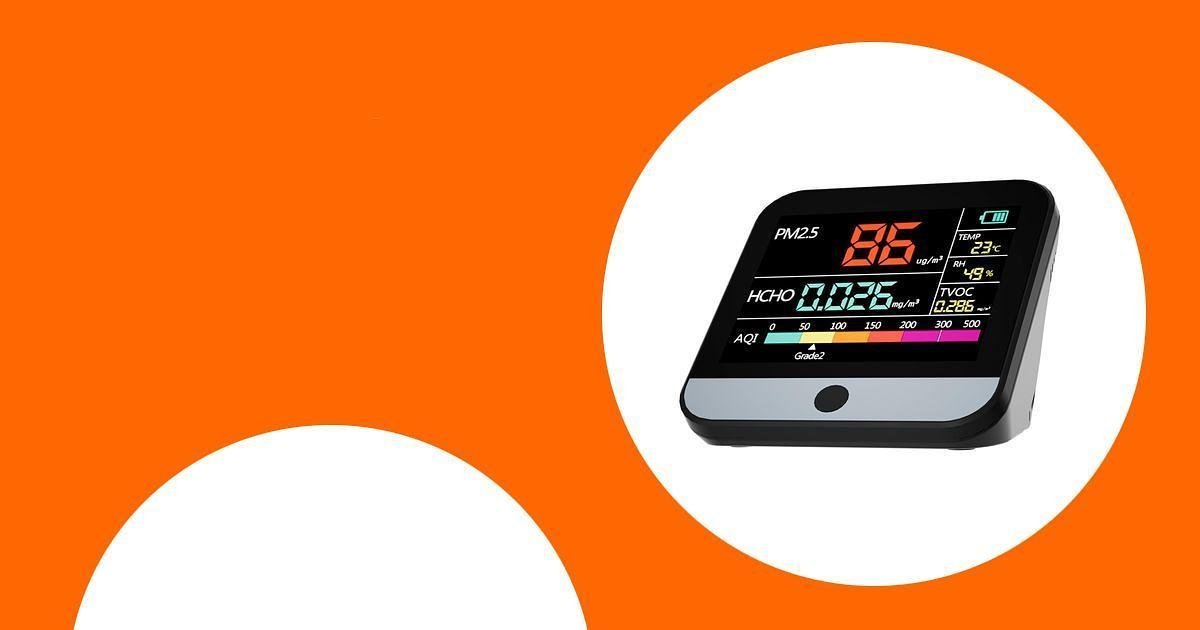
Understanding your indoor air quality can help you make better decisions about ventilation, filtration, humidity control, and radon testing. A smart or portable air quality monitor gives you a clearer view of what may be happening inside your home, whether you are tracking CO2 during gatherings, checking particle levels after cooking, watching humidity, or keeping an eye on radon in a basement.
The best choice depends on what you want to measure. Some monitors focus on broad particle and gas screening, while others specialize in CO2 or radon. This guide keeps the recommendations focused on three practical indoor air monitoring needs so you can choose the device that fits your home, office, or travel routine.
This roundup is reader-supported. When you click through links, we may earn a referral commission on qualifying purchases. As an Amazon Associate I earn from qualifying purchases.
Quick Verdict
Choose the 13 in 1 Air Quality Tester if you want one portable screen for particle readings, humidity, TVOC, temperature, and formaldehyde trend checks.
Choose the SAF Aranet4 Home if your main concern is CO2 and ventilation. It is the strongest fit for homes, offices, classrooms, and shared indoor spaces.
Choose the SAF Aranet Radon Detector if you specifically want to monitor radon levels in a basement, lower floor, older home, or property you are preparing to sell.
Top Picks
- Best Multi-Sensor Pick: 13 in 1 Air Quality Tester for Home
- Best for CO2 Monitoring: SAF Aranet4 Home: Wireless Indoor Air Quality Monitor
- Best for Radon Detection: SAF Aranet Radon Detector for Home
Selection Criteria
When selecting a smart air quality monitor, focus on the pollutants or conditions you actually want to track. CO2 monitors are useful for ventilation decisions. PM2.5 and PM10 readings help you watch particle trends from smoke, dust, and cooking. TVOC and formaldehyde readings can help you spot chemical off-gassing trends, while radon detectors are specialized tools for long-term radon awareness. Also compare display quality, app history, battery life, calibration needs, portability, and how easy the monitor is to place in a useful location.
Before You Buy
- Know your main concern: CO2, particles, VOCs, formaldehyde, humidity, and radon are different measurements. One device may not cover them all.
- Check the sensor limits: Consumer monitors are helpful for trends, but they are not replacements for certified lab testing or professional inspections.
- Think about placement: Keep monitors away from direct sunlight, vents, open windows, and steam so readings are more consistent.
- Look for history tracking: App graphs and stored data make it easier to see patterns across a day, week, or month.
- Plan your response: A monitor is most useful when you act on the readings by improving ventilation, using filtration, managing humidity, or arranging follow-up testing when needed.
13 in 1 Air Quality Tester for Home

The 13 in 1 Air Quality Tester is the most flexible pick if you want one portable device for checking several indoor air quality indicators. It is designed to show readings such as PM1, PM2.5, PM10, AQI, humidity, TVOC, temperature, and formaldehyde. That makes it useful for quick spot checks after cooking, cleaning, painting, renovation work, wildfire smoke events, or seasonal allergy flare-ups.
Its biggest advantage is breadth. Instead of focusing on one measurement, it gives you a broader snapshot of your indoor environment. The tradeoff is that consumer-grade multi-sensor monitors should be treated as trend tools, especially for VOC and formaldehyde readings. If you need certified results for a lease, workplace, health investigation, or real estate decision, use professional testing.
Best For
- Homes where you want a broad indoor air quality snapshot
- People who want particle, humidity, TVOC, temperature, and formaldehyde trend readings in one device
- Spot checks after cleaning, painting, new furniture, cooking, smoke, or renovation work
Buyer Feedback Themes
Buyers tend to like the easy-to-read display and the wide range of measurements. The main hesitation is that the device may need a warm-up period before readings settle, so it is better for trend awareness than instant pass-or-fail decisions.
Pros and Cons
Pros:
- Tracks several indoor air quality indicators in one portable device
- Clear display for quick room checks
- Useful for particle, humidity, TVOC, temperature, and formaldehyde trend awareness
Cons:
- Requires a warm-up period for steadier readings
- Not the best choice if you need certified lab-level measurements
- Smart app features are not as clear as dedicated connected monitors
Key Benefits
- Broad multi-sensor monitoring for everyday indoor air checks
- Portable design for moving between rooms
- USB-C charging for convenient home use
Who Should Buy This
Choose this monitor if you want a simple screen that helps you compare air quality trends from room to room. It is especially useful if you want a broad view instead of a single-purpose CO2 or radon device.
Who Should Avoid This
Skip it if you need advanced app history, certified testing, or a monitor focused on one measurement with deeper accuracy documentation.
When to Use It
Use it in living rooms, bedrooms, home offices, garages, and recently renovated spaces. It can also be helpful during allergy season, wildfire smoke periods, or after using strong-smelling cleaners.
Check Product Details on Amazon
SAF Aranet4 Home

The SAF Aranet4 Home is the best fit if your main goal is CO2 monitoring. CO2 levels are often used as a practical indicator for ventilation in occupied indoor spaces. This monitor measures CO2, temperature, relative humidity, and atmospheric pressure, and it uses a clear e-ink display that is easy to read without bright lights.
It is especially useful in bedrooms, classrooms, home offices, meeting rooms, and shared spaces where ventilation can change quickly. The app helps you review historical data, which is helpful because a single reading is less useful than seeing how CO2 rises and falls over time. This is not a particle, VOC, formaldehyde, or radon monitor, so choose it for ventilation awareness rather than all-in-one air testing.
Best For
- CO2 and ventilation tracking
- Bedrooms, offices, classrooms, meeting rooms, and shared indoor spaces
- People who want app history and a readable e-ink display
Buyer Feedback Themes
Buyers often highlight the clear display, compact design, long battery life, and useful app graphs. The main limitation is that calibration and placement matter, and Bluetooth range may not be enough for every home layout.
Pros and Cons
Pros:
- Strong choice for CO2-focused indoor air monitoring
- Portable and battery powered
- E-ink display is easy to read and not distracting at night
- App history helps you understand ventilation patterns over time
Cons:
- Calibration may be needed for best accuracy
- Does not measure PM2.5, VOCs, formaldehyde, or radon
- Bluetooth-only connectivity may limit remote checking
Key Benefits
- Real-time CO2, temperature, humidity, and pressure monitoring
- Portable design with long battery life
- User-friendly app for reviewing air quality trends
Who Should Buy This
Choose the Aranet4 Home if you want a dependable CO2 monitor that helps you decide when to open windows, adjust ventilation, or reduce crowding in a room.
Who Should Avoid This
Skip it if you need particle, VOC, formaldehyde, or radon readings. It is excellent for CO2, but it is not a complete indoor pollutant monitor.
When to Use It
Use it during work, sleep, gatherings, classes, or travel in enclosed spaces. It is especially helpful when you want to see whether CO2 builds up over time and whether ventilation changes improve the room.
Check Current Amazon Availability
SAF Aranet Radon Detector for Home

The SAF Aranet Radon Detector is the specialized pick for homes where radon is the main concern. Radon can vary by region, foundation type, season, and ventilation pattern, so a continuous monitor can help you watch short-term and longer-term trends instead of relying on one quick reading.
This detector measures radon and also tracks temperature, relative humidity, and atmospheric pressure. The e-ink display is simple to read, and the app gives you a better way to review changes over time. It is a strong option for basements, lower-level rooms, older homes, and real estate preparation, but it should not be treated as a full replacement for other air quality monitors because it does not measure CO2, PM2.5, VOCs, or formaldehyde.
Best For
- Radon-specific monitoring
- Basements, lower floors, older homes, and regional radon concern areas
- Homeowners who want trend data before deciding whether follow-up testing or mitigation guidance is needed
Buyer Feedback Themes
Buyers often like the straightforward setup, readable display, and app-based trend tracking. The most common limitation is Bluetooth range, which may require you to be near the device to sync data.
Pros and Cons
Pros:
- Purpose-built for radon monitoring
- Tracks radon along with temperature, humidity, and pressure
- Portable design with app-based data history
- Long battery life for continuous monitoring
Cons:
- Bluetooth range is limited
- Not a general PM, VOC, CO2, or formaldehyde monitor
- Radon decisions may still require local guidance or professional follow-up testing
Key Benefits
- Continuous radon measurement with frequent updates
- Portable design for testing different rooms
- Supports multiple radon units and app-based trend review
Who Should Buy This
Choose this monitor if you want a dedicated radon detector for a basement, lower floor, real estate check, or long-term home awareness.
Who Should Avoid This
Skip it if your main concern is CO2, smoke particles, VOCs, or formaldehyde. For those concerns, choose a CO2 monitor or a multi-sensor air quality tester instead.
When to Use It
Use it in basements, lower-level bedrooms, crawl-space-adjacent rooms, and homes in areas where radon is a known concern. Review longer-term averages rather than reacting to one isolated reading.
Check Product Details on Amazon
How to Choose the Right Air Quality Monitor
| 13 in 1 Air Quality Tester | SAF Aranet4 Home | SAF Aranet Radon Detector | |
|---|---|---|---|
|
|
|
 |
|
| Best For | Broad indoor air quality trend checks | CO2 and ventilation tracking | Radon-specific monitoring |
| Measures | PM1, PM2.5, PM10, AQI, humidity, TVOC, temperature, and formaldehyde trend readings. | CO2, temperature, relative humidity, and atmospheric pressure. | Radon, temperature, relative humidity, and atmospheric pressure. |
| Pros | Wide range of readings, portable design, easy-to-read display. | Battery powered, compact, e-ink display, app history, strong CO2 focus. | Dedicated radon monitoring, portable design, app integration, long battery life. |
| Cons | Consumer-grade readings are best used for trends, and warm-up time may be needed. | Focused on CO2, so it does not measure particles, VOCs, formaldehyde, or radon. | Radon-specific device, limited Bluetooth range, and not a general IAQ monitor. |
| Check Product Details on Amazon | Check Current Amazon Availability | Check Product Details on Amazon |
FAQ
What Should I Consider When Buying a Smart Air Quality Monitor?
Start with the measurement you care about most. Choose CO2 if you want ventilation guidance, PM2.5 and PM10 if you care about particles from smoke, dust, or cooking, VOC and formaldehyde readings if you want chemical off-gassing trend awareness, humidity if comfort and moisture are concerns, and radon if your home or region has radon risk. Also compare display clarity, calibration needs, battery life, app history, data export, and portability.
How Do I Use a Smart Air Quality Monitor Effectively?
Place the monitor where you spend time, but keep it away from vents, open windows, direct sunlight, humidifiers, cooking steam, and cleaning spray. Watch patterns instead of reacting to one reading. If CO2 rises, improve ventilation. If particles rise, check cooking, smoke, dust, or filtration. If humidity stays high, look for moisture sources. If radon readings remain elevated, follow local guidance and consider professional testing or mitigation advice.
Are Air Quality Monitors Always Accurate?
No consumer monitor is perfect. Accuracy can vary by sensor type, calibration, placement, temperature, humidity, and the pollutant being measured. Use these devices to understand trends and decide when to take practical action. For legal, medical, workplace, or real estate decisions, use certified tests or qualified professionals.
Which Monitor Is Best for CO2?
The SAF Aranet4 Home is the strongest pick here for CO2 because it focuses on CO2, temperature, humidity, and pressure while giving you an easy-to-read display and app history. It is a better CO2 choice than a broad multi-sensor tester if ventilation tracking is your main goal.
Which Monitor Is Best for Radon?
The SAF Aranet Radon Detector is the best fit in this roundup if radon is your main concern. It is made for radon trend monitoring and is useful for basements, lower levels, older homes, and properties where radon awareness is important.
Do I Still Need an Air Purifier?
A monitor does not clean the air. It only helps you see readings and trends. If particle levels are high, an air purifier with the right filter size for your room may help. If CO2 is high, ventilation is usually the issue. If radon is high, filtration is not the normal fix, so follow local radon guidance.
Final Recommendation
If you want the broadest snapshot, the 13 in 1 Air Quality Tester for Home gives you the widest range of readings in one portable device. If you care most about ventilation, the SAF Aranet4 Home is the best match because it focuses on CO2 and makes trends easy to review. If radon is your concern, the SAF Aranet Radon Detector for Home is the right specialized pick.
The best air quality monitor is the one that matches the action you are willing to take. Choose a device that measures your main concern, place it carefully, review trends over time, and use the readings to guide ventilation, filtration, humidity control, or radon follow-up.
This Roundup is reader-supported. When you click through links we may earn a referral commission on qualifying purchases.