
You need a Weldpro welder that matches the metals, repairs and shop setup you actually use. A good multi-process or AC/DC TIG machine can help you handle aluminum, stainless, mild steel, repair work and small fabrication without buying equipment you do not need.
In this guide, you’ll find four distinct Weldpro welders that balance versatility, control, portability and value. Some are TIG-focused machines for cleaner aluminum and stainless work, while others add MIG, flux-core, stick and spool-gun compatibility for broader home-shop use.
This roundup is reader-supported. When you click through Amazon links, we may earn a referral commission on qualifying purchases. As an Amazon Associate I earn from qualifying purchases.
Quick Verdict
Best overall multi-process pick: Choose the Weldpro OMNI210 if you want MIG, flux-core, stick and AC/DC TIG capability in one machine.
Best precision TIG pick: Choose the Weldpro TIGACDC250GD if your priority is higher TIG output, AC/DC control, pulse adjustment and repeatable saved settings.
Best home-shop MIG pick: Choose the Weldpro MIG210LCD if you mainly want a dual-voltage MIG and flux-core machine with Stick and Lift TIG flexibility.
Best value AC/DC TIG pick: Choose the Weldpro TIG200ACDCGD if you mainly want aluminum-capable AC/DC TIG without stepping up to the larger TIG250 platform.
Top Picks
|
Category |
Product |
Best For |
|---|---|---|
|
🏆 Best Overall Multi-Process |
Mixed MIG, TIG, flux-core and Stick work |
|
|
🎯 Best Precision TIG |
Higher-output AC/DC TIG and repeatable setups |
|
|
💰 Best Value AC/DC TIG |
Aluminum, stainless and precision TIG work |
|
|
🧰 Best For Home Shops |
MIG, flux-core and everyday repair work |
How We Chose These Welders
You want a welder that fits your power supply, materials and skill level. We prioritized process flexibility, AC/DC capability for aluminum TIG, MIG and spool-gun support where applicable, pulse controls, duty-cycle awareness, cooling requirements, included accessories, dual-voltage operation, portability and overall usefulness.
We also looked at practical buying differences such as control layout, display design, TIG foot-pedal support, accessory requirements and whether a machine is focused on TIG precision or faster wire-feed work. Instead of treating different accessory packages of the same power source as separate welders, this comparison focuses on distinct machines with meaningfully different use cases.
Before You Buy
- Check your power: Dual-voltage machines can handle lighter work on household power, but their highest output generally requires the appropriate 220/240 V circuit.
- Match the process to the metal: AC TIG is the key mode for aluminum TIG, while DC TIG is commonly used for steel and stainless. Aluminum MIG normally requires the correct spool-gun setup.
- Confirm what is included: “Spool-gun compatible” or “spool-gun ready” does not mean the spool gun is automatically included.
- Check the duty cycle: Higher-amperage welding may require cooling periods. Match your work pace to the machine’s rated duty cycle.
- Plan for consumables: Budget for tungsten, filler rod or wire, contact tips, nozzles, cups, shielding gas and proper PPE.
- Check the live listing: Accessory bundles, sellers, warranty terms and availability can change, so verify the exact package before ordering.
Safety Note: Welding involves electrical, heat, UV-light and fume hazards. Use the correct circuit and grounding, wear suitable welding PPE, provide adequate ventilation and follow the manufacturer’s manual for setup, duty cycle, torch cooling and operating limits.
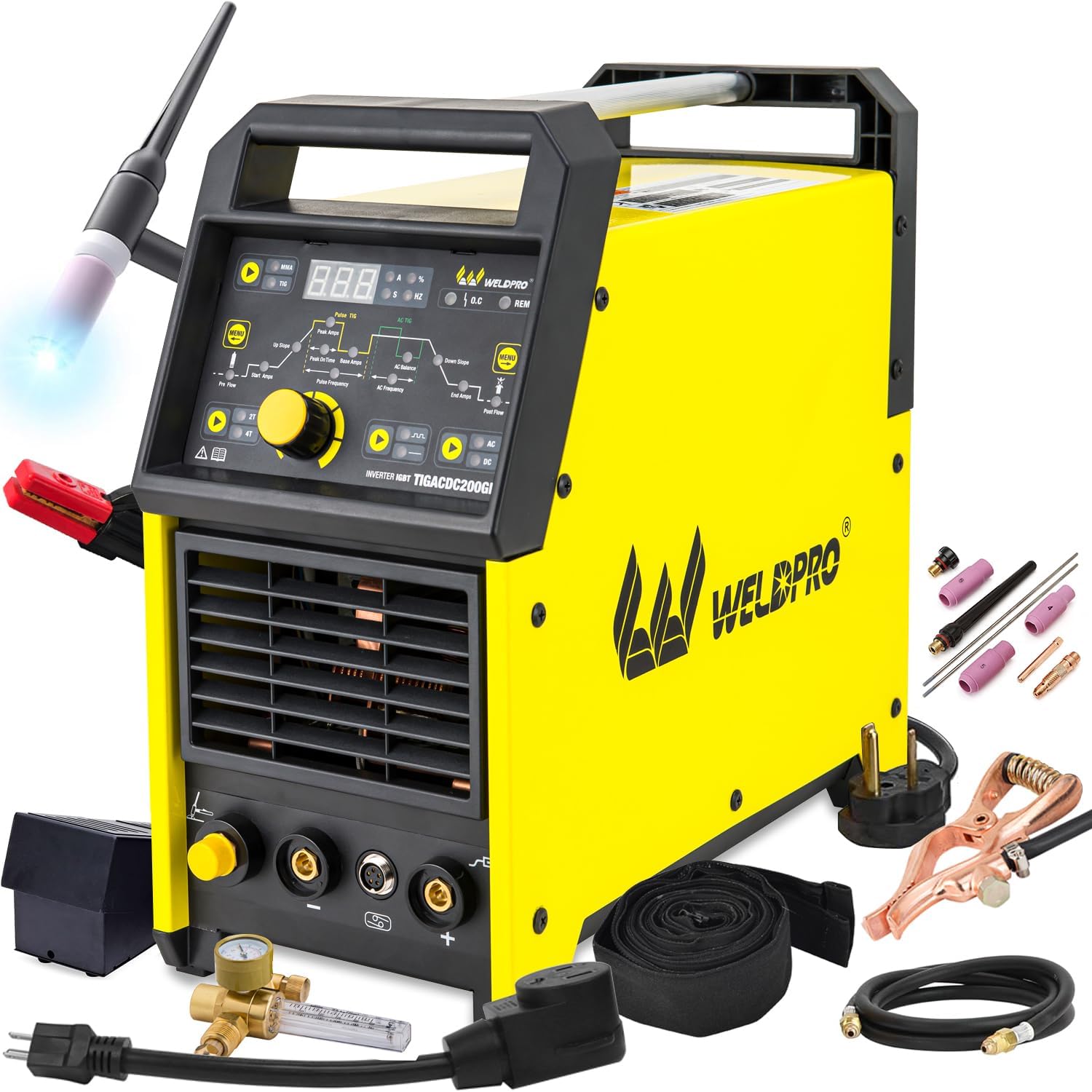
The Weldpro TIG200ACDCGD is a strong fit if your projects lean toward aluminum TIG, stainless, mild steel and controlled bench work. It provides AC/DC TIG, pulse adjustment and Stick capability, so you can move from precision TIG work to electrode welding without changing power sources.
Its main advantage is adjustability. The digital controls let you work with AC balance, AC frequency, pulse settings and other TIG parameters, while the foot pedal provides variable amperage control. Weldpro lists dual-voltage 120/240 V operation and a 40% duty cycle at 200A for the power source.
This is not the right choice if your main priority is fast wire-feed fabrication. For buyers who primarily want MIG or flux-core welding, the MIG210LCD or OMNI210 is a better match.
Buyer Feedback & Practical Considerations
Buyer sentiment can change over time, so treat the chart below as a directional snapshot rather than a current star rating or review-count claim. Before buying, check recent listing feedback for shipping condition, accessory completeness, setup experience and long-term reliability.
Overall Sentiment Snapshot: Positive

Who Should Buy This
- Home-shop welders who want AC/DC TIG without moving to a larger TIG platform
- Users who work with aluminum, stainless and mild steel
- Buyers who value pulse adjustment and foot-pedal amperage control
Who Should Avoid This
- Anyone who mainly needs MIG speed for repeated wire-feed work
- Buyers specifically looking for an included aluminum MIG spool gun
- High-volume production users who need substantially longer continuous high-output operation
Key Benefits
- AC/DC TIG plus Stick capability
- Full pulse controls for managing heat input
- Adjustable AC balance and AC frequency for aluminum TIG setup
- Dual-voltage 120/240 V operation
- Foot-pedal amperage control
- Compact 31 lb power source listed by Weldpro
Check Product Details on Amazon

The Weldpro MIG210LCD is the most straightforward choice here if your day-to-day work involves mild-steel repairs, brackets, automotive patches, small fabrication or flux-core welding. It focuses on MIG/FCAW first, then adds DC Stick and Lift TIG for extra flexibility.
The full-color LCD and auto-set menu can reduce setup guesswork by helping establish starting parameters for the selected process, gas, electrode and material thickness. You can then fine-tune MIG voltage and wire speed independently.
Important aluminum note: Weldpro lists the compatible SB8 spool gun as an optional accessory sold separately. If aluminum MIG is part of your plan, confirm the spool gun and other required accessories before ordering.
Buyer Feedback & Practical Considerations
Use the sentiment chart below as a directional snapshot, not a current rating. Check recent live-listing feedback for wire-feed setup, accessory completeness, display operation and reliability before making your final decision.
Overall Sentiment Snapshot: Positive

Who Should Buy This
- Home-shop users who primarily want MIG and flux-core welding
- Beginners who appreciate a visual display and guided starting settings
- Buyers who want dual-voltage flexibility for garage and shop use
Who Should Avoid This
- Welders who need full AC TIG for aluminum TIG work
- Buyers who assume an aluminum spool gun is included
- Users who need advanced TIG pulse, AC balance and AC frequency controls
Key Benefits
- MIG/FCAW, DC Stick and Lift TIG capability
- Dual-voltage 120/240 V operation
- Full-color LCD with auto-set menu
- Optional spool-gun support for aluminum MIG
- MIG spot timer, inductance and run-in speed adjustments
- 30% duty cycle at full output on 240 V as specified by Weldpro
Check Product Details on Amazon
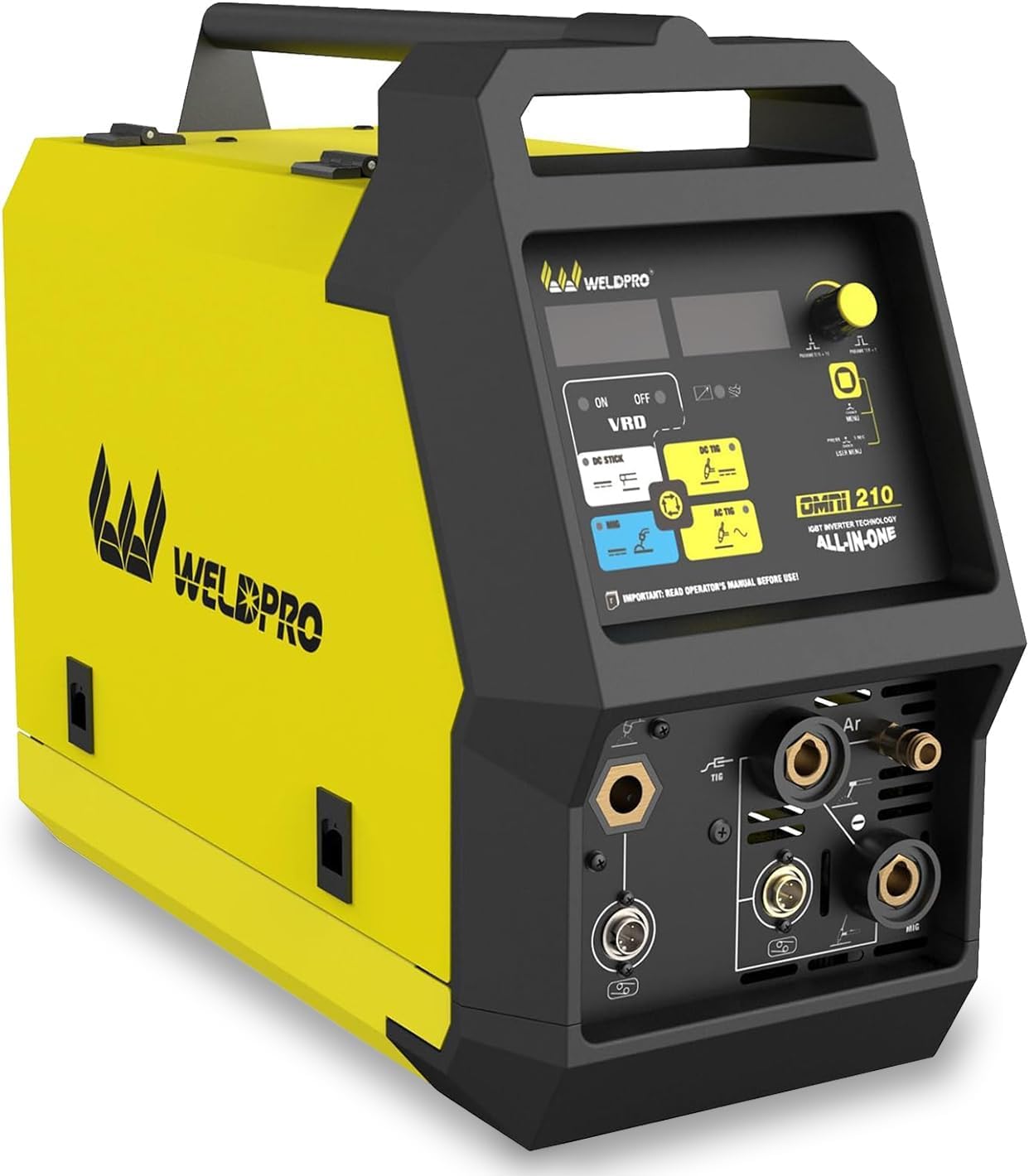
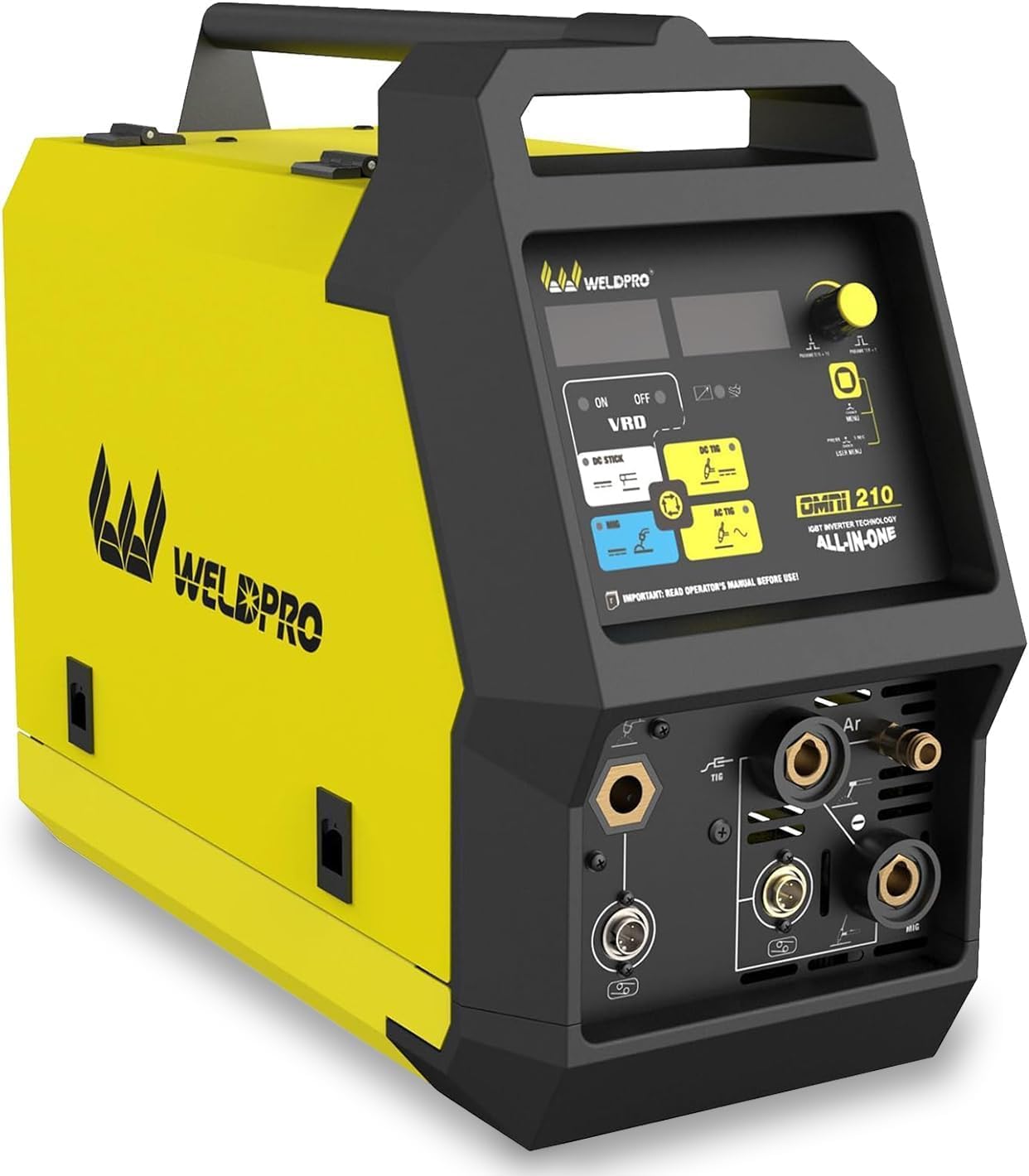
The Weldpro OMNI210 is the strongest fit if you want one machine to cover the widest range of welding processes in this comparison. It combines MIG and flux-core productivity with DC Stick and AC/DC TIG capability, giving mixed-process users more room to handle different metals and project types.
On 240 V power, Weldpro specifies up to 200A output across its major welding processes, with separate output ranges for MIG, Stick, AC TIG and DC TIG. The machine also uses digital auto-set controls to help establish starting settings.
The tradeoff is complexity. If you will only use MIG or flux-core, the MIG210LCD is simpler. If nearly all your work is precision TIG, a dedicated TIG200 or TIG250 platform may provide a more focused setup.
Buyer Feedback & Practical Considerations
The chart below should be treated as a directional sentiment snapshot rather than a current star rating. Check recent buyer feedback and the current listing for included TIG accessories, spool-gun requirements, shipping condition and setup details.
Overall Sentiment Snapshot: Positive

Who Should Buy This
- Users who want MIG, flux-core, Stick and AC/DC TIG capability in one machine
- Home fabricators who regularly switch between steel, stainless and aluminum projects
- Buyers who want AC/DC TIG without giving up wire-feed capability
Who Should Avoid This
- Beginners who only need straightforward flux-core or MIG welding
- Buyers prioritizing the smallest and simplest portable setup
- Users who prefer a dedicated TIG machine instead of a multi-process platform
Key Benefits
- MIG/FCAW, DC Stick and AC/DC TIG in one power source
- Dual-voltage 120/240 V design
- Digital auto-set controls for process setup
- Foot-amperage control support for TIG work
- Useful choice for mixed-process home fabrication
- 30% duty cycle at full output on 240 V as specified by Weldpro
Check Product Details on Amazon

The Weldpro TIGACDC250GD is the most TIG-focused, higher-output machine in this roundup. It is aimed at users who care about arc control, pulse tuning, AC balance, AC frequency and repeatable settings more than simple wire-feed productivity.
Weldpro specifies a TIG range up to 250A, with 250A TIG output at a 30% duty cycle on 230/240 V input. It also provides AC/DC Stick operation and 10 memory locations for saving frequently used settings.
If you weld aluminum frequently, repeat similar jobs or simply want more TIG headroom than a 200A machine provides, this is the stronger precision choice. It is more machine than many first-time hobbyists need, and TIG-focused buyers should also check the exact torch package before ordering.
Buyer Feedback & Practical Considerations
The chart below is best used as a directional snapshot rather than a live rating. Check current feedback for torch-package preferences, shipping condition, cooling requirements and accessory completeness before buying.
Overall Sentiment Snapshot: Positive

Who Should Buy This
- TIG-focused users who weld aluminum, stainless and mild steel
- Buyers who want memory presets for repeated welding setups
- Users who want more TIG output headroom than the TIG200ACDCGD provides
Who Should Avoid This
- Buyers who mainly need MIG or flux-core welding
- Beginners who want the simplest possible first welder
- Users who prioritize a lightweight machine for frequent transport
Key Benefits
- AC/DC TIG and AC/DC Stick capability
- Up to 250A TIG output on suitable input power
- Pulse, AC balance and AC frequency controls
- 10 memory locations for repeatable setups
- Dual-voltage 120/240 V operation
- 30% TIG duty cycle at 250A on 230/240 V input
Check Product Details on Amazon
Which Weldpro Welder Fits Your Work?
Choose the OMNI210 if you regularly switch between MIG, flux-core, Stick and AC/DC TIG and want to keep those processes in one machine.
Choose the TIGACDC250GD if TIG is your main process and higher output, pulse adjustment, AC controls and saved settings matter more than MIG capability.
Choose the TIG200ACDCGD if you want a more compact AC/DC TIG setup for aluminum, stainless and steel without paying for capabilities you may not use.
Choose the MIG210LCD if most of your work is general repair, mild-steel fabrication, automotive patches, MIG or flux-core welding and you only need occasional Lift TIG.
FAQ
How Do I Choose The Right Weldpro Welder?
Start with the process you will use most. If you mostly repair mild steel, brackets, gates and automotive patches, a MIG-centered machine like the MIG210LCD is easier to live with. If you want controlled aluminum and stainless TIG welds, choose an AC/DC TIG machine such as the TIG200ACDCGD or TIGACDC250GD. If you genuinely use several welding processes, the OMNI210 offers the broadest flexibility here.
Also check input power, breaker capacity, duty cycle, torch type, included accessories, shielding-gas requirements and whether any aluminum MIG accessories are included or sold separately.
Can These Welders Handle Aluminum?
Yes, but the method and setup matter. The TIG200ACDCGD, OMNI210 and TIGACDC250GD provide AC TIG capability for aluminum TIG work. The MIG210LCD can be configured for aluminum MIG with a compatible optional spool gun. Always confirm the correct shielding gas, filler material, torch or spool-gun setup and metal preparation for the process you plan to use.
What Is The Difference Between The TIG200ACDCGD And MIG210LCD?
The TIG200ACDCGD is a TIG-focused machine with AC/DC capability, making it the better choice for aluminum TIG and more precise torch control. The MIG210LCD is MIG-focused, making it more convenient for faster wire-feed fabrication, flux-core repairs and general home-shop work. Its TIG function is Lift TIG rather than full AC/DC TIG.
Is The OMNI210 Worth It Over The MIG210LCD?
The OMNI210 is worth considering when you want MIG/FCAW productivity and true AC/DC TIG capability in one power source. The MIG210LCD is the simpler choice when most of your work is MIG, flux-core, Lift TIG and Stick. If you will not use AC TIG, paying for the OMNI210’s broader process range may not make sense.
TIG200ACDCGD Or TIGACDC250GD: Which Is Better?
The TIG200ACDCGD makes more sense for many home-shop users who want AC/DC TIG, pulse controls and a lighter power source. The TIGACDC250GD is the stronger choice when you need more TIG output, memory presets and additional headroom for demanding TIG work. Your available input power and typical material thickness should guide the decision.
Do I Need 240 V Power?
These machines offer dual-voltage flexibility, but their maximum welding output is generally available only on the higher-voltage input. Household 120 V power can be useful for lighter jobs, while higher-amperage work requires an appropriately sized 220/240 V circuit. Check the manual and circuit requirements before setup.
Does The MIG210LCD Include A Spool Gun?
Do not assume it does. Weldpro lists its compatible aluminum spool gun as an optional accessory sold separately. Check the current Amazon package contents before ordering if aluminum MIG is important to you.
What Safety Gear Should I Use?
Use a properly rated welding helmet, welding gloves, flame-resistant clothing, appropriate eye protection and suitable footwear. Maintain safe grounding and adequate ventilation, protect nearby people from arc exposure, and follow the machine manual and local electrical and workplace-safety requirements.
Final Recommendation
For the widest process range: choose the Weldpro OMNI210.
For the strongest TIG-focused setup in this comparison: choose the Weldpro TIGACDC250GD.
For value-focused AC/DC TIG: choose the Weldpro TIG200ACDCGD.
For everyday MIG and flux-core home-shop work: choose the Weldpro MIG210LCD.
Match the machine to your main welding process first, then confirm input power, duty cycle, torch package and any optional aluminum accessories before you buy.
| Product | Image | Best For | Processes & Input | Duty Cycle / Key Note | Key Highlights |
|---|---|---|---|---|---|
| Weldpro TIG200ACDCGD |
 |
Value-focused AC/DC TIG for aluminum, stainless and mild steel | AC/DC TIG and Stick; 120/240 V dual voltage | 40% at 200A; 31 lb power source |
|
| Weldpro MIG210LCD |
 |
Home-shop MIG, flux-core, Stick and occasional Lift TIG | MIG/FCAW, DC Stick and Lift TIG; 120/240 V dual voltage | 30% at full output on 240 V; aluminum spool gun is optional |
|
| Weldpro OMNI210 |
 |
Broadest all-in-one process coverage | MIG/FCAW, DC Stick and AC/DC TIG; 120/240 V dual voltage | 30% at full output on 240 V |
|
| Weldpro TIGACDC250GD |
 |
Higher-output precision TIG and repeatable setups | AC/DC TIG and AC/DC Stick; 120/240 V dual voltage | 30% TIG duty cycle at 250A on 230/240 V input |
|
This roundup is reader-supported. When you click through links, we may earn a referral commission on qualifying purchases.