
Doing laundry in an RV usually means a laundromat run or a sink full of hand-washed clothes. A portable washing machine for your RV changes that, letting you run small loads between drives and keep towels and bedding fresher.
For most RVers, the Sustainova Portable Washing Machine is the easiest place to start: it’s light, low-power, and simple enough to run on a generator or small inverter. If you’d rather load it and walk away, the Nictemaw Portable Washing Machine is the strongest fully automatic value pick here.
Every pick below was checked against its own listing and manufacturer specs, screened for safety recalls, and weighed against real owner feedback from retailer reviews and RV forums — not paid testing.
Portable Washers for RVs Compared
| Product | Best for | Capacity | Wash Type |
|---|---|---|---|
|
Budget
|
Simple, low-power RV laundry | 9.9 lbs total | Semi-automatic twin tub |
|
Mid-range
|
Hands-off washing in a larger RV | Large capacity | Fully automatic |
|
Mid-range
|
Small automatic loads | 6.6 lbs (0.9 cu. ft.) | Fully automatic |
|
Premium
|
Bigger RVs with steady hookups | 2.4 cu. ft. | Fully automatic |
|
Mid-range
|
Mid-size automatic RV laundry | 11 lbs (1.7 cu. ft.) | Fully automatic |
Portable Washers for RVs: Our Top Picks
1. Sustainova Portable Washing Machine
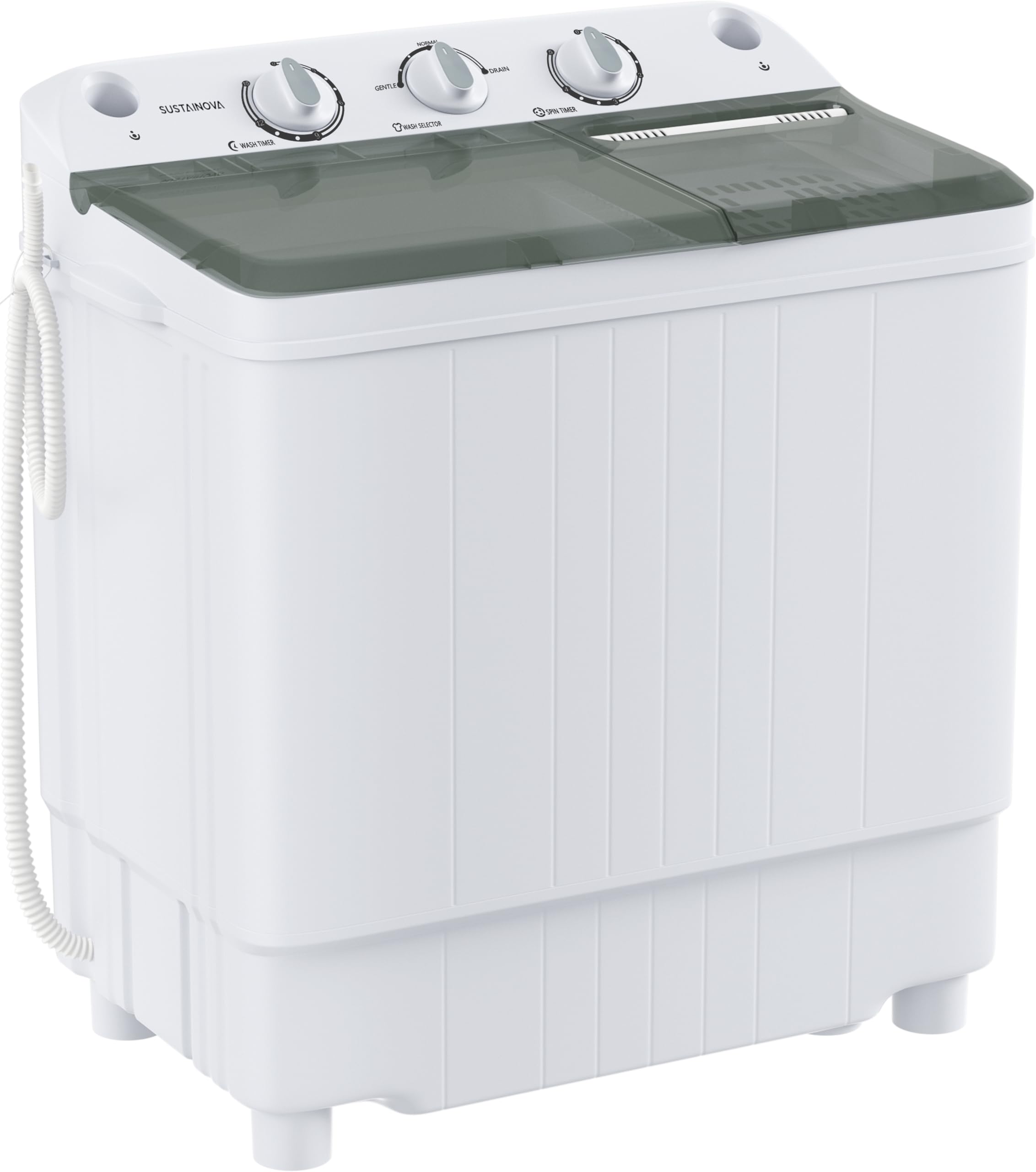
Bottom line: This twin tub is the simplest, lowest-power way to do laundry in an RV — two small tubs, two timers, and a lot less waiting around for a laundromat.
- Capacity: 9.9 lbs total (7.7 lb wash tub, 2.2 lb spin tub), sized for shirts, socks, underwear, and light towels
- Wash type: Semi-automatic twin tub, so you move clothes from the wash side to the spin side yourself
- Power: 240W wash motor and 120W spin motor, light enough for a small inverter or generator
- Programs: A 15-minute wash timer and a 5-minute spin timer, so you set the time instead of picking a preset cycle
Because it draws so little power, this is the machine RVers reach for when they’re boondocking off a generator or solar setup rather than parked at a full-hookup site. Fill it from a bucket, a showerhead, or a low-pressure line, run the wash timer, then move the load to the spin side.
The tradeoff is that you’re doing some of the work a fully automatic washer would otherwise do for you, and the spin tub holds noticeably less than the wash tub. For a couple of shirts and socks between stops, that’s a minor hassle. For a pile of jeans and towels, you’ll be running it in smaller batches.
- Very compact and lightweight for tight RV storage
- Twin-tub layout lets you wash and spin in parallel
- Low 240W/120W power draw suits generators and small inverters
- Simple timer controls with few parts to break
- One of the more affordable options in this lineup
- Semi-automatic — you handle moving clothes between tubs
- Spin tub capacity is much smaller than the wash tub
- No heated wash option
2. Nictemaw Portable Washing Machine

Bottom line: The Nictemaw is built for RVers who want to load it, start it, and come back to clean clothes, at the cost of being one of the bigger machines in this lineup.
- Capacity: One of the larger capacities in this lineup, sized for more than a single day’s laundry between stops
- Wash type: Fully automatic, one-button operation from wash through spin
- Programs: 10 wash programs and 8 water levels for different fabrics
- Special feature: Built-in drain pump and drain hose, useful when the washer can’t drain straight down into a floor drain
Where the twin tub asks for your attention partway through, the Nictemaw runs the whole cycle on its own. That matters if you’d rather spend your stop outside than standing over a washer, and the drain pump means you’re not limited to spots with a low drain point nearby.
The tradeoff is size: this is a fully automatic machine with a real footprint, so it suits a motorhome or larger trailer with room to park it more than a compact camper you’re packing up daily.
- Fully automatic, one-button operation
- 10 programs and 8 water levels cover most fabric types
- Built-in drain pump helps where there’s no floor drain
- 24-hour delay start for flexible timing
- One of the larger, heavier machines here, so it asks more of your floor space
- As a smaller brand, parts and support may be harder to track down than with a name brand
- We couldn’t confirm an exact capacity figure for this specific listing
3. BLACK+DECKER 0.9 Cu. Ft. Portable Washer
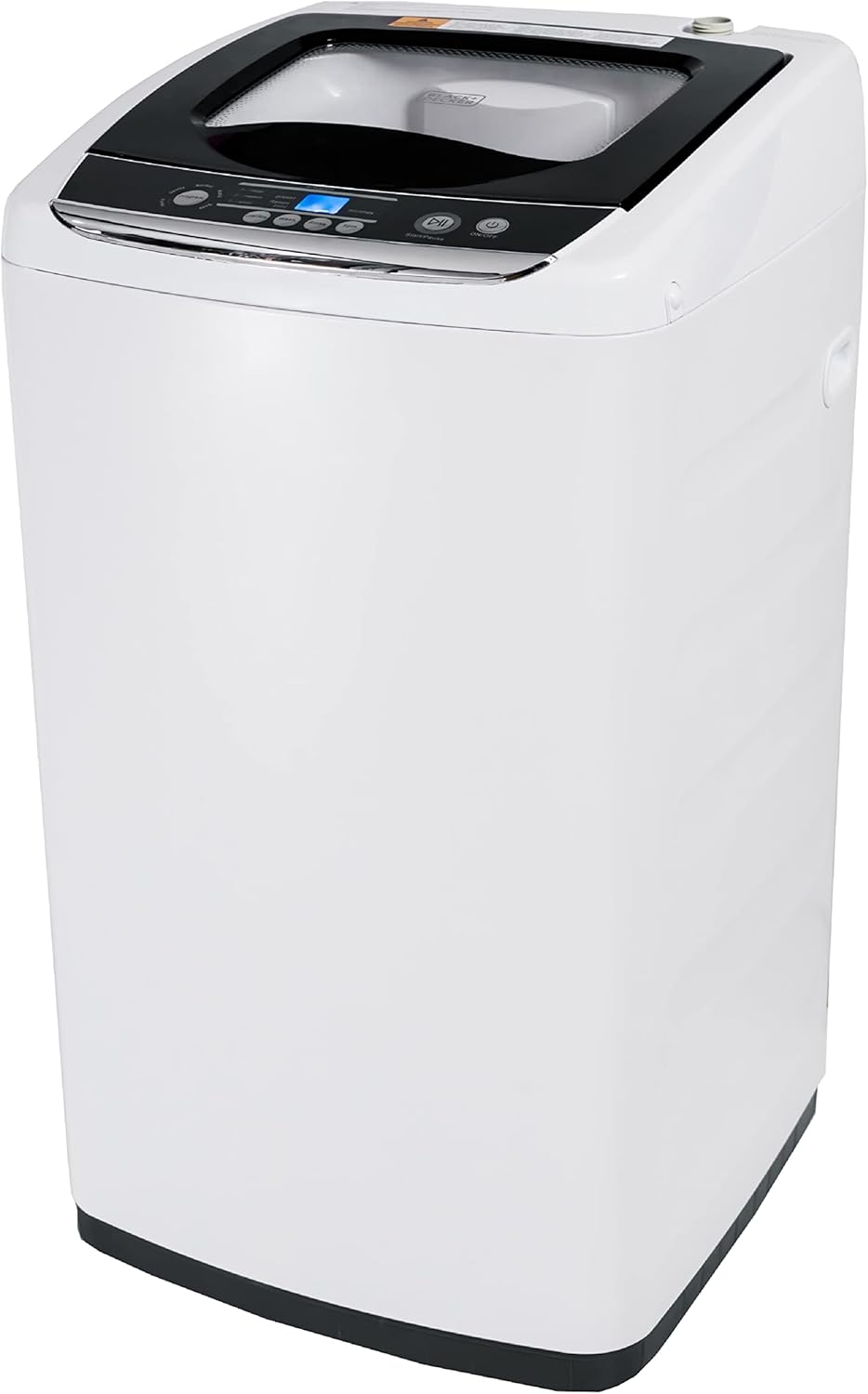
Bottom line: This is the closest thing to a normal, fully automatic washer in a compact footprint, from a brand most RVers already recognize.
- Capacity: 6.6 lbs (0.9 cu. ft.), sized for a few days of clothes rather than a full hamper
- Wash type: Fully automatic, cold water only
- Programs: 5 cycles — Heavy, Gentle, Normal, Rapid, and Soak
- Special feature: Stainless steel tub, plus a quick-connect sink adapter and drain hose included
Owners reviewing this washer consistently mention how straightforward setup is, including some who specifically call out that it’s manageable for people with limited mobility — a fair point for a machine you’ll be connecting and disconnecting at a sink rather than plumbing in permanently.
It’s a cold-water-only machine built for small, frequent loads, so it suits a weekly rotation of shirts and underwear better than a once-a-week wash of everything at once.
- Recognizable, established brand
- Stainless steel tub resists rust
- Quick-connect sink adapter and drain hose included
- Auto unbalance detection and child lock
- Reviewers report easy setup, even for those with mobility limitations
- Cold water wash only
- 6.6 lb capacity means frequent, smaller loads
- Not built for bedding or bulky items
4. COMFEE’ 2.4 Cu.Ft Portable Washing Machine

Bottom line: The COMFEE’ 2.4 cu. ft. is the biggest, most feature-rich washer here, built for RVs with the space and steady hookups to support it.
- Capacity: 2.4 cu. ft., the largest in this lineup
- Wash type: Fully automatic, with a Turbo Wash mode for faster loads
- Programs: 8 programs, including a Hygiene+ mode that triple-rinses
- Special feature: Child lock and LED display, made by Midea, a major appliance manufacturer
This is the only machine in the lineup built by a large, established appliance company rather than a smaller import brand, and it shows in the feature list: an auto-clean function for the drum itself, a stronger rinse mode, and a display that tells you what’s happening mid-cycle.
At 88.2 lbs and over three feet tall, it’s not a machine you’ll want to move often. It makes the most sense in a bigger rig, a park model, or a semi-permanent site where it can stay hooked up between washes.
- Largest capacity in this lineup at 2.4 cu. ft.
- Turbo Wash and Hygiene+ triple-rinse modes
- Child lock and LED display
- Backed by Midea, a major appliance manufacturer
- Heaviest and largest machine here at 88.2 lbs
- Better suited to steady hookups than frequent packing and unpacking
- Leaves less floor space to spare in a small rig
5. Panda 1.7 cu.ft Portable Washing Machine

Bottom line: The Panda 1.7 cu. ft. splits the difference between the smallest automatic washers and the largest, with enough capacity for regular loads in a still-portable machine.
- Capacity: 11 lbs (1.7 cu. ft.)
- Wash type: Fully automatic
- Programs: Six wash cycles for everyday clothes and delicates
- Special feature: Stainless steel tub, child lock, and a quick-connect adapter for sink setup
At this size, it holds noticeably more than the BLACK+DECKER without asking for the space and hookups the COMFEE’ needs, which is why it tends to come up as the middle-ground pick for RVers who’ve outgrown the smallest automatics.
Set it up carefully the first time: check the hose fittings and drain route before you start a wash, not after.
- Middle-of-the-road capacity that still fits typical RV bathrooms
- Stainless steel tub with child lock
- Quick-connect adapter for easier sink setup
- Owners report quiet operation and good durability
- Included fill hose is a known weak point — budget for a replacement
- Drain and hookup setup should be checked carefully before the first wash
- Six cycles is fewer than some competitors here
Sustainova vs Nictemaw: Which Should You Get?
The core trade-off is effort versus footprint: one machine asks you to do a little work between wash and spin, the other does the whole cycle on its own but takes up more room.
- Effort: the Sustainova asks you to move laundry between tubs yourself; the Nictemaw runs the whole cycle without you.
- Power draw: the Sustainova’s 240W/120W motors are easier on a generator or inverter than a full automatic cycle.
- Footprint: the Sustainova is the more compact, easier-to-stow machine; the Nictemaw needs more floor space.
- Control: the Nictemaw’s 10 programs and 8 water levels give more control over different fabrics than the Sustainova’s two timers.
Which Portable Washer Should You Buy?
- Want the lightest, cheapest, lowest-power option: get the Sustainova Portable Washing Machine.
- Want to load it and walk away: get the Nictemaw Portable Washing Machine.
- Want a well-known brand for small, frequent loads: get the BLACK+DECKER 0.9 Cu. Ft. Portable Washer.
- Have the space and steady hookups for the biggest capacity: get the COMFEE’ 2.4 Cu.Ft Portable Washing Machine.
- Want more capacity than the smallest automatics without going to the biggest machine: get the Panda 1.7 cu.ft Portable Washing Machine.
How We Chose
- Checked each machine’s capacity, cycle count, and included accessories against its listing and, where we could find one, the manufacturer’s own product page.
- Checked U.S. CPSC recall records for every brand in this roundup.
- Looked for recurring themes in owner reviews on retailer sites and RV or camping forums, outside of Amazon’s own review count, rather than doing any hands-on testing ourselves.
- Compared relative price tier across the lineup instead of exact prices, since Amazon prices change often.
- Weighed how each machine’s power draw, footprint, and hookup needs fit typical RV constraints.
Buying Guide: Portable Washers for RVs
Floor Space and Storage
Measure both the washer’s footprint and the height you’ll need to open the lid, not just the box dimensions. A twin tub like the Sustainova Portable Washing Machine can tuck into a shower stall or closet, while a 2.4 cu. ft. machine needs a dedicated spot it can stay in.
Faucet and Water Connection
Most portable washers connect with a quick-connect sink adapter, but RV faucet threading isn’t universal. Keep a basic adapter kit on hand so a mismatched fitting doesn’t derail wash day.
Drain Setup
A built-in drain pump, like the one on the Nictemaw Portable Washing Machine, can push water up and out when there’s no low drain point nearby. A gravity-drain twin tub needs to sit level with or above wherever the water is going.
Water Use, Especially When Boondocking
If you’re relying on a fresh tank, a smaller manual machine uses less water per load, and some RVers fill it by bucket or showerhead rather than plumbing it in at all.
Power Draw
Twin tubs draw the least: the Sustainova Portable Washing Machine‘s 240W wash motor and 120W spin motor are easy on a small inverter or generator. Fully automatic machines draw power continuously through a longer cycle, so check your setup can handle that before you buy one.
Mistakes to Avoid When Buying a Portable Washer for Your RV
- Buying by capacity alone: check lid clearance and floor footprint in your specific RV before you order.
- Assuming every faucet adapter fits: check the thread size first.
- Skipping the drain plan: figure out where the water goes before wash day, not during it.
- Choosing a heavy, fully automatic machine for a rig you pack up daily: if you’re stowing the washer after every use, weight matters as much as capacity.
- Ignoring power draw if you boondock: a machine that’s fine on shore power can strain a generator or inverter.
FAQs
What Should I Consider When Buying a Portable Washer for My RV?
Start with size, weight, and where the washer will sit during use. Then check the faucet connection, drain setup, power source, and water supply. If you dry camp often, also think about fresh-water use and gray-tank capacity. A larger washer may save time, but a smaller one may be easier to store and move.
Is a Twin-Tub or Fully Automatic Washer Better for RV Living?
A twin tub like the Sustainova is usually lighter and easier to store, but needs more of your time. A fully automatic machine like the Nictemaw is easier to use, but is typically heavier and needs a more reliable water and drain setup.
How Do I Properly Use a Portable Washer in My RV?
Place the washer on a level surface, connect the water inlet hose, and secure the drain hose before starting. Use the right water level, avoid overloading the tub, and use a small amount of suitable detergent. After each wash day, drain the machine fully, wipe down the lid and tub, and let it dry before storing.
Can a Portable Washer Handle Bedding in an RV?
Some larger portable washers can handle light sheets or small bedding, but compact models aren’t built for thick comforters, heavy blankets, or oversized loads. Follow the washer’s load limit, and plan to wash bulky items at a laundromat when needed.
Are Portable Washers Efficient for RV Living?
Yes, for small, regular loads. They can cut down on laundromat trips and keep clothes fresher while traveling. The key is matching the washer’s size and power needs to your RV space, water access, and laundry habits.
Do I Need Special Detergent for a Portable Washing Machine?
Use a high-efficiency (HE) detergent in small amounts. HE formulas produce fewer suds, which matters in a machine that uses less water than a standard washer — regular detergent can over-suds and leave residue behind.
Can I Run a Portable Washer While Boondocking?
Yes, within limits. Lower-power machines like a twin tub are the easier fit for a generator or solar setup, since they draw far less than a full automatic cycle. Either way, factor the water into your fresh-tank and gray-tank math before you start.
How Long Does a Wash Cycle Take in a Portable Washer?
It depends on the type. A twin tub typically runs a 15-minute wash and a separate 5-minute spin, so you’re moving the load yourself in between. A fully automatic machine runs everything in one cycle, often 45 to 90 minutes depending on the program.
Final Verdict
The right portable washer for your RV comes down to how much space you have and how much manual work you’re willing to trade for a lighter, cheaper machine. Measure your floor space, settle on a drain plan, and match the washer to how you actually travel before you buy.
If you’d rather have a fully automatic wash, the Nictemaw Portable Washing Machine is the strongest value pick, and the COMFEE’ 2.4 Cu.Ft Portable Washing Machine is worth the extra space if your RV can spare it.