Finding the right stud finder can make wall projects easier and reduce guesswork before you drill. Whether you are hanging shelves, mounting a TV, installing cabinets, or lining up artwork, a wall scanner can help you locate framing behind the surface. Some models can also provide metal or live-wire alerts, but those features should be treated as additional warning aids rather than a guarantee that a drilling location is clear.
This guide compares five stud finders for different needs, including multi-mode wall scanners, full-width Franklin Sensors models, deeper-scanning options, and no-calibration tools. Use the quick picks, comparison notes, and buying guidance below to choose a model that fits your wall type and project style.
Affiliate disclosure:. As an Amazon Associate I earn from qualifying purchases. This roundup is reader-supported. When you click through Amazon links, we may earn a referral commission on qualifying purchases at no extra cost to you.
Quick Verdict
Choose the Franklin Sensors ProSensor M210 if you want the best overall balance of full-width stud detection, no-calibration operation, live-wire awareness, and everyday convenience. Choose the ProSensor MAX if you regularly scan thicker or layered wall surfaces. Choose the Franklin Sensors 710 if you mainly want straightforward full-width stud finding without the M210’s extra live-wire features.
Top Picks
- Best Overall Everyday Pick: Franklin Sensors ProSensor M210 Stud Finder
- Best for Thick or Layered Walls: Franklin Sensors ProSensor MAX Stud Finder
- Best Simple No-Calibration Pick: Franklin Sensors 710 Professional Stud Finder
- Best Multi-Mode Starter Pick: Stud Finder Wall Scanner with Magnetic Sensor
- Best Compact Multi-Mode Option: Stud Finder Wall Scanner – 6 in 1 Detector
How We Selected Our Top Picks
This roundup prioritizes the features that matter most when comparing stud finders: detection type, wall compatibility, ease of use, depth capability, display clarity, calibration requirements, and safety-focused warning features.
The selected models cover common home projects such as TV mounting, shelf installation, picture hanging, cabinet work, and light renovation. Useful differences include full-width LED stud indication, LCD feedback, audio alerts, deeper scanning modes, metal detection, and live AC or live-wire awareness where the product supports those functions.
Safety Note Before You Drill
A stud finder is a locating aid, not proof that a wall is free of electrical wiring, plumbing, or other hidden objects. Scan carefully, follow the manufacturer’s instructions, and confirm readings from more than one direction when appropriate. Do not drill where the tool indicates possible live wiring. If you suspect electrical wiring or are uncertain about what is behind the wall, stop and use appropriate verification methods or contact a qualified professional.
Before You Buy a Stud Finder
- For basic drywall projects: a straightforward no-calibration stud finder may be enough.
- For plaster, tile, double drywall, or layered walls: look for a model specifically designed for deeper scanning through layered surfaces.
- For wiring awareness: consider live AC detection or a live-wire meter, but never rely on that feature as your only electrical safety check.
- For easier marking: full-width LED models can help you visualize stud edges and center positions.
- For occasional DIY use: a multi-mode LCD wall scanner can provide wood, metal, and wiring-related detection modes in one tool.
- Before ordering: check the current product listing and manual for supported wall materials, batteries, operating procedure, and detection limitations.
Stud Finder Wall Scanner with Magnetic Sensor
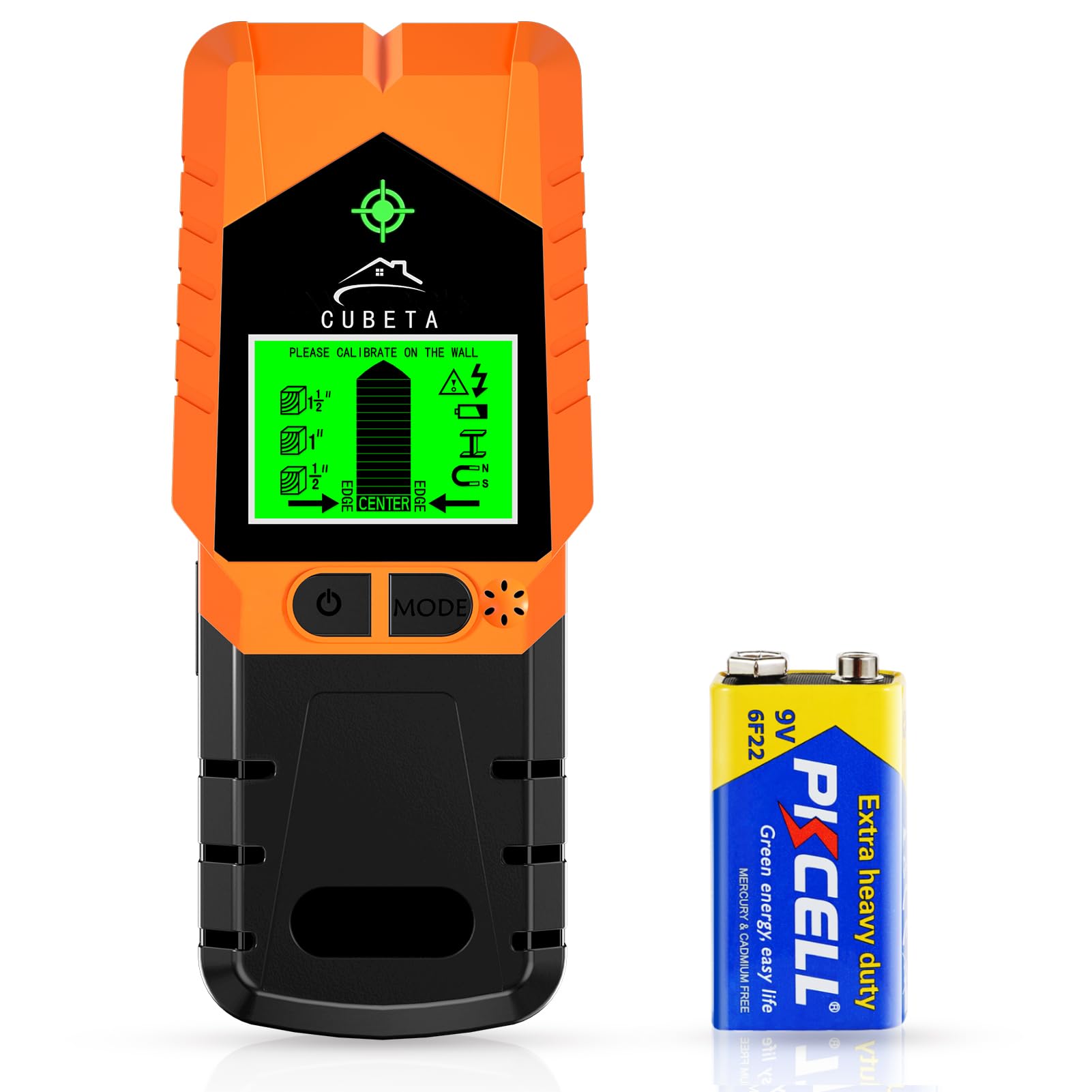
The CUBETA Stud Finder Wall Scanner is a relevant option if you want one tool for several common wall-scanning tasks. The product listing describes a 6-in-1 design with modes intended for locating wood or metal framing and possible live AC wiring, along with an LCD display and audio feedback.
This type of multi-mode wall scanner can make sense for homeowners handling occasional DIY projects who want more detection choices than a basic stud-only tool. For hanging shelves, installing small fixtures, or checking a wall before drilling, follow the supplied calibration procedure carefully and make controlled passes before marking a location.
Why You’ll Like It
- Multiple scanning modes provide flexibility for common wood, metal, and wiring-awareness tasks
- LCD feedback and sound alerts can make readings easier to follow
- One multi-mode tool can cover several occasional household scanning jobs
Best For
Choose this if you want a multi-mode LCD wall scanner for common DIY projects and prefer several detection modes in one device.
Keep in Mind
Follow the current product manual for calibration and supported materials. Use slow, controlled passes, and treat any live-wire alert as a warning signal rather than assuming areas without an alert are safe to drill.
Check Product Details on Amazon
Franklin Sensors ProSensor MAX Stud Finder

The Franklin Sensors ProSensor MAX is the strongest fit in this roundup for thicker or layered wall surfaces. It uses 13 larger sensors, 35 LEDs, and two detection modes, with a maximum listed detection depth of up to 2.5 inches.
Mode 1 is intended for standard single-layer drywall, while Mode 2 is designed for more demanding layered surfaces such as double-layer drywall, lath and plaster, and large tile. The wide LED layout indicates the detected stud area across multiple LEDs instead of relying on a single edge indicator.
Why You’ll Like It
- 13 larger sensors are designed for deeper wall scanning
- 35-LED display helps show the detected width of a stud
- Two modes cover standard drywall and supported layered surfaces
- Maximum listed detection depth is up to 2.5 inches
- No manual calibration is required before scanning
Best For
Choose this if you regularly work with double-layer drywall, lath and plaster, large tile, or other supported layered surfaces where a deeper-scanning stud finder is useful.
Keep in Mind
The MAX is designed around deeper stud detection, but finding a stud does not confirm structural capacity or prove that wiring or plumbing is absent. Check the wall construction and choose appropriate fasteners for the item you plan to mount.
Check Product Details on Amazon
Franklin Sensors ProSensor M210 Stud Finder

The Franklin Sensors ProSensor M210 is the best overall everyday pick in this roundup for homeowners and frequent DIYers. It combines 13 sensors, a 21-LED display, a built-in bubble level, a live wire meter, and a pencil caddy, giving you a practical mix of stud-location features and project convenience.
The M210 does not require manual calibration before each scan. Hold it against the wall as directed, press the operating button, and use the LED display to identify the detected stud area. The built-in level and pencil caddy can also be useful when laying out shelf rails, TV brackets, or other mounting hardware.
Why You’ll Like It
- 13 sensors and a wide LED display help indicate the full detected stud width
- Live wire meter provides an additional warning aid around possible energized wiring
- Built-in bubble level and pencil caddy add practical marking convenience
- No manual calibration is required
- Maximum listed detection depth is up to 1.7 inches
Best For
Choose this if you want one versatile stud finder for regular home projects and value full-width indication, no-calibration operation, and live-wire awareness.
Keep in Mind
The live wire meter is an additional warning feature, not a replacement for electrical safety procedures. Never assume a location is safe to drill simply because the meter does not show a warning.
Check Product Details on Amazon
Stud Finder Wall Scanner – 6 in 1 Detector
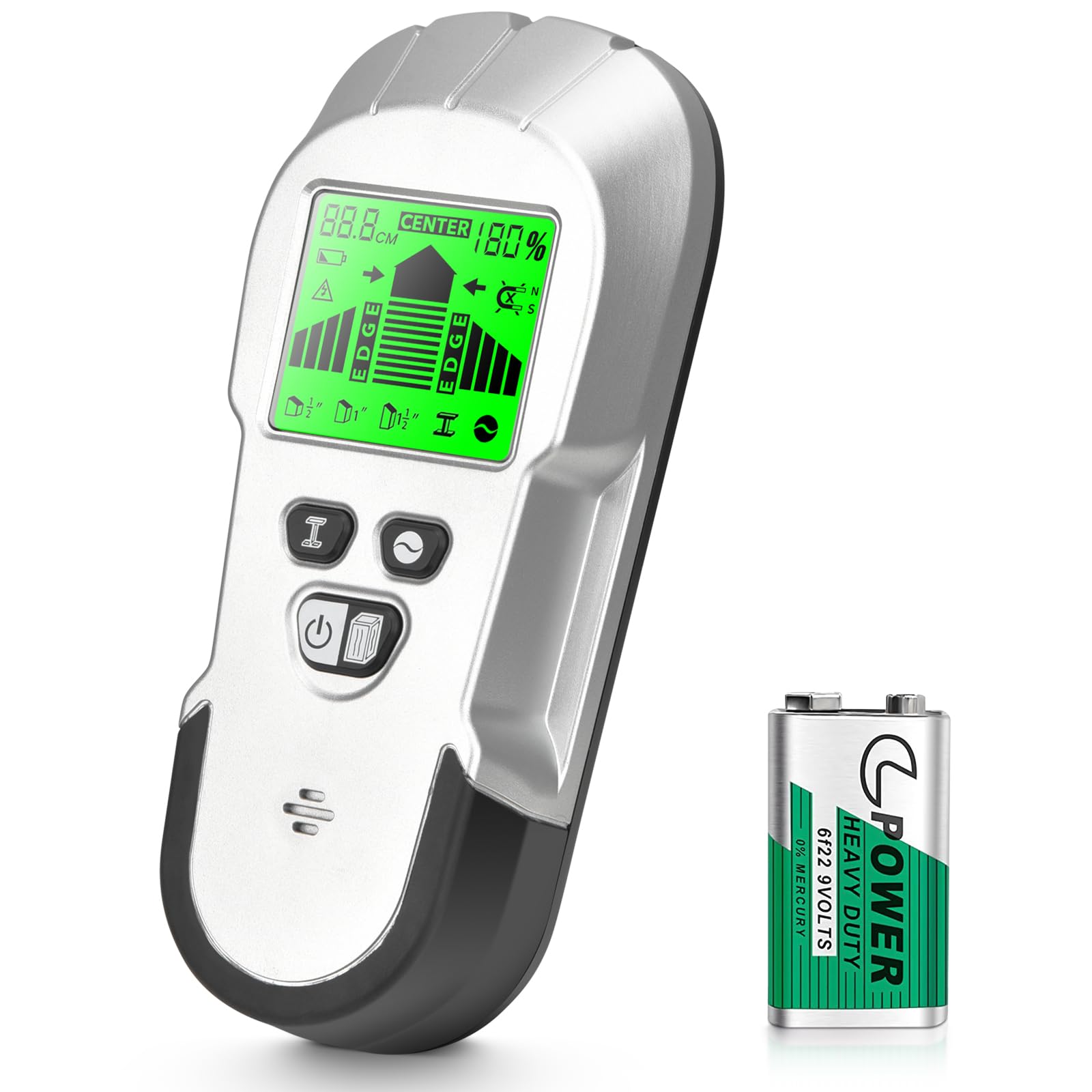
The FREETIM Stud Finder Wall Scanner is another multi-mode option for buyers who prefer LCD-style feedback. Product information for this model describes six scanning functions, an LCD display, and audio alerts intended to assist with locating wood or metal framing and possible live AC wiring.
This model is best suited to light home repair and installation work where you want several scanning modes in one compact tool. Because calibration and scanning technique can affect multi-mode wall scanners, follow the current instructions and confirm a suspected location with repeated, controlled passes before drilling.
Why You’ll Like It
- Six scanning functions provide options for several common detection tasks
- LCD display and audio alerts provide both visual and audible feedback
- Multi-mode design can suit occasional household repairs and installation projects
Best For
Choose this if you want an LCD-style multi-mode wall scanner for occasional DIY projects rather than a dedicated full-width LED stud finder.
Keep in Mind
Calibration and scanning technique matter. Follow the manual, keep the scanner properly positioned against the wall, and repeat a scan when a reading appears inconsistent.
Check Product Details on Amazon
Franklin Sensors 710 Professional Stud Finder

The Franklin Sensors 710 is a strong choice if your priority is straightforward full-width stud detection without extra features such as the M210’s live wire meter. It uses 13 sensors and 13 LEDs to indicate the detected stud area across the width of the tool.
No manual calibration is required. Press and hold the operating button as directed and use the LED indicators to locate the detected stud width. That straightforward operation makes the 710 a practical option for shelves, artwork, handrails, and other common mounting projects where stud location is the main goal.
Why You’ll Like It
- 13 sensors and 13 LEDs provide full-width stud indication
- No manual calibration is required before scanning
- Simple feature set keeps the focus on stud location
- Maximum listed detection depth is up to 1.6 inches
Best For
Choose this if you want a simple Franklin Sensors model focused on full-width stud finding and do not need the additional live-wire features of the M210.
Keep in Mind
This model focuses on stud detection rather than dedicated live-wire warning features. If live-wire awareness is an important buying requirement, the ProSensor M210 is the better match within this roundup.
Check Product Details on Amazon
FAQ
What should I look for when buying a stud finder?
Start with your wall type and the kind of work you normally do. For standard drywall, a simple no-calibration stud finder may be enough. For double drywall, plaster, tile, or other layered surfaces, look for a model specifically designed for deeper scanning. If wiring awareness matters, consider a model with a live AC alert or live wire meter while remembering that the feature is only an additional warning aid.
How do I use a stud finder effectively?
Read the manufacturer’s instructions first because operating procedures vary. Keep the scanner positioned against the wall as directed, move it at the recommended speed, and repeat the scan when a reading is uncertain. With edge-detection models, confirm both sides of a suspected stud when possible. With full-width LED models, use the illuminated area according to the manufacturer’s instructions.
Can a stud finder help me avoid electrical wires?
Some models can alert you to possible live AC wiring, but no stud finder should be treated as proof that an area is electrically safe. Hidden wiring may not always be detected. Do not drill where you receive a wire warning, and use appropriate electrical verification or professional help when the wall layout is uncertain.
Can a stud finder detect pipes?
Some multi-mode wall scanners include metal-detection functions that may react to metallic pipes, fasteners, rebar, or other hidden metal. However, a detection signal does not necessarily identify exactly what the object is. Treat unexpected readings cautiously before drilling or cutting into the wall.
Are no-calibration stud finders better?
No-calibration models can be faster and simpler to operate because you do not have to perform a separate manual calibration step before scanning. That convenience can be valuable for frequent use. Calibration-based scanners can still be useful, especially when they provide several material-detection modes, but their setup instructions need to be followed carefully.
Which stud finder is best for thick walls?
For thicker or layered surfaces among the products in this roundup, the Franklin Sensors ProSensor MAX is the most purpose-built option. It provides two operating modes and a maximum listed detection depth of up to 2.5 inches, with its deeper mode designed for supported layered surfaces such as double-layer drywall, lath and plaster, and large tile.
Wrapping Up
If you want the best everyday balance of full-width stud detection, simple operation, and live-wire awareness, the Franklin Sensors ProSensor M210 is the most complete choice in this roundup. If you routinely work on thicker or layered surfaces, the ProSensor MAX offers the deeper-scanning design.
For straightforward stud location without extra live-wire features, the Franklin Sensors 710 keeps the process simple. If you prefer an LCD wall scanner with several detection modes, the CUBETA and FREETIM options provide a different approach for occasional DIY projects, but careful setup and scanning technique remain important.
Detailed Stud Finder Comparison
Use this table as a quick feature reference. Product specifications and listing details can change, so confirm the current Amazon listing and manufacturer instructions before ordering or drilling.
| Product | Image | Best For | Highlights | Pros | Cons |
|---|---|---|---|---|---|
| Stud Finder Wall Scanner with Magnetic Sensor |
 |
Multi-mode DIY scanning | Listing-stated 6-in-1 functionality, LCD display, audio feedback, and modes for wood, metal, and possible live AC wiring. | Multiple scanning modes and visual plus audible feedback for common household projects. | Requires careful setup and scanning technique; confirm current specifications in the product manual. |
| Franklin Sensors ProSensor MAX |
 |
Thick or layered wall surfaces | 13 larger sensors, 35 LEDs, two detection modes, and up to 2.5″ maximum listed detection depth. | Deep-scanning design, no manual calibration, and full-width LED stud indication. | More capability than many basic drywall projects require. |
| Franklin Sensors ProSensor M210 |
 |
Best overall everyday use | 13 sensors, 21 LEDs, live wire meter, built-in level, pencil caddy, and up to 1.7″ maximum listed detection depth. | Full-width stud indication, no manual calibration, and useful layout features. | Live-wire indication remains a warning aid and does not replace electrical safety checks. |
| Stud Finder Wall Scanner – 6 in 1 Detector |
 |
LCD-style multi-mode scanning | Six scanning functions, LCD feedback, audio alerts, and modes intended for wood, metal, and possible live AC wiring. | Several detection modes with both visual and audible feedback. | Calibration and scanning technique can affect readings. |
| Franklin Sensors 710 Professional Stud Finder |
 |
Simple no-calibration stud detection | 13 sensors, 13 LEDs, full-width stud indication, and up to 1.6″ maximum listed detection depth. | Straightforward operation with no manual calibration required. | Does not include the M210’s live wire meter. |
Final Recommendation
For most DIY users: start with the Franklin Sensors ProSensor M210 for its combination of full-width stud indication, no-calibration operation, and live-wire awareness. Choose the ProSensor MAX when deeper scanning through supported layered walls is the priority, or the ProSensor 710 when you want a simpler stud-focused tool without extra wiring features.