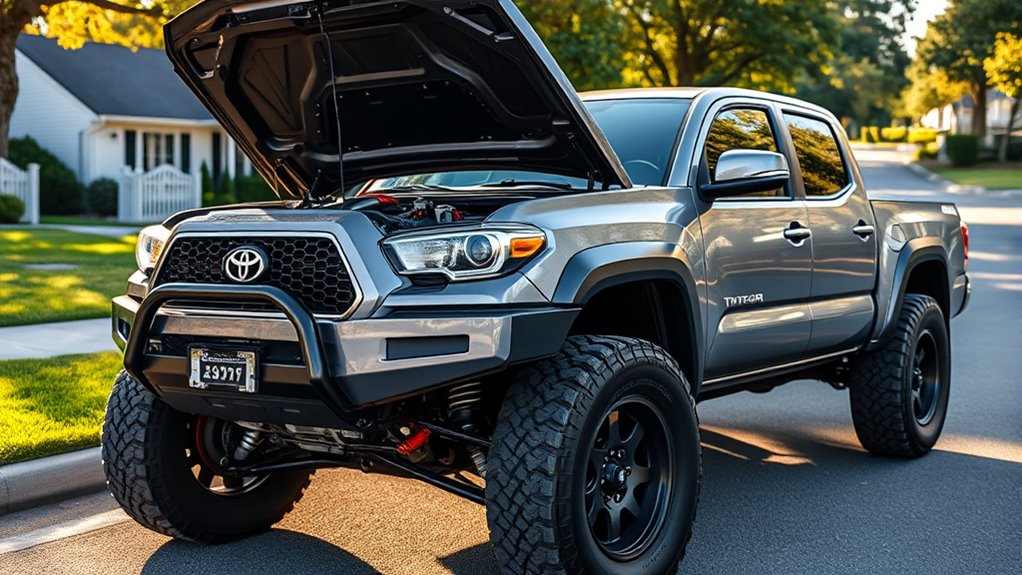
What does i-FORCE mean on a Tacoma? It is Toyota’s name for the truck’s turbocharged gasoline powertrain, designed to deliver strong torque from a relatively small engine. The newer Tacoma also offers i-FORCE MAX, a hybrid version that adds electric motor assistance. Understanding the difference helps you compare power, fuel economy, towing capacity, and available trims.
Quick Answer
On the 2026 Toyota Tacoma, i-FORCE means a 2.4-liter turbocharged four-cylinder gasoline engine producing up to 278 horsepower and 317 lb-ft of torque. i-FORCE MAX adds an electric motor, increasing output to as much as 326 horsepower and 465 lb-ft. Both offer strong low-speed pulling power, but their transmissions, fuel economy, and towing ratings differ.
Key Takeaways
- The standard i-FORCE is gasoline-only. The i-FORCE MAX combines the turbo engine with an electric motor and hybrid battery.
- Not every gas Tacoma produces 278 horsepower. The SR automatic makes 228 hp, while available manual models make 270 hp.
- Most i-FORCE MAX models produce 326 hp, while the Trailhunter is rated at 323 hp. Both deliver 465 lb-ft of torque.
- Maximum towing is 6,500 pounds for certain gasoline configurations versus 6,000 pounds for properly equipped hybrids.
- For 2026, the hybrid is standard on TRD Pro and Trailhunter and available on TRD Sport, TRD Off-Road, and Limited.
What Does i-FORCE Mean on a Tacoma?
)
i-FORCE is Toyota’s truck engine branding. On the fourth-generation Tacoma, introduced for the 2024 model year, it identifies the 2.4-liter turbocharged gasoline engine.
A turbocharger uses exhaust energy to force additional air into the engine. With more air available for combustion, the engine can produce greater power and torque than a similar naturally aspirated engine.
The result is useful pulling power at relatively low engine speeds. This helps during acceleration, hill climbing, and driving with cargo.
However, i-FORCE does not mean every Tacoma has the same output. Engine tuning and transmission choice affect horsepower and torque.
- SR with automatic: 228 horsepower and 243 lb-ft of torque.
- Higher-output automatic: 278 horsepower and 317 lb-ft of torque.
- Available six-speed manual: 270 horsepower and 310 lb-ft of torque.
Toyota confirms these engine choices in its 2026 Tacoma announcement.
The i-FORCE name does not identify four-wheel drive, a particular trim, or a towing package. It identifies the engine family.
How Tacoma i-FORCE Works
Standard Tacoma i-FORCE uses a turbocharged gasoline engine without electric motor assistance. The i-FORCE MAX hybrid uses the same basic engine design but adds an electric motor and battery to support acceleration and driving efficiency.
The key difference is how each system produces torque and manages power under changing driving conditions.
i-FORCE Power Basics
The standard i-FORCE engine uses a turbocharger to increase the amount of air entering its cylinders. The engine control system manages fuel delivery and turbo boost to produce the requested power.
In automatic configurations, an eight-speed transmission selects gears to balance acceleration, engine speed, and efficiency.
Toyota also offers a six-speed intelligent manual transmission on select gas-powered Tacoma models. It includes automatic rev-matching and anti-stall technology.
The automatic and manual transmissions have different engine output ratings, so they should not be treated as identical configurations.
According to Toyota’s truck powertrain information, Tacoma’s gasoline engine produces up to 278 horsepower and 317 lb-ft, with an available eight-speed automatic or six-speed manual transmission.
The driving characteristics can be summarized in three points:
- Turbocharged torque: Helps the engine respond when accelerating or climbing a hill.
- Transmission management: Keeps the engine operating in a useful speed range.
- Driver control: Automatic models manage gear changes, while manual models allow the driver to select gears directly.
This setup works for commuting, highway driving, and off-road use without requiring a hybrid battery.
i-FORCE MAX Hybrid Functionality
i-FORCE MAX adds a 48-horsepower electric motor integrated into the eight-speed automatic transmission. The motor works with the 2.4-liter turbocharged engine rather than replacing it.
The system uses a 1.87-kWh nickel-metal hydride battery to supply electric power when assistance is needed.
During acceleration, the electric motor can provide torque before the turbocharged engine reaches its strongest operating range. This improves response when starting from a stop or pulling a load.
During braking and deceleration, regenerative braking recovers some of the vehicle’s movement energy and stores it in the battery. The gasoline engine can also help maintain the battery’s charge.
These components are described in Toyota’s i-FORCE MAX engineering explanation.
The main hybrid components and their purposes are shown below.
| Feature | Benefit |
|---|---|
| 48-hp electric motor | Adds torque during acceleration |
| Turbocharged 2.4L engine | Provides gasoline power for driving and heavy loads |
| 1.87-kWh battery | Stores energy for hybrid assistance |
| 8-speed automatic | Manages power delivery through conventional gears |
| Regenerative braking | Recovers energy during deceleration |
Unlike a plug-in hybrid, the Tacoma i-FORCE MAX does not need external charging. Its hybrid system manages battery charging automatically while the truck operates.
What Does i-FORCE MAX Add?
i-FORCE MAX adds electric assistance, increasing total system output to as much as 326 horsepower and 465 lb-ft of torque. That is 48 more horsepower and 148 more lb-ft than the higher-output gasoline automatic.
The added torque is especially useful when moving from a stop, climbing grades, or driving with heavier loads.
However, the hybrid’s advantage is not limited to acceleration.
- Stronger low-speed response: Electric assistance helps deliver torque quickly without relying entirely on turbo boost.
- Hybrid energy recovery: Regenerative braking captures energy that would otherwise be lost as heat during braking.
- Automatic power management: The truck controls electric assistance and battery charging without a separate charging routine.
- Additional onboard electricity: Hybrid Tacomas include a standard 2,400-watt AC power supply for the cabin and bed, subject to the system’s operating limits.
One detail matters when comparing specifications: Trailhunter produces 323 horsepower, while other i-FORCE MAX versions are rated at 326 horsepower.
Toyota confirms the Trailhunter-specific output in its Trailhunter powertrain and equipment overview. Torque remains 465 lb-ft.
The hybrid system also adds weight and mechanical complexity. More torque does not automatically mean greater towing or payload capacity.
Tacoma i-FORCE vs. i-FORCE MAX
The biggest difference between Tacoma i-FORCE and i-FORCE MAX is the power source. The regular engine relies on gasoline, while the hybrid combines gasoline power with electric assistance.
For the 2026 US Tacoma, engine output also changes according to the transmission and trim.
| Powertrain | Horsepower | Torque | Transmission |
|---|---|---|---|
| i-FORCE SR automatic | 228 hp | 243 lb-ft | 8-speed automatic |
| i-FORCE higher-output automatic | 278 hp | 317 lb-ft | 8-speed automatic |
| i-FORCE manual | 270 hp | 310 lb-ft | 6-speed manual |
| i-FORCE MAX hybrid | 326 hp | 465 lb-ft | 8-speed automatic |
| i-FORCE MAX Trailhunter | 323 hp | 465 lb-ft | 8-speed automatic |
Standard vs. Hybrid Power
If you want a gasoline-only pickup, standard i-FORCE offers strong turbocharged performance without a high-voltage hybrid drive system.
It also provides the option of a manual transmission on select models, which the hybrid does not offer.
The i-FORCE MAX is better suited to drivers who value stronger low-speed acceleration and electric motor assistance.
Its combined output is higher, although that does not mean every hybrid Tacoma accelerates equally or has the same carrying capacity. Vehicle weight, tires, gearing, and equipment affect performance.
Towing, MPG, and Trims
The standard gasoline engine has the higher maximum towing rating, while the hybrid offers substantially more torque.
The two systems also differ in fuel efficiency. Certain rear-wheel-drive gasoline Tacomas achieve similar combined MPG to the hybrid, although the hybrid generally performs better in city driving than comparable four-wheel-drive gasoline models.
Trim choice matters as much as the engine. TRD Sport and TRD Off-Road offer both gasoline and hybrid versions, while TRD Pro and Trailhunter use i-FORCE MAX exclusively.
For the best comparison, consider the exact cab, transmission, drivetrain, and equipment rather than judging either system by its highest advertised number.
How i-FORCE Helps Towing and Hauling
Both Tacoma powertrains provide useful towing performance, but the maximum ratings differ. For 2026, certain gasoline i-FORCE configurations can tow up to 6,500 pounds, while i-FORCE MAX models reach a maximum of 6,000 pounds.
The hybrid may feel stronger when starting with a trailer because its electric motor adds low-speed torque. However, increased torque does not override the truck’s certified towing limit.
Toyota’s 2026 Tacoma trailer towing instructions list different towing ratings by model code, cab, bed, and grade.
For example, certain gas-powered SR5 and TRD PreRunner XtraCab configurations reach 6,500 pounds, while some other Tacoma configurations have lower ratings. A base SR configuration can be rated for considerably less.
Payload also depends on the particular truck. Published maximum figures reach approximately 1,710 pounds for certain i-FORCE MAX configurations and 1,705 pounds for certain gasoline configurations.
That difference is small, and it does not mean every hybrid can carry more cargo. Heavier trim equipment can reduce the available payload.
Warning: Never use the model’s advertised maximum towing or payload figure as the rating for every Tacoma. Check the vehicle-specific weight labels and owner’s manual. Passengers, cargo, accessories, trailer tongue weight, and vehicle equipment count toward applicable weight limits.
Available towing aids can make a difference when carrying a heavy load. Depending on equipment, Tacoma may include:
- Tow/Haul mode: Adjusts vehicle response and transmission operation for heavier loads.
- Integrated trailer brake controller: Helps manage compatible electric trailer brakes.
- Trailer Backup Guide: Provides assistance when positioning a trailer.
- Trailer cameras and monitoring: Improve visibility while maneuvering.
Before towing, confirm the trailer’s loaded weight, tongue weight, hitch rating, and the truck’s available payload. These limits matter more than engine horsepower alone.
Tacoma i-FORCE MPG and Performance
For the 2026 Tacoma, fuel economy varies by engine, transmission, drivetrain, and trim. The i-FORCE MAX hybrid generally returns about 23 mpg combined, while gasoline models range from roughly 20 to 23 mpg combined in common configurations.
The hybrid’s fuel economy advantage is most noticeable when compared with four-wheel-drive gasoline models in city traffic.
Here are selected US fuel economy estimates for the 2026 Tacoma lineup.
| Configuration | City MPG | Highway MPG | Combined MPG |
|---|---|---|---|
| SR, RWD, automatic | 20 | 26 | 23 |
| SR5, RWD, automatic | 21 | 26 | 23 |
| SR5, 4WD, automatic | 19 | 24 | 21 |
| 4WD, six-speed manual | 18 | 23 | 20 |
| TRD Sport / TRD Off-Road i-FORCE MAX | 22 | 24 | 23 |
| Limited i-FORCE MAX | 23 | 24 | 23 |
| Trailhunter / TRD Pro hybrid | 22 | 24 | 23 |
Source: Toyota’s 2026 Tacoma specifications and fuel economy listings. Figures are estimates for the configurations shown; individual vehicle specifications may differ.
A 4WD gas Tacoma returning 21 mpg combined has a lower estimate than a comparable hybrid returning 23 mpg combined. However, a rear-wheel-drive SR5 automatic can also reach 23 mpg combined.
This means the hybrid is not automatically the most fuel-efficient Tacoma in every comparison.
Driving conditions also affect real-world results. Stop-and-go traffic gives the hybrid more opportunities to recover braking energy, while steady highway driving may reduce that advantage.
Heavy cargo, towing, steep grades, aggressive acceleration, and off-road tires can all increase fuel consumption.
For performance-focused buyers, the larger hybrid torque output is the main attraction. For drivers who prioritize lower system complexity or a manual transmission, gasoline i-FORCE remains an appealing option.
Which Tacoma Trims Offer i-FORCE?
The 2026 Tacoma offers the gasoline i-FORCE engine across its standard and midrange lineup. The i-FORCE MAX hybrid is available on selected higher trims and standard on the two most specialized off-road models.
Here is how the US lineup is organized.
- SR: Gasoline i-FORCE, with the lower-output automatic calibration or available manual configuration.
- SR5: Higher-output gasoline i-FORCE with automatic transmission.
- TRD PreRunner: Gasoline i-FORCE with rear-wheel drive and an off-road-inspired setup.
- TRD Sport: Gasoline i-FORCE or available i-FORCE MAX hybrid.
- TRD Off-Road: Gasoline i-FORCE or available i-FORCE MAX hybrid, with off-road-focused equipment.
- Limited: Gasoline i-FORCE or available i-FORCE MAX hybrid, emphasizing comfort and additional technology.
- Trailhunter: Standard i-FORCE MAX hybrid with overlanding-focused equipment.
- TRD Pro: Standard i-FORCE MAX hybrid with performance-oriented off-road equipment.
For buyers who frequently drive on trails, TRD Off-Road offers a choice between gasoline and hybrid power. TRD Pro and Trailhunter add specialized equipment beyond the engine itself.
The Limited i-FORCE MAX takes a different approach, pairing hybrid torque with comfort features and a full-time four-wheel-drive system.
Choosing the right Tacoma therefore involves more than selecting the strongest engine. Think about whether you value towing capacity, manual shifting, fuel economy, road comfort, or trail-focused equipment most.
Frequently Asked Questions
What Does “i-FORCE” Mean on a Toyota Tacoma?
i-FORCE is Toyota’s name for the Tacoma’s turbocharged gasoline powertrain. On the 2026 model, it uses a 2.4-liter four-cylinder engine with different output ratings depending on the configuration. The i-FORCE MAX name identifies the version that adds electric motor assistance.
Can You Leave ECT Power on All the Time?
Yes, ECT Power can generally remain on in a Tacoma equipped with that mode. It changes transmission and throttle response rather than increasing the engine’s rated horsepower. Fuel consumption may increase depending on how you drive. You can switch it off for normal driving when the extra response is unnecessary.
What Is Toyota’s i-FORCE?
Toyota’s i-FORCE is a family of truck engine branding used to identify performance-focused gasoline powertrains. On the modern Tacoma, it refers to a 2.4-liter turbocharged four-cylinder engine. The name also appears on other Toyota trucks, so engine size and specifications depend on the vehicle.
Is the Toyota Tacoma i-FORCE MAX Reliable?
The i-FORCE MAX uses Toyota hybrid technology, but its long-term durability is still being established because the hybrid Tacoma debuted for the 2024 model year. Toyota provides an eight-year/100,000-mile hybrid component warranty and a 10-year/150,000-mile hybrid battery warranty in the US, subject to warranty terms.
Does Tacoma i-FORCE MAX Need to Be Plugged In?
No, the Tacoma i-FORCE MAX is a conventional hybrid, not a plug-in hybrid. It charges its battery through regenerative braking and gasoline-engine operation. You fill its fuel tank normally, and the hybrid control system manages electric assistance and battery charging automatically.
Does i-FORCE Mean a Tacoma Has Four-Wheel Drive?
No, i-FORCE refers to the engine, not the drivetrain. Gasoline-powered Tacomas are available with rear-wheel drive or four-wheel drive, depending on trim. The 2026 i-FORCE MAX hybrid models come with four-wheel drive, including a full-time system on the Limited hybrid.
For vehicle-specific operating instructions and warranty details, use Toyota’s official 2026 Tacoma owner’s manuals and warranty resources.
Conclusion
Tacoma’s i-FORCE engine provides turbocharged gasoline performance, while i-FORCE MAX adds hybrid assistance for substantially more torque and stronger low-speed response.
Neither system is automatically better for every driver. Gasoline i-FORCE offers the higher maximum towing rating and an available manual transmission. The hybrid delivers stronger combined output and can improve city fuel economy compared with similar four-wheel-drive gas models.
Before choosing, compare the specific trim’s horsepower, fuel economy, towing rating, payload, and equipment. That gives you a more useful answer than relying on the i-FORCE badge alone.
Sources
- Toyota USA Newsroom: The 2026 Toyota Tacoma: Engine output, hybrid availability, towing, fuel economy, and model-year specifications.
- Toyota Trucks Family: i-FORCE and i-FORCE MAX engine output and transmission options.
- Toyota USA Newsroom: Tacoma Powertrain Engineering: Electric motor output, hybrid battery capacity, and transmission integration.
- Toyota USA Newsroom: Trailhunter Features: Trailhunter’s 323-horsepower hybrid output and off-road equipment.
- Toyota Owners: 2026 Tacoma Trailer Towing: Vehicle-specific towing ratings and operating limitations.
- Toyota: 2026 Tacoma Specifications: Trim availability, fuel economy, and powertrain features.
- Toyota Owners: 2026 Tacoma Manuals and Warranties: Owner instructions, warranty resources, and maintenance information.

