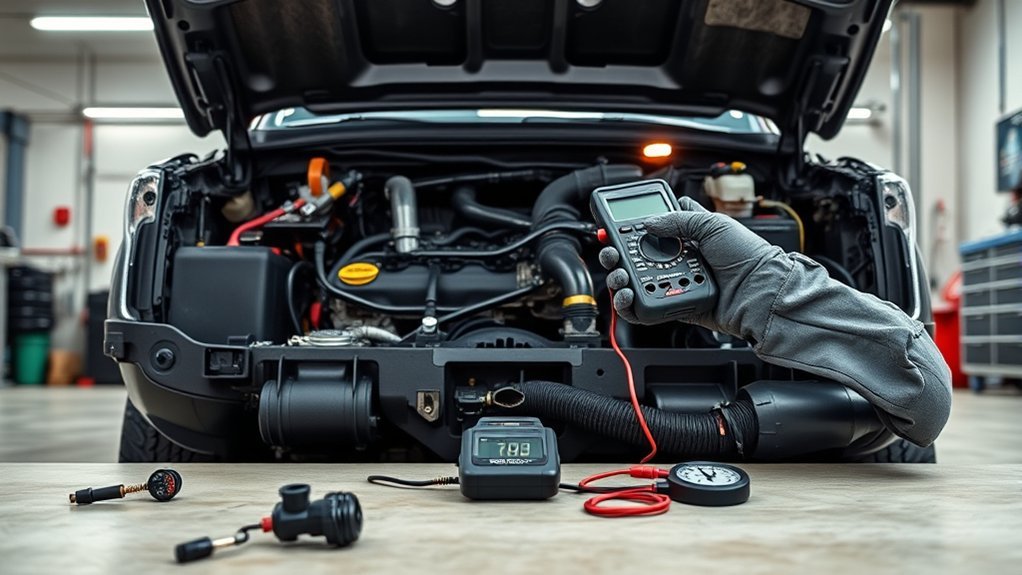
If your Toyota Tacoma cranks but won’t start, avoid replacing parts until you know whether the engine is missing fuel, spark, injector command, compression, or start authorization. Begin with the 12-volt battery, diagnostic trouble codes, security indicator, and model-specific fuses. Then move to fuel, ignition, sensor, and mechanical tests.
Quick Answer
If your Toyota Tacoma cranks but will not start, first confirm the 12-volt battery cranks the engine at normal speed, scan for trouble codes, and check the security light. Then test model-specific fuses, fuel pressure and injector command, spark, and compression. Avoid universal pressure numbers because Tacoma specifications vary by year and engine.
Key Takeaways
- A crank-no-start condition differs from a no-crank or slow-crank problem, so confirm what the engine is doing before testing parts.
- Scan for trouble codes and review engine-speed data before disconnecting the battery or clearing information.
- Fuel-pressure specifications, fuse labels, relay logic, and test points vary by model year and engine.
- Use an approved spark tester with fuel delivery disabled instead of exposing an ignition spark near gasoline vapor.
- Stop and seek professional help if you find a fuel leak, damaged high-current wiring, abnormal mechanical sounds, or an i-FORCE MAX high-voltage fault.
At a Glance
| Time Required | About 20 to 90 minutes for basic diagnosis |
| Difficulty | Beginner for visual checks; intermediate to advanced for circuit, pressure, spark, and compression testing |
| Tools Needed | OBD-II scan tool, digital multimeter, battery tester or charger, approved spark tester, compression gauge, and model-specific fuel-pressure equipment when required |
| Cost | Visual checks may cost nothing; diagnostic tools, towing, or professional labor add cost |
Warning: Work outdoors or in a well-ventilated area. Keep cigarettes, heaters, open flames, and loose sparks away from gasoline. Do not open a pressurized fuel system without the correct procedure. Keep hands, clothing, and test leads clear of belts, fans, and pulleys while someone cranks the engine.
Common Causes of a Tacoma Not Starting
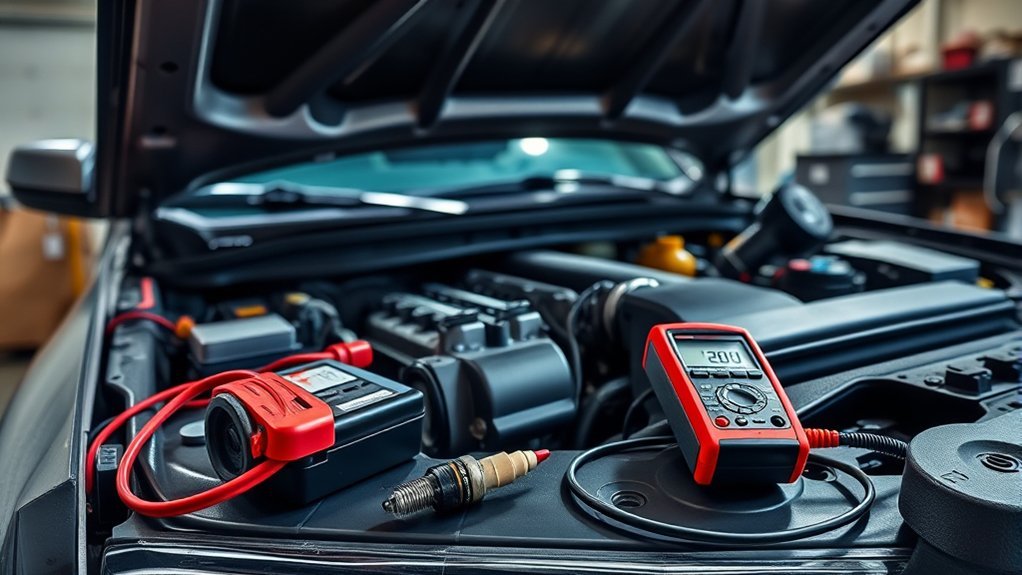
A Toyota Tacoma needs adequate cranking speed, start authorization, correctly timed spark, injector operation, fuel pressure, airflow, and compression. A failure in any one of these areas can let the starter turn the engine without allowing it to run.
- Weak 12-volt battery or poor connections: The starter may still turn while voltage drops too far for control modules, injectors, or ignition coils to operate correctly.
- Immobilizer or key problem: The engine may crank while the security system blocks injection or ignition authorization.
- Blown fuse, failed relay, or missing module power: A failed circuit can interrupt power to the engine control module, injectors, coils, or fuel pump.
- Fuel-delivery problem: Possible causes include insufficient pressure, a failed pump circuit, contaminated fuel, a restriction, or an incorrect sensor input.
- Ignition problem: Worn plugs, damaged coils, missing coil power, or absent timing signals can prevent a usable spark.
- Crankshaft or camshaft signal failure: The control module needs reliable position information to schedule spark and injection.
- Loss of compression or mechanical timing: A damaged timing component, valve problem, severe overheating event, or internal engine fault can cause a no-start.
- Major air-intake or metering problem: A blocked intake, disconnected duct, contaminated sensor, or severe vacuum leak may disrupt the air-fuel mixture.
- Damaged wiring: Rodents, corrosion, collision damage, poor repairs, and loose grounds can interrupt sensor or actuator circuits.
Note: Record the model year, engine, transmission, and whether the truck uses the i-FORCE MAX hybrid system. Fuse names, fuel-pressure specifications, sensor tests, and wiring paths differ between Tacoma configurations.
Step-by-Step Troubleshooting for Tacoma Starting Issues
Use a low-risk diagnostic order instead of jumping directly to the fuel pump or ignition coils. Each result should determine the next test.
A crank-no-start diagnosis becomes faster when you prove what the engine has and what it lacks before replacing any component.
- Confirm the symptom. Listen for normal cranking speed. A slow, uneven, or unusually fast cranking sound may point to a battery, starter, compression, or mechanical problem.
- Inspect the 12-volt battery. Check for loose terminals, corrosion, damaged cables, and poor engine or body grounds. Charge and test the battery when cranking appears slow.
- Scan the vehicle. Read stored, pending, and permanent diagnostic trouble codes before disconnecting the battery. Check all available modules, not only the engine module.
- Watch engine-speed data. If the scan tool shows no engine RPM while cranking, investigate the crankshaft-position signal, related wiring, module power, and scan-tool communication.
- Check the security indicator. An abnormal security-light pattern or key warning may indicate failed start authorization. Try a known registered spare key when one is available.
- Inspect model-specific fuses and relays. Use the fuse-box diagram and wiring information for your exact Tacoma. Confirm power and ground only under the operating condition specified for that circuit.
- Test fuel pressure and injector command. Use the correct adapter, pressure specification, and test condition. A pump sound does not prove pressure, and correct pressure does not prove the injectors are being commanded.
- Test for spark safely. Disable fuel delivery and use an approved inline or enclosed spark tester. Do not create an exposed spark near an open fuel system.
- Check compression and mechanical timing. Continue here when fuel, injector command, and spark are present but the engine still will not start.
Pro Tip: Save freeze-frame data and write down every code before clearing anything. That information may show engine temperature, RPM, voltage, and operating conditions present when the fault occurred.
Fuel System Evaluation: Ensuring Proper Fuel Delivery
Fuel diagnosis requires more than listening for a pump. You need to determine whether the pump is commanded, whether power reaches it, whether pressure meets the correct specification, and whether the injectors receive a usable command.
[Amazon Products Picked for You]
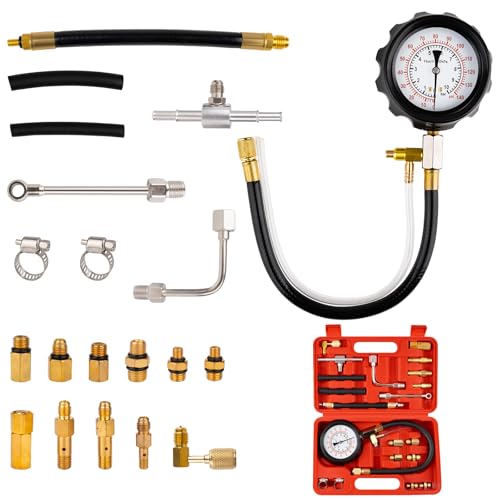
Compatibility Note: For further confirmation of specific model compatibility, refer to the vehicle owner's manual or contact a professional technician. Excludes Fo/rd, K/I/A, Bo/s/ch, C/I/S Je/tro/nic, G//M Th/rot/tle Bo/dy Systems, A/cu/ra, J/ee/p, B/M/W, Ni/s/san, and To/yo/ta fuel systems. Not compatible with small/non/standard S/chra/der vallves, high/pre/ssure direct in/ject/ed engines, or die//sel injection pumps. Verify your vehicle’s vallve size and pressure specs before purchase

FUEL INJECTION PRESSURE TESTER KIT: Fuel injection pressure kit is made of high quality materials which have good durability and reliability.
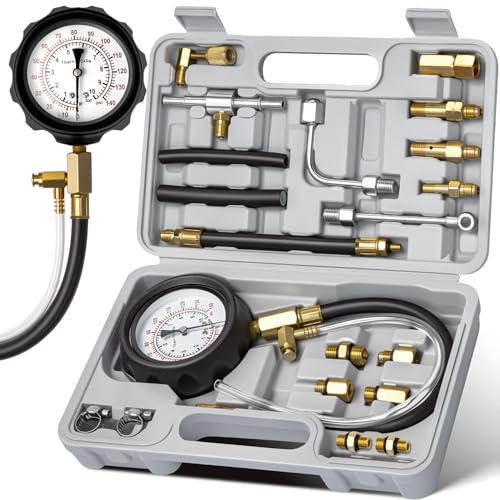
ACCURATE DUAL-SCALE GAUGE: Features a shock-resistant dry gauge with built-in damping mechanism, providing clear 0–140 PSI and 0–10 BAR dual scales for precise fuel system diagnostics
Fuel Pump Functionality Check
Do not condemn the fuel pump because you cannot hear it when the ignition is switched on. Pump-control behavior and sound level vary, and background noise may hide normal operation.
- Check relevant fuel, EFI, ignition, and engine-control fuses using the vehicle’s fuse diagram.
- Use a scan tool to look for fuel-pump, circuit, pressure, or communication codes.
- Test pump power and ground only at the correct connector and under the specified command or cranking condition.
- Inspect accessible wiring and connectors for corrosion, overheating, rodent damage, and loose terminals.
- Do not bypass a relay or apply power directly unless the model-specific service procedure permits it.
A pump can run but still fail to create enough pressure or volume. A silent pump can also result from a control, relay, wiring, ground, immobilizer, or module-power problem.
Fuel Pressure Verification
Use the pressure specification for the exact model year and engine. The original blanket ranges of 30–40 psi and 40–50 psi are not reliable for every Tacoma.
Some fuel systems provide an accessible test connection, while others require a model-specific adapter or service procedure. Follow Toyota repair information before opening a line or installing a gauge.
- Relieve fuel pressure using the approved method.
- Use equipment rated for gasoline and the expected system pressure.
- Inspect every connection for leakage before and during testing.
- Compare pressure during the exact condition required by the repair procedure, such as cranking, commanded pump operation, idle, or a residual-pressure test.
- Do not replace the pump until its power, ground, command, pressure, and related restrictions have been evaluated.
Low pressure may result from a weak pump, restricted pickup or filter, voltage loss, poor ground, leaking line, pressure-control fault, or an incorrect test setup. Excessive pressure can also produce starting and mixture problems.
Injector Signal Assessment
Correct fuel pressure does not confirm that fuel enters the cylinders. The injectors must receive power and a timed control signal.
- Use a compatible noid light, oscilloscope, or scan-tool test recommended for the injector circuit.
- Confirm injector power and control without shorting connector terminals.
- Check for an engine-speed signal because missing crank or cam data can stop injector command.
- Inspect shared injector-power circuits, grounds, and wiring before blaming several injectors at once.
- Consider flooded or fuel-fouled cylinders when plugs are wet and the engine has been cranked repeatedly.
Repeated cranking can discharge the battery, overheat the starter, and add more fuel to an already flooded engine. Pause between attempts and recharge the battery when needed.
What to Do If Fuel Delivery Is Normal
If pressure and injector command meet the correct specifications, move to ignition, engine-position signals, compression, and mechanical timing. Avoid repeating fuel tests that have already produced valid results.
| Component or Signal | Recommended Check | What the Result May Show |
|---|---|---|
| Spark output | Approved spark tester with fuel disabled | Whether usable spark reaches the plugs during cranking |
| Coil power and ground | Wiring diagram, multimeter, or oscilloscope | Shared power failure, ground problem, or control-signal loss |
| Crank and cam signals | Scan data, trouble codes, or waveform testing | Missing engine-position information or a correlation problem |
| Compression | Compression or relative-compression test | Cylinder sealing or mechanical timing trouble |
| Air intake | Inspect filter, ducting, throttle path, connectors, and major leaks | Restriction, disconnected duct, damaged wiring, or severe unmetered air |
Is Your Tacoma’s Ignition System Working?
A working ignition system needs more than undamaged spark plugs. The coils require correct power, ground, control signals, and engine-position data.
[Amazon Products Picked for You]

Compatibility: Ignition Coil Pack for 2005 2006 2007 2008 2009 2010 2011 2012 2013 2014 2015 Toyota Tacoma 4.0 V6 | 2003 2004 2005 2006 2007 2008 2009 Toyota 4Runner 4.0L V6 | 2007-2009 Toyota FJ Cruiser 4.0L V6 | 2005-2011 Toyota Tundra 4.0 V6

Vehicle Compatibility: Ignition Coils Pack of 4 compatible with 2000 2001 2002 2003 2004 Toyota Tacoma DLX Base Pre Runner with 2.4L and 2.7L L4 engines

This 6 pack DENSO Direct Ignition Coil is compatible with Toyota Tacoma 2015, 2014, 2013, 2012, 2011, 2010, 2009, 2008, 2007, 2006, 2005 4.0L V6
Check Spark Plug Condition
Remove spark plugs only when you can follow the correct procedure for the engine. Inspect them for fuel wetness, oil fouling, heavy deposits, cracked insulation, damaged electrodes, and an incorrect gap.
- Wet with gasoline: The cylinders may be flooded, or spark may be missing.
- Dry after repeated cranking: Fuel may not be reaching the cylinders.
- Oil fouling: An internal engine or ventilation problem may be present.
- Heavy wear or damage: Replace the plugs with the correct specification and investigate the cause.
Plug appearance provides clues, but it does not replace fuel-pressure, injector-command, spark, and compression tests.
Verify Ignition Coil Functionality
Disable fuel delivery before testing spark. Connect an approved spark tester according to its instructions, keep it away from open fuel connections, and have a helper crank the engine briefly.
When spark is missing from every cylinder, inspect shared coil power, grounds, crank and cam signals, immobilizer authorization, and engine-control power. When one cylinder lacks spark, compare its coil, connector, plug, and control signal with a working cylinder.
A simple resistance reading does not always prove a coil can produce adequate output under load. Use the test method specified for the truck’s ignition system.
| Check | Safe Diagnostic Action |
|---|---|
| Spark plugs | Inspect condition and test spark with an approved tester |
| Ignition coils | Check connector condition, shared power, ground, and control signal |
| Wiring | Inspect for corrosion, backed-out terminals, heat damage, and rodent damage |
| Crankshaft and camshaft signals | Check trouble codes, RPM data, synchronization data, and waveforms when available |
| Immobilizer authorization | Observe the security indicator and test a registered spare key |
Assess Crankshaft and Camshaft Signals
The engine-control module uses crankshaft and camshaft position information to control ignition and fuel injection. A missing or implausible signal can cause a crank-no-start condition.
- Check for crankshaft-position, camshaft-position, and correlation codes.
- Watch engine RPM on the scan tool while cranking.
- Inspect sensor connectors and nearby harnesses for oil, corrosion, rubbing, heat, or rodent damage.
- Use the specified waveform, voltage, resistance, or air-gap procedure for the exact sensor design.
- Do not replace a sensor based only on one generic resistance value.
If spark and injector command disappear together, a missing engine-position signal, immobilizer problem, module-power fault, or network issue becomes more likely than several failed coils and injectors.
Check Compression and Mechanical Timing
Fuel and spark cannot start an engine that lacks adequate compression or correct valve timing. Consider a mechanical test when the engine cranks unusually fast, sounds uneven, backfires, or has fuel and spark but never attempts to run.
- Perform a compression test using the correct disabling and cranking procedure.
- Use a relative-compression test when suitable equipment is available.
- Compare cylinders instead of relying only on an unsupported universal number.
- Investigate low readings with a leak-down test and mechanical-timing inspection.
- Stop cranking if you hear grinding, knocking, or other abnormal internal sounds.
A sudden no-start after engine work may also result from disconnected grounds, crossed connectors, incorrect timing, an unplugged airflow sensor, or a missed vacuum connection.
Test Your Tacoma’s Electrical Components: Fuses and Relays
Fuse names and circuit layouts differ across Tacoma generations. Use the diagram supplied for your truck rather than assuming every model has the same EFI, STA, ignition, or fuel-pump arrangement.
- Identify the correct fuse and relay from the owner information or wiring diagram.
- Inspect the fuse visually, then verify it electrically with a test light or multimeter.
- Test both fuse terminals while the circuit is supposed to be energized.
- Check relay command, power, ground, and output instead of judging the relay by sound alone.
- Inspect battery grounds, engine grounds, module grounds, and high-current connections.
- Look for overheated terminals, melted plastic, corrosion, water entry, and poorly installed accessories.
If the check-engine light does not illuminate when expected, treat that as a diagnostic clue rather than proof of a failed PCM. Check battery voltage, engine-control fuses, grounds, scan-tool communication, network faults, and instrument-cluster operation.
Use Toyota’s vehicle-specific manuals and Technical Information System when you need exact fuse locations, wiring diagrams, connector views, test conditions, and specifications.
[Amazon Products Picked for You]

EASY TO USE: The tester will automatically detect the pin position, the release time of the action, and the consistency of the relay in each test phase. If the tester lights up the green LED light, the relay is normal; if the red LED light is on, the relay is abnormal. The relay puller makes it easy to remove the relays to be tested. USA Patented

QUICKLY TEST RELAYS OUTSIDE OF THE VEHICLE to check coil and switch contact function

Improved test finds bad relays effectively
Check the Immobilizer and Key
A Tacoma may crank while the security system prevents normal starting. Observe the security indicator before and during the start attempt.
- Try a registered spare key when available.
- Move other electronic keys or transponders away from the ignition area.
- Check for key, immobilizer, certification ECU, or communication warnings.
- Scan immobilizer and body-control modules when the scan tool supports them.
- Do not attempt an immobilizer reset without the correct service procedure and ownership authorization.
A damaged key, low smart-key battery, antenna fault, lost registration, module replacement, or network problem can interfere with start authorization.
Check Recalls and Service Campaigns
Before purchasing expensive parts, check the truck’s VIN for open recalls and manufacturer campaigns. Year-and-model searches provide general results, while a VIN search identifies unrepaired recalls associated with a specific vehicle.
Use the NHTSA recall lookup and Toyota’s recall or service-campaign lookup. Recently announced recalls may take time to appear for every affected VIN, so check again when Toyota or NHTSA issues a relevant notice.
Special Warning for an i-FORCE MAX Tacoma
An i-FORCE MAX Tacoma combines a gasoline engine with high-voltage hybrid components. Its engine-starting operation and safety procedures differ from those of a conventional gasoline-only Tacoma.
Warning: Do not probe, disconnect, open, or repair orange high-voltage cables, the traction battery, inverter, motor-generator, or related connectors. High-voltage diagnosis requires specialized training, protective equipment, and approved test procedures.
You may inspect the 12-volt battery and follow owner-manual procedures, but hybrid-system faults should be handled by a qualified technician. Review NHTSA’s electric and hybrid vehicle safety guidance before working around an electrified powertrain.
Signs Your Tacoma Needs Professional Diagnostics
Basic checks can identify loose battery terminals, blown fuses, obvious wiring damage, or an abnormal security indicator. More advanced faults require proper service information and diagnostic equipment.
- Fuel is leaking or you smell strong gasoline.
- The engine cranks unevenly, unusually fast, or with grinding or knocking sounds.
- No scan tool can communicate with the engine-control module.
- Several modules report network or power-supply faults.
- Spark and injector command are both missing.
- Compression is low across multiple cylinders.
- Wiring is melted, heavily corroded, or damaged inside a harness.
- The problem began after collision damage, flooding, engine work, module replacement, or an aftermarket electrical installation.
- The truck uses an i-FORCE MAX hybrid system and reports a hybrid or high-voltage fault.
Professional diagnosis may include oscilloscope testing, bidirectional fuel-pump commands, injector-current analysis, pressure and volume testing, relative compression, leak-down testing, immobilizer data, and network diagnosis.
Related Guides
Frequently Asked Questions
Why is my Toyota Tacoma cranking but not starting?
The engine may be missing start authorization, adequate battery voltage, fuel pressure, injector command, spark, engine-position data, compression, or correct mechanical timing. Scan for codes and test each requirement instead of replacing parts based on symptoms alone.
Can a weak battery make a Tacoma crank but not start?
Yes. A weak battery may turn the starter while voltage drops too far for control modules, ignition coils, injectors, or relays to operate correctly. Check terminal condition, cranking speed, battery state of charge, and voltage behavior under load.
Should I hear the Tacoma’s fuel pump when I turn on the ignition?
Not hearing the pump does not prove it has failed. Pump-control strategy, vehicle configuration, sound insulation, and background noise can affect what you hear. Verify pump command, power, ground, and pressure using the correct model-specific procedure.
What fuel pressure should a Toyota Tacoma have?
No single pressure range applies to every Tacoma. The required pressure, connection method, and test condition depend on the model year, engine, and fuel system. Use Toyota repair information for your exact truck before connecting a gauge.
Can an immobilizer problem let the engine crank?
Yes. Some security faults allow the starter to operate while injection, ignition, or start authorization remains disabled. Watch the security indicator, scan the related modules, and try a registered spare key when available.
How do you diagnose a crank-no-start condition?
Confirm normal cranking speed, scan for codes, check security authorization and engine RPM data, inspect model-specific fuses, and test fuel pressure, injector command, spark, compression, and mechanical timing in that order.
When should I stop cranking the engine?
Stop if you smell leaking fuel, hear grinding or internal knocking, see smoke, notice overheated wiring, or the battery becomes weak. Use brief attempts with pauses so you do not overheat the starter or flood the cylinders.
Conclusion
If your Toyota Tacoma cranks but won’t start, begin with the battery, diagnostic codes, security indicator, engine-speed data, and model-specific fuses. Then determine whether the engine has correct fuel pressure, injector command, spark, compression, and mechanical timing.
Avoid assuming that one fuel-pressure range, fuse layout, or pump behavior applies to every Tacoma. Use the factory information for your exact model and stop when a test requires opening the fuel system, advanced electrical work, or contact with hybrid high-voltage components.
Sources
- Toyota Manuals and Warranties — vehicle-specific owner information and manual access
- Toyota Technical Information System — factory repair manuals, wiring diagrams, service bulletins, diagnostic information, and immobilizer resources
- NHTSA Recall Lookup — VIN-based safety recall information
- NHTSA Electric and Hybrid Vehicle Safety — high-voltage system and qualified-service guidance
- OSHA 29 CFR 1910.106 — flammable-liquid safety requirements
