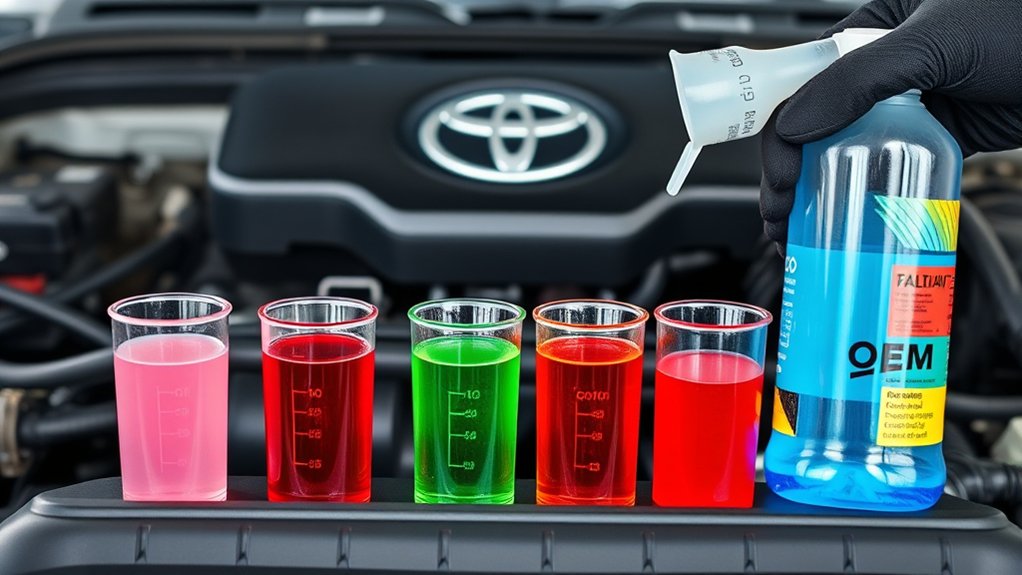
Your Toyota Tacoma needs coolant that matches the specification in its owner’s manual, not simply a familiar color. Toyota Super Long Life Coolant is common in late-model Tacomas, but the correct product, concentration, capacity, and replacement schedule can vary by model year, engine, and cooling system.
Quick Answer
For most late-model Toyota Tacomas, use Toyota Super Long Life Coolant or an equivalent ethylene-glycol coolant that meets Toyota’s hybrid-organic-acid specification. Check the manual for your exact truck. Do not dilute ready-to-use premix, mix unknown coolant formulas, or open a hot cooling system.
Key Takeaways
- Use the coolant specification listed for your Tacoma’s model year and engine. Color alone does not confirm compatibility.
- Toyota Super Long Life Coolant is commonly pink, but older or previously serviced Tacomas may use a different approved product.
- Toyota’s 2023 Tacoma guide calls for the first coolant replacement at 100,000 miles or 120 months, then every 50,000 miles or 60 months.
- Never add water to coolant labeled ready to use or premixed. Dilute concentrate only according to its label and the owner’s manual.
- A falling coolant level, overheating, steam, or visible contamination needs diagnosis rather than repeated topping off.
What Coolant Does a Toyota Tacoma Use?
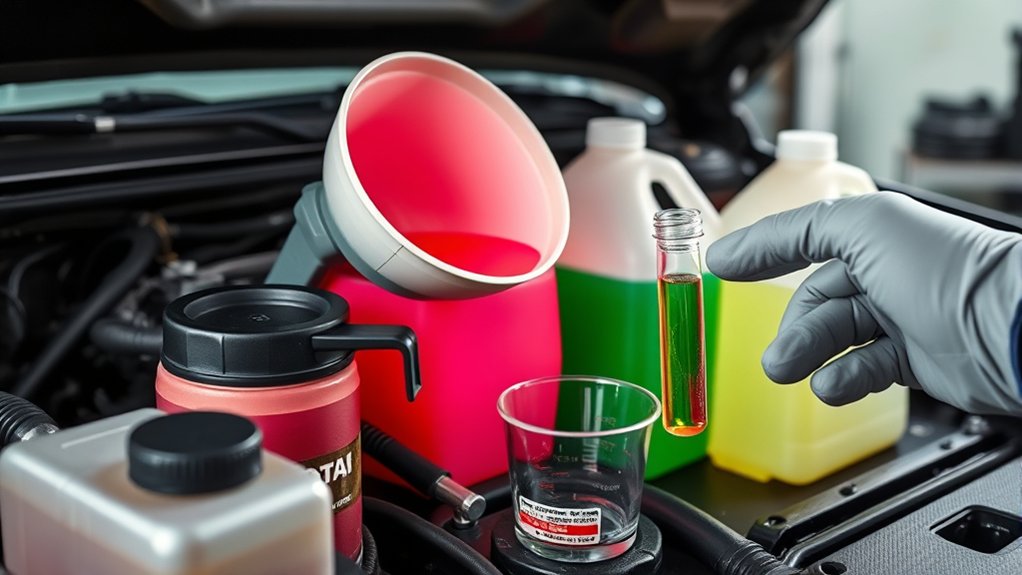
Many late-model Tacomas use Genuine Toyota Super Long Life Coolant, which is normally identified by its pink dye. Toyota also allows a similar high-quality ethylene-glycol coolant when it meets the specification listed in the truck’s manual.
For example, Toyota’s 2023 Tacoma Warranty and Maintenance Guide describes the approved equivalent as a non-silicate, non-amine, non-borate coolant using long-life hybrid organic acid technology. Toyota explains that this technology combines low phosphates with organic acids.
Do not select coolant by color alone. Pink, red, green, blue, or yellow dye can help identify a product, but manufacturers do not follow one universal color standard. Read the product label and confirm that its specification matches your Tacoma’s manual.
| What the Manual Specifies | What to Buy | Important Check |
|---|---|---|
| Toyota Super Long Life Coolant | Toyota SLLC or a clearly compatible equivalent | Confirm whether the container is premixed or concentrated. |
| Toyota Long Life Coolant | The specified Toyota LLC or a matching approved equivalent | Do not assume newer pink coolant follows the same mixing instructions. |
| A detailed chemical specification | An aftermarket coolant that lists the same specification | A generic “universal” claim is not enough unless compatibility is stated. |
| Unclear or unknown | Do not guess | Check the manual, VIN, dealer parts catalog, and service history first. |
Why Toyota’s Pink Super Long Life Coolant Is Different From Red or Green Coolant
Toyota Super Long Life Coolant uses a long-life hybrid organic acid formulation designed for compatible Toyota cooling-system materials. Toyota’s documented specification includes ethylene glycol, low phosphates, organic acids, and the absence of silicates, amines, and borates.
This description is more useful than calling the coolant plain OAT. It tells you which inhibitor system an aftermarket replacement needs to match.
Note: Coolant color is a visual identifier, not a technical standard. Two pink products can have different chemistry, while two differently colored products may meet a similar specification. Always verify the label and manual.
Premixed Coolant Versus Concentrate
Check the front and back labels before adding anything to the container:
- Ready-to-use or premixed coolant: Add it as supplied. Do not dilute it again.
- Concentrated coolant: Mix it only in the proportion stated on the label and approved by the owner’s manual.
- Unknown product: Do not pour it into the truck until you confirm its formulation and concentration.
Adding water to an existing 50/50 premix lowers its antifreeze and corrosion-protection concentration. Using undiluted concentrate can also produce an improper mixture. The label determines which procedure applies.
How Can I Confirm the Right Coolant for My Tacoma? (VIN, Manual, Part Numbers)
Use three checks before buying coolant: the owner’s manual, your Tacoma’s VIN, and the complete specification on the product label. These checks are more dependable than choosing a bottle because its dye looks similar to the coolant in the reservoir.
Check Your Owner’s Manual
Start with the cooling-system or maintenance section of your owner’s manual. It should identify the recommended coolant type, acceptable equivalent, concentration, replacement interval, and sometimes the system capacity.
You can select your model year through Toyota’s official manuals and warranties portal. Make sure you open the guide for the exact model year rather than relying on a schedule written for another Tacoma generation.
Use Your VIN Lookup
Your 17-character VIN identifies the truck’s production details. Give it to a Toyota parts department or enter it into an official parts catalog when the manual does not provide enough detail.
A VIN check is especially useful when:
- You recently bought the Tacoma used.
- The truck has an uncommon engine or powertrain.
- You do not know whether a previous owner changed coolant types.
- The product catalog lists several fluids or part-number revisions.
- Your Tacoma has more than one coolant reservoir or thermal-management circuit.
Match Part Numbers and Specifications
Toyota currently lists 00272-SLLC2 as a Genuine Toyota Super Long Life Coolant part number. A valid Toyota number confirms the product’s identity, but it does not replace a vehicle-fit check.
When comparing an aftermarket coolant, look for all of the following:
- An explicit statement of Toyota or Asian-vehicle compatibility
- The required ethylene-glycol base
- The correct hybrid-organic-acid inhibitor system
- Any required non-silicate, non-amine, and non-borate wording
- Clear premix or concentrate instructions
- A recommendation covering your Tacoma’s model year and engine
Can You Mix Coolants on a Tacoma? Risks and When to Flush
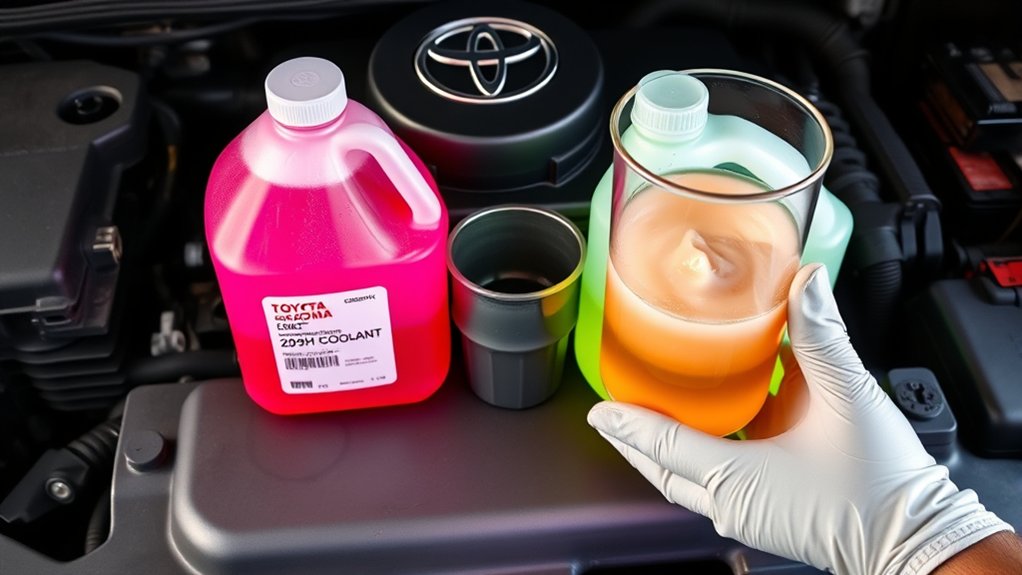
Avoid mixing coolant when you cannot confirm that both products meet the same specification. Mixing does not guarantee immediate damage, but it can weaken corrosion protection, shorten the service interval, alter freeze protection, or create deposits when the formulas are incompatible.
| Situation | Risk | Best Action |
|---|---|---|
| Same approved product and concentration | Low when the system is otherwise healthy | Top off to the cold-level mark. |
| Different colors but confirmed matching specification | Possible color change and uncertain service history | Follow the manufacturer’s compatibility instructions. |
| Unknown coolant already in the truck | Unknown concentration and inhibitor chemistry | Have the coolant identified or perform a proper drain and refill. |
| Visible sludge, oil, rust, or particles | Restricted flow, corrosion, or internal engine problems | Stop topping off and have the system inspected. |
| Wrong coolant was recently added | Compatibility and protection are uncertain | Contact a qualified technician before continued driving. |
Pro Tip: Photograph the coolant label and record the date, mileage, brand, product number, and concentration after service. This prevents uncertainty during the next top-off.
How Long Does Tacoma Coolant Last and When Should You Replace It?
The correct replacement interval depends on the Tacoma’s model year and the coolant used. Do not apply a generic two-year or 30,000-mile flush rule to every truck.
For a documented example, Toyota’s 2023 Tacoma maintenance guide schedules the initial coolant replacement at 100,000 miles or 120 months, whichever comes first. It then calls for replacement every 50,000 miles or 60 months. Toyota bases that schedule on Genuine Toyota Super Long Life Coolant or a qualifying equivalent.
For the 2023 Tacoma, Toyota schedules the first coolant replacement at 100,000 miles or 10 years, then every 50,000 miles or five years.
Your truck may use a different schedule. Check the guide for its exact model year, especially when the system contains an older coolant, an aftermarket formula, or an unknown mixture.
What Can Shorten Coolant Life?
Mileage and age are not the only reasons to service coolant. Arrange an inspection sooner when you find:
- Rust, sediment, gel, floating debris, or an oily film
- A weak freeze-protection reading
- Repeated coolant loss
- Leaking hoses, clamps, radiator seams, or water-pump areas
- Overheating or changing temperature readings
- Poor cabin heat accompanied by low coolant
- A recent repair that opened or contaminated the cooling system
- An unknown service history
Inspection Is Not the Same as Replacement
A technician can inspect the coolant level, condition, and freezing point without automatically replacing the fluid. Clean-looking coolant can still have an incorrect concentration, while discolored coolant may indicate contamination that requires diagnosis.
Use the scheduled interval as the normal replacement point, then adjust only when inspection results, repairs, contamination, or the model-specific manual justify earlier service.
How Much Coolant Does My Tacoma Need, and How Do I Top It Off Safely?
No single coolant-capacity number covers every Toyota Tacoma. Capacity changes with model year, engine, drivetrain, installed cooling equipment, and the number of cooling circuits.
The amount needed for a routine drain and refill may also be lower than the listed dry-system capacity. Coolant can remain inside the engine block, heater core, hoses, and other components after draining.
Find the exact figure in your owner’s manual, repair information, or VIN-based service data. Buy enough of the correct product to complete the job without substituting a different coolant halfway through.
At a Glance
| Time Required | About 10 to 15 minutes for a basic reservoir inspection and top-off |
| Difficulty | Easy, provided the engine is completely cool and the correct reservoir is identified |
| Tools Needed | Correct coolant, gloves, clean funnel, shop towel, and flashlight |
| Cost | Usually one coolant container for a small top-off; full-service requirements vary |
Warning: Never remove a radiator cap, pressure cap, or pressurized reservoir cap while the engine is hot. Hot coolant and steam can escape forcefully and cause severe burns. If the truck is overheating or steaming, stop safely, switch off the engine, and let it cool completely.
How to Top Off Tacoma Coolant
- Park on level ground. Turn off the engine and allow it to become completely cold.
- Confirm the correct product. Check the manual, coolant label, concentration, and existing service history.
- Identify the correct reservoir. Do not assume every translucent tank under the hood serves the engine cooling system.
- Inspect before adding fluid. Look for wet areas, dried coolant residue, cracked hoses, a loose cap, sludge, rust, or oil contamination.
- Read the cold-level marks. The coolant should sit between the appropriate LOW and FULL marks when the truck is cold.
- Add small amounts. Use a clean funnel and stop at the cold FULL line. Do not overfill.
- Secure the cap. Wipe away spills and confirm that the cap is fully seated.
- Monitor the level. Recheck it after normal driving and complete cooling. A second drop indicates a possible leak or trapped air.
Do not treat repeated topping off as routine maintenance. A sealed cooling system should not continually lose coolant.
Can You Add Water in an Emergency?
Clean water may provide temporary help during a true roadside emergency when the engine is fully cool and the correct coolant is unavailable. However, water alone reduces freeze, boiling, and corrosion protection.
Use it only as a temporary measure, avoid opening a hot system, and restore the correct concentration as soon as possible. If the truck overheated or lost a large amount of coolant, arrange an inspection before continued driving.
OEM Toyota vs. Aftermarket Coolants: Best Replacement Options for Tacomas
Genuine Toyota coolant offers the simplest match when the manual specifically calls for it. The container, formulation, and Toyota part information reduce the chance of selecting an incompatible product.
An aftermarket coolant can also work when its manufacturer clearly states that it meets the full Toyota specification for your truck. Toyota’s maintenance guide permits a similar high-quality coolant rather than stating that only Toyota-branded fluid can be used.
| Option | Advantages | What to Verify |
|---|---|---|
| Genuine Toyota coolant | Straightforward identification and Toyota catalog support | Vehicle fit, current part number, and premix or concentrate status |
| Toyota-compatible aftermarket coolant | Wider availability and potentially more package choices | Exact chemistry, model coverage, concentration, and manufacturer instructions |
| Generic universal coolant | Convenient availability | Do not use unless the label explicitly supports the required Toyota specification |
Avoid relying on advertising phrases such as “works with all colors.” The product should identify the required Toyota or Asian-vehicle application and provide enough technical information to compare it with the manual.
Special Caution for Hybrid-Equipped Tacomas
A hybrid-equipped Tacoma may have cooling components beyond the conventional engine system. Before adding coolant, identify the reservoir and circuit described in the exact owner’s manual.
Do not assume that every reservoir uses the same fill procedure, coolant quantity, or bleeding method. Incorrectly filling a hybrid thermal-management circuit can leave air trapped in the system or create an improper level. A Toyota dealer or hybrid-qualified technician should handle the service when the reservoir or procedure is unclear.
Signs of Coolant Problems on a Tacoma and Quick Troubleshooting Steps
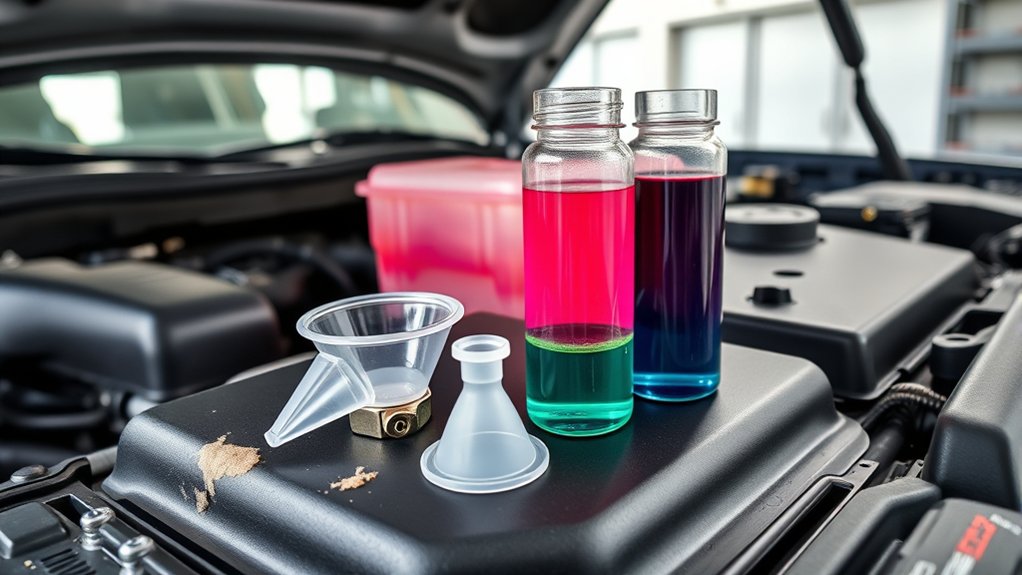
Check the cooling system promptly when the temperature reading changes, the heater stops working normally, coolant disappears, or residue appears under the hood. These symptoms can point to a leak, trapped air, restricted flow, a faulty cap, thermostat trouble, water-pump failure, or another cooling-system problem.
| Symptom | Possible Meaning | Immediate Action |
|---|---|---|
| Temperature warning, rising gauge, or steam | Low coolant, failed circulation, restricted airflow, or another serious fault | Stop safely, turn off the engine, and do not open the hot system. |
| Level repeatedly falls | External or internal leak | Inspect for residue and arrange a pressure test. |
| Sweet odor or colored residue | Seeping hose, radiator, cap, pump, or fitting | Keep children and pets away and locate the leak. |
| Rust, sludge, or floating particles | Contamination, corrosion, or incompatible products | Do not continue topping off. Have the system evaluated. |
| Milky or oily coolant | Possible oil or transmission-fluid contamination | Avoid driving and seek professional diagnosis. |
| Little cabin heat with a warm engine | Low coolant, trapped air, or heater-core flow problem | Check the cold level and arrange service if the condition continues. |
Coolant Handling and Disposal
Many automotive coolants contain ethylene glycol, which can produce severe poisoning if swallowed. Keep coolant in its original labeled container and away from children and pets. Clean spills promptly and never transfer coolant into a beverage or food container.
Collect drained coolant in a clean, sealable container. Do not pour it onto the ground, into a storm drain, or into household plumbing. Follow the product label and contact your local environmental or solid-waste agency for an approved collection site. The U.S. Environmental Protection Agency’s household hazardous waste guidance explains why potentially toxic household products require careful storage and disposal.
Related Guides
Frequently Asked Questions
Does Toyota require special coolant?
Toyota requires coolant that meets the specification in the vehicle’s manual. Genuine Toyota Super Long Life Coolant is one option for trucks that specify it. A high-quality aftermarket equivalent can also work when it matches Toyota’s required chemistry and vehicle application.
What color is Toyota Tacoma coolant?
Toyota Super Long Life Coolant is commonly pink. However, an older Tacoma or a previously serviced truck may contain red or another color. Use the owner’s manual and product specification rather than color alone.
Can you mix Toyota red and pink coolant?
Do not mix them based only on their Toyota branding or color. Check the specifications and manufacturer instructions. Mixing formulas can change the protection level or service interval. When the existing coolant is unknown, a proper drain and refill is safer than guessing.
Why do many Toyotas use pink coolant?
Pink dye identifies Toyota Super Long Life Coolant, while the protection comes from its approved ethylene-glycol and hybrid-organic-acid formulation. The chemistry, not the dye itself, determines whether the coolant suits your Tacoma.
Do you add water to Toyota Super Long Life Coolant?
Add water only when the container is a concentrate and its instructions require dilution. Do not add water to coolant labeled premixed, pre-diluted, or ready to use.
How often should Tacoma coolant be changed?
Follow the maintenance guide for your exact model year. As one documented example, Toyota’s 2023 Tacoma guide specifies the first replacement at 100,000 miles or 120 months and later replacements every 50,000 miles or 60 months.
Can universal coolant be used in a Tacoma?
Use it only when its manufacturer explicitly states that it meets the Toyota specification required for your model year and engine. A general claim that it mixes with every color does not prove full compatibility.
Why does my Tacoma keep losing coolant?
Repeated coolant loss can come from a leaking hose, cap, radiator, water pump, heater core, gasket, or another internal problem. Do not keep topping it off without finding the cause.
Conclusion
Use the coolant specification listed for your Tacoma’s exact model year, engine, and cooling system. Toyota Super Long Life Coolant is common in late-model trucks, but color alone cannot confirm compatibility.
Check whether the product is premixed or concentrated, avoid mixing unknown formulas, and use the model-specific maintenance interval. Let the engine cool completely before opening the system, and investigate any repeated coolant loss, contamination, steam, or overheating rather than relying on another top-off.
Sources
- Toyota 2023 Tacoma Warranty and Maintenance Guide — coolant specification, inspection guidance, and replacement intervals
- Toyota Manuals and Warranties — model-year owner’s manuals and maintenance guides
- Genuine Toyota Super Long Life Coolant — Toyota product identity and part number 00272-SLLC2
- CDC/NIOSH Ethylene Glycol Safety Information — ingestion and exposure hazards
- U.S. EPA Household Hazardous Waste Guidance — safe storage and disposal principles
