When your Toyota Tacoma’s check engine light turns on, the safest response depends on how the truck is running and whether the light is steady or flashing. Start by checking for severe symptoms, inspecting the fuel cap, and reading the stored OBD-II codes. Avoid replacing parts until testing confirms the cause.
Last updated: July 13, 2026.
Quick Answer
A steady Toyota Tacoma check engine light means the onboard diagnostic system detected an emissions-related fault. Check the fuel cap, note any symptoms, and read the stored codes. A flashing light, severe shaking, smoke, overheating, strong fuel odor, or major power loss calls for an immediate safe stop and professional help.
Key Takeaways
- A flashing check engine light can signal a malfunction that may damage the catalytic converter.
- A steady light still needs diagnosis, especially when the Tacoma has reduced power, rough running, smoke, overheating, or unusual noises.
- A trouble code identifies a detected condition or affected system. It does not automatically prove that a specific part has failed.
- Record the codes and freeze-frame data before clearing anything or disconnecting the battery.
- Use the owner’s manual and maintenance guide for your exact Tacoma model year and engine.
At a Glance
| Time Required | About 10–20 minutes for preliminary checks and code retrieval; repair time varies |
| Difficulty | Beginner for visual checks and reading codes; intermediate to advanced for testing and repairs |
| Tools Needed | OBD-II scanner, flashlight, phone or notepad, and the model-specific owner’s manual |
| Cost | Visual checks may cost nothing; scanner access, testing, parts, and labor vary by fault |
Understanding the Check Engine Light on Your Toyota Tacoma
Your Tacoma’s check engine light is also called the malfunction indicator lamp. The onboard diagnostic system monitors components that can affect emissions and stores information when it detects a fault.
The light can result from a minor sealing problem, an ignition misfire, an air-fuel control issue, a sensor circuit fault, or an emissions-system problem. The light alone does not identify which part needs replacement.
Steady Versus Flashing Check Engine Light
A steady check engine light means the system has detected a fault. You should arrange diagnosis soon, even when the truck appears to run normally. Do not assume that every steady light is harmless.
A flashing check engine light can indicate an active malfunction capable of damaging the catalytic converter. Reduce speed, avoid hard acceleration and towing, and stop safely when the Tacoma shakes, loses power, overheats, smokes, or produces a strong fuel odor.
Warning: Pull over and shut off the engine when a flashing light is accompanied by severe misfiring, smoke, overheating, a strong fuel smell, loud mechanical noise, or major power loss. Arrange towing when continued operation could damage the engine, catalytic converter, or another system.
Check Engine Light Versus Other Warning Lights
The check engine light is not the same as the maintenance reminder. A maintenance reminder normally indicates that scheduled service is due, while the check engine light means the diagnostic system detected a fault.
Red oil-pressure, charging-system, and high-temperature warnings may require more immediate action than a steady check engine light. Review the symbol and instructions in the Toyota warning-light guide and the manual for your exact model year.
Note: Tacoma engines, ignition systems, turbocharging equipment, and hybrid components differ by generation. Use Toyota’s manual selector before following model-specific procedures.
Common Causes of the Check Engine Light Activation
Many faults can activate the Toyota Tacoma check engine light. These are common categories, not confirmed diagnoses:
- Loose, damaged, or incorrectly installed fuel cap: A poor seal can create an evaporative-emissions leak.
- EVAP system leak: Cracked vapor hoses, valves, seals, or canister problems may trigger leak-related codes.
- Spark plug or ignition-coil fault: An ignition problem can cause rough running, reduced power, and a cylinder-misfire code.
- Fuel-delivery problem: Injector, pressure, or fuel-quality issues can disturb combustion.
- Intake leak or air-metering fault: Unmetered air, damaged wiring, or a faulty air-measurement sensor can affect fuel control.
- Air-fuel ratio or oxygen-sensor circuit problem: Sensor data, wiring faults, exhaust leaks, and engine problems can all affect readings.
- Catalyst-efficiency fault: A converter problem is possible, but misfires, exhaust leaks, fuel-control faults, and sensor issues must also be checked.
- Turbocharger or boost-control fault: Applicable turbocharged Tacoma models may set codes for boost, airflow, or related control problems.
- Electrical or connector problem: Corrosion, damaged wiring, loose grounds, or low system voltage can create misleading symptoms or codes.
A trouble code tells you what condition the computer detected. It does not automatically tell you which part to replace.
First Steps to Diagnose Your Check Engine Light Issue
Begin with safety and observation before opening the hood or connecting a scanner. Record when the light appeared, how the Tacoma was being driven, and whether another warning light came on at the same time.
[Amazon Products Picked for You]

CEL Doctor: The ANCEL AD310 is one of the best-selling OBD II scanners on the market and is recommended by Scotty Kilmer, a YouTuber and auto mechanic. It can easily determine the cause of the check engine light coming on. After repairing the vehicle's problems, it can quickly read and clear diagnostic trouble codes of emission system, read live data & hard memory data, view freeze frame, I/M monitor readiness and collect vehicle information

Understand Your Check Engine Light – The ANCEL AD410 OBD2 scanner helps everyday drivers quickly read and clear engine-related fault codes, view code definitions, and understand why the check engine light is on before visiting a repair shop. With 42,000+ built-in DTC lookups, this car code reader helps reduce guesswork and makes basic vehicle diagnostics easier for beginners and DIY users
Check for Urgent Symptoms
Stop driving and seek professional assistance when you notice any of these conditions:
- A flashing check engine light with severe shaking or stumbling
- Major loss of acceleration or inability to maintain a safe speed
- Overheating or a high-temperature warning
- A red oil-pressure warning
- Smoke, a strong raw-fuel odor, or signs of leaking fluid
- Loud knocking, grinding, or other new mechanical noises
If the light is steady and the truck runs normally, avoid hard acceleration, heavy loads, and towing until you identify the cause.
Check Gas Cap Tightness
Turn off the engine and inspect the fuel cap. Make sure it is installed correctly and tightened according to the owner’s manual. Look for a cracked seal, damaged threads, or dirt that could prevent proper sealing.
A loose or damaged cap can allow fuel vapor to escape and trigger an EVAP leak code. The light may not turn off immediately after you correct the cap because the system must rerun its monitor under the required driving conditions.
If the cap is secure and undamaged, continue with an OBD-II scan. Do not assume that every EVAP code comes from the cap.
Retrieve Diagnostic Trouble Codes
Connect a compatible OBD-II scanner and retrieve all stored, pending, and permanent diagnostic trouble codes that the tool can display. Record the exact code numbers before clearing anything.
The following examples show why a code must be treated as a starting point:
| DTC Example | Generic Description | Appropriate Next Step |
|---|---|---|
| P0420 | Catalyst system efficiency below threshold, Bank 1 | Check for misfires, exhaust leaks, fuel-control problems, and abnormal air-fuel or oxygen-sensor data before condemning the converter. |
| P0301 | Cylinder 1 misfire detected | Inspect the spark plug, ignition coil, injector, wiring, compression, and other causes affecting that cylinder. |
| P0455 | Large EVAP system leak detected | Inspect the fuel cap and visible EVAP connections. A smoke test may be needed to locate a leak. |
Some auto-parts stores offer basic code reading, although availability and included services vary. A code-reading service does not replace a complete diagnosis.
Pro Tip: Save the codes, freeze-frame data, fuel-trim readings, coolant temperature, engine speed, and vehicle speed before clearing the computer. That information may show the conditions present when the fault occurred.
How to Read Codes After Troubleshooting
Reading a code is only the first diagnostic step. You must connect the code to the symptoms, freeze-frame data, service information, visual inspection, and test results.
[Amazon Products Picked for You]

【Diagnose Check Engine Light in Seconds – No Mechanic Needed】The FOXWELL NT301 OBD2 scanner instantly reads & clears engine fault codes (DTCs) with one click. Simply plug into the 16-pin DLC port, turn ignition on, and get accurate results within seconds—No prior car knowledge required. Save hundreds on dealership fees by knowing exactly what’s wrong before you visit a shop. The #1 choice car scanner for DIYers and car owners who want to take control of their vehicle’s health
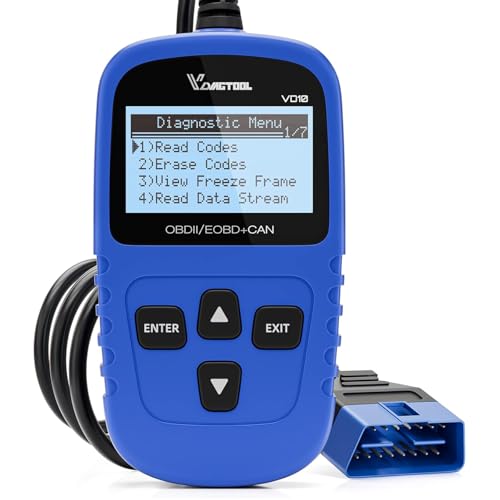
【A MUST-HAVE TOOL FOR DIYERS】 - VDIAGTOOL VD10 car code reader is an incredibly useful obd scanner for each car owner or hobbyist, even for those with little to no experience when it comes to vehicle mechanics! Similar to a fixd car diagnostic tool, using this car diagnostic scanner is extremely easy. All you have to do is attach it to your car OBDII port and you can diagnose car problems in seconds! Read Codes (DTCs); Clear Codes; Live Data; View Freeze Frame; I/M Readiness; Vehicle Information.
Use OBD-II Scanner
- Park safely, apply the parking brake, and turn off unnecessary electrical accessories.
- Locate the diagnostic connector, usually beneath the driver’s side of the dashboard. Its exact position can vary.
- Connect the scanner with the ignition off unless the scanner instructions say otherwise.
- Place the vehicle in the ignition-on, engine-off mode when requested by the tool. Follow the scanner and owner’s-manual instructions for push-button-start models.
- Read stored, pending, and permanent powertrain codes.
- Open the freeze-frame screen and save the available data.
- Check whether the scanner reports incomplete readiness monitors.
- Do not erase the codes until you have recorded the information and decided on the next diagnostic step.
Interpret Diagnostic Codes
The first letter identifies the broad system. A code beginning with “P” relates to the powertrain. Generic and manufacturer-specific codes can require different service information.
A pending code means the system detected a potential fault that has not yet met all conditions for a confirmed code. A confirmed or stored code has met the system’s criteria. A permanent code may remain after a repair until the vehicle completes the required monitor and confirms that the fault is gone.
Use the exact code, freeze-frame data, symptoms, and Tacoma-specific repair information together. For example, P0420 describes catalyst efficiency. It does not prove that installing a new catalytic converter will solve the problem.
Clearing the code or disconnecting the battery also resets diagnostic information and may change readiness-monitor status. That can make diagnosis harder and may delay an emissions inspection.
Seek Professional Help
Consult a qualified technician when the code requires electrical testing, smoke testing, fuel-pressure testing, compression testing, oscilloscope analysis, software updates, or manufacturer-specific scan-tool functions.
Professional diagnosis is also appropriate when the same code returns, several unrelated codes appear together, the light flashes, or the Tacoma has noticeable drivability problems.
Bring the technician your saved code list, freeze-frame data, symptom notes, recent repair history, and details about when the light appeared. This information can shorten the diagnostic process.
Why Diagnostic Tools Matter for Troubleshooting Your Tacoma
A basic code reader can show emissions-related codes, but a more capable scan tool may also display live data, freeze-frame information, readiness status, misfire counts, fuel trims, and manufacturer-specific modules.
- Stored and pending codes: Show which monitored conditions the vehicle has detected.
- Freeze-frame data: Captures selected operating conditions from the time a fault was recorded.
- Live data: Helps compare sensor readings while the engine runs.
- Readiness monitors: Show whether the vehicle has completed its emissions self-checks.
- Bidirectional tests: Available on some advanced tools and used by trained technicians to command certain components for testing.
More data does not automatically produce a diagnosis. Accurate troubleshooting still requires knowledge of the system, wiring diagrams, specifications, and suitable tests.
[Amazon Products Picked for You]

[Easy to Use—Work Out of the Box] + [FOXWELL 2026 New Version] FOXWELL NT604 Elite scan tool is the 2026 new version from FOXWELL, designed for car owners who want to figure out the cause of issues before fixing car problems by scanning common systems like ABS, SRS, engine, and transmission. The NT604 Elite obd2 scanner diagnostic tool comes with the latest software—no need to waste time downloading software first. Plug the scanner into the OBDII port with OBDII cable to start the diagnosis.

Turn your iPhone, Android device, or Windows PC into a professional grade diagnostic scan tool.

[Diagnose Like a Pro] BlueDriver Pro is a professional OBD2 scanner and diagnostic tool that helps you scan, understand, and clear vehicle trouble codes with confidence. Turn your phone into a powerful car diagnostic scanner—no guesswork, no unnecessary repairs.
When to Seek Professional Help for Your Check Engine Light?
Arrange immediate help when the light flashes or the truck runs badly. Stop and consider towing when you have severe shaking, smoke, overheating, major power loss, a strong fuel odor, a red warning light, or a loud mechanical noise.
A steady light with normal operation still deserves timely diagnosis. Continuing to drive for an extended period can increase emissions, reduce fuel economy, worsen drivability, or allow another component to be damaged.
Seek professional diagnosis when:
- The same code returns after a verified repair
- The light remains on and the cause is not clear
- The engine stalls, hesitates, runs roughly, or is difficult to start
- Several codes appear across different systems
- You suspect damaged wiring, a fuel-system problem, an exhaust leak, or internal engine trouble
- The repair requires programming, relearning, calibration, or manufacturer-specific equipment
Do not rely on a fixed number of miles for the light to reset. The required monitor may need several qualifying drive cycles with specific temperatures, speeds, fuel levels, and operating conditions.
You can also check your VIN through Toyota’s safety recall and service-campaign lookup. A recall lookup does not diagnose the check engine light, but it can identify an open campaign relevant to your vehicle.
Symptoms of Check Engine Light Issues
The check engine light may appear before you notice another symptom. In other cases, the truck’s behavior provides important clues about the type and severity of the problem.
The combination of the warning light, stored data, and driving symptoms is more useful than the code number by itself.
- Difficulty starting the engine
- Rough idle, shaking, or stalling
- Hesitation or delayed throttle response
- Reduced acceleration or a limited-power mode
- Poor fuel economy
- Fuel, exhaust, or sulfur-like odors
- Popping, knocking, ticking, or hissing sounds
- Visible exhaust smoke
- A flashing check engine light
Write down when each symptom occurs. Note whether the engine is cold or warm, the fuel level, outside temperature, road speed, load, recent refueling, and whether the truck is towing.
These details can help distinguish an intermittent electrical fault from a leak, ignition problem, fuel issue, or temperature-related failure.
Preventative Maintenance to Avoid Future Check Engine Light Problems
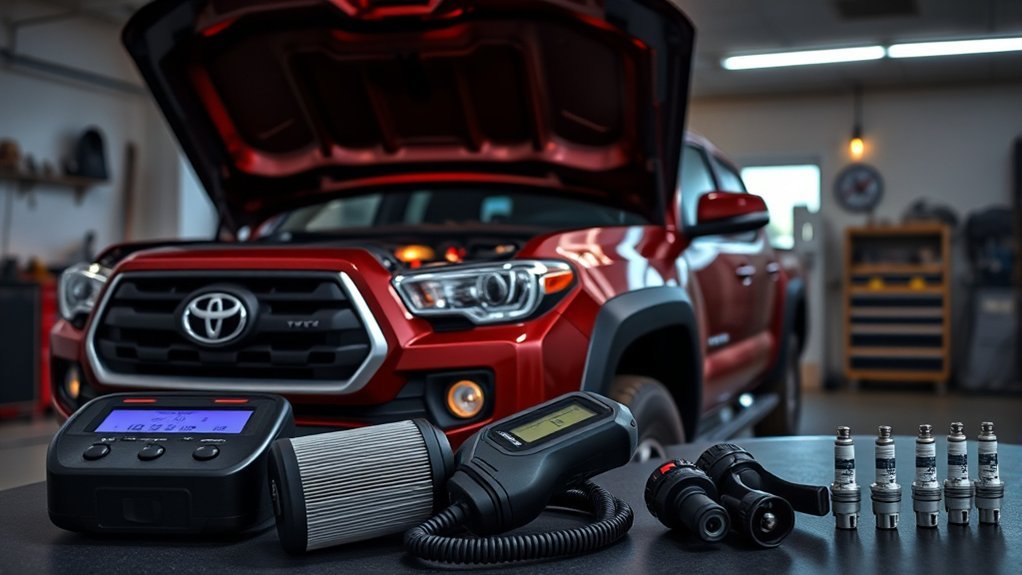
Routine maintenance cannot prevent every check engine light, but it can reduce faults caused by neglected filters, worn ignition parts, damaged hoses, low fluids, and missed service items.
| Maintenance Item | Recommended Approach |
|---|---|
| Fuel cap and seal | Install it correctly after refueling and inspect it when an EVAP-related code appears. |
| Engine oil and filter | Follow the exact interval, oil specification, and severe-service guidance in the model-year maintenance guide. |
| Engine air filter | Inspect and replace it according to Toyota’s schedule and more often when operating in dusty conditions. |
| Spark plugs | Use the interval and plug specification listed for the exact engine and model year. |
| Hoses, wiring, and connectors | Inspect during scheduled service and whenever codes, leaks, rodent damage, corrosion, or intermittent symptoms appear. |
| MAF, air-fuel, and oxygen sensors | Do not clean or replace them on a universal annual schedule. Test them when codes and live data support further diagnosis. |
| Software and service campaigns | Ask a Toyota service provider about applicable updates and check the VIN for open campaigns. |
Follow the Toyota maintenance guide for your exact Tacoma. A schedule written for another generation or engine may list the wrong interval, fluid, plug type, or inspection procedure.
When a check engine light appears, diagnose the cause before clearing it. Erasing the code without correcting the fault can hide useful evidence while the problem remains.
Related Guides
Frequently Asked Questions
Why is the check engine light on in my Toyota Tacoma?
The onboard diagnostic system detected a fault that can affect emissions or system monitoring. Possible causes include an EVAP leak, ignition misfire, intake leak, fuel-control issue, sensor circuit fault, exhaust leak, catalyst-efficiency problem, or an electrical issue. Read the stored codes and test the affected system before replacing parts.
What is the most common reason for a Toyota check engine light?
No single cause applies to every Toyota or Tacoma model year. A loose fuel cap is one simple possibility, but misfires, EVAP leaks, air-fuel control faults, and sensor or wiring problems are also common categories. The stored code and operating data provide a better starting point than guessing.
Can I drive my Toyota Tacoma with a check engine light?
A short, gentle drive to a safe location or repair facility may be reasonable when the light is steady and the truck runs normally. Stop driving when the light flashes or you notice severe shaking, overheating, smoke, a strong fuel odor, loud mechanical noise, a red warning light, or major power loss.
What does a solid check engine light mean?
A solid light means the diagnostic system has confirmed a fault and turned on the malfunction indicator lamp. It does not reveal the fault’s severity by itself. Check for other warning lights and symptoms, then retrieve the stored codes and arrange diagnosis.
Will tightening the gas cap turn off the check engine light?
It may turn off after the EVAP monitor reruns and confirms that the system seals correctly. This can take several qualifying drive cycles. If the light remains on, read the codes because the cap may be damaged or another EVAP fault may be present.
Does clearing an OBD-II code fix the problem?
No. Clearing a code only erases stored diagnostic information and turns off the light temporarily. The light can return when the system detects the fault again. Clearing codes can also reset readiness monitors and remove freeze-frame data needed for diagnosis.
Conclusion
A Toyota Tacoma check engine light deserves a methodical response rather than panic or guesswork. First, decide whether the symptoms make continued driving unsafe. Then inspect the fuel cap, retrieve every available code, save the freeze-frame data, and use model-specific information to test the affected system.
A flashing light or severe drivability problem requires immediate attention. A steady light may give you time to arrange diagnosis, but it should not be ignored. Accurate testing helps you correct the cause without replacing good parts or overlooking a more serious fault.
Sources
- Toyota Warning Lights — official guidance on Toyota dashboard indicators and consulting the owner’s manual.
- Toyota Manuals and Warranties — model-year-specific owner’s manuals and maintenance information.
- California Air Resources Board OBD II Fact Sheet — check engine light behavior, OBD monitoring, blinking-light risks, and readiness information.
- California Air Resources Board OBD Program — how onboard diagnostics monitor emissions-related components and store malfunction information.
- Toyota Recall and Service Campaign Lookup — VIN-based lookup for open Toyota safety recalls and service campaigns.
