
A Toyota Camry tire pressure warning light usually means one or more tires are significantly underinflated. If the light flashes for 60 to 90 seconds and then stays on, the Tire Pressure Monitoring System (TPMS) has detected a malfunction. Move to a safe place, inspect all four tires, and check them with a gauge against the cold PSI on the Tire and Loading Information label inside the driver-side doorjamb.
Last updated: September 11, 2026. This guide was checked against current Toyota owner guidance, NHTSA TireWise, and federal TPMS requirements.
Quick Answer
A solid Toyota Camry tire pressure light usually means at least one tire is significantly underinflated. Stop safely, inspect the tires, then check all four with a gauge and inflate them to the cold PSI on the driver-door placard. If the light flashes for 60 to 90 seconds and then stays on, or remains on after the pressures are correct and you have followed the model-specific update procedure, have the TPMS inspected.
Key Takeaways
- Use the cold tire pressure printed on your Camry’s driver-door placard, not a generic PSI range or the maximum pressure molded into the tire.
- A steady light usually means low pressure. A light that flashes for 60 to 90 seconds and then remains on points to a TPMS malfunction.
- Inspect all four tires for punctures, bulges, cuts, valve leaks, or rapid pressure loss before driving farther.
- Reset and initialization procedures vary by Camry model year, so avoid generic reset instructions that are not in your owner’s manual.
At a Glance
| Time Required | About 10 to 20 minutes for a basic inspection, pressure adjustment, and recheck; leak or TPMS diagnosis takes longer |
| Difficulty | Basic pressure checking is straightforward; tire damage or a TPMS fault may require professional service |
| Tools Needed | Accurate tire pressure gauge, air compressor or inflator, and a flashlight |
| Cost | No service cost if you already have a gauge and inflator; tool purchase and leak or TPMS repair costs vary |
What Does the Toyota Camry Tire Pressure Warning Light Mean?

Toyota’s warning-light guidance says the tire pressure warning light can indicate low tire inflation pressure or a malfunction in the tire pressure warning system. Your Camry’s TPMS is an early warning system, but it does not replace regular checks with a tire pressure gauge.
| Warning behavior | Likely meaning | What to do |
|---|---|---|
| Steady light | At least one tire is likely significantly underinflated. | Inspect all tires and check their pressure as soon as it is safe. |
| Flashes for 60 to 90 seconds, then stays on | The TPMS has detected a malfunction. | Check pressure manually and arrange TPMS diagnosis. |
| Comes on during a cold morning, then turns off | One or more tires may be close to the warning threshold and lose pressure as the temperature falls. | Check and adjust the tires while cold instead of waiting for the light to return. |
Under federal TPMS rules, the system must warn by the time one or more tires reaches the higher of 25% below the vehicle manufacturer’s recommended cold pressure or the applicable minimum pressure in the standard. A vehicle may warn sooner. That means a tire can still be underinflated before the dashboard light appears. The National Highway Traffic Safety Administration recommends checking tire pressure with an accurate gauge at least once a month.
Note: The TPMS warning threshold is not your inflation target. Inflate each tire to the cold PSI listed on the vehicle placard, even if the warning light has not appeared.
Why Does a Toyota Camry Tire Pressure Light Come On?
A tire may lose pressure because of temperature changes, ordinary air permeation, or physical damage. If the same tire repeatedly becomes low, treat it as a possible leak rather than continuing to add air.
| Cause | What you may notice |
|---|---|
| Falling temperature | Several tires read slightly low after a cold night, especially if they were already near the lower limit. |
| Nail, screw, or tread puncture | One tire loses pressure repeatedly or more quickly than the others. |
| Valve core or valve-stem leak | Air escapes near the valve, or the stem is cracked, loose, bent, or damaged. |
| Bead or wheel leak | Pressure falls because the tire does not seal correctly against a corroded, bent, or damaged wheel. |
| Impact damage | A pothole or curb strike leaves a bulge, cut, bent rim, vibration, or rapid air loss. |
| Normal gradual air loss | All tires lose small amounts over time and need periodic adjustment. |
| TPMS sensor or registration problem | The light flashes, remains on with correct pressures, or appears after tire, wheel, or sensor service. |
Immediate Actions When the Tire Pressure Light Comes On
Do not make a sudden stop in traffic. Reduce speed, avoid sharp steering or hard braking, and move to a safe, level location where you can inspect the vehicle.
- Pay attention to the car’s behavior. Pull over promptly if the Camry pulls to one side, vibrates, feels unstable, or makes a flapping or thumping sound.
- Inspect all four road tires. Look for a visibly flat tire, sidewall bulge, deep cut, exposed cords, lodged object, or wheel damage.
- Find the vehicle’s correct pressure. Read the Tire and Loading Information label on the driver-side doorjamb.
- Measure each tire. Use a gauge even when the tires look normal. Visual inspection alone cannot reliably identify moderate underinflation.
- Add air where needed. Inflate to the placard pressure and recheck with the gauge.
- Watch for recurring pressure loss. A tire that becomes low again needs leak inspection and repair.
Warning: Do not continue driving on a visibly flat tire, a tire with sidewall damage or exposed cords, or a tire that is losing air rapidly. Do not drive if the Camry is difficult to control. Install the spare if it is safe and you know how, or request roadside assistance.
[Amazon Products Picked for You]

TRUSTED BY OVER 3 MILLION USERS: Based in Garden Grove, California, AstroAI serves customers in more than 15 countries worldwide. Known for professional-grade accuracy and durable construction, this digital tire inflator with gauge is a trusted choice for drivers, mechanics, and DIYers who rely on dependable tools.

Advanced accuracy: Professionally calibrated tire pressure gauges for cars. Accurately measures from 0-100 PSI with a resolution of +/-1 PSI.

RAPID INFLATION & ROAD-READY PORTABILITY: Powerful 120W motor delivers up to 35L/min airflow—inflates a standard car tire (195/65 R15) from 30 to 36 PSI in under 1 minute under ideal operating conditions. Weighs only 2.2 lbs and fits glove compartments or trunks for daily commutes, road trips, and emergencies. Plugs into standard 12V DC car outlet with 15A fuse protection. AIRUN H features its cordless counterpart H2 Pro.
How to Check and Inflate Your Camry’s Tires Properly
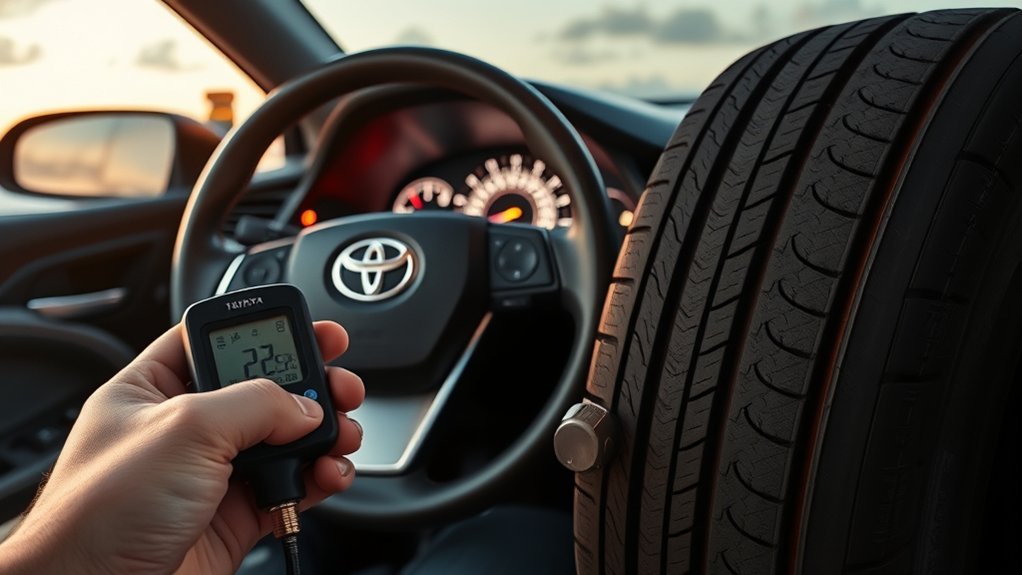
For the most accurate result, check the tires when they are cold. NHTSA defines cold tires as tires on a vehicle that has been parked for at least three hours. If you must add air after driving, inflate an underinflated tire to the vehicle’s recommended cold pressure as a temporary measure, then recheck and adjust it once the tire is cold. Do not bleed a warm tire down simply because its reading is above the cold specification.
- Park on level ground. Set the parking brake and switch off the vehicle.
- Read the driver-door placard. Note the recommended cold pressure for the front and rear tires. The values may not always be identical.
- Remove one valve cap. Keep it in a clean, safe place so dirt does not enter the valve.
- Press the gauge firmly onto the valve. A brief hiss is normal, but continued hissing means the gauge is not seated correctly.
- Compare the reading with the placard. Add air in short bursts if the pressure is low.
- Release excess air only from a cold tire. If a cold tire is above the placard specification, press the valve core briefly and measure again. Do not bleed a warm tire down to the cold placard pressure.
- Reinstall the valve cap. Repeat the process on all four tires, not only the one you suspect is low.
- Check the spare if equipped. The spare may require a different pressure and may not be monitored by the TPMS.
Warning: Do not use the maximum pressure molded into the tire sidewall as your normal inflation target. Use the vehicle manufacturer’s cold-pressure specification on the driver-door placard.
Pro Tip: Keep a digital or dial tire gauge in the glove box and take a clear photo of the doorjamb pressure label. You will have the correct values available even when lighting is poor or the label becomes dirty.
TPMS is a warning system, not a replacement for monthly pressure checks with an accurate gauge.
[Amazon Products Picked for You]
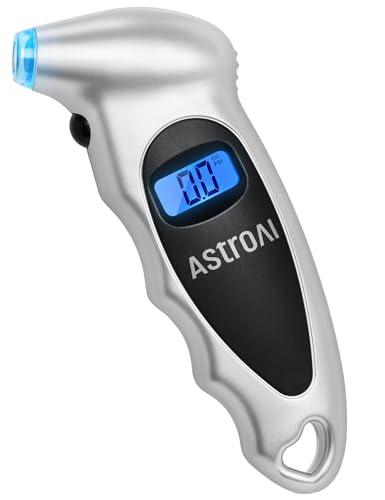
Accurate, Dependable Readings: Factory‑calibrated to ±1 PSI, so you can confidently match your vehicle’s recommended PSI (check the door jamb sticker). Ideal for monthly checks and road trips — consistent results every time, cold or warm.

EXPERT-GRADE CALIBRATION: Each AstroAI Tire Pressure Gauge is calibrated with professional-grade tools, ensuring quick and accurate measurement results within plus-minus 1PSI. Stay prepared for any roadside emergency and travel with peace of mind.

【Accurate Digital Tire Gauge】Safeguard your every trip. HYVOHEX tire pressure gauge is certified by ANSI B40.7 Grade 2A standard and equipped with a high-sensitivity sensor to provide you with instant, error-free results (±0.1 PSI). The intelligent anti-interference chip ensures stable operation in extreme temperatures (-4°F-130°F). Whether it is daily commuting or long-distance driving, you can always know the tire condition
How to Reset the Toyota Camry Tire Pressure Light
First correct the reason the light came on. Resetting or initializing the system while a tire is still low can store an incorrect reference pressure or hide a problem temporarily.
- Set all four road tires to the cold pressures listed on the driver-door placard.
- Switch the vehicle on and check whether the light turns off after the system receives updated pressure readings.
- If initialization is required, follow the instructions for your exact Camry year. Depending on the vehicle, the control may be a physical reset switch or an option in the multi-information display.
- Drive only as directed by the model-specific owner’s manual so the system can update.
- If the light flashes or remains on after the pressures are correct, arrange a TPMS inspection instead of repeatedly resetting it.
Pressure initialization and sensor registration are separate procedures on Camrys that provide both functions. Initialization establishes the pressure reference; it does not repair a failed sensor or communication fault. If a tire-pressure sensor or wheel was replaced, follow the procedure for your exact model year or have a TPMS-equipped shop confirm the sensor IDs.
Note: There is no single reset procedure that fits every Toyota Camry. Do not assume a generic “drive at 50 mph for ten minutes” method applies to your vehicle. Select your model year through the official Toyota manual lookup and follow its TPMS instructions.
How to Find Which Camry Tire Is Low
Some Camry displays can show individual tire pressures or identify a tire position, while other versions provide only the general warning light. The available display depends on the model year and equipment.
If your dashboard does not identify a tire, check every tire with a gauge. Do not rely on appearance alone because a radial tire can be significantly underinflated without looking flat. Compare the readings and inspect the lowest tire for a puncture, leaking valve, wheel damage, or bead leak.
Check all four tires even after finding one low reading. A seasonal temperature drop may lower several tires at the same time.
[Amazon Products Picked for You]

RUGGED DESIGN: The stainless steel components prevent rust and corrosion while the precision-crafted nozzle seamlessly seals onto the valve stems for highly accurate readings (±2% span). We also provide 4 valve stem caps for convenient replacement.

HIGH ACCURACY: Every ETENWOLF's pencil tire gauge is calibrated to ANSI B40.1 Grade B, it is accurate to 2% of span in the middle 50% of range and 3% of span in the lower and upper 25% of range. Each ETENWOLF pencil tire pressure gauge is manually calibrated and has its unique calibration number printed on the pencil

PROCESS LEVEL ACCURACY: This heavy duty tire pressure gauge is calibrated manually to ANSI B40.1 Grade A (±1% of span)
When to Get Help for Your TPMS Problems
Have the tire or TPMS inspected by a Toyota dealer or qualified TPMS-equipped tire shop when any of these conditions occur:
- The warning light flashes for 60 to 90 seconds and then remains illuminated.
- A tire loses pressure again within hours or days after inflation.
- You find a nail, screw, bulge, deep cut, exposed cords, or damaged wheel.
- The warning appeared after tires, wheels, valve stems, or TPMS sensors were replaced.
- The pressures match the placard but the light does not clear after the model-specific update procedure.
- The dashboard pressure reading differs substantially from an accurate hand gauge.
- The vehicle vibrates, pulls, handles poorly, or makes an unusual tire noise.
A technician can test the sensor signals, check sensor identification and registration, inspect the valve assemblies, and locate slow leaks at the tread, bead, valve, or wheel.
How to Prevent the Warning Light From Returning
- Check all road tires at least once a month while they are cold, and check the spare if equipped.
- Check them again before long trips and after a major temperature change.
- Keep valve caps installed to protect the valve cores from dirt and moisture.
- Inspect the tread and sidewalls for punctures, cracking, bulges, and uneven wear.
- Have recurring pressure loss repaired instead of repeatedly adding air.
- Tell the tire shop that the vehicle has TPMS when replacing tires, wheels, or valve components.
Correct inflation also helps reduce rolling resistance. According to FuelEconomy.gov, keeping tires at the proper pressure can improve gas mileage by about 0.6% on average and by up to 3% in some cases. It also estimates that underinflation can reduce gas mileage by about 0.2% for every 1 psi drop in the average pressure of all tires.
Related Toyota Camry TPMS Guides
- Toyota Camry tire pressure light blinking — focused troubleshooting for the flashing-then-steady malfunction pattern.
- How to set tire pressure on a Toyota Camry — a focused guide to the door-placard PSI and pressure-setting process.
- Camry TPMS light stays on after airing tires — troubleshooting when correct inflation does not clear the warning.
Related Guides
Frequently Asked Questions
Why is my Toyota Camry tire pressure light on when the tires look fine?
A tire can be significantly underinflated without looking flat. Check all four tires with a gauge and compare them with the driver-door placard. If the pressures are correct, possible causes include a slow leak, recent temperature change, failed sensor, damaged valve stem, or sensor registration problem.
Can I drive my Camry with the tire pressure light on?
Inspect the tires before driving farther. Do not drive on a visibly flat or damaged tire, or when the car vibrates, pulls, or feels unstable. If a tire is only slightly low and has no visible damage, add air before continuing or drive cautiously to the nearest safe inflation or service location.
Why does the tire pressure light return during cold weather?
Air pressure falls as ambient temperature falls. Tires that were already close to the warning threshold may trigger the light after a cold night. Check them while cold and adjust them to the door-placard specification rather than waiting for warmer driving temperatures to turn the light off.
How do I know which tire is low on a Toyota Camry?
Check the multi-information display to see whether your Camry shows individual pressure readings. If it does not, measure every tire with a gauge. The lowest reading usually identifies the problem, but all tires should still be adjusted to their specified cold pressures.
Why is the Toyota Camry tire pressure light flashing?
A light that flashes for about 60 to 90 seconds and then remains on indicates a TPMS malfunction. Possible causes include a failed sensor, damaged sensor or valve assembly, an unregistered replacement sensor, an incompatible replacement wheel or tire setup, or a communication fault. Check the tires manually and schedule diagnosis.
Why is the light still on after I inflated the tires?
One tire may still be below its placard pressure, the reading may have been taken while the tire was warm, or the vehicle may need its model-specific update or initialization process. A slow leak or TPMS malfunction is also possible. Recheck all tires cold before attempting another reset.
What PSI should my Toyota Camry tires be?
There is no single tire-pressure number that applies to every Toyota Camry. Use the recommended cold PSI printed on the Tire and Loading Information label inside your driver-side doorjamb. The front and rear specifications may differ. Do not use the maximum pressure molded into the tire sidewall as the normal target.
Do I need to reset the Camry TPMS after adding air?
Do not reset the TPMS before correcting the tire pressures. Set every road tire to its specified cold pressure and give the system time to update. If the warning does not clear, follow the initialization instructions for your exact Camry model year. A light that flashes for about a minute and then stays on indicates a malfunction that needs diagnosis rather than repeated resetting.
Conclusion
When your Toyota Camry’s tire pressure warning light comes on, inspect the tires and check all four pressures against the cold PSI on the driver-door placard. Never use the tire sidewall maximum as the normal target, and do not bleed a warm tire down to the cold specification. Stop driving if a tire is flat, damaged, rapidly losing air, or affecting vehicle control. If the pressures are correct but the light flashes or remains on, follow the instructions for your exact Camry year and arrange professional TPMS diagnosis when needed.
Sources
- Toyota Manuals and Warranties — model-year-specific owner’s manuals and TPMS procedures
- Toyota Warning Lights — official Toyota warning-light guidance and manual lookup
- NHTSA TireWise — cold-pressure checks, TPMS behavior, tire inspection, and safety guidance
- 49 CFR § 571.138 — federal TPMS warning and malfunction-indicator requirements
- FuelEconomy.gov — proper inflation and fuel-economy information
