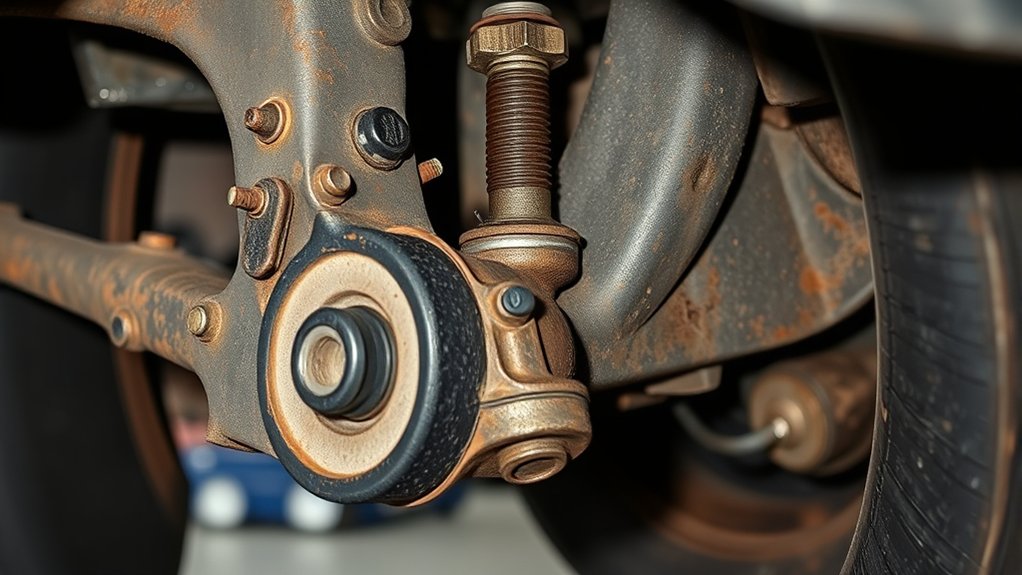
Common Toyota Camry ball joint symptoms include front-end clunks over bumps or during turns, loose or wandering steering, uneven front-tire wear, and abnormal wheel movement. A damaged dust boot or grease around the joint is stronger visual evidence, but none of these signs proves the ball joint is bad because tie rods, control-arm bushings, strut mounts, wheel bearings, tires, and alignment problems can feel similar. If a wheel tilts, steering changes suddenly, or heavy banging and instability develop, stop driving and arrange a tow.
Last updated: September 22, 2026 — Toyota repair-information links, NHTSA guidance, recall information, and current repair-cost data were rechecked.
Verification note: This is a source-based diagnostic guide. It does not claim that one symptom, mileage, home test, or inspection limit applies to every Toyota Camry generation. Use the repair procedure for your exact model year and VIN.
Quick Answer
A failing Toyota Camry ball joint may cause front-end clunks over bumps or turns, wandering steering, uneven tire wear, or looseness at the wheel. Stop driving and arrange a tow if a wheel tilts, steering changes suddenly, or severe knocking and instability develop. A technician should test the joint using the procedure for your Camry’s exact model year; that may include checking looseness, dust-cover condition, abnormal movement, or specified turning torque.
Key Takeaways
- Clunking, wandering, vibration, and uneven tire wear are possible ball-joint symptoms, not a complete diagnosis.
- There is no dependable universal mileage at which every Toyota Camry ball joint must be replaced.
- A damaged dust boot, grease at the joint, confirmed looseness, or abnormal wheel movement provides stronger evidence than noise alone.
- Do not drive if the wheel is visibly tilted, the steering changes suddenly, or the suspension feels unstable.
- Certain 2014 Camry and Camry Hybrid vehicles were included in NHTSA campaign 14V715000 involving the left front lower control arm’s connection to the lower ball joint; check your VIN for coverage.
- Inspection and replacement procedures depend on the Camry’s model year and suspension design.
What Are the Symptoms of a Bad Toyota Camry Ball Joint?
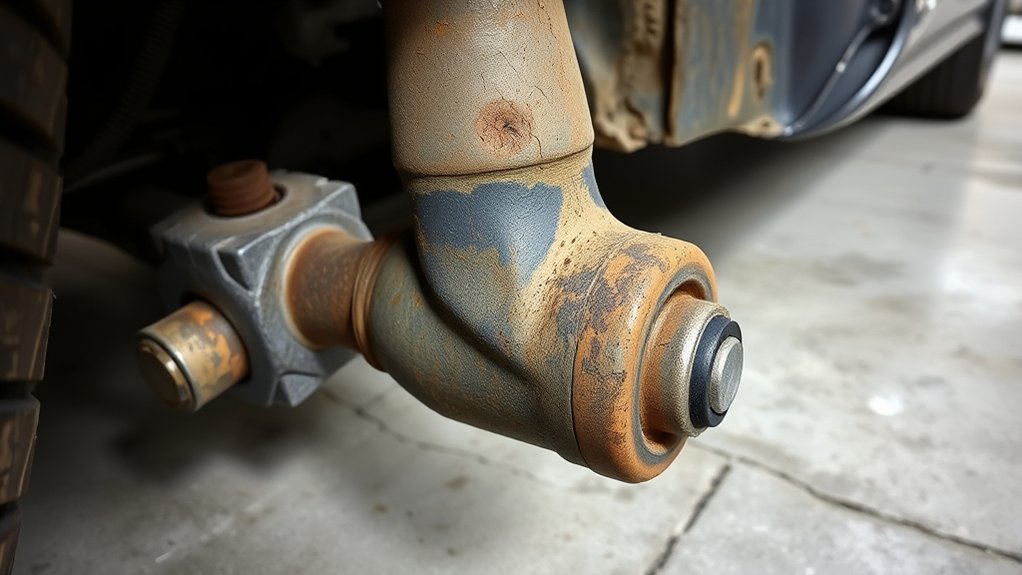
A worn ball joint usually creates one or more changes in noise, steering, wheel movement, or tire wear. The symptoms often begin gradually, so compare what you feel now with how your Camry normally drives.
- Clunking or knocking over bumps: A loose joint may move inside its socket when suspension loads change.
- Popping or creaking during turns: A worn or contaminated joint can make noise as steering and suspension loads shift.
- Loose or wandering steering: Excess movement may make the car feel less precise or require frequent correction.
- Uneven tire wear: A worn suspension component can allow alignment angles to change, although tire pressure and other alignment faults can cause similar patterns.
- Steering-wheel or body vibration: This deserves inspection but is not specific to a ball joint. Tire balance, a damaged wheel, a wheel bearing, an axle, or another suspension part may be responsible.
- Damaged dust boot: A split, cracked, missing, or grease-covered boot can indicate that the joint has lost protection from contamination.
- Abnormal wheel angle: A wheel that appears tilted or displaced can signal severe suspension damage and should be treated as urgent.
Note: A symptom tells you where to begin looking, not which part to buy. Sway-bar links, tie-rod ends, control-arm bushings, strut mounts, wheel bearings, loose fasteners, tires, and wheels can produce similar noises or handling changes.
| What You Notice | Possible Ball-Joint Connection | Other Common Causes |
|---|---|---|
| Clunk over bumps | Clearance inside the joint may let the stud move in the socket. | Sway-bar links, strut mounts, bushings, or loose hardware |
| Wandering or vague steering | Joint play may let the wheel angle change under load. | Tie-rod wear, alignment, tire pressure, or control-arm bushings |
| Uneven tire wear | Suspension looseness can disturb alignment while driving. | Incorrect pressure, alignment, tire rotation, or other worn parts |
| Vibration | Severe looseness may contribute, but vibration alone is weak evidence. | Wheel balance, tire damage, bent wheel, axle, or wheel bearing |
| Torn boot or grease around the joint | Loss of sealing or lubrication protection can expose the joint to accelerated wear. | Grease or fluid may have come from a nearby component, so the source must be confirmed. |
How Do Ball-Joint Symptoms Differ From Common Lookalikes?
The pattern of the symptom can narrow the inspection without proving which part has failed. Use these distinctions as diagnostic clues rather than a parts-replacement checklist.
- Repeated clunks over bumps: Ball joints are one possibility, but sway-bar links, bushings, mounts, and loose hardware are also common. See the Toyota Camry clunking-noise guide for a broader diagnostic path.
- Humming or growling that rises with road speed: A wheel bearing or tire problem becomes more important to investigate than a ball joint. See the Camry wheel-bearing guide.
- Clunk or movement during braking and acceleration: A control-arm bushing can allow the arm to shift under load. Compare the symptoms with the Camry control-arm bushing guide.
- Vibration mainly at highway speed: Start with tire pressure, tire condition, wheel balance, and wheel damage before assuming the ball joint is responsible. See the Camry highway-vibration guide.
- Several worn suspension parts at once: Older or rough-road vehicles can have more than one source of looseness or noise. The Camry suspension lifespan guide explains how struts, mounts, bushings, and related components overlap.
What Ball Joints Do in Your Camry and Why They Matter
A ball joint is a pivot between a suspension control arm and the steering knuckle. It allows the wheel to steer while the suspension moves up and down. On many Camry model years, a front lower ball joint performs this job, but the mounting arrangement, part design, inspection method, and service procedure can vary by generation and build configuration.
Because the ball joint helps locate the wheel, excessive looseness can affect steering precision and wheel alignment. Severe separation can allow the control arm and steering knuckle to move apart, which can make the vehicle difficult or impossible to control.
Use Toyota’s manual and warranty portal to find information for your exact model year. Professional repair procedures and vehicle-specific specifications are available through the Toyota Technical Information System.
What Happens If a Toyota Camry Ball Joint Gets Worse?
A mildly worn ball joint may first cause noise or imprecise handling. As clearance increases, it can disturb wheel alignment, accelerate tire wear, place extra stress on nearby components, and make the Camry less predictable during braking, turning, or rough-road impacts.
The most serious risk is joint separation. This is not the outcome of every clunk or torn boot, but it is serious enough that sudden steering changes or visible wheel displacement should never be ignored.
Warning: Stop driving and arrange a tow if a front wheel appears tilted or pushed out of position, the steering suddenly becomes very loose, the car pulls sharply, you hear repeated heavy banging, or the suspension feels unstable. Do not crawl under a vehicle supported only by a jack.
How Does a Worn Ball Joint Affect Camry Steering and Tire Wear?
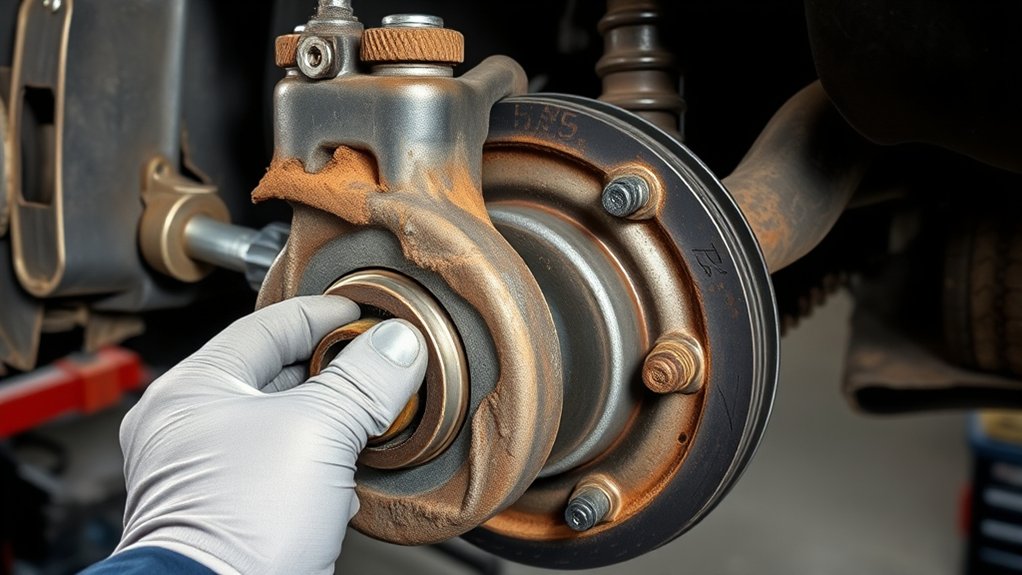
A healthy ball joint holds the steering knuckle in its intended position while still allowing controlled suspension and steering movement. When the joint develops excess play, the wheel’s alignment can change as the car accelerates, brakes, turns, or crosses a bump.
You may notice delayed steering response, wandering, a pull that changes with road conditions, or a clunk when load transfers through the suspension. Tire contact with the road may also become less consistent. However, these effects overlap with tire, alignment, tie-rod, bushing, and wheel-bearing problems, so the ball joint should be tested rather than diagnosed from the driver’s seat alone.
NHTSA’s TireWise guidance notes that proper wheel balancing helps prevent wheel shake or vibration, while correct alignment helps prevent veering and maximize tire life. A complete inspection should therefore include the tires, wheels, steering linkage, and suspension.
What Causes Toyota Camry Ball Joints to Wear?
Ball-joint life varies widely. A joint can remain serviceable for many years, or wear sooner when it is exposed to harsh conditions. There is no reliable mileage that applies to every Toyota Camry.
- Normal internal wear: Repeated steering and suspension movement gradually wears the joint’s internal bearing surfaces.
- Dust-boot damage: A split or cracked boot can reduce the joint’s protection from moisture, road salt, and grit.
- Pothole or curb impacts: A hard impact can damage the joint, control arm, steering knuckle, wheel, tire, or alignment.
- Corrosion: Moisture and road salt can damage the housing, stud, fasteners, or surrounding parts.
- Rough-road use: Frequent impacts and large suspension movements can increase wear.
- Collision or incorrect repair: Bent components, loose fasteners, or improper installation can create abnormal loading.
Pro Tip: After a hard pothole or curb strike, inspect the tire and wheel as well as the suspension. A new noise after an impact may come from more than one damaged part.
How Does a Technician Confirm a Bad Camry Ball Joint?
A qualified technician should follow the procedure for the Camry’s exact year and suspension design. Support position and joint loading matter, and Toyota procedures are not identical across every generation. A generic wheel-shake threshold should therefore not be substituted for the applicable repair information.
A professional inspection may include:
- Confirming the complaint: The technician listens for the noise and checks steering behavior during a controlled road test when the vehicle is safe to drive.
- Inspecting the joint and boot: The technician looks for cracks, grease around the joint, corrosion, impact damage, loose fasteners, and movement between connected parts.
- Supporting the vehicle correctly: The Camry is raised and secured using approved lifting and support points for that model.
- Checking the joint: The technician follows Toyota’s applicable procedure for looseness, movement, dust-cover condition, turning torque, or other specified criteria.
- Checking nearby components: Tie-rod ends, wheel bearings, control-arm bushings, sway-bar links, struts, mounts, tires, wheels, and mounting hardware are inspected.
- Checking alignment when indicated: Tire wear and alignment readings can help identify bent, loose, or displaced components after mechanical faults have been corrected.
For example, published repair information for the 2018–2024 Camry uses an on-vehicle looseness check and a separate off-vehicle inspection of joint operation and dust-cover condition. Other Camry generations can use different procedures, which is why the Toyota Technical Information System should be checked for the exact vehicle.
Note: Shaking the tire by hand does not isolate the ball joint. Movement may come from a wheel bearing, tie-rod end, control-arm bushing, or another connection. The joint must be evaluated using the correct service procedure.
What Should You Do If You Notice Ball-Joint Symptoms?
Base your response on the severity of the symptoms. Avoid repeated test drives when the steering or wheel position has changed noticeably.
| Symptoms | Immediate Action | What the Inspection Should Cover |
|---|---|---|
| Mild clunk over bumps with normal steering | Arrange an inspection soon and avoid rough roads or unnecessary driving. | Ball joints, sway-bar links, bushings, strut mounts, and fasteners |
| Wandering, looseness, pulling, or uneven tire wear | Limit driving and schedule a steering, suspension, tire, and alignment inspection. | Ball joints, tie rods, control arms, wheel bearings, tires, wheels, and alignment |
| Sudden steering change, severe banging, unstable handling, or visibly tilted wheel | Stop driving and arrange a tow. | Complete front-suspension and steering inspection for separation, bending, or loose hardware |
| Vibration without looseness or clunking | Check tire pressure and arrange an inspection if the vibration continues. | Tires, wheel balance, bent wheels, wheel bearings, axles, and suspension |
Is There a Toyota Camry Ball-Joint Recall?
There is a directly relevant recall for certain 2014 vehicles, although it was technically a front lower control-arm recall rather than a general ball-joint recall. NHTSA campaign 14V715000 covered certain 2014 Toyota Camry, Camry Hybrid, Avalon, and Avalon Hybrid vehicles equipped with 16-inch or 17-inch wheels. Toyota reported that the left front lower suspension arm could have insufficient clamping surface for a bolt securing the lower arm to the lower ball joint.
The campaign listed 5,650 potentially affected vehicles and warned that insufficient clamping force could allow the lower arm to separate from the ball joint, increasing crash risk. The recall remedy was replacement of the affected left lower arm.
Do not assume every 2014 Camry is affected. Recall eligibility depends on the vehicle. Check your VIN through Toyota’s Safety Recall and Service Campaign Lookup and the NHTSA recall database. Owners of other model years should also use the VIN tools because recall coverage can change and model-year listings alone do not establish eligibility.
What Does Toyota Camry Ball-Joint Replacement Involve?
The repair depends on the Camry’s model year and parts design. On versions with a separately serviceable front lower ball joint, the joint can be disconnected from the lower arm and steering knuckle according to the model-specific procedure. Damage, corrosion, related wear, or another suspension fault can still make replacement of additional components appropriate.
The technician should inspect the steering knuckle, control arm and bushings, fasteners, dust shields, axle area, ABS wiring where applicable, tires, and the corresponding joint on the opposite side. Replacement hardware requirements and torque specifications must come from the applicable Toyota repair information rather than a universal value.
Do Both Sides Need to Be Replaced?
Not automatically. Both sides should be inspected because they have operated under similar conditions, but one side may be worn while the other remains serviceable. Replacing both may be practical when both are deteriorated or when related work creates meaningful labor overlap, but pair replacement should not be presented as a universal safety requirement.
Is an Alignment Needed After Replacement?
An alignment check is usually sensible after ball-joint or control-arm work, especially when suspension mounting points were disturbed, another locating component was replaced, the vehicle pulled before repair, or the tires show irregular wear. RepairPal recommends a four-wheel alignment after Camry ball-joint replacement. All loose or bent parts should be corrected before final alignment because alignment cannot compensate for a mechanically unstable suspension.
How Much Does Toyota Camry Ball-Joint Replacement Cost?
As of September 3, 2026, RepairPal estimates the average Toyota Camry suspension ball-joint replacement at $347 to $511. Its estimate breaks that into approximately $263 to $385 for labor and $84 to $126 for parts.
The estimate excludes taxes, fees, location adjustments, and related repairs. Model year also matters: RepairPal’s current table lists different ranges across Camry generations, so use the figure as a planning range rather than a repair quote. Costs can rise if corrosion, damaged control-arm bushings, steering-knuckle damage, worn tires, alignment work, or other suspension repairs are found during inspection.
Estimate tip: Ask whether the quote covers the ball joint alone or a larger suspension assembly, replacement hardware, wheel alignment, diagnostic labor, taxes, and any related repairs. Those differences can make two estimates look farther apart than they really are.
How Can You Reduce Future Ball-Joint Problems?
- Have new clunks, steering changes, or irregular tire wear inspected early.
- Check the front suspension after a severe pothole, curb strike, or collision.
- Maintain the tire pressures shown on the driver-door placard.
- Correct alignment problems instead of replacing tires without finding the cause.
- Ask for the dust boots and steering linkage to be checked during tire, brake, or suspension service.
- Use the maintenance and repair information for your exact Camry year rather than following a universal mileage estimate.
- Check Toyota and NHTSA recall tools periodically using the VIN.
Frequently Asked Questions
What are the signs of a failing Toyota Camry ball joint?
Possible signs include clunking over bumps or turns, wandering steering, uneven tire wear, a damaged dust boot, grease around the joint, or confirmed looseness. These symptoms can also come from tires, tie rods, bushings, wheel bearings, struts, or sway-bar links, so an inspection is required.
What does a bad Toyota Camry ball joint sound like?
A worn ball joint can produce a dull clunk, knock, pop, creak, or similar suspension noise as the wheel moves over bumps or steering and suspension loads change. The sound alone cannot confirm the joint because sway-bar links, bushings, strut mounts, tie rods, brakes, and other parts can make similar noises.
How long do Toyota Camry ball joints last?
There is no dependable universal lifespan. Joint life depends on the model year, road conditions, impacts, corrosion, dust-boot condition, vehicle use, and previous repairs. Replace a joint when the applicable inspection confirms excessive looseness, abnormal operation, physical damage, or another condition that fails Toyota’s service criteria.
Why do Toyota Camry ball joints wear out?
Normal movement gradually wears the internal surfaces. Pothole impacts, damaged dust boots, water, road salt, contamination, corrosion, collision damage, incorrect installation, and prolonged rough-road use can shorten the joint’s service life.
What happens if a ball joint separates?
The control arm and steering knuckle can move out of their intended relationship, allowing the wheel to tilt or shift. Steering control may be severely reduced, and nearby parts, the tire, or the wheel can be damaged. A suspected separation requires towing rather than continued driving.
Can I drive a Toyota Camry with a bad ball joint?
Driving is not recommended once excessive looseness or damage has been confirmed. Stop immediately and tow the car if the wheel angle looks abnormal, steering changes suddenly, the car pulls sharply, or severe knocking and instability develop. With only a mild unexplained noise and normal steering, arrange a prompt inspection and minimize unnecessary driving.
Can I check a Toyota Camry ball joint at home?
You can perform a basic no-lift screening by checking the tires for unusual wear, looking through the wheel opening for visible boot damage when accessible, and noting exactly when a clunk or steering change occurs. Do not rely on a generic wheel-shake test to diagnose the joint, and never work under a vehicle supported only by a jack. A definitive check should follow the Toyota procedure for the exact model year.
Should Toyota Camry ball joints be replaced in pairs?
Both sides should be inspected, but both do not always require replacement. Replace the opposite side when it is also worn or damaged, when the applicable service procedure calls for additional work, or when replacing both is a sensible preventive choice based on the actual condition and labor involved.
Does a Camry need an alignment after ball-joint replacement?
An alignment check is usually wise after ball-joint or control-arm work. It is especially important when suspension mounting points were disturbed, the vehicle pulled before repair, or the tires have uneven wear. All loose or bent parts must be corrected before final alignment.
Is there a Toyota Camry ball-joint recall?
NHTSA campaign 14V715000 covered certain 2014 Camry and Camry Hybrid vehicles for a left front lower-control-arm manufacturing issue at the connection to the lower ball joint. It was not a recall of every Camry or every ball joint. Check the vehicle’s VIN with Toyota or NHTSA to determine whether a specific car is covered.
How much does Toyota Camry ball-joint replacement cost?
RepairPal’s estimate updated September 3, 2026 places average Toyota Camry suspension ball-joint replacement at $347 to $511, including approximately $263 to $385 for labor and $84 to $126 for parts. Taxes, fees, location, model year, alignment, and related repairs can change the final price.
Conclusion
Common Toyota Camry ball joint symptoms include clunking or popping from the front suspension, wandering steering, irregular tire wear, boot damage, and abnormal looseness. None of those signs identifies the ball joint by itself, so have the joint and nearby steering, wheel, tire, and suspension components checked using the procedure for your exact model year.
There is no universal ball-joint replacement mileage. Base the repair on the joint’s inspected condition, and check recall status by VIN if you own a 2014 Camry. If steering changes suddenly, a wheel appears tilted, or the suspension becomes unstable, stop driving and arrange a tow.
Sources
- Toyota Manuals and Warranties — year-specific owner, warranty, and maintenance documentation
- Toyota Technical Information System — official service procedures and vehicle-specific specifications
- Toyota Safety Recall and Service Campaign Lookup — VIN-based Toyota recall and campaign information
- National Highway Traffic Safety Administration Recall Lookup — federal recalls, investigations, complaints, and manufacturer communications
- NHTSA TireWise — tire pressure, tread, balance, alignment, vibration, and tire-maintenance guidance
- RepairPal Toyota Camry Suspension Ball Joint Replacement Cost — current replacement-cost estimate and year-specific ranges
