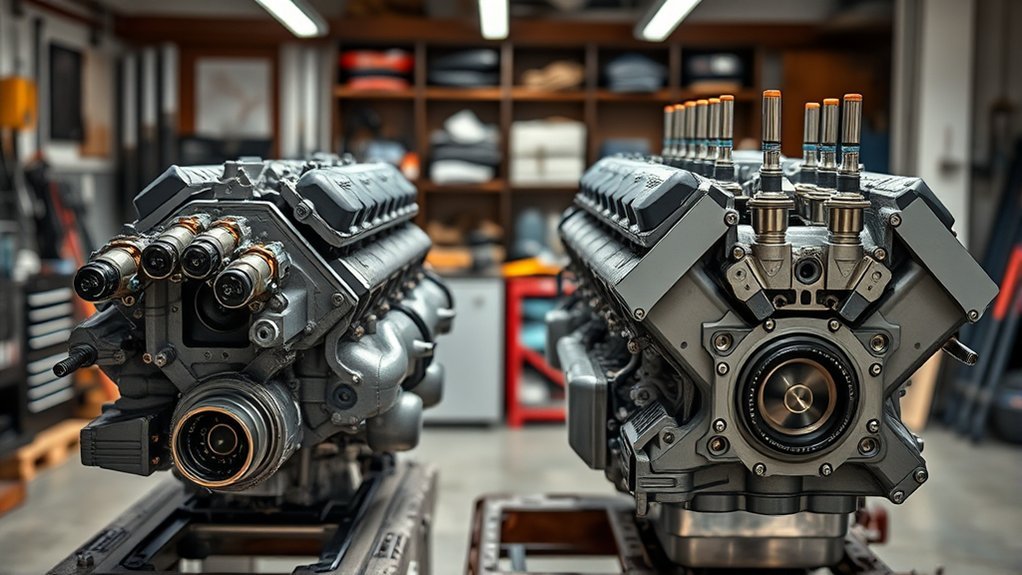
Direct injection and port injection deliver gasoline at different points in the engine. That difference affects fuel pressure, mixture control, performance potential, intake-valve deposits, emissions, and repair complexity. Neither system is automatically better in every vehicle, so you should judge the complete engine design and its reliability history rather than the injection label alone.
Quick Answer
Direct injection sprays fuel inside the combustion chamber and can improve high-load fuel control, knock resistance, efficiency, and power potential. Port injection sprays fuel before the intake valve, uses a simpler low-pressure system, and helps wash deposits from the valve. Dual injection combines both methods and can reduce their individual drawbacks.
Key Takeaways
- Direct injection, or DI, places the injector in the combustion chamber and operates at much higher fuel pressure than port injection.
- Port fuel injection, or PFI, sprays fuel into the intake port, where it can pass over and help clean the intake valve.
- DI can support strong power and efficiency, but it does not guarantee a fixed horsepower or fuel-economy increase.
- Intake-valve deposits are a greater concern on some DI-only engines, but not every DI engine requires routine carbon cleaning.
- Dual-injection systems use DI, PI, or both according to engine temperature, speed, load, and emissions needs.
- When buying a vehicle, compare the specific engine’s service history, known problems, fuel requirements, and repair costs.
How Direct and Port Injection Work
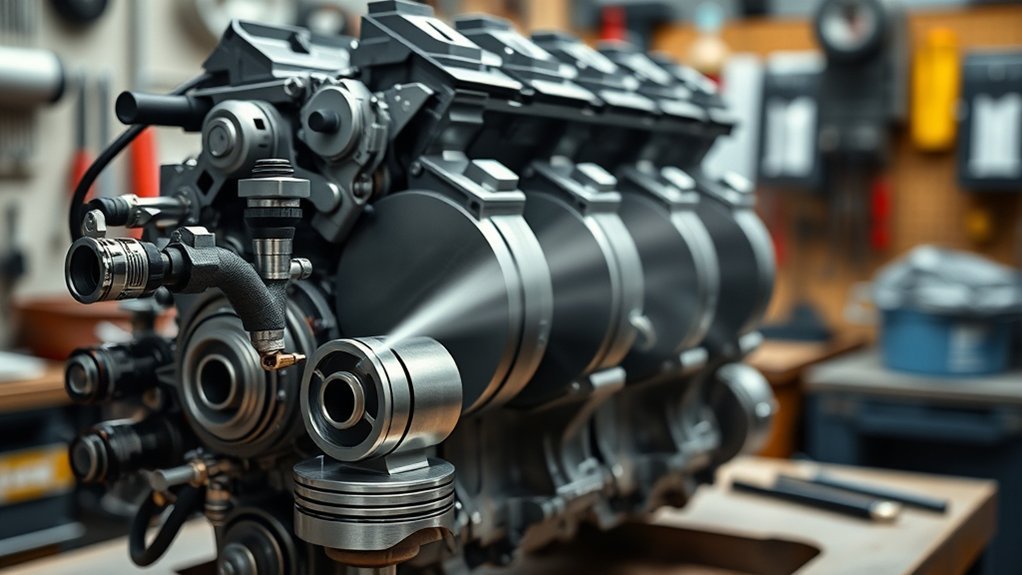
Both systems use electronically controlled injectors, but they introduce fuel at different points in the four-stroke combustion cycle.
Direct Injection
In a gasoline direct-injection engine, the injector extends into the combustion chamber and sprays fuel near the piston and spark plug. A mechanically driven high-pressure pump usually raises fuel pressure far above the pressure used by a port-injection system.
Because the engine computer can control the timing and amount of fuel delivered inside the cylinder, DI can support precise mixture formation under changing loads. Fuel evaporation inside the chamber can also cool the charge and help reduce the tendency to knock. This gives engineers more freedom to use higher compression ratios, turbocharging, or aggressive ignition timing when the rest of the engine is designed for it.
Port Fuel Injection
Port fuel injection places each injector in the intake manifold or cylinder-head intake port, upstream of the intake valve. The gasoline mixes with incoming air before the mixture enters the combustion chamber.
PFI operates at lower pressure and generally requires fewer high-pressure components. As the fuel passes over the back of the intake valve, it can dissolve or carry away some oil-based residue. This valve-washing effect is one reason intake-valve deposits are usually less troublesome in port-injected engines.
What PFI, MPFI, and Sequential Injection Mean
PFI means port fuel injection. MPFI or MPI means multi-port fuel injection, with a separate injector serving each cylinder’s intake port. Sequential fuel injection describes how the injectors are timed, usually so each one sprays in relation to its cylinder’s intake event.
“Regular injection” is not a precise engineering term. In many consumer discussions, it refers to conventional multi-port fuel injection rather than direct injection.
Dual Injection
A dual-injection engine has both a port injector and a direct injector for each cylinder. The engine computer may use port injection during cold operation or light loads, direct injection at higher loads, or both systems together when additional fuel flow or mixture control is helpful.
The U.S. Environmental Protection Agency identifies combined gasoline direct-injection and port-injection systems as an advanced technology that can switch between injection methods according to engine conditions.
Note: Dual injection adds injectors, fuel rails, control logic, and plumbing. It can improve flexibility and intake-valve cleanliness, but it is not automatically simpler or cheaper to repair.
Direct Injection vs. Port Injection Comparison
| Feature | Direct Injection | Port Injection |
|---|---|---|
| Injector location | Inside the combustion chamber | In the intake port before the intake valve |
| Fuel pressure | High pressure; exact pressure varies by engine and operating condition | Much lower pressure than DI |
| Mixture control | Precise in-cylinder injection timing and quantity | More time for fuel and air to mix before entering the cylinder |
| Power potential | Can support higher compression, boost, and charge cooling | Can still produce high power, especially with sufficient injector flow and good airflow |
| Fuel economy | May improve efficiency as part of an optimized engine design | Can be efficient but offers less in-cylinder injection flexibility |
| Intake-valve cleaning | Little or no fuel passes over the valve | Fuel passes over the valve and can help limit deposits |
| Particle formation | Can be higher under some operating conditions | Premixing generally helps limit fuel-rich zones and particle formation |
| System complexity | High-pressure pump, rail, injectors, seals, and control system | Generally simpler and easier to access |
| Typical ownership concern | Intake deposits, injector condition, and high-pressure components | Injector clogging, fuel-pressure issues, and ordinary intake deposits |
Performance and Fuel Economy
Direct injection can improve an engine’s performance potential, but the injector location alone does not determine horsepower. The final result also depends on displacement, turbocharger size, compression ratio, cam timing, intake and exhaust flow, cooling, fuel octane, and engine calibration.
DI’s main performance advantage is control. Engineers can inject fuel at carefully selected points in the intake or compression stroke. Evaporation inside the cylinder can lower charge temperature and reduce knock risk, which may allow more compression or boost.
Port injection has its own advantages. Fuel has more time to mix with air before entering the chamber, and the injector can continue supplying fuel without the same short in-cylinder injection window faced by a direct injector at high engine speed. A well-designed PFI engine can therefore be responsive, powerful, and reliable.
Direct injection creates engineering opportunities for more power and efficiency, but it does not provide a universal horsepower percentage or guarantee better real-world fuel economy.
The EPA describes gasoline direct injection as one of several technologies that allow more efficient engine design and operation. However, real-world fuel economy still depends on the vehicle’s weight, gearing, aerodynamics, hybrid assistance, engine size, and how you drive.
[Amazon Products Picked for You]

BOTTLE SIZE: One 12 fl oz bottle of STP Complete Fuel System Cleaner, a gas additive and automotive maintenance product for gasoline engines
Gasoline quality is inconsistent; And when gas at the pump varies in quality, the result is deposit buildup, inefficient ignition and combustion, and poor power output; To make matters worse, small, high output engines are extremely sensitive to deposits that build up on fuel injectors, intake ports, on intake valves and in combustion chambers; Even small amounts of deposits cause increased exhaust emissions, reduced fuel economy, drivability problems, and engine knock

Universal Fitment – Works on 27 - 214 direct injection vehicles. 4.3L 3.6L 3.0L GDI V6, 2.5L 2.4L 2.0L GDI I-4. Note: If you are working on a 5.3L or 6.2L you will need a quantity of 2 sets. (See following for specify model)
How Port Injection Reduces Intake-Valve Deposits
Oil vapor from the positive crankcase ventilation system, combustion gases, and other contaminants can enter the intake tract. In a port-injected engine, gasoline sprays onto or near the back of the intake valve and helps carry away some of this residue.
In a DI-only engine, gasoline is introduced after the intake valve, so the valve does not receive the same washing action. The SAE study on intake-valve deposits in gasoline direct-injection engines explains why this deposit mechanism deserves attention.
This does not mean every DI engine will develop a serious deposit problem. Deposit formation varies with cylinder-head design, valve temperature, PCV routing, oil consumption, valve timing, driving pattern, maintenance, and calibration.
Possible Symptoms of Intake-Valve Deposits
- Rough idle, especially when the engine is cold
- Cold-start misfires or hesitation
- Loss of power at higher airflow
- Reduced fuel economy
- Check-engine codes related to misfires or fuel trim
- Uneven cylinder compression or airflow in severe cases
These symptoms do not prove that carbon is the cause. Ignition coils, spark plugs, vacuum leaks, injectors, compression loss, sensors, or fuel-pressure faults can produce similar behavior.
Diagnosing and Cleaning Intake-Valve Deposits
A technician may review trouble codes, misfire counters, fuel trims, compression, leak-down results, and fuel pressure before inspecting the intake valves with a borescope. Cleaning should be recommended only after the deposits are confirmed or strongly supported by model-specific service guidance.
Depending on the engine and severity, professional cleaning may involve removing the intake manifold and using media blasting, manual cleaning, or an approved chemical process. The correct method depends on the engine manufacturer and the location of the deposits.
Warning: A gasoline direct-injection system can retain extremely high fuel pressure after the engine is switched off. Do not loosen high-pressure pumps, rails, lines, or injectors without the correct service procedure, protective equipment, and pressure-relief steps. Do not spray an unapproved cleaner into the intake because liquid ingestion can damage the engine or emissions system.
Pro Tip: Before paying for carbon cleaning, ask the shop how the deposits were confirmed. A borescope image, model-specific service bulletin, or test result is more useful than recommending cleaning by mileage alone.
Emissions Differences Between DI and PI
Direct injection can improve thermal efficiency and reduce fuel use in a properly optimized engine. Lower fuel consumption can reduce carbon dioxide emissions per mile, but DI also creates a separate particulate-emissions challenge.
Fuel injected directly into the chamber has limited time to evaporate and mix. During cold starts, rapid acceleration, or other demanding conditions, small fuel-rich regions or wall wetting can produce soot particles. Port injection gives the gasoline more time to vaporize before combustion and generally creates a more uniform mixture.
A peer-reviewed Environmental Science & Technology study examined the climate and health implications of particle emissions associated with a shift from PFI to GDI technology. The result is an important reminder that efficiency and tailpipe pollution must be evaluated together rather than treating either injection method as universally cleaner.
Manufacturers can reduce DI particle emissions through injector design, higher pressure, multiple injection events, improved mixture control, warm-up strategies, dual injection, and gasoline particulate filters. Research published in the Johnson Matthey Technology Review discusses catalyst coatings and gasoline particulate-filter design.
Cost and Maintenance Comparison
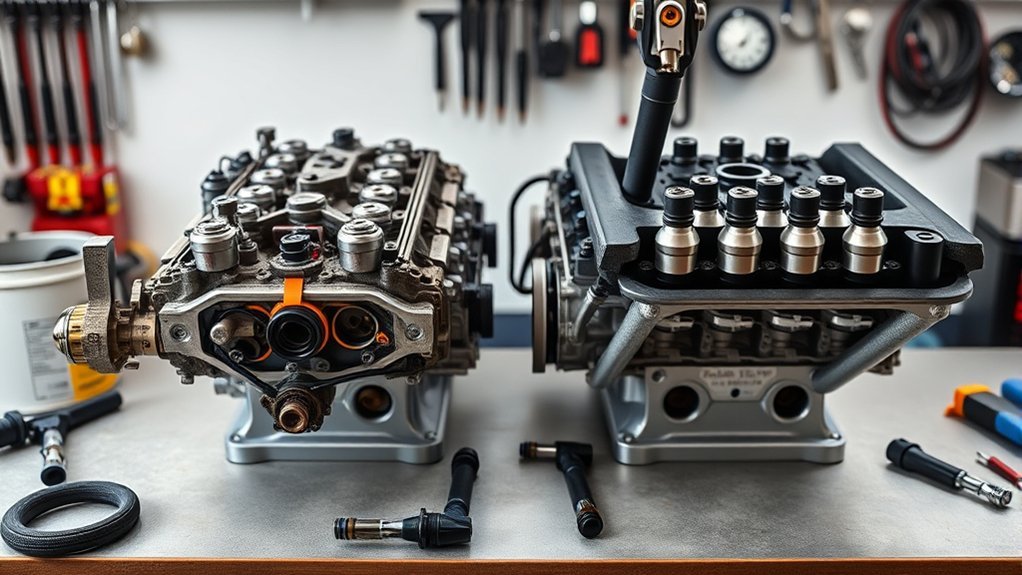
Port injection is usually mechanically simpler because it does not need the same type of engine-driven high-pressure pump, high-pressure rail, or in-cylinder injectors. That simplicity can reduce parts cost and make some repairs easier.
Direct-injection components operate under more demanding pressure and temperature conditions. Diagnosis may require a scan tool, fuel-pressure data, specialized test procedures, and careful handling of the high-pressure circuit. Direct injectors may also be more expensive than conventional port injectors.
However, system complexity alone does not determine total ownership cost. A reliable DI engine may cost less to own than a poorly designed or neglected PI engine. Vehicle value, fuel economy, warranty coverage, labor access, oil consumption, parts prices, and model-specific reliability are more useful than a general DI-versus-PI label.
| Maintenance item | DI consideration | PI consideration |
|---|---|---|
| Fuel injectors | High-pressure, heat-exposed, and often more costly | Lower-pressure and often easier to access |
| Fuel pump | Usually includes low-pressure supply and mechanical high-pressure stages | Usually relies on a lower-pressure electric supply system |
| Intake valves | No routine fuel washing on a DI-only engine | Fuel washing helps limit oil-based deposits |
| Cleaning interval | No universal interval; diagnose symptoms and follow manufacturer guidance | No universal intake-cleaning interval in normal service |
| Repair safety | Strict high-pressure relief and service procedures required | Lower pressure, but normal gasoline fire and exposure precautions still apply |
[Amazon Products Picked for You]

Restore power and performance - Restores lost power and performance by removing gum, varnish, and other fuel system deposits.

Direct replacement - this fuel injector line is engineered to match the original fuel injector line on specified vehicles

[INDUSTRY LEADER] - Bosch has produced over 1 billion fuel injectors and is the number one name in original equipment (OE) injectors, with more than 45 years of gasoline system experience
Which Injection System Is Best for Your Vehicle?
You normally cannot choose an injection system independently of the engine. DI, PI, and dual injection are integrated into the cylinder head, fuel system, engine computer, emissions equipment, and combustion design. Converting a production vehicle from one type to another would require extensive engineering and is not a normal maintenance upgrade.
The practical decision arises when you compare vehicles or replacement engines.
[Amazon Products Picked for You]
Dual Dial For Accurate Reading, With A 140 PSI /10 Bar Scale

Digital Fuel Pressure Gauge: Accurate and clear data is easier to read on the backlight display. The buttons could adjusted to 4 different kinds of numerical units in PSI, KPA, BAR, KG/CM² for use.

Upgraded Universal Fuel Injector Tester and Cleaner Tool Kit---Operates injectors individually to diagnose fuel delivery problems on petrol vehicles with electronic fuel injection, such as blockage, leakage, damage, and burnout of the injectors. The included 8-size cleaning adapters combined with the tester pulse mode can quickly clean the injectors. TURN OFF THE ENGINE BEFORE USE.
A DI-Equipped Vehicle May Suit You When
- You want a modern turbocharged or high-compression engine with strong low-speed torque.
- The specific engine has a good reliability record.
- You value efficiency and performance more than the simplest possible fuel system.
- You have access to qualified service for high-pressure fuel-system diagnosis.
A Port-Injected Vehicle May Suit You When
- You prioritize mechanical simplicity and easier fuel-system service.
- You want the intake-valve washing effect of port-delivered gasoline.
- You are comparing older or lower-cost vehicles with well-documented PFI engines.
- The port-injected model has a stronger reliability and ownership-cost history than the available DI alternative.
A Dual-Injection Vehicle May Suit You When
- You want the load control and charge-cooling advantages of DI.
- You also want port injection available for mixture preparation and intake-valve washing.
- The engine has a proven service history and the added system complexity fits your budget.
Used-Vehicle Checklist
- Confirm whether the engine uses PI, DI, or both. Do not rely only on the model name because injection systems can differ by engine and model year.
- Check for cold-start misfires, rough idle, hesitation, fuel odors, warning lights, or unusual high-pressure-pump noise.
- Scan for stored and pending trouble codes, even when the check-engine light is off.
- Review oil-change history because oil vapor and consumption can influence deposit formation.
- Ask whether the injectors, high-pressure pump, intake valves, or PCV components have been serviced.
- Research the exact engine code for recalls, warranty extensions, service bulletins, and common failures.
- Arrange a pre-purchase inspection if the engine has symptoms or an uncertain maintenance history.
Note: Fuel with adequate detergent can help keep injectors and combustion surfaces cleaner, but detergent in the fuel cannot wash the intake valves of a DI-only engine because the gasoline is injected after those valves.
Frequently Asked Questions
What is the main difference between port injection and direct injection?
Port injection sprays fuel into the intake port before the intake valve. Direct injection sprays fuel inside the combustion chamber. DI uses much higher pressure and gives the engine computer more control over in-cylinder fuel delivery, while PI provides more premixing time and washes the intake valve with fuel.
Does direct injection make more power than port injection?
Direct injection can support more power by cooling the cylinder charge, improving knock resistance, and controlling fuel precisely under load. It does not guarantee a set horsepower increase. A port-injected engine can outperform a DI engine if its displacement, airflow, boost, calibration, and other components are better suited to the performance target.
What is the difference between direct injection and regular fuel injection?
“Regular fuel injection” usually means conventional multi-port fuel injection. In that system, fuel is sprayed into the intake port. Direct injection places the injector in the combustion chamber and requires a separate high-pressure fuel circuit.
What is the difference between PFI and DI?
PFI stands for port fuel injection, while DI stands for direct injection. PFI introduces gasoline before the intake valve and helps keep that valve cleaner. DI introduces gasoline inside the cylinder and offers greater control over injection timing, but a DI-only system does not wash the intake valve.
Does premium gasoline prevent carbon buildup in a direct-injection engine?
Premium gasoline has a higher octane rating, but octane alone does not clean DI intake valves. Because DI fuel is sprayed inside the cylinder, it does not pass over the intake valves. Use the octane and fuel quality specified in the owner’s manual, but do not treat premium fuel as a guaranteed intake-valve cleaning method.
Is port injection more reliable than direct injection?
Port injection is generally simpler and operates at lower pressure, but injection type alone does not determine reliability. Some DI engines are highly durable, while some PI engines have model-specific faults. Compare the exact engine’s maintenance history, oil consumption, fuel-system failures, recalls, and repair costs.
Is dual injection better than DI or PI alone?
Dual injection gives engineers access to both methods. Port injection can improve mixture preparation and wash the intake valves, while direct injection can provide precise high-load fueling and charge cooling. The tradeoff is additional parts and control complexity, so the quality of the complete engine design still matters.
Conclusion
Direct injection offers precise in-cylinder fueling, strong performance potential, and opportunities for better engine efficiency. Port injection uses a simpler low-pressure layout, provides more premixing time, and helps keep intake valves cleaner. Dual injection can combine these strengths, although it adds complexity.
For most buyers, the best choice is not DI or PI in isolation. Compare the exact engine’s reliability record, maintenance history, fuel requirement, emissions equipment, repair access, and real-world fuel economy. A proven engine with consistent maintenance is usually a better purchase than choosing solely by its injection type.
Sources
- U.S. EPA Automotive Trends Report — supports the role of gasoline direct injection, combined DI/PFI systems, and advanced engine technology.
- SAE International: Formation of Intake Valve Deposits in Gasoline Direct Injection Engines — supports the intake-valve deposit mechanism in GDI engines.
- Environmental Science & Technology: Direct Radiative Effect and Public Health Implications of GDI Aerosol Emissions — supports the particulate-emissions tradeoff between GDI and PFI technologies.
- Johnson Matthey Technology Review: Coated Gasoline Particulate Filter Design — supports the use and design of gasoline particulate filters for controlling particle emissions.
