Choosing a food thermometer is easier when you match the thermometer to the way you cook. Fast instant-read models are ideal for checking meat, fish, bread, and other foods in seconds, while leave-in probes work better for roasts and smoking. Candy and frying call for a long probe, secure pot clip, and a wide temperature range. Accuracy, response time, probe design, water resistance, and easy accuracy checking matter more than extra features most cooks will rarely use.
Quick Answer
For most home cooks, a fast digital instant-read thermometer is the best first choice. Look for good stated accuracy, a response time of a few seconds, a thin probe, an easy-to-read display, and water resistance. Choose a leave-in alarm thermometer for smoking or roasting and a long clip-on probe for candy or deep frying.
Key Takeaways
- A fast instant-read thermometer is the most versatile option for everyday meat, fish, baking, and grilling.
- Use a leave-in probe thermometer for roasts, smoking, and other long cooks that benefit from continuous monitoring.
- Candy and deep frying are easier with a long probe, pot clip, and a temperature range that extends well above normal meat temperatures.
- Check accuracy periodically, place the probe correctly, and follow the manufacturer’s required insertion depth.
- For food safety, rely on internal temperature rather than color, texture, or cooking time alone.
Why a Food Thermometer Matters
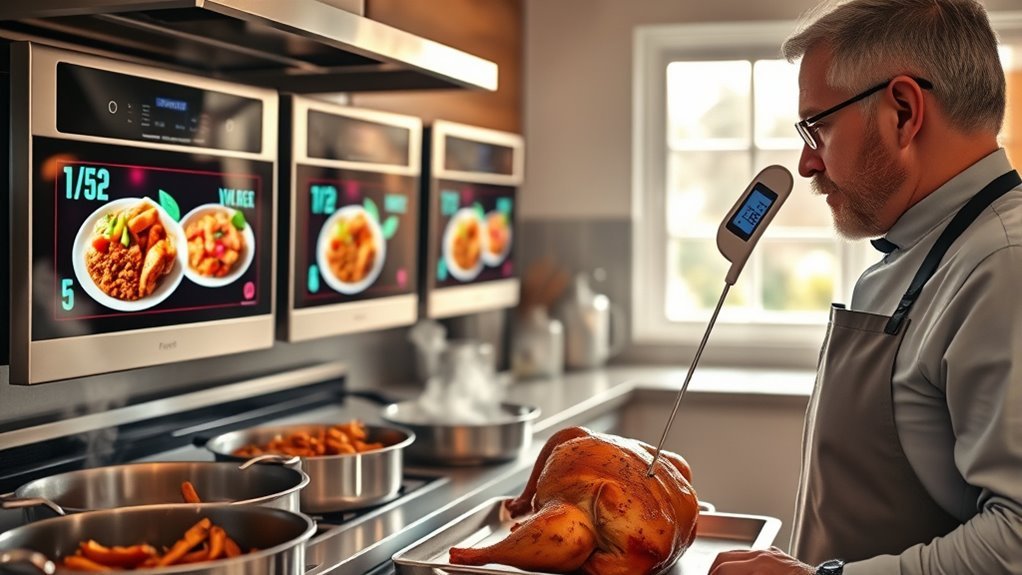
A food thermometer improves both safety and consistency. The USDA recommends cooking all poultry, including whole birds, poultry parts, and ground poultry, to a safe minimum internal temperature of 165°F (74°C). Other foods have different minimum temperatures, so appearance alone is not enough to judge safety.
The USDA Food Safety and Inspection Service advises placing a thermometer in the thickest part of food, away from bone, fat, and gristle. Thin foods such as burgers and chicken breasts are often measured more accurately by inserting the probe from the side so the sensing area reaches the center.
A thermometer is useful beyond meat. Depending on the model and temperature range, it can help with bread, custards, chocolate, caramel, cooking oil, beverages, and other temperature-sensitive foods.
Visual cues can be misleading. Meat can look browned before it reaches a safe internal temperature, while perfectly safe meat may still retain some pink color. A thermometer replaces that guesswork with a measurable result.
CDC estimates that about 48 million people in the United States get sick from foodborne illness each year, with approximately 128,000 hospitalizations and 3,000 deaths.
Those figures come from the Centers for Disease Control and Prevention. A thermometer cannot prevent every food-safety problem, but correct cooking temperatures are an important part of reducing risk.
How to Choose the Right Food Thermometer
The right food thermometer depends first on the cooking task. A fast instant-read model is usually the best all-purpose choice, but long roasts, smoking, candy making, and deep frying have different requirements.
At a Glance
| Time Required | About 5–10 minutes to compare the important specifications |
| Difficulty | Easy |
| Tools Needed | Your cooking-task list and the manufacturer’s specification sheet |
| Cost | Many capable basic models fall around $20–$50; premium wireless and multi-probe systems can cost considerably more |
[Amazon Products Picked for You]

Instant Read Food Thermometer | Our instant read thermometer features a temperature probe and advanced, highly accurate technology with 1-2 seconds response time; Instructions, meat temperature chart, comes pre-calibrated for your convenience, and recalibrating feature if needed.

Fast & Accurate: Get precise readings in just 1 second with ±0.9°F accuracy. NSF Certified for trusted food safety, this digital food thermometer features a 4.3 inches food-grade stainless steel meat probe, perfect for grilling, frying, baking, making candy and more

【Fast & Accurate】Our meat thermometer digital delivers accurate readings within ±1°F in just 1–2 seconds, with a wide temperature range of -58°F to 572°F (-50°C to 300°C). No more waiting over the heat - know your food's exact temperature instantly.
Choose the Thermometer Type First
Instant-read digital thermometers are designed for brief checks near the end of cooking. Fast thermocouple models can respond in roughly 2–5 seconds, while many thermistor models take around 10 seconds. Actual speed depends on the sensor and model, so use the manufacturer’s specification rather than assuming every digital thermometer behaves the same way.
Leave-in probe thermometers remain in the food during cooking while a cable, base station, or wireless connection displays the temperature. They are useful for roasts, smoking, baking, and other long cooks.
Wireless and smart thermometers add remote monitoring, alerts, and sometimes multiple probes. They are convenient when moving between the kitchen and grill, but connectivity and app features add cost and complexity.
Candy and deep-fry thermometers should have a long probe, a secure pot clip, and a range high enough for hot sugar and cooking oil. Hands-free monitoring is more important here than a folding pocket design.
Dial thermometers can be inexpensive and useful, but many are slower and require a deeper insertion depth than thin digital probes. USDA notes that dial bimetal models may take 15–20 seconds for an instant reading, while oven-safe versions can take one to two minutes.
Infrared thermometers measure surface temperature. They can be useful for pans, griddles, or other surfaces, but the FDA notes that infrared devices are inappropriate for measuring a food’s internal cooking temperature. Use a probe thermometer when safety depends on the center of the food reaching a target temperature.
Compare Accuracy, Speed, and Probe Design
For quick checks, response time has a practical effect: a faster thermometer means less time holding your hand over a grill or leaving an oven door open. Accuracy also matters, especially near a safe minimum temperature or when working with temperature-sensitive candy.
Check the manufacturer’s stated accuracy range, not just display resolution. A display that shows tenths of a degree is not automatically accurate to one-tenth of a degree.
Probe geometry matters too. A thin tip and short sensing area make it easier to measure burgers, fish fillets, steaks, chops, and thin chicken breasts. Larger dial thermometers may require two or more inches of insertion because their sensing area extends farther up the stem.
Look at Range, Display, Cleaning, and Alarms
A thermometer used only for cooked meat does not need the same range as a candy or frying thermometer. Buying a model with a broad range, however, can make it useful for more kitchen jobs.
A bright display, automatic rotation, large digits, Fahrenheit/Celsius switching, and an automatic shutoff can improve daily use. For leave-in thermometers, audible alarms and remote notifications can be more valuable than extreme instant-read speed.
Waterproof and water-resistant are not interchangeable claims. Check the manufacturer’s IP rating and cleaning instructions before rinsing or immersing any electronic thermometer.
Pro Tip: If you buy only one thermometer, start with a fast, thin-tip instant-read model. Add a leave-in alarm or wireless probe later if you frequently smoke, roast, or grill for long periods.
Best Budget Food Thermometers
Several budget food thermometers provide enough speed and accuracy for home cooking without moving into premium wireless pricing. The best choice depends on whether you need fast spot checks or continuous monitoring.
The current ThermoWorks ThermoPop 2 is a practical all-purpose instant-read option. ThermoWorks specifies a 2–3 second response time for the 4.5-inch probe version, ±1°F accuracy from 14°F to 208°F, a -58°F to 572°F measurement range, an auto-rotating backlit display, and an IP67 waterproof rating.
Its published list price is under $40 at the time of this review, although promotions and pricing can change. Those specifications make it suitable for checking meat, fish, bread, frying oil, and many other everyday foods.
For candy and frying, the TP510 candy and deep-fry thermometer, sold under ThermoPro or TempPro branding depending on market, serves a different role. Current specifications list a temperature range of approximately -58°F to 572°F, an approximately 8-inch stainless-steel probe, a pot clip, backlit display, and IPX5 water resistance.
The TP510’s long probe and clip are useful when the thermometer needs to stay positioned in hot oil or sugar syrup. For quickly checking a steak or chicken breast, however, a compact instant-read design is usually easier to handle.
[Amazon Products Picked for You]

FOOD SAFETY: Thermometer displays true oven temperature instantly to ensure safe food preparation

WATERPROOF DESIGN: This thermometer is designed to get wet without ruining the product. It takes splashes without damage, but please note that the unit should not be submersed in water

【No More Overcooking, 8X Faster】Ultra-fast 0.5 second instant read meat thermometer delivers accurate temperature instantly, helping you avoid overcooking and achieve perfect doneness every time.
Best Thermometers for Smoking and Frying
Smoking and deep frying benefit from thermometers designed for continuous or hands-free monitoring rather than repeated manual checks.
For smoking, the ThermoWorks DOT Simple Alarm Thermometer is a straightforward leave-in option. Its probe stays in the food while the display remains outside the cooker. The current DOT measures from -58°F to 572°F, provides a 70 dB alarm, and is rated to ±1.8°F accuracy through much of its normal cooking range.
A leave-in system helps avoid repeatedly opening a smoker or oven. Wireless models add more freedom by sending temperatures to a receiver or smartphone, and multi-probe versions can monitor more than one piece of food or cooking zone at a time.
For frying and candy making, a long clip-on thermometer such as the TP510 keeps the probe positioned in the liquid while helping keep hands farther from hot oil or sugar. Its current -58°F to 572°F range is considerably wider than the 100°F-to-400°F range sometimes quoted for the model.
Warning: Do not leave a normal instant-read thermometer inside an oven, grill, smoker, fryer, or pot unless the manufacturer specifically says the probe and any attached components are designed for continuous high-heat use.
[Amazon Products Picked for You]
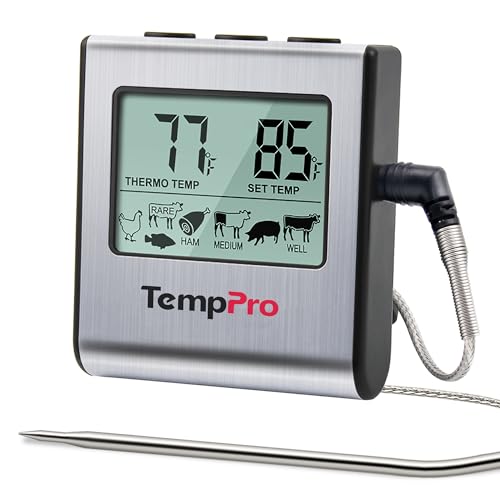
Cook mode with USDA preset temperature settings: TempPro cooking thermometer ideal for meat, oven, smoker or stove top; Programmable alert with preset temperatures for specific foods recommended by USDA; All of the preset temps can be reset to your desired tastes

【Dual Safe Probes for Multi-Use】Vuwwey meat thermometer probe is great for meat, liquids, oil frying, baking, candy making, kitchen & outdoors. The wired probe is ideal for monitoring air fryers, ovens, grills, BBQ, smokers. It's your hands-free assistant: set the alarm, stick it on, and step away from the heat

KT THERMO -【SAFE LEAVE-IN DESIGN】 Cook with confidence. Crafted from heat-resistant 304 stainless steel and reinforced glass, this mechanical meat thermometer is designed to stay inside the oven or grill (up to 220°F) throughout the entire cooking process for real-time monitoring
How to Use and Calibrate a Food Thermometer
An accurate thermometer can still give a misleading result when it is inserted incorrectly. Proper placement depends on both the food and the sensing area of the probe.
Place the Probe in the Correct Spot
For steaks, chops, roasts, and similar foods, insert the probe into the thickest part while avoiding bone, fat, and gristle. Check large or irregular cuts in more than one location.
For thin foods such as burgers, sausage patties, thin chops, fish fillets, and chicken breasts, insert the thermometer from the side toward the center. This allows more of the sensing area to sit inside the food instead of passing through it.
For whole poultry, USDA guidance calls for checking the innermost thigh, innermost wing, and thickest part of the breast while avoiding bone.
When measuring oil, syrup, or another liquid, position the sensing area in the liquid without letting the probe tip rest against the bottom or side of the pot, which can distort the reading.
Wait for the Correct Response Time
Do not automatically wait 20–30 seconds for every digital thermometer. USDA lists thermocouple thermometers at roughly 2–5 seconds and many thermistor models at about 10 seconds, while dial instant-read thermometers may require 15–20 seconds.
Follow the response time stated in your thermometer’s instructions and wait until the display has stabilized before recording the result.
Check Accuracy With Ice Water
The USDA calibration procedure recommends an ice-water or boiling-water check. For the ice method, fill a large glass with finely crushed ice, add clean water, stir, and insert the sensing portion of the thermometer without touching the glass. After the reading stabilizes, it should be approximately 32°F (0°C).
If the thermometer has an adjustment function, follow the manufacturer’s instructions to correct it. Some digital thermometers are not user-adjustable. In that case, an accuracy test still tells you whether the thermometer is trustworthy; a badly inaccurate unit that cannot be corrected should be replaced.
Note: Boiling water is about 212°F (100°C) at sea level, but the boiling point falls as altitude increases and also varies with atmospheric conditions. Account for your local boiling point before using boiling water as an accuracy reference.
Clean the Probe After Use
Wash the probe with hot, soapy water before and after use, following the manufacturer’s instructions. This is particularly important after the probe has contacted raw meat, poultry, seafood, or eggs.
Do not immerse the entire thermometer unless it is specifically rated for immersion. A waterproof probe does not necessarily mean that every connector, cable, display, or battery compartment can be submerged.
What to Do if the Readings Seem Wrong
If results are inconsistent, first check probe placement and required insertion depth. Then perform an ice-water accuracy check. Also inspect the battery, probe connector, cable, and probe tip for damage.
If a thermometer consistently reads several degrees high or low and the model cannot be adjusted, replacement is safer than trying to remember a correction every time you cook.
Food Safety Basics for Every Cook
Food safety involves more than reaching one universal temperature. Different foods have different safe minimums, and storage time also matters.
The current FoodSafety.gov minimum-temperature chart gives the following commonly used targets:
| Food | Safe Minimum Internal Temperature |
| Beef, pork, veal, lamb, and goat steaks, chops, and roasts | 145°F (63°C), followed by a 3-minute rest |
| Ground beef, pork, veal, lamb, and sausage | 160°F (71°C) |
| Chicken, turkey, and other poultry | 165°F (74°C) |
| Fish | 145°F (63°C) |
| Egg dishes | 160°F (71°C) |
| Leftovers and casseroles | 165°F (74°C) |
These are safety minimums, not necessarily the temperature every cook will choose for texture or preference. Some foods may be intentionally cooked beyond their minimum safe temperature.
Temperature control also matters after cooking. USDA defines the food-safety danger zone as approximately 40°F to 140°F (4.4°C to 60°C), where bacteria can multiply rapidly. Perishable food generally should not remain in that range for more than two hours, or more than one hour when the surrounding temperature is above 90°F (32°C).
Keep raw meat, poultry, seafood, and eggs separated from ready-to-eat foods, and clean utensils and food-contact surfaces after handling raw products. A thermometer verifies cooking temperature, but it does not correct contamination caused by poor storage or cross-contamination.
Frequently Asked Questions
What should I consider before buying a food thermometer?
Start with how you cook. For general kitchen use, prioritize an instant-read thermometer with good stated accuracy, a fast response time, a thin probe, a readable display, and easy cleaning. For smoking or roasting, consider a leave-in alarm probe. Candy and frying benefit from a long probe, pot clip, and wider high-temperature range.
What do I need to buy with a food thermometer?
Most instant-read thermometers need no additional accessories beyond the included battery and protective probe cover, if supplied. Leave-in systems may accept extra probes, clips, or replacement cables. Before buying accessories, confirm compatibility with the exact thermometer model.
What type of thermometer is best for smoking or frying?
For smoking, a leave-in wired or wireless probe with a target-temperature alarm is usually the most convenient. For frying, choose a long high-temperature probe with a secure pot clip so the sensing area stays in the oil without resting against the pan.
How can I tell whether a food thermometer is accurate?
Check the manufacturer’s accuracy specification, then periodically test the thermometer in a properly prepared ice-water bath. The reading should be close to 32°F (0°C). If the thermometer is adjustable, calibrate it according to its instructions. If it is significantly inaccurate and cannot be adjusted, replace it.
Can an infrared thermometer replace a meat thermometer?
No. Infrared thermometers measure surface temperature rather than the internal temperature of food. They can be useful for checking a pan, griddle, or other surface, but use a probe thermometer to verify whether meat, poultry, fish, casseroles, and other foods have reached a safe internal temperature.
Sources
- USDA Food Safety and Inspection Service — Food Thermometers — thermometer types, response times, placement, cleaning, and calibration guidance.
- FoodSafety.gov — Safe Minimum Internal Temperatures — current cooking-temperature targets for meat, poultry, seafood, egg dishes, leftovers, and casseroles.
- USDA FSIS — How to Calibrate a Food Thermometer — ice-water and boiling-water accuracy checks and the altitude caveat.
- CDC — Facts About Food Poisoning — U.S. foodborne-illness estimates.
- ThermoWorks — ThermoPop 2 Specifications — response time, accuracy, temperature range, waterproof rating, and current model details.
- ThermoWorks — DOT Simple Alarm Thermometer Specifications — leave-in probe range, accuracy, alarm, and heat specifications.
Conclusion
A good food thermometer does not need to be complicated. For most cooks, a fast instant-read model with dependable accuracy, a thin probe, a clear display, and easy cleaning offers the most value. Leave-in probes are better for smoking and roasting, while long clip-on models suit candy and frying. Whatever style you choose, correct placement and periodic accuracy checks matter as much as the thermometer itself. Used properly, it replaces uncertain visual guesses with repeatable temperature measurements and helps make everyday cooking both safer and more consistent.
