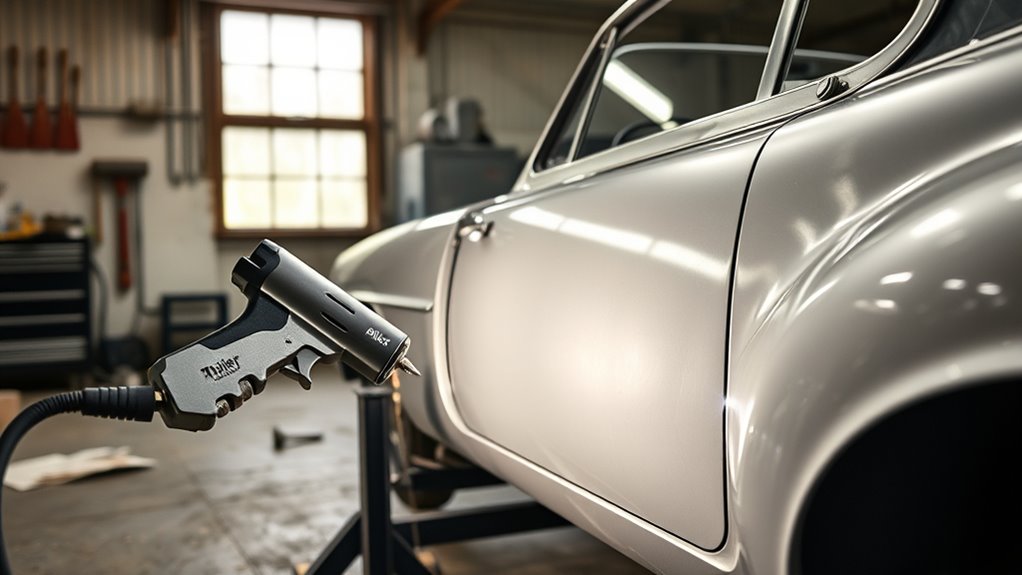
The Miller 251 MIG welder is generally good for autobody work when paired with .023 wire and C25 shielding gas. Its 250A output, adjustable voltage, and stable wire feed provide enough control for sheet metal, rust repair, and heavier panels. However, the machine can run hot on very thin gauge steel, so careful heat management is essential. With proper settings and technique, it can produce clean, repeatable results, and the details become clearer from here.
Key Takeaways
- Yes, the Miller 251 is capable of autobody work, especially rust repair and larger panel jobs.
- Its 250A output and precise voltage control help maintain a stable arc on thin sheet metal.
- Using .023 wire improves control and reduces burn-through on 18-22 gauge body panels.
- It can still be too hot for very thin metal, so careful heat management is essential.
- For light patching, smaller welders like the Miller 211 or 140 may be easier to control.
Is the Miller 251 Good for Autobody Work?
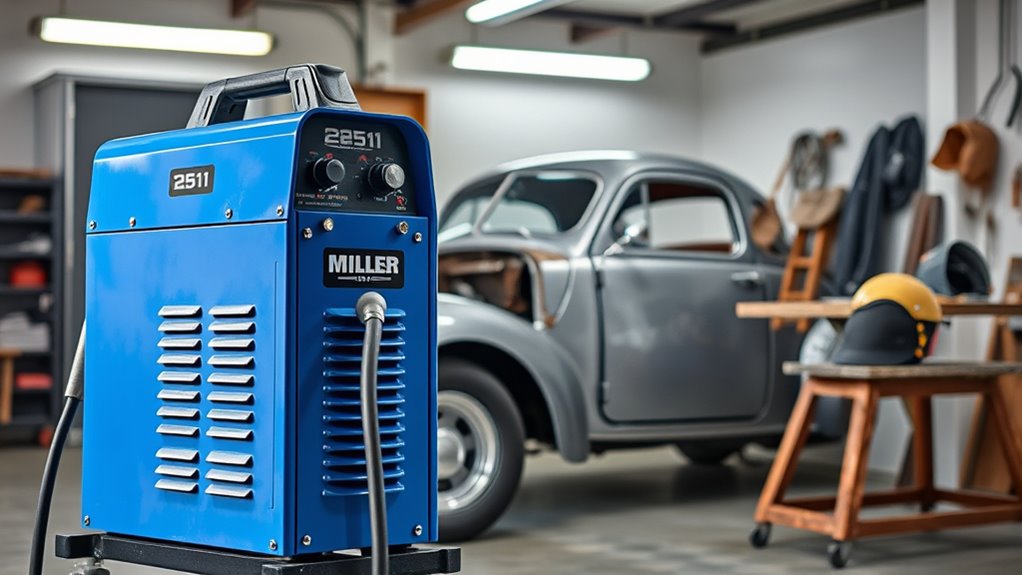
Yes—the Miller 251 is generally well-suited for autobody work. As a MIG welder, it offers 250A output, giving it enough range for thin sheet metal repairs and heavier structural tasks.
Its precise voltage control and adjustable wire feed speed support stable arc behavior, which matters in automotive welding where consistency and restraint are essential. With .023 wire, the Miller 251 can reduce burn-through on body panels while still producing sound fusion.
Precise voltage and wire feed control help the Miller 251 deliver stable, low-burn-through welds on body panels.
The 40% duty cycle at 250A also supports extended repair sessions without frequent interruption, a practical advantage for continuous shop work. Users commonly report strong satisfaction with its versatility and output quality.
For those pursuing repair work that is both technically competent and independent of unnecessary limitation, the machine provides a credible balance of control, capacity, and reliability.
Miller 251 for Sheet Metal and Body Panels
For sheet metal and body panels, the Miller 251 is a capable choice because its output range and fine control support the demands of autobody welding. This MIG welder offers about 250 amps, giving enough reserve for rust repair while still accommodating thin material. Operators often select .023 wire size for tighter puddle control on body panels, helping limit burn-through and preserve fitment. Infinite voltage adjustment permits exact tuning across varying gauges, which is useful when moving from patch work to heavier seams.
| Setting | Use | Effect |
|---|---|---|
| .023 wire | thin material | precise control |
| voltage adjustment | body panels | tailored arc |
| 250 amps | rust repair | material versatility |
Its 60% duty cycle at 210 amps supports sustained work on larger restoration jobs. Overall, the Miller 251 remains technically well matched to autobody tasks requiring disciplined heat management and repeatable weld quality, without forcing the operator into compromise or dependence.
Is the Miller 251 Too Hot for Thin Sheet Metal?
The Miller 251 can be considered too hot for very thin sheet metal if it is not set up and handled carefully, since its high amperage output exceeds what materials such as 24-gauge steel typically require.
On thin sheet metal, excessive heat input can quickly cause burn-through, distortion, or an uneven bead if the operator does not control travel speed and arc duration. A smaller wire diameter, such as .023, is often preferred because it improves control and helps limit heat transfer.
A copper backing bar can also absorb and disperse heat, offering additional protection against warping and blow-through.
Because the Miller 251 is built for heavier work, its duty cycle at higher settings may contribute to more retained heat during repeated passes.
For body repair, the machine is not inherently unsuitable, but it does demand disciplined technique, careful parameter changes, and a restrained approach to preserve the integrity of delicate panels and keep the work free.
Best Miller 251 Settings and Wire for Autobody
Proper setup matters as much as machine capacity when using the Miller 251 on autobody panels, because thin-gauge sheet metal responds best to low-heat, tightly controlled parameters. For 18-22 gauge autobody work, the MIG welder performs well with .023 wire, which improves arc control and lowers burn-through risk. A practical starting range is 15-20 voltage and 200-300 inches per minute wire feed speed, then refine settings by panel thickness and joint fit-up. C25 shielding gas also helps limit spatter and produces cleaner beads.
| Setting | Range |
|---|---|
| Voltage | 15-20 |
| Wire feed speed | 200-300 ipm |
| Wire | .023 wire |
The Miller 251’s 30% duty cycle at 90A supports repeated panel repairs without excessive heat buildup. In disciplined hands, this balance of voltage, wire feed speed, and shielding gas gives controlled penetration, reduced distortion, and dependable welds for autobody work.
Better Miller Alternatives for Autobody Work
Several Miller machines are better matched to autobody work than the Miller 251, depending on panel thickness and repair scope.
The Miller 211 PRO is commonly favored because its dual-voltage design and Auto-Set™ controls simplify voltage and wire selection, making it practical for MIG welders doing body panel work and automotive fabrication. It can weld materials as thin as 24-gauge with reduced burn-through risk, a key advantage when welding thin sheet metal.
For light repairs, the Miller Millermatic 140 is a compact 120V option with lower amperage, well suited to sheet metal and localized patching.
For heavier structural repair, the Millermatic 185 and 210 provide greater duty cycles and output for frame sections.
Frequently Asked Questions
What Is the Best MIG Welder for Auto Body Work?
The best MIG welder for auto body work is a precise, low-amperage unit with stable amperage settings, fine wire types, strong welder portability, and proven MIG welding techniques for auto body materials, repair methods, and welding safety tips.
Is the Millermatic 251 Discontinued?
Yes; the Millermatic 251 is discontinued. Its Miller 251 features, welding performance, user reviews, maintenance tips, comparison models, price analysis, and availability issues should be assessed carefully by prospective buyers seeking reliable equipment.
What Type of Welder Is Best for Car Body Repairs?
MIG welding is typically best for car repairs, because it balances control, metal thickness versatility, and weld penetration. Flux core is less ideal for body panels. Proper welding safety and welder maintenance remain essential throughout.
How Much Is a Millermatic 251 Worth?
As the adage says, value follows reliability: a Millermatic 251 typically commands $2,500–$3,500. Miller welder features, pricing trends, used equipment value, maintenance tips, warranty options, user reviews, and resale market conditions shape its worth.
Conclusion
To sum up, the Miller 251 can be a capable autobody tool when used with the right wire, low-voltage settings, and disciplined trigger control. Coincidentally, its stronger output, often seen as a drawback on thin sheet metal, can also provide useful versatility for heavier repair sections. Still, for many body panel jobs, smaller MIG units or a dedicated 120V welder may offer easier control. The best choice depends on material thickness, skill level, and repair priorities.

