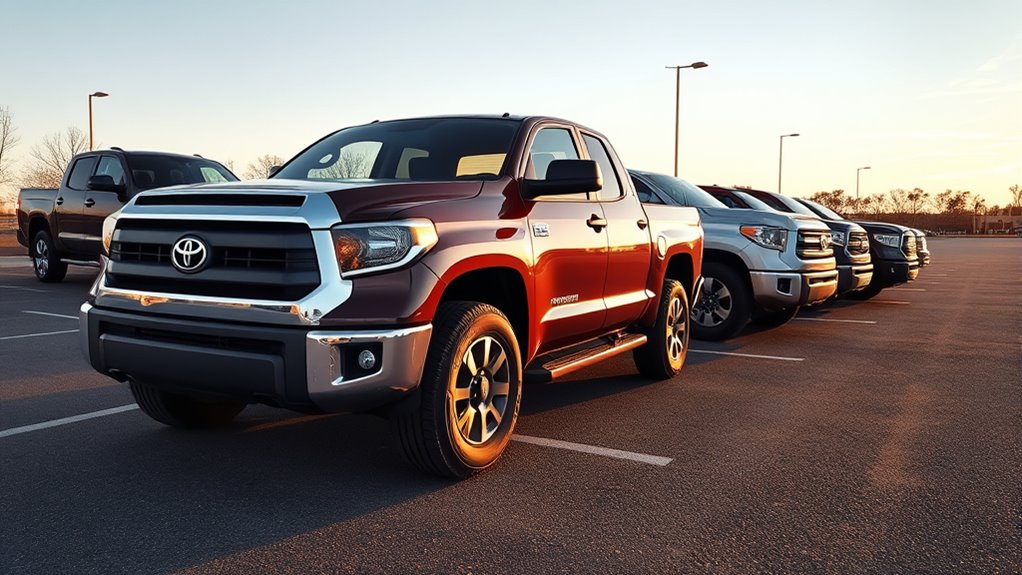
The second-generation Toyota Tundra runs from the 2007 through 2021 model years. It launched at the 2006 Chicago Auto Show and was built in San Antonio, Texas. Early models brought a 5.7L V8 and stronger towing capability, while the 2014 refresh added new styling and safety tech. Buyers often look for the 5.7L or 4.6L V8 and service history. More details on trims, updates, and common issues follow below.
Key Takeaways
- The Toyota Tundra second generation spans the 2007 through 2021 model years.
- It debuted at the 2006 Chicago Auto Show and launched as a 2007 model.
- This generation ended after the 2021 model year, before the full redesign.
- Major updates came in 2014, including styling, dashboard changes, and added safety tech.
- Engine choices included 4.0L V6, 4.6L V8, and 5.7L V8, with the 5.7L offering the most power.
Toyota Tundra 2nd Gen Years
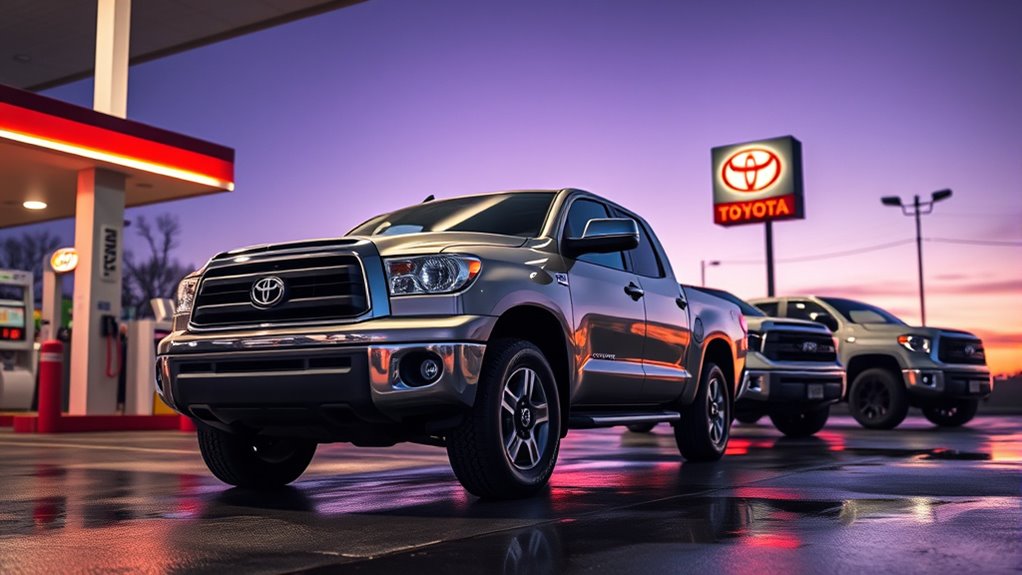
The second-generation Toyota Tundra covered the 2007 through 2021 model years, marking a major step forward for the full-size pickup. Launched at the 2006 Chicago Auto Show and built in San Antonio, Texas, the Toyota Tundra second generation arrived with broader capability and a stronger market position.
The 2007 model year introduced a 5.7L V8 engine, rated at 381 horsepower and capable of towing more than 10,000 pounds. Multiple trim levels expanded buyer choice, while the Platinum Package joined the lineup for 2010.
In 2015, the TRD Pro added a more off-road focused option. Safety improvements also defined the generation, and a five-star NHTSA crash test rating in 2010 reflected the progress.
The 2021 model year closed this era before the next redesign.
2007–2013 Toyota Tundra Updates
Arriving in 2007, the second-generation Toyota Tundra introduced a 5.7L V8 rated at 381 hp, giving the truck a major power increase over its predecessor. This redesign set the tone for 2007-2021, with stronger towing credentials and clearer purpose.
In 2008, E85 fuel capability arrived, along with the TRD Supercharged option, pushing performance to 504 hp and 550 lb-ft of torque for drivers seeking more freedom from ordinary output.
By 2010, updates added front knee airbags and the Platinum Package, improving safety features while bringing more upscale equipment.
By 2010, the Tundra added front knee airbags and Platinum trim, blending safety with a more upscale feel.
Throughout 2007–2013, the Toyota Tundra remained the second generation’s core expression: a full-size truck built around a V8 engine, robust capability, and practical upgrades rather than visual excess.
These years established the platform before the later refresh, keeping focus on power, utility, and durability for buyers who value capability and independence.
2014–2021 Toyota Tundra Refresh
For 2014, the Toyota Tundra received a major refresh that sharpened its styling with a larger grille, revised fenders, and redesigned taillights, while also updating the cabin with a completely restyled dashboard for improved ergonomics and technology.
This second generation update gave the Tundra stronger aesthetic appeal without changing its core purpose as a capable full-size truck.
The 2014 refresh also added Toyota Safety Sense features, bringing advanced driver assistance into the lineup and improving everyday safety.
Through 2021, the model continued to emphasize utility, with its V8 engine delivering consistent performance and supporting towing capacity up to 10,800 lbs.
Interior ergonomics improved the driving position and control layout, making long workdays easier to manage.
The 2014–2021 span consequently stands as the refined phase of the second generation, balancing durability, safety features, and straightforward capability.
Toyota Tundra Engines and Trims
Across its second generation from 2007 to 2021, the Toyota Tundra offered a straightforward range of powertrains and trims, starting with a 4.0L V6 and moving up to a 4.6L V8 introduced in 2010, plus the 5.7L V8 rated at 381 hp and 401 lb-ft of torque. The second generation balanced work-duty strength with freedom from complication.
- 4.0L V6: entry-level efficiency and basic performance.
- 4.6L V8: added stronger midrange power and usable towing capacity.
- 5.7L V8: maximum performance, up to 10,800 lbs towing capacity.
- Trims: Base, SR5, Limited, Platinum, and TRD Pro, from utility to luxury.
The Toyota Tundra’s six-speed automatic kept the 5.7L V8 responsive and smooth.
In 2018, Toyota Safety Sense became standard across trims, adding modern driver aids without diluting the truck’s rugged character.
This second generation remained a clear choice for buyers seeking capability, control, and open-road confidence.
What to Check Before Buying a 2nd Gen Tundra?
Before buying a second-generation Toyota Tundra, buyers should verify the engine, safety equipment, and overall condition of the truck.
The best engine options are the 5.7L V8 and 4.6L V8; these units are strong, though some model years can show common issues such as water pump failures or cracked exhaust manifolds. The 5.7L V8 is often associated with 381 hp, while the 4.6L V8 delivers 310 hp; a 7L V8 or 6L V8 is not part of this generation, so listings should be checked carefully.
Safety features matter as well, especially 2010-and-later trucks with knee airbags and a backup camera.
Interior condition should be inspected for wear, hard plastics, and seat comfort. A full service history and maintenance records help confirm repairs, recall completion, and responsible ownership.
For any used pickup truck, these checks support a freer, smarter purchase decision across all model years.
Frequently Asked Questions
Which Year Is the Best to Buy a 2nd Generation Tundra?
2016 is often the best 2nd generation Tundra, balancing best features, performance reviews, reliability ratings, and owner testimonials. It delivers strong towing capacity, acceptable fuel efficiency, ample aftermarket upgrades, few common issues, solid resale value, and manageable maintenance costs.
Should I Buy a 2nd or 3rd Gen Tundra?
The choice depends on priorities. Better safe than sorry: second gen favors Tundra reliability, towing capacity, resale value, lower maintenance costs, and owner satisfaction; third gen adds engine options, fuel efficiency, interior features, safety ratings, off road capability.
Which Year Tundra to Stay Away From?
2010 and early 2011 Tundras are the ones to stay away from; troublesome features, engine issues, rust problems, transmission failures, electrical faults, fuel economy, safety ratings, resale value, maintenance costs, recall history matter most.
When Did the 2nd Gen Tundra Get a Facelift?
It received its major facelift in 2014, with facelift features and design changes. Model comparisons, performance upgrades, consumer reviews, reliability ratings, market trends, aftermarket modifications, ownership experiences, and resale value all reflect a notable update.
Conclusion
The second-generation Toyota Tundra spans the 2007 to 2021 model years, with a major refresh arriving for 2014 and carrying through 2021. For buyers, that means the “real answer” is not a single block of identical trucks, but two distinct phases under the same generation. From engines to trims, the lineup evolved considerably. Anyone shopping used should verify cab, drivetrain, and service history carefully. In the truck world, this generation is a true heavyweight.

