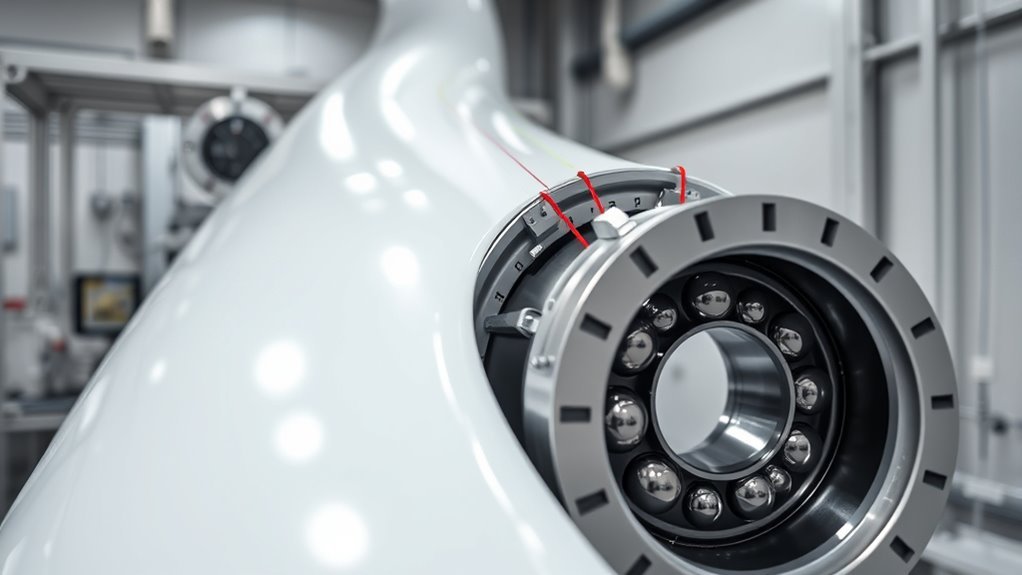
Barrel twist rate is the rifling speed that spins a bullet and helps it stay stable in flight. Stability depends more on bullet length than weight, since longer projectiles need faster twists. Common rates include 1:7 to 1:9 for .223 Remington, 1:10 for .308 Winchester, and 1:8 for 6.5 Creedmoor. Matching ammunition to twist rate improves accuracy, consistency, and terminal performance. A closer look reveals how calculators and formulas refine the choice.
Key Takeaways
- Twistrate beskriver hvor hurtigt riflingen spinner kuglen, og den afgør, om projektilet stabiliseres korrekt i flight.
- Længde er vigtigere end vægt for stabilitet, fordi længere kugler kræver hurtigere twistrate for at flyve stabilt.
- Typiske twistrates er 1:7–1:9 til .223 Remington og 1:10 til .308 Winchester, afhængigt af kugletypen.
- Forkert match mellem kugle og twistrate kan give dårlig præcision, større spredning og ustabil kugleflyvning.
- Miller-formlen og twistrate-kalkulatorer hjælper med at vælge den rette rifling til specifikke projektiler og forhold.
What Is Barrel Twist Rate?
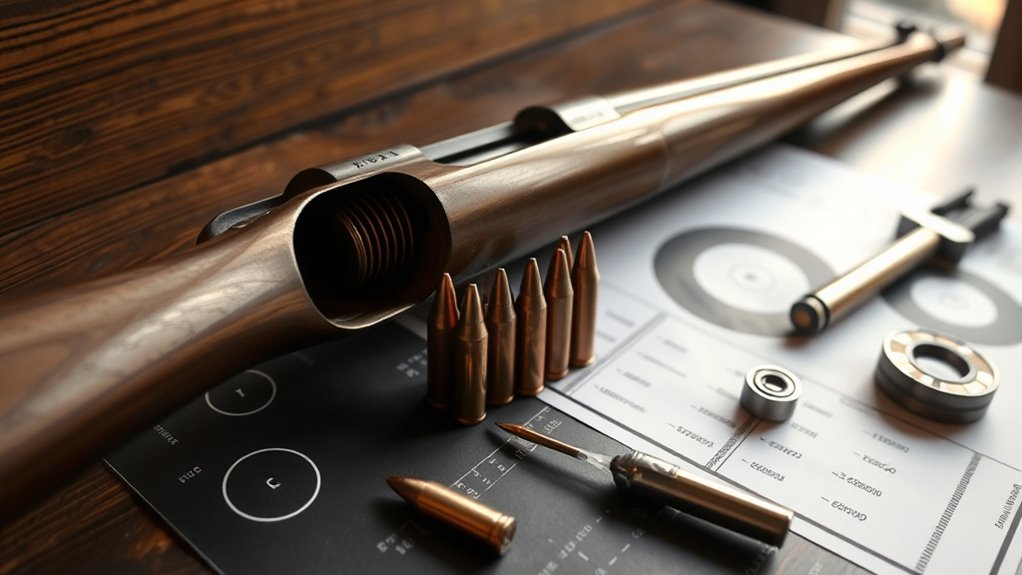
Barrel twist rate refers to the rate at which rifling inside a barrel spins a bullet, typically expressed as a ratio such as 1:10, meaning one full rotation occurs every 10 inches of barrel length. This barrel twist rate is a mechanical specification, not a matter of preference, and it determines how quickly the bullet is driven into rotation by the rifling.
Twist rates are selected according to bullet weight and length, because heavier, longer projectiles generally require faster spin to stabilize, while lighter, shorter rounds may function with slower rates. In common calibers, .223 Remington often uses 1:7 to 1:9, while .308 Winchester is frequently paired with 1:10.
Matching ammunition to the rifle’s twist rates allows the projectile to travel with disciplined flight rather than unstable motion. For those seeking liberation through precision, the specification is essential: it governs whether a round can stabilize effectively.
Why Twist Rate Affects Accuracy
Twist rate governs bullet stability by controlling rotational speed, and that stability depends strongly on bullet length.
Longer projectiles generally require faster twists to remain point-forward in flight, while insufficient spin can produce yaw, tumbling, and keyholing.
At longer ranges, a mismatch between bullet and twist rate becomes more pronounced, reducing accuracy and consistency.
Bullet Stability
Bullet stability is governed by the barrel’s twist rate, which determines how far a projectile travels for each full rotation and consequently how effectively it is spun to maintain a stable flight path. A suitable Twist preserves bullet stability; an inadequate twist rate invites yaw, tumbling, and keyholing. Heavier bullets demand faster twists to resist destabilization.
| Twist rate | Bullet type | Result |
|---|---|---|
| 1:9 | Light bullets | Reliable |
| 1:7 | Heavier bullets | Stable |
| Too slow | Long projectiles | Tumbling |
For precision shooters seeking liberation through control, correct matching of bullet and barrel specifications is decisive. Stable flight improves accuracy, consistency, and downrange performance without surrendering autonomy to random dispersion.
Length And Spin
Length, more than mass alone, often determines the spin requirement for a projectile because longer bullets need higher rotational speed to remain aerodynamically stable in flight.
In practical terms, the length of the bullet drives the need to spin a bullet faster as its center of pressure shifts and overturning moments increase. A faster twist rate, such as 1:8 or 1:7, can support elongated projectiles that a 1:10 barrel may not fully stabilize.
When twist is insufficient, keyholing appears and precision collapses. A twist rate stability calculator or the Miller Twist Rate formula offers a disciplined method for matching barrel twist to bullet geometry, helping shooters select combinations that preserve stability, efficiency, and freedom from arbitrary trial and error.
Accuracy At Range
At distance, barrel twist rate becomes a direct determinant of how well a projectile preserves stability and, by extension, how consistently it prints on target.
Proper bullet stabilization depends on matching spin to bullet length and mass; when the rifles twist rate is too slow, heavier bullets may yaw, tumble, or keyhole, degrading accuracy.
Faster twists, such as 1:7 or 1:8, better support longer projectiles and sustain a stable trajectory.
Standard .223 Remington configurations span roughly 1:7 to 1:9, shifting effective range across bullet weights.
Ammunition must be tested against the bore’s twist rate, because mismatches increase drag, widen dispersion, and reduce precision.
Correct spin minimizes drag, preserves velocity, and secures dependable long-range performance.
Why Bullet Length Matters More Than Weight
Bullet length is a more direct determinant of stability than weight, because longer projectiles impose greater aerodynamic and gyroscopic demands on the twist rate.
The Miller formula reflects this by treating length as a primary variable, while weight alone can misstate the required stabilization.
As a result, longer bullets typically require faster twists, even when a heavier but shorter bullet may not.
Bullet Length Vs Weight
In twist-rate analysis, the projectile’s physical length is often the more decisive variable than its mass, because longer bullets present greater gyroscopic instability and consequently demand faster rifling twist to remain point-forward in flight.
Bullet length hence enters the twist rate calculation more directly than weight alone. A shorter, heavier bullet design may stabilize with a slower twist than a longer, lighter one, because the length-to-weight ratio governs rotational demand.
The Miller Twist Rate Formula formalizes this by weighing bullet length alongside mass, confirming that tighter twist is usually required as length increases.
Practically, this distinction helps shooters choose ammunition that can stabilize efficiently, preserve ballistic coefficient, and deliver precise trajectories.
For those seeking liberation through accuracy, measurement outranks assumption.
Stability Depends On Length
Length governs stability more decisively than mass because a longer projectile places greater demands on spin to remain point-forward in flight.
In external ballistics, bullet length sets the dominant requirement for twist rate, since extended ogive and shank geometry increase overturning moments. A heavier but shorter bullet may stabilize in modest rifling, while a lighter, longer one can demand a tighter twist to prevent tumbling.
When bullet length exceeds roughly 1.5 times diameter, the length-to-diameter ratio usually determines the needed spin for accuracy. Longer, streamlined designs also raise ballistic coefficient, improving downrange performance.
Shooters can use calculators to match ammunition to barrel rifling, selecting the twist rate needed to stabilize each bullet length and preserve accuracy without unnecessary constraint.
Common Twist Rates for Popular Calibers
Common twist rates vary by cartridge and intended projectile weight, with .223 Remington commonly ranging from 1:7 to 1:9 to better stabilize heavier bullets, .308 Winchester often using 1:10 for 150- to 180-grain projectiles, and 6.5 Creedmoor typically standardized at 1:8 for long, high-BC bullets. In technical terms, twist rate determines how rapidly a bullet spins, and barrel length can affect practical performance. The common twist rates below show a clear pattern of mechanical freedom:
| Cartridge | Typical Twist |
|---|---|
| .223 Remington | 1:7–1:9 |
| .308 Winchester | 1:10 |
| 6.5 Creedmoor | 1:8 |
| Military 5.56 | 1:7 |
| Civilian AR | 1:7–1:9 |
A 1:7 rifling profile often stabilizes bullets up to 90 grains, while 1:8 offers versatile control to stabilize bullets up to 80 grains. These common twist rates illustrate deliberate engineering, not guesswork.
How to Match Ammo to Your Twist Rate
Matching ammunition to a rifle’s twist rate requires aligning projectile weight and length with the barrel’s rotational speed. For reliable bullet stability, the match must be specific: a 1:8 twist rate typically stabilizes bullets up to 80 grains, while projectiles above 90 grains often demand a faster 1:7 twist.
Match bullet weight and length to barrel twist for reliable stability and consistent accuracy.
Lighter loads can function well in slower 1:9 barrels. Length matters as much as mass; longer bullets impose greater gyroscopic demand and thus require tighter twist to preserve accuracy.
The rifles used in military service commonly employ 1:7 to support heavy projectiles, whereas civilian platforms may range from 1:7 to 1:9 according to intended use.
A precision shooter benefits from this matching discipline because it reduces dispersion and supports consistent terminal behavior. The practical aim is liberation from guesswork: select ammunition that the barrel can stabilize, and performance becomes more predictable, controlled, and efficient under field or range conditions.
How to Use a Twist Rate Calculator
A twist rate calculator provides a systematic way to estimate the barrel twist needed to stabilize a specific bullet by entering caliber, weight in grains, length, and ballistic coefficient. It converts these variables into a practical estimate of twist rate, allowing evaluation of bullet stability before firing.
Accurate input matters: bullet length may be approximated by multiplying diameter by 4.2 when direct measurement is unavailable, though precise dimensions improve output. Muzzle velocity, expressed in FPS, also influences the result, especially at longer ranges where stability can decline.
Local atmospheric conditions, including temperature and altitude, should be entered when possible because air density changes the required rifling behavior. Many calculators apply the Miller Twist Rate Formula, which refines the best twist rate for a given projectile.
Used correctly, the twist rate calculator frees the shooter from guesswork, aligning ammunition, rifling, and target demands with disciplined precision.
Frequently Asked Questions
Can You Explain What a Gun Barrel Twist Rate Is and What It Does?
A gun barrel twist rate describes rifling types that spin a bullet, improving bullet stabilization. It affects projectile design, accuracy factors, and barrel length interactions, helping match ammunition to a rifle for ideal flight and precision.
Is a 1,7 or 1,8 Twist Rate Better?
As if deciding the fate of empires, neither is universally better: 1:7 favors heavier bullets and stronger bullet stability, while 1:8 offers broader versatility. Twist rate, caliber impact, barrel length, and shooting accuracy determine selection.
What Does 1/10 Twist Rate Mean?
1/10 twist rate means the rifling spins a bullet once every 10 inches of barrel length. This Twist rate influences bullet stability, accuracy factors, and ammunition types, especially for longer projectiles and proper load selection.
Is a Higher Twist Rate Better?
Not always; higher twist rate can be a tailored key, releasing bullet stability for longer projectiles. Its twist rate impact depends on ammunition compatibility, accuracy factors, and barrel length, where mismatched rates may diminish performance.
Conclusion
To sum up, twist rate and bullet stability are shown to be tightly linked by design rather than chance. When barrel twist, bullet length, and velocity align, accuracy emerges with predictable consistency. When they do not, dispersion appears immediately. The coincidence is notable: the same simple measurement that guides spin also determines whether a round flies cleanly or fails in flight. For the informed shooter, matching ammunition to twist rate remains the decisive variable.
