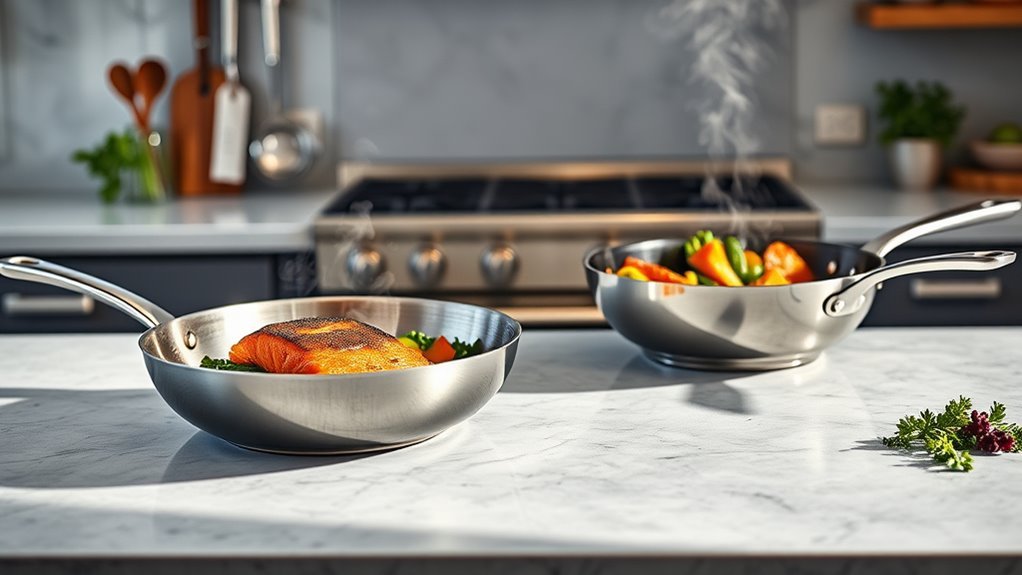
Henckels Paradigm performs very close to HexClad in eggs, pancakes, and seared meats, yet costs far less. HexClad offers stronger heat retention and a more durable textured hybrid surface, but Henckels heats faster and often browns food more quickly. Both need grease for best nonstick results. Henckels also brings better value, making it the more practical choice for most kitchens. The finer trade-offs become clearer in the sections ahead.
Key Takeaways
- Henckels Paradigm performs nearly as well as HexClad in everyday cooking, despite costing much less.
- Henckels heats faster, giving better egg crisping, quicker browning, and slightly stronger initial searing.
- HexClad retains heat better and offers steadier temperature control during longer cooking sessions.
- HexClad’s ceramic-hex design may improve durability, while Henckels uses a smoother PTFE nonstick surface.
- Choose Henckels for value and practicality, or HexClad for premium build, heat retention, and easier cleaning.
HexClad Vs. Henckels Paradigm: Which Wins?
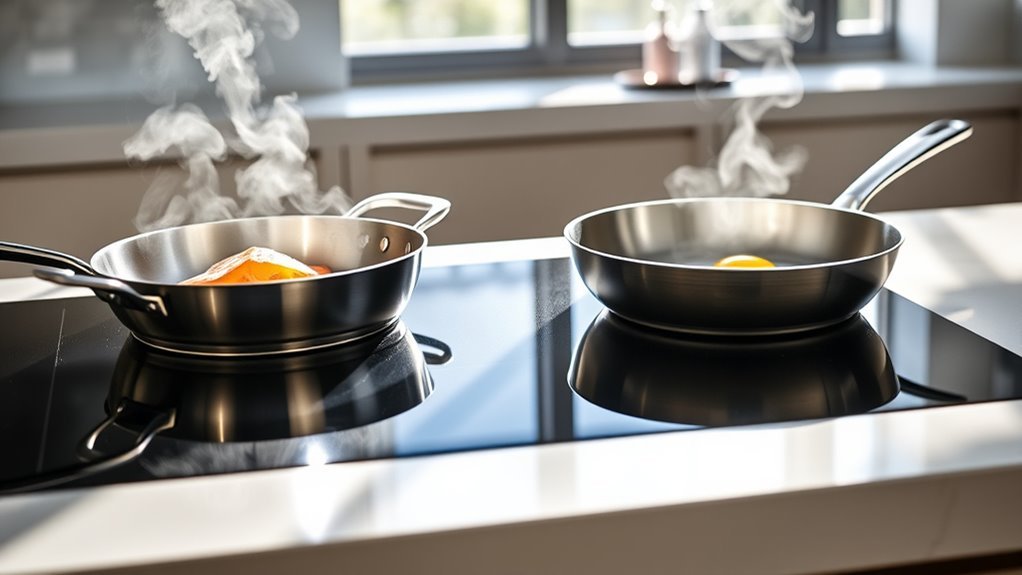
HexClad and Henckels Paradigm diverge most sharply on price-to-performance balance: HexClad commands a premium, with a 12-inch frying pan costing more than an entire Henckels 3-piece set, yet the cooking results are closely matched.
HexClad’s premium price outpaces its advantage, while Henckels delivers nearly the same cooking results for far less.
In direct use, Henckels heats faster, producing stronger browning and crispier surfaces, which favors controlled searing and efficient weeknight cooking. HexClad responds well on induction, boiling water in about 5:30 minutes, and its heat retention remains stronger after the burner is lowered, helping stabilize finished dishes.
HexClad’s TerraBond ceramic layer and Henckels’ PTFE-based options also shape nonstick behavior and wear profiles. Still, the overall performance gap is narrow. For cooks seeking practical autonomy from inflated branding, Henckels often delivers the more rational balance of speed, release, and durability.
HexClad wins on retained warmth; Henckels wins on immediacy and browning.
Price And Value Breakdown
The price gap between HexClad and Henckels Paradigm is substantial, with HexClad pans costing more than twice as much. A 12-inch HexClad frying pan exceeds the price of a complete 3-piece Henckels set.
Henckels Paradigm delivers comparable core features at a lower entry cost, creating a stronger value-for-money profile for cost-conscious buyers.
When cost is weighed against feature parity and everyday utility, Henckels Paradigm presents the more efficient purchase.
Price Gap Analysis
Although both cookware lines deliver strong cooking results, their pricing positions them in very different tiers. This price gap analysis shows HexClad cookware at more than double the cost of Henckels pans, creating a sharp entry barrier for buyers seeking material freedom. A single 12-inch HexClad frying pan can surpass the price of a 3-piece Henckels Paradigm set, underscoring the disparity.
| Cookware | Price Position |
|---|---|
| Henckels Paradigm | Budget-oriented |
| HexClad cookware | Premium, higher-cost |
Both brands test well, yet the cost delta remains substantial. Henckels Paradigm preserves core performance while requiring less capital, making it a practical option for households that want competent tools without premium pricing. That spread defines the market choice.
Value For Money
Price alone does not determine cookware value, but it does shape the return each buyer gets for the money spent.
In this comparison, Henckels Paradigm presents a stronger value for money position because its cookware costs remain far below HexClad’s premium level.
HexClad pans can cost more than twice as much, and one 12-inch skillet can exceed the full price of a Henckels Paradigm 3-piece set.
That gap makes Henckels HXagon easier to access for buyers seeking performance without financial strain.
While HexClad may justify its tariff for some users, Henckels delivers similar cooking results, including rapid heating and crisp browning, at a lower entry point.
For consumers pursuing practical freedom from overpayment, Henckels offers the more efficient exchange between price and performance.
Cost Versus Features
Cost-to-feature balance tilts toward Henckels Paradigm, as its lower entry price delivers a comparable cooking toolkit without the premium surcharge attached to HexClad.
In direct cost terms, HexClad pans often cost more than twice as much, and a 12-inch frying pan can exceed the price of an entire Henckels Paradigm 3-piece set.
Yet the core features remain closely aligned: both lines provide hybrid-style usability, responsive heating, and the same need for greasing to resist sticking.
That means the higher HexClad cost does not reliably buy superior performance.
For buyers seeking practical autonomy from brand markup, Henckels offers the more efficient allocation of capital.
Its feature set is near-parity, while the price gap stays materially lower, strengthening overall value.
Cooking Performance On Eggs, Pancakes, And Meat
Henckels Paradigm shows the stronger edge in cooking responsiveness, heating faster than HexClad and producing crisper eggs and quicker pancake browning, which points to better surface searing for delicate foods.
In HexClad vs. Henckels comparisons, this cooking performance favors cooks seeking liberation from slow preheating and uneven initial contact. Both pans still need grease to limit sticking, yet the faster conductive response gives Henckels an advantage for low-mass foods.
- Eggs: crisper edges and cleaner release.
- Pancakes: faster browning and tighter control.
- Chicken thighs: superior initial coloration.
- Burgers: nearly matched sear quality.
A water-conduction test supports the difference: Henckels reached boil in 2:19, while HexClad needed 2:30.
Heat retention, however, is not the focus here; the key point is that immediate responsiveness shapes early browning and timing. For meat, that means more assertive first contact, especially where a quick crust matters.
Heat-Up Speed Vs. Heat Retention
Henckels heats more quickly, bringing two cups of water to a boil in 2 minutes and 19 seconds versus HexClad’s 2 minutes and 30 seconds, which reflects a faster initial response.
On induction, however, HexClad reaches a full boil at 5 minutes and 30 seconds while Henckels is still simmering, showing a slower warm-up under that condition.
HexClad then holds heat more effectively, staying at 102°F after 10 minutes compared with Henckels at 96°F, a result consistent with its thicker construction.
Heat-Up Speed
When comparing heat-up speed, the lighter Henckels construction gives it a clear edge in rapid response, bringing two cups of water to a boil in 2 minutes and 19 seconds versus HexClad’s 2 minutes and 30 seconds. This heat-up speed favors Henckels for users seeking swift, autonomous cooking control.
In practical terms, the difference is modest, yet measurable:
- Henckels accelerates faster on standard burners.
- HexClad reaches full boil more gradually on induction, near 5:30.
- Henckels may need closer attention because it can move from hot to simmering quickly.
- HexClad’s response is steadier, supporting deliberate pacing.
For those who value liberation through efficiency, Henckels offers faster ignition, while HexClad trades immediacy for a more measured ramp-up.
Heat Retention
Although Henckels heats more quickly, HexClad demonstrates stronger thermal retention once heat is established.
In direct comparison, Henckels boils two cups of water in 2 minutes and 19 seconds, slightly ahead of HexClad at 2 minutes and 30 seconds. Yet this early advantage does not translate into sustained performance.
After 10 minutes, HexClad maintains water at 102°F, while Henckels falls to 96°F, indicating weaker heat retention. The thicker HexClad construction helps stabilize temperature and reduce thermal loss, whereas the lighter Henckels design favors rapid response over persistence.
On induction cooktops, HexClad can also reach a full boil faster overall, though Henckels requires closer monitoring.
For cooks seeking control and autonomy, HexClad offers the more dependable thermal profile.
HexClad And Henckels Paradigm Design Differences
On the surface, the two lines diverge in both coating strategy and physical layout: HexClad uses a proprietary TerraBond ceramic layer with a hexagon pattern extending across the interior and bottom surfaces to improve release and simplify cleaning, while Henckels Paradigm relies on a PTFE-based coating, with both standard and PTFE-free ceramic variants available, plus a higher steel-to-non-stick ratio for added durability.
HexClad and Henckels present clear design differences that shape use and upkeep. HexClad’s textured field of raised stainless steel peaks adds visual complexity and abrasion resistance, while Henckels pursues a smoother profile with less surface texturing.
- HexClad wraps non-stick treatment across more external area.
- Henckels emphasizes a denser steel matrix for resilience.
- HexClad’s coated bottom reduces scrubbing demands.
- Henckels’ polished steel base is more prone to staining.
For users seeking kitchen freedom, the contrast is structural: HexClad prioritizes maximal release; Henckels favors simpler surfaces and a tougher core.
Handle Comfort And Cooktop Safety
Handle comfort and cooktop safety further separate the two lines, as Henckels Paradigm uses 8.5-inch handles mounted 3.5 inches above the counter, giving greater clearance, a steadier grip, and less heat transfer during stovetop use.
That geometry supports handle comfort by reducing wrist strain and by placing the hand farther from surrounding heat. The engraved logo and thumb indentation add tactile control, creating ergonomic support that can feel more liberated under frequent lifting and turning.
That geometry reduces wrist strain, while the engraved logo and thumb indentation add tactile control for easier lifting and turning.
HexClad’s 8-inch handles sit 2.5 inches above the counter and present a smoother profile, so the grip may feel less anchored during extended cooking.
On the surface below, Henckels’ polished steel bottoms are less likely to scratch cooktops, reinforcing cooktop safety and preserving the working area.
Taken together, the Henckels arrangement prioritizes secure handling, stable control, and surface protection, while HexClad appears more minimal and less structured in these specific contact points.
Induction Cooktop Performance
Induction cooktop performance separates the two lines in a measurable way, with HexClad heating faster and moving water to a full boil in 5 minutes and 30 seconds, while Henckels Paradigm lags behind and remains at a simmer for longer.
On induction cooktops, HexClad pans show bubbling at 2 minutes and 10 seconds, signaling quicker energy transfer and more immediate control. Henckels, being lighter, can warm rapidly too, yet its response is less forceful.
- HexClad reaches boil sooner.
- Henckels trails in initial bubbling.
- HexClad heat retention steadies output after preheat.
- Both demand careful monitoring with delicate foods.
This contrast matters for cooks seeking liberated precision: faster ramp-up, stable recovery, and less waiting.
HexClad also carries superior temperature control on gas and electric surfaces, reinforcing its multi-method consistency.
Henckels remains competent, but HexClad’s induction profile is more assertive, especially when sustained heat retention is needed.
Which Pan Is Better For Your Kitchen?
For most kitchens, the better choice depends on priorities rather than absolute performance: Henckels Paradigm offers the stronger value proposition, costing far less while still delivering comparable everyday cooking results, faster heating, and better browning for eggs and pancakes.
Henckels also benefits from longer handles and a polished bottom, which improves ergonomics and lowers scratch risk on delicate cooktops.
HexClad, by contrast, justifies part of its premium through superior heat retention, keeping water hotter after boiling and supporting steadier thermal recovery during repeated use.
Its proprietary non-stick coating also cleans more easily and may offer greater durability under heavy rotation.
For cooks seeking practical independence from inflated pricing, Henckels is the leaner, more accessible tool.
For those prioritizing sustained thermal stability and reduced cleanup effort, HexClad remains compelling.
In a liberated kitchen, the ideal choice is not brand prestige but the pan that best aligns cost, handling, and performance needs.
Frequently Asked Questions
Are Henckels Paradigms as Good as Hexclad?
No, Henckels Paradigms are not quite as good as HexClad overall. Durability Comparison favors HexClad’s heat retention; Cooking Performance favors Henckels’ faster browning; Price Analysis strongly favors Henckels’ lower cost and accessible value.
Are Henckels Paradigm Pans Any Good?
Yes—Henckels Paradigm pans are generally good. A 3-piece set offers strong value. In durability comparison and heat distribution, user reviews favor quick responsiveness, even browning, and comfortable handles, though induction cooking requires closer monitoring.
Which Knives Are Better, Henckels or Hexclad?
Henckels knives are better; HexClad offers no serious knife line. Knife durability comparison favors Henckels’ high-carbon stainless steel. Brand reputation analysis shows deeper cutlery expertise. Price value assessment generally rewards Henckels for broader, proven utility.
Is There a Dupe for the Henckels Hexclad Pan?
Yes—Henckels Paradigm serves as an affordable alternative, like a well-tuned engine beside a premium one. In cookware comparisons, performance reviews show quicker heating, solid browning, and similar nonstick behavior, though greasing remains necessary.
Conclusion
In a direct comparison, HexClad and Henckels Paradigm each deliver distinct strengths, but the better fit depends on priorities. HexClad offers faster heat response and stronger nonstick convenience for eggs and pancakes, while Henckels Paradigm provides a more traditional stainless-steel feel with solid heat retention and refined control for meat. Which matters more in a busy kitchen: quick-release ease or steady searing performance? For cooks seeking versatility and value, the choice is ultimately application-specific.
