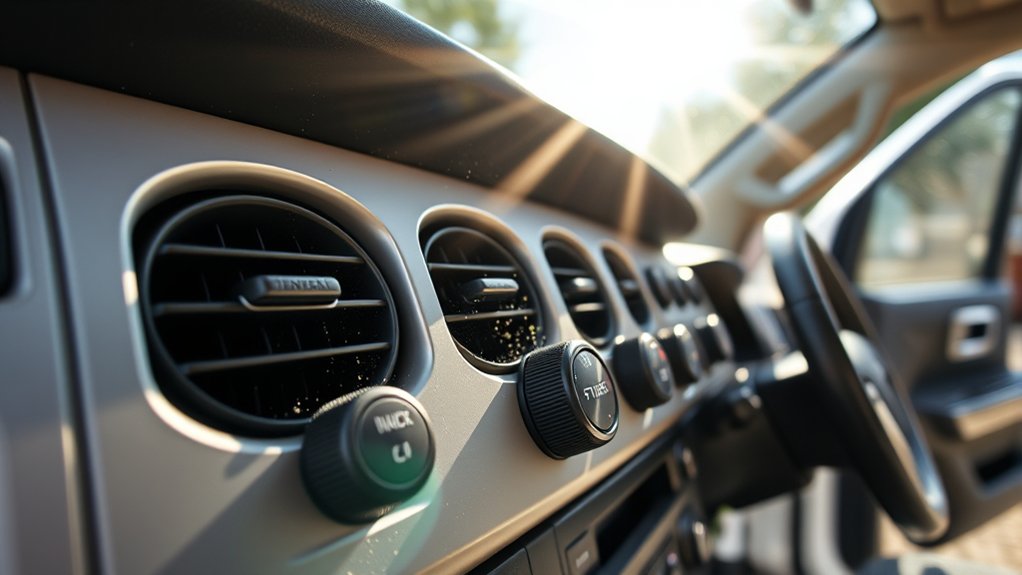
A Toyota Tundra AC that cools only on max fan and recirculation usually has reduced airflow, low refrigerant, or a condenser or compressor issue. Vent temperature should drop about 20 degrees below ambient after 15 minutes. A clogged cabin air filter, weak blower motor, debris in the condenser, or blend door faults can also limit cooling. Best setup starts with max AC, high fan, and shade reduction. Further checks can isolate the exact fault quickly.
Spot Signs of Weak Tundra AC

How can weak Tundra AC performance be identified before it becomes a larger drivability concern? Early indicators usually appear as operational dependence rather than outright failure.
On the 2018 Tundra, owners frequently report that acceptable cooling requires maximum blower speed and recirculation mode, a pattern suggesting reduced system efficiency.
Another sign is delayed cooldown after startup, especially following sun exposure or during short trips, when the system fails to stabilize cabin comfort promptly.
In hotter regions above 95 degrees, performance degradation becomes easier to detect. Reports commonly describe cooling that feels marginal compared with earlier Tundra models, particularly in humid conditions.
If the cabin never reaches a meaningful reduction from outside heat, weak AC operation should be suspected.
Diagnostic attention should begin with routine service items, including refrigerant charge verification and inspection of the cabin air filter.
Identifying these symptoms early gives the owner more control and prevents minor inefficiency from becoming a restrictive comfort problem.
Check Tundra AC Vent Temperature
Vent temperature should be verified with a small probe thermometer placed at the outlet after the Tundra AC system has operated for at least 15 minutes.
The reading should then be compared to ambient air temperature, with an expected drop of approximately 20 degrees under proper operation.
During the test, fan speed and recirculation settings should be confirmed, and inadequate cooling should prompt inspection of the cabin air filter, refrigerant level, and compressor function.
Vent Temperature Range
Measure the 2018 Tundra’s AC output at a center dash vent with a thermometer after the system has operated for about 15 minutes, using recirculation mode to stabilize cabin cooling before switching to outside air if needed.
A practical vent temperature range is indicated by a drop of up to about 20 degrees Fahrenheit below ambient conditions. If the measured reduction is smaller, cooling performance may be constrained by airflow restriction, elevated cabin heat load, or environmental stressors.
High humidity and direct sunlight can suppress effective cooling and distort perceptions of system output. Shaded parking reduces initial thermal saturation and supports more accurate assessment.
Cabin air filter condition also affects airflow volume and discharge temperature stability. For drivers seeking freedom from guesswork, this range establishes a clear diagnostic baseline without overinterpreting short-term fluctuations or comfort impressions.
Thermometer Testing Steps
Begin with a small probe thermometer positioned at a center dash vent, then operate the 2018 Tundra’s AC on recirculation for at least 15 minutes before recording discharge temperature.
These thermometer testing steps isolate system behavior and free the diagnosis from guesswork:
- Park in shade or pre-cool the cabin to suppress greenhouse heat.
- Measure ambient temperature first for a clean baseline.
- Verify roughly a 20°F drop at the vent.
- Inspect cabin filter restriction if air flow feels weak.
- Log readings for before-and-after maintenance comparison.
A precise vent reading reveals whether cooling performance aligns with specification. If discharge temperature remains too warm, restricted air flow, debris-loaded filtration, or other efficiency losses become more likely.
Consistent documentation builds an evidence trail, enabling informed service decisions without confusion or wasted parts replacement later.
Use the Best Tundra AC Settings
For faster cabin pull-down in a Toyota Tundra, the AC should be set to maximum cooling with a high fan speed at startup to accelerate heat removal. This initial setting reduces stored interior heat more efficiently than moderate blower operation.
Once the cabin temperature stabilizes, switching to recirculation mode helps preserve colder air and reduces compressor workload. A clean cabin filter also supports consistent system performance by preventing restriction that can reduce effective cooling capacity.
Thermal load management is equally important for liberated operation in high-heat conditions. Parking in shade lowers starting cabin temperature, allowing the AC system to reach target output sooner.
Sunshades reduce dashboard and seat heat saturation, while quality window tinting limits radiant heat gain through glass. These passive measures do not repair faults, but they improve AC effectiveness by reducing the heat burden placed on the system during startup and steady-state cooling in demanding summer use.
Fix Low Airflow From Tundra Vents
Even with correct cooling settings, weak vent output in a Toyota Tundra usually indicates a restriction or component fault within the airflow path. A systematic inspection frees the diagnosis from guesswork and targets the air conditioning system where resistance actually forms.
The most common airflow losses originate at serviceable components before deeper disassembly is justified.
- A cabin air filter packed with dust acts like a closed gate, choking vent delivery.
- A blower motor with weak speed or abnormal noise suggests worn bearings, brushes, or electrical faults.
- Damaged or obstructed ductwork can behave like a pinched artery, reducing volume at the registers.
- A failing blend door actuator may misposition internal doors, disrupting proper air routing and temperature mixing.
- Low refrigerant from leaks can lower evaporator performance, weakening overall airflow and cabin cooling output.
Addressing these checkpoints restores control, improves circulation, and helps the Tundra deliver stronger, more consistent vent performance under load conditions.
Find Causes of Cool but Not Cold AC
Several faults can leave a Toyota Tundra AC system delivering cool air instead of cold, and diagnosis should start with components that most directly affect heat removal and refrigerant pressure. Among the common reasons, low refrigerant is primary, often tracing to leaks at hoses, seals, or fittings. A restricted condenser also weakens heat rejection, raising pressures and limiting cabin cooling. Dirty cabin filters reduce airflow across the evaporator, making outlet air feel less cold. Compressor faults further reduce refrigerant compression and system performance. Electrical faults or damaged parts can intensify these conditions.
| Cause | Effect | Check |
|---|---|---|
| Low refrigerant | Weak cooling | Leak signs |
| Condenser blockage | Poor heat transfer | Debris, bent fins |
| Dirty cabin filter | Reduced airflow | Filter condition |
| Compressor malfunction | Low compression | Engagement, noise |
Methodical inspection supports independent, informed action and prevents misreading symptoms. Regular maintenance checks preserve performance and isolate faults before they cascade.
Know When Tundra AC Needs Repair
When a Toyota Tundra AC begins blowing warm air, producing weak airflow, or making unusual noises during operation, repair is typically required rather than simple adjustment.
Diagnostic attention should focus on failures that limit cooling and undermine reliability. The owners manual helps confirm service intervals and basic inspection points before deeper testing starts.
- Warm air from vents under load
- Weak airflow through dusty cabin passages
- Clicking or grinding near compressor clutch
- Oily residue around hoses or condenser
- Cooling that fades in stop-and-go traffic
Warm air from vents often traces to low refrigerant, and low charge commonly indicates leaks at O-rings, seals, hoses, or the condenser.
Warm vents often signal low refrigerant, usually caused by leaks at seals, hoses, O-rings, or the condenser.
Weak airflow usually points to a clogged cabin air filter restricting vent volume.
Unusual noise with the AC engaged may indicate compressor damage or electrical faults affecting clutch operation.
Regular maintenance checks preserve system freedom by catching minor defects before they become expensive component failures.
Prompt repair restores stable cabin cooling, airflow, efficiency, and confidence.
Frequently Asked Questions
Why Isn’t My AC Cooling Like Before?
It is likely cooling less due to low refrigerant, restricted airflow, humidity load, or failing components. A technical Maintenance Checklist should verify cabin filter condition, pressures, condenser performance, and compressor operation to restore dependable climate control.
Why Is My Toyota Tundra’s AC Not Blowing Cold Enough?
Usually, insufficient cooling results from low refrigerant, restricted airflow, condenser leaks, or high heat load; through AC Maintenance, filter inspection, leak testing, and recirculation use, the driver gains freedom from weak, uneven, frustrating cabin cooling.
What Is the 3-Minute Rule for Air Conditioners?
The 3-minute rule states an air conditioner may require up to three minutes before delivering noticeably cold air, allowing compressor stabilization and refrigerant cooling. An Efficiency Check includes recirculation use, filter cleanliness, and refrigerant level verification.
How Do I Reset My Toyota Climate Control System?
To reset the Climate Control, ignition is switched off, battery negative disconnected ten minutes, then reconnected. If unresolved, AUTO and OFF are held briefly. Defaults are restored, calibration begins, and hidden faults may finally release.
Conclusion
A Tundra AC that “works” yet fails to cool is a precise reminder that operation and performance are not identical. Vent temperature, airflow volume, control settings, and refrigerant state must all verify within spec, or comfort declines despite apparent function. Ironically, the loudest clue is often air that blows confidently while cooling poorly. Systematic diagnosis isolates whether correction is procedural, mechanical, or refrigerant-related, preventing unnecessary parts replacement and restoring the cabin to designed thermal control.