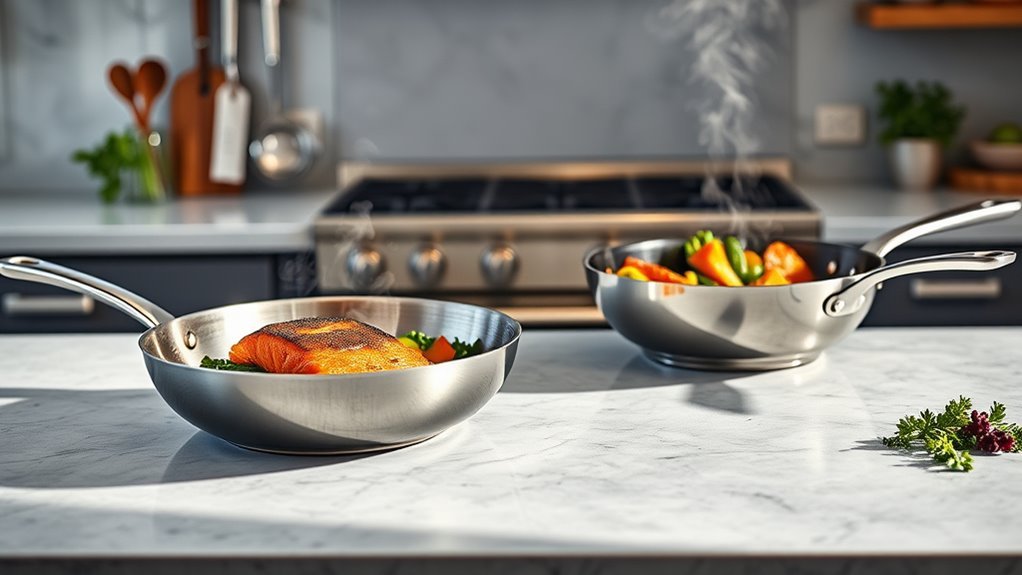
HexClad vs Henckels Paradigm is a close comparison if you want hybrid cookware without paying for features you may not need. Both combine raised stainless steel with nonstick-coated areas, but they differ in price, heating behavior, surface design, and handling. This guide compares their cooking results, construction, induction performance, and maintenance needs so you can choose the right pan for your kitchen.
Quick Answer
Henckels Paradigm offers similar everyday cooking performance at a lower price. It heats faster on a standard electric burner and browns eggs and pancakes quickly. HexClad retains heat better, performs well on induction, and has a patterned exterior that simplifies cleaning. Both benefit from oil or butter, especially when cooking delicate foods.
Last checked: September 26, 2026. Listed prices and product specifications were checked against manufacturer and retailer pages. Cooking-test figures are attributed to a published comparison.
Key Takeaways
- Henckels Paradigm and HexClad both use hybrid cooking surfaces with raised stainless steel and recessed nonstick areas.
- The original Paradigm line uses PTFE-based nonstick, while Paradigm Ceramic is a separate PTFE-free option.
- Henckels reached boiling temperature 11 seconds faster in the referenced electric-burner test.
- HexClad retained more heat after removal from the burner and reached a full boil first in the induction test.
- Henckels has longer, more angled handles and a polished exterior base. HexClad extends its textured pattern across the bottom.
- Both pans require suitable heat control, appropriate cleaning, and some cooking fat for reliable food release.
HexClad vs. Henckels Paradigm: Which Wins?
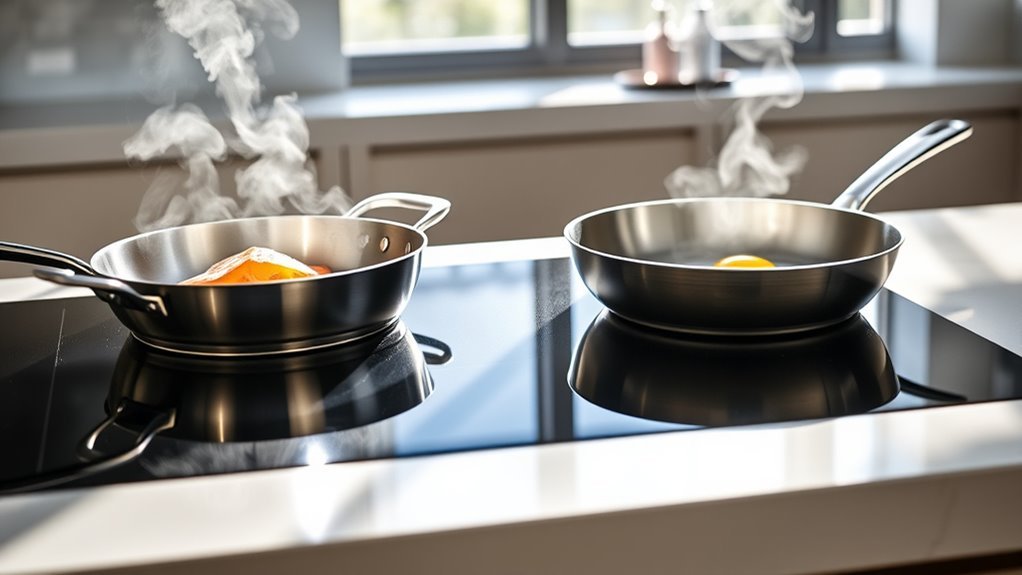
Henckels Paradigm offers a lower-cost way to get hybrid cooking performance, while HexClad provides greater heat retention and a heavier construction. Both can cook eggs, pancakes, burgers, and chicken effectively when used with suitable heat and cooking fat.
The main differences become clearer when you compare individual features rather than treating either pan as universally superior.
| Feature | Henckels Paradigm | HexClad |
|---|---|---|
| Price position | Lower-cost hybrid options | Premium-priced hybrid cookware |
| Heating response | Faster in the referenced electric-burner test | Stronger heat retention |
| Induction performance | Compatible; slower in the referenced test | Compatible; reached a full boil first |
| Nonstick coating | Traditional PTFE or separate ceramic version | TerraBond ceramic |
| Exterior bottom | Polished stainless steel | Textured hybrid pattern |
The practical choice depends on whether you prefer faster initial heating and lower purchase cost or greater thermal stability and easier exterior cleanup.
Price and Value Breakdown
HexClad generally costs more than Henckels Paradigm, but the difference depends on the exact model, set, coating, and retailer. Comparing a single pan with a multi-pan set also requires checking what each purchase includes.
Current product listings provide a clearer comparison than an older blanket claim about one brand costing more than twice as much.
Price Gap Analysis
The HexClad 12-inch hybrid frying pan was listed at $179 without a lid when checked.
Costco listed the Henckels Paradigm Ceramic 3-piece frying pan set at $109.99, including shipping and handling. Local warehouse prices may differ.
These listings show why comparing the actual products matters. The Henckels set includes three frying pans, while the quoted HexClad price is for one pan.
| Cookware | Price Position |
|---|---|
| Henckels Paradigm | Lower-cost hybrid option |
| HexClad cookware | Premium, higher-cost option |
Prices are US listings checked in September 2026, not guaranteed future selling prices. Discounts, membership requirements, and different set configurations can change the comparison.
Value for Money
Henckels Paradigm delivers much of the everyday usefulness of hybrid cookware at a lower entry cost. That matters if you mainly prepare eggs, pancakes, vegetables, and smaller portions of meat.
HexClad offers benefits that may matter more during demanding cooking sessions, including greater heat retention and a thicker body in the compared pans.
A lower purchase price does not automatically mean a lower lifetime cost. Coating condition, cleaning habits, storage, and frequency of use all affect how long cookware remains useful.
Cost Versus Features
Both brands combine stainless steel with a heat-conducting aluminum core and a hybrid cooking surface. However, the coatings and exterior designs are different.
Before comparing prices, check these details:
- Whether the Henckels listing is the traditional Paradigm or Paradigm Ceramic version.
- Whether the advertised price includes a lid.
- How many pans are included in the set.
- The oven-temperature rating for the specific pan and its lid.
- The manufacturer’s warranty terms and exclusions.
These details help you compare products with similar cooking capacity and features rather than relying on price alone.
Cooking Performance on Eggs, Pancakes, and Meat
Henckels Paradigm and HexClad both handle common frying tasks well, but their heating characteristics affect the results. Henckels responds quickly, while HexClad holds heat more effectively when cooler ingredients enter the pan.
The referenced side-by-side comparison found that both surfaces released food more effectively after oil or butter was added.
- Eggs: Henckels produced crispier edges under the same cooking conditions. Without grease, eggs stuck to both surfaces.
- Pancakes: Both pans released pancakes successfully, but the Henckels pan browned them more quickly.
- Chicken: Both produced browned surfaces. HexClad’s stronger heat retention can help maintain contact temperature during searing.
- Burgers: Both developed a crust, although HexClad maintained its sear more consistently when cold patties reduced the cooking temperature.
The main lesson is that faster heating and better heat retention are different qualities. Faster heating can shorten the wait before cooking, but a pan that holds heat may recover more steadily when you add food.
For delicate ingredients, start with moderate heat and use enough fat to coat the cooking surface. Hybrid cookware should not be treated as a completely grease-free replacement for conventional nonstick pans.
Heat-Up Speed vs. Heat Retention
Henckels heated faster on the standard electric burner, while HexClad retained more heat after removal. These results reflect two separate performance characteristics and should not be combined into a single measure.
The comparison used equal amounts of water and measured both boiling time and cooling behavior.
| Test | Henckels Paradigm | HexClad |
|---|---|---|
| Electric-burner boiling time | 2 minutes 19 seconds | 2 minutes 30 seconds |
| Water temperature after 5 minutes off heat | 113°F | 120°F |
| Water temperature after 10 minutes off heat | 96°F | 102°F |
These are results from a published comparison, not universal performance ratings. Burner output, pan size, starting temperature, and test conditions can change the results.
Heat-Up Speed
Henckels reached boiling temperature 11 seconds sooner in the electric-burner test. The lighter construction required less time to reach the measured condition.
That difference is modest for a single cooking task, but it helps explain why eggs and pancakes browned more quickly in the Henckels pan.
Faster heating also means you should pay attention during preheating. Leaving either hybrid pan on excessive heat can cause food to stick or burn.
Heat Retention
HexClad held more heat after both pans were removed from the burner. After 10 minutes, the water in the HexClad pan measured 102°F, compared with 96°F in Henckels.
The compared HexClad pan measured approximately 3 mm thick, while the Henckels measured about 2.4 mm. Their similar layered construction helps explain why the thicker pan retained more thermal energy.
This can be useful when searing burgers or chicken. Cold meat lowers the pan’s temperature, and greater thermal mass can reduce that drop.
However, heat retention is not the same as heating speed. A pan that stays warm longer can also take longer to cool when you need to lower the cooking temperature.
HexClad and Henckels Paradigm Design Differences
Both pans use a hybrid surface with raised stainless steel and recessed nonstick areas. The exposed steel supports browning, while the coated areas help food release.
The most important design distinction is the coating material. You should identify the exact Henckels version before comparing its surface with HexClad.
Nonstick Coating Materials
HexClad uses its proprietary TerraBond ceramic nonstick coating. The manufacturer states that the coating is made without PTFE and PFAS.
Traditional Henckels Paradigm cookware uses a PTFE-based nonstick coating. However, the separate Paradigm Ceramic collection uses a coating made without PFAS, PFOA, PTFE, lead, or cadmium.
Both versions retain the raised stainless-steel cooking pattern.
Do not assume that every product labeled Paradigm has the same coating. Check whether the product name specifically includes Ceramic.
Steel Pattern and Exterior Construction
Henckels exposes a greater proportion of stainless steel on the compared cooking surface. HexClad uses a different pattern of raised steel peaks and coated valleys.
Both designs protect recessed coating areas from some direct utensil contact, but neither makes the coating immune to wear.
HexClad also extends its hybrid pattern across the exterior bottom. That surface can make cooked-on exterior residue easier to remove.
Henckels uses a polished stainless-steel bottom. It has a smoother contact surface but may develop visible stains or discoloration during repeated cooking.
The exposed rivets also differ. Henckels’ more prominent rivets can collect food residue around their edges, while HexClad’s flatter rivets leave less space for buildup.
Handle Comfort and Cooktop Safety
Henckels Paradigm has a longer, more elevated handle in the compared models. HexClad has a shorter handle with a flatter profile.
Both designs provide useful grip options, but the preferred shape depends on your hand size and cooking habits.
The measured handle differences are:
- Henckels handle length: 8.5 inches.
- HexClad handle length: 8 inches.
- Henckels handle height above the counter: 3.5 inches.
- HexClad handle height above the counter: 2.5 inches.
Henckels also includes an engraved logo and thumb indentation. These provide a defined position for your thumb during lifting and turning.
The higher angle keeps your hand farther from the burner, while HexClad’s flatter handle can fit more easily into a crowded oven.
Neither design guarantees a cool handle under every condition. Use an oven mitt when removing cookware from the oven or when the handle has become hot.
Which Bottom Is Better for a Glass Cooktop?
Henckels’ polished base provides a smoother contact surface. HexClad’s raised exterior pattern may require additional care on glass or ceramic cooktops.
A small number of reported scratching complaints have involved HexClad’s textured bottom. However, those reports do not establish that scratching is common or inevitable.
Keep the cooktop and pan bottom clean. Lift cookware rather than dragging it across glass, regardless of which brand you use.
Induction Cooktop Performance
Both HexClad and Henckels Paradigm work on induction cooktops. In the referenced comparison, HexClad reached boiling temperature first despite Henckels heating faster on the standard electric burner.
The test used two cups of cold water in each 8-inch pan, with the induction burners set to the same temperature.
- HexClad showed initial bubbling at approximately 2 minutes and 10 seconds.
- HexClad reached a full boil at approximately 5 minutes and 30 seconds.
- Henckels was still simmering when HexClad reached a full boil.
- Both pans remained compatible with the induction cooking surface.
This demonstrates why induction performance should be evaluated separately from conventional electric or gas heating.
Induction uses a magnetic field to produce heat directly in compatible cookware. The pan’s magnetic properties, construction, size, and contact with the cooking zone influence the result.
These test figures do not guarantee identical boiling times on every induction cooktop. They show how the compared models performed under one controlled setup.
Which Pan Is Better for Your Kitchen?
The right choice depends on the food you cook, your cooktop, and how much you want to spend. Both cookware lines provide hybrid functionality, but they emphasize different strengths.
Match those differences to your cooking habits rather than relying only on branding or appearance.
Choose Henckels Paradigm If You Prefer
- A lower purchase price for everyday hybrid cookware.
- Faster initial heating on a standard electric burner.
- Quick browning for eggs and pancakes.
- A longer handle with a more elevated grip.
- A polished stainless-steel exterior bottom.
- The option to choose between traditional PTFE and a separate ceramic-coated collection.
Choose HexClad If You Prefer
- Greater heat retention during repeated cooking.
- Steadier temperature behavior when adding cold meat.
- The induction performance demonstrated in the referenced comparison.
- A textured exterior that can simplify cleaning.
- The TerraBond ceramic hybrid surface.
- A heavier pan with a longer-established product history.
Cleaning and Maintaining Both Pans
Both cookware lines benefit from sensible heat control and gentle cleaning. Their hybrid surfaces are designed to combine exposed stainless steel with protected nonstick areas, not eliminate maintenance.
HexClad recommends washing cookware before first use and seasoning its hybrid surface. Its official care instructions explain the process.
- Wash the new pan with warm, soapy water and dry it.
- Heat the HexClad pan over medium-low heat.
- Spread approximately one teaspoon of vegetable oil across the interior.
- Leave it on the heat for two to three minutes.
- Allow the pan to cool and remove excess oil before storing it.
Use a small amount of oil or butter during normal cooking, particularly with eggs and other delicate foods.
Both brands offer dishwasher-safe products, but hand washing with a soft sponge helps preserve the finish. Allow cookware to cool before washing, and dry it before storage.
For stubborn residue, soak the pan in warm, soapy water before cleaning. Avoid harsh abrasive tools on coated cooking surfaces.
Warning: Do not assume that an oven-safe pan lid has the same temperature rating as the pan itself. Follow the lowest applicable limit for the exact cookware configuration, and avoid sudden temperature changes that may damage the pan.
The Henckels Paradigm Ceramic frying pan is rated oven-safe up to 500°F. HexClad lists its current hybrid frying pan as oven-safe up to 900°F. These figures apply to the specified pans, not automatically to every lid or accessory.
Frequently Asked Questions
Are Henckels Paradigm pans as good as HexClad?
Henckels Paradigm delivers comparable everyday cooking results but differs in heat retention, induction response, and construction. It heats faster in the referenced electric-burner test, while HexClad maintains heat more effectively. Both release delicate foods better when used with oil or butter.
Are Henckels Paradigm pans any good?
Yes, Henckels Paradigm pans provide useful hybrid cooking performance at a lower price than HexClad. They heat quickly, brown food effectively, and offer comfortable handles. Their faster temperature changes mean you should monitor the heat carefully when cooking delicate ingredients.
Which knives are better, Henckels or HexClad?
Both Henckels and HexClad sell kitchen knives, but their collections differ. Henckels offers traditional stainless-steel cutlery across several product lines, while HexClad offers Damascus-style knives and knife sets. Compare individual blade materials, handles, maintenance requirements, and prices rather than judging either brand solely by its cookware.
Is Henckels Paradigm a less expensive alternative to HexClad?
Yes, Henckels Paradigm is a lower-cost hybrid alternative to HexClad. Both use raised stainless steel with recessed nonstick areas and can produce similar everyday cooking results. The main trade-offs involve thermal retention, induction performance, coating options, and exterior construction.
Are HexClad and Henckels Paradigm induction-compatible?
Yes, both cookware lines are compatible with induction cooktops. HexClad reached a full boil first in the referenced induction comparison, while Henckels heated faster in the conventional electric-burner test. Actual performance depends on the cooktop and the specific pan.
Is every Henckels Paradigm pan PTFE-free?
No, the traditional Paradigm line uses PTFE-based nonstick, while Paradigm Ceramic is made without PTFE. Check the full product name and coating specifications before buying because the two versions share similar hybrid designs.
Conclusion
HexClad and Henckels Paradigm deliver similar everyday hybrid cooking performance through different designs. Henckels offers faster initial heating and a lower entry price, while HexClad provides stronger heat retention and a textured exterior that can simplify cleaning.
Before purchasing, compare the exact pan size, coating, included accessories, and current price. Those details will help you choose cookware that matches how you actually cook.
Sources
- HexClad — 12-Inch Hybrid Frying Pan: Price, TerraBond coating, construction, oven compatibility, and product specifications.
- Costco — Henckels Paradigm Ceramic 3-Piece Fry Pan Set: Listed price, coating, set configuration, and compatibility.
- Henckels — Paradigm Ceramic Product Specifications: Coating materials, construction, induction compatibility, and oven-temperature rating.
- HexClad — Proper Use and Care: Washing, seasoning, temperature control, and cleaning instructions.
- HexClad — Kitchen Knives: Available knife collections and product types.
- Henckels — CLASSIC Knife Specifications: Stainless-steel blade construction and cutlery features.
