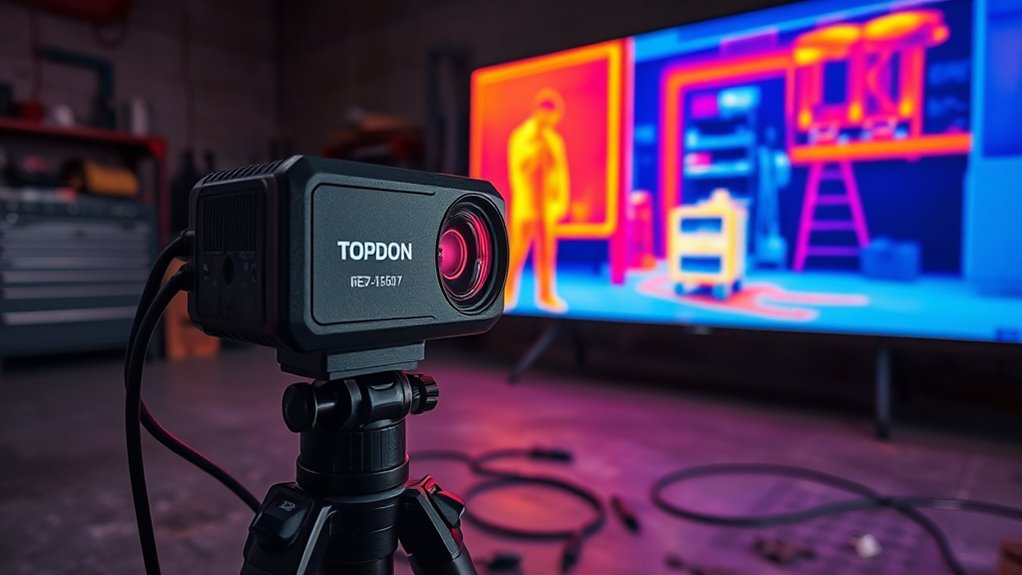
TOPDON thermal cameras do not record pure infrared pictures in the usual sense. They capture thermal images that measure temperature differences and map heat patterns for inspection. The TC002 uses 256×192 resolution and TISR processing to improve clarity, but it does not fuse infrared with optical data. The app displays, stores, and organizes thermal readings for analysis. For users comparing models or output types, the distinctions become more specific.
Key Takeaways
- TOPDON thermal cameras record true thermal images, not fused pure infrared-optical pictures.
- The TC002 captures measurable heat patterns at 256×192 resolution for diagnostic use.
- TISR processing sharpens the thermal image, but it does not convert it into a pure IR photo.
- The app displays real-time thermal data and stores images with temperature information.
- If you want higher detail, choose a model like TC004, but it still records thermal data, not pure infrared scenes.
Does the TOPDON TC002 Record Pure IR?
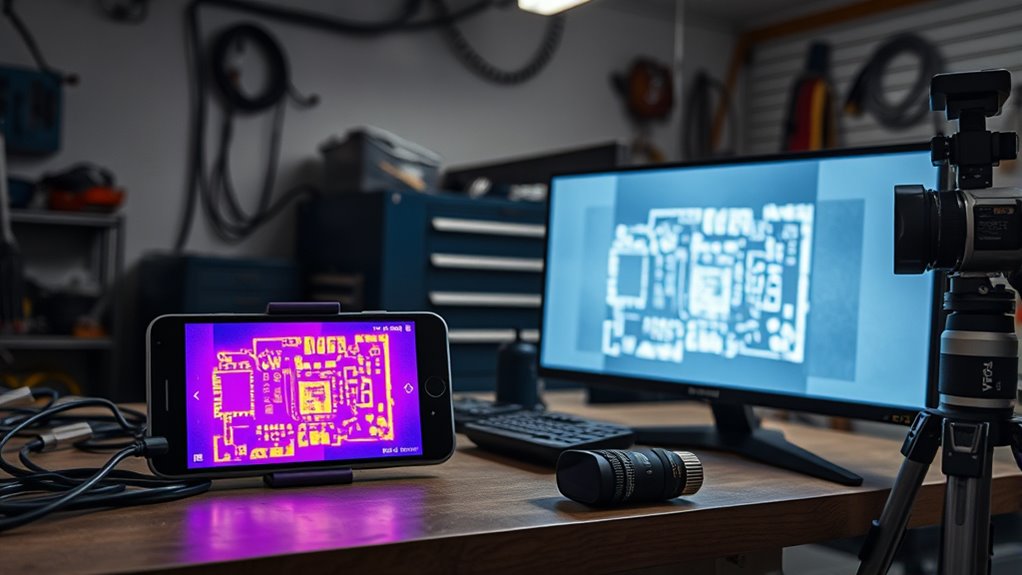
The TOPDON TC002 does not record pure IR in the strictest sense; it captures thermal images at a 256×192 resolution and uses TISR processing to improve visual clarity, but it does not combine infrared and optical data into a blended image.
The TOPDON TC002 captures thermal images with TISR enhancement, but does not blend infrared with optical data.
As a thermal camera, it presents measurable heat patterns rather than a fused representation found in some infrared cameras. This distinction matters because the device is optimized for direct thermal inspection, not for visual augmentation.
Its output can reveal temperature gradients with sufficient precision for diagnostic work, yet the absence of MSX-style blending limits contextual interpretation. The saved images also require manual rotation from portrait orientation, which can interrupt rapid analysis.
Even so, the system still provides disciplined thermal images that support independent assessment. For users seeking technical autonomy, the TC002 offers a focused, uncompromised thermal view, but not a composite or pure infrared record in the imaging sense.
What the TC002 Really Captures
Captured by the TOPDON TC002 is a 256×192 thermal image that maps heat variation rather than a fused infrared-optical scene. This IR camera records thermal imaging across -4°F to 1022°F (-20°C to 550°C), preserving temperature gradients with analytical clarity.
TISR technology is applied to refine edge definition and improve perceived detail, but it does not create a pure infrared photograph or mixed visual frame. The result is a calibrated heat map suited to inspection, diagnosis, and rapid assessment.
- 256×192 resolution supports readable thermal structure.
- Wide temperature span exposes subtle and extreme heat.
- TISR technology sharpens image interpretation.
- Smartphone connection streamlines transfer and reporting.
Images save in portrait orientation and may require rotation for landscape review, yet the capture itself remains direct and practical.
For users seeking technical freedom from ambiguity, the TC002 delivers measurable thermal data, not optical decoration.
Thermal Images vs. Pure Infrared Photos: What’s the Difference?
Unlike pure infrared photos, thermal images from the Topdon Thermal Camera render surface temperature variation as measurable data, not just visual contrast. This thermal camera uses infrared radiation to map heat, exposing liberated diagnostics that conventional imagery cannot deliver. With 256×192 resolution and TISR enhancement, subtle gradients become legible, supporting precise readings down to 0.1ºC.
| Thermal image | Pure infrared photo |
|---|---|
| Shows temperature data | May show visual appearance |
| Measures heat patterns | Lacks temperature measurement |
| Detects small anomalies | Emphasizes contrast |
Such output assists analysis of insulation loss, overheating circuits, and other thermal faults. The infrared basis is not decorative; it converts emitted energy into actionable information. By contrast, pure infrared photography may preserve surface aesthetics while omitting thermal context, limiting technical utility. In this sense, the Topdon camera prioritizes measurable truth over image-only interpretation, enabling users to inspect systems with greater clarity, autonomy, and control.
How the TOPDON App Handles Thermal Data
Once thermal variation is converted into measurable image data, the TOPDON app serves as the control layer for viewing and documenting that information in real time. The thermal imager output is presented through a clear interface, giving the user an ability to capture temperature patterns without delay. By choosing to download the app, the operator gains access to customizable color limits that refine contrast and expose narrow thermal differences.
TOPDON app displays thermal data in real time with customizable color limits for clearer temperature analysis.
- Real-time recording preserves thermal data as it appears.
- Waveform graphs show high, low, and average values over time.
- Saved images are stored on the device for sharing and reporting.
- Previous settings are retained, reducing repeat setup work.
This structure supports disciplined analysis while limiting friction. The recorded file retains annotations, making later review more precise.
For users seeking practical control, the app converts raw readings into organized evidence, allowing thermal observations to be reviewed, compared, and communicated with minimal procedural burden.
When the TC002 Is the Better Choice
The TOPDON TC002 is the more suitable option when the task requires a compact thermal camera that still delivers detailed infrared imagery. Its 256×192 sensor provides sharp thermal maps for diagnostics, while the 30g body and 71x42x14mm size support mobile fieldwork without encumbrance.
With Android and iPhone compatibility, it converts a smartphone into a practical inspection tool, reducing dependence on heavier dedicated instruments. The wide temperature range from -4°F to 1022°F makes it effective for electrical fault tracing, building assessments, and HVAC technicians who need broad operational coverage.
Real-time app display and adjustable temperature limits improve measurement control and interpretation. For users seeking an affordable route to thermal inspection, the TC002 offers disciplined performance, portability, and a degree of analytical freedom that expands access to infrared testing.
Which TOPDON Thermal Camera Is Right for You?
Selecting the right TOPDON thermal camera depends largely on device compatibility, imaging resolution, and inspection demands. TC002 fits iPhone users, while TC001 serves Android workflows, giving operators freedom from platform lock-in.
For many home inspectors, the TC004 Lite or TC004 Mini remains affordable without sacrificing a 256×192 thermal core. The TC004 suits more exacting analysis, since TISR raises output to 512×384 for finer fault localization.
All models share a -4°F to 1022°F span, supporting HVAC, automotive, and building diagnostics. The compact TC004 Mini, at 350 grams, favors portable service calls where mobility matters.
- TC002: iPhone compatibility
- TC001: Android compatibility
- TC004: highest resolution and analytical depth
- TC004 Mini: lightweight field portability
Frame rate and image detail should be weighed against task complexity. When rapid surveys suffice, economical models work well; when evidence-grade inspection is needed, the enhanced TC004 is the stronger choice for disciplined, independent thermal assessment.
Frequently Asked Questions
Do Thermal Cameras Pick up IR?
Yes, thermal cameras detect infrared spectrum radiation, converting it through thermal imaging camera technology into temperature maps. They do not capture visible light directly, instead measuring emitted heat with technical precision and analytical fidelity.
Is Topdon a Good Brand for Thermal Cameras?
No smoke without fire: Topdon appears a credible thermal-camera brand. Topdon reviews cite solid thermal camera features, responsive smartphone transfer, and dependable infrared technology. Its 20-year expertise and sub-$300 TC002 suggest practical value, especially for autonomous users.
What Is the Best Camera for Infrared Thermography?
The best camera for infrared thermography is a high-resolution thermal imager, ideally 256×192 or greater, with broad temperature span, ±3.6°F accuracy, and smartphone-ready camera features, suited to diverse infrared applications and rigorous thermal imaging.
Which Is Better, IR or Thermal?
Thermal imaging is generally better for diagnostics; infrared applications are broader, but thermal imaging turns heat differences into actionable data. With better camera features, it liberates technicians from guesswork, a remarkably modern upgrade, indeed.
Conclusion
In practice, the TOPDON TC002 does not record “pure infrared” in the romantic sense of an invisible, unprocessed truth. It records thermal data and renders it as a false-color image, because raw heat fields are not especially photogenic. The app then adds measurement tools, palettes, and overlays that improve utility, not purity. For users needing diagnostics rather than spectral poetry, this is the correct compromise: a camera that measures reality before beautifying it.