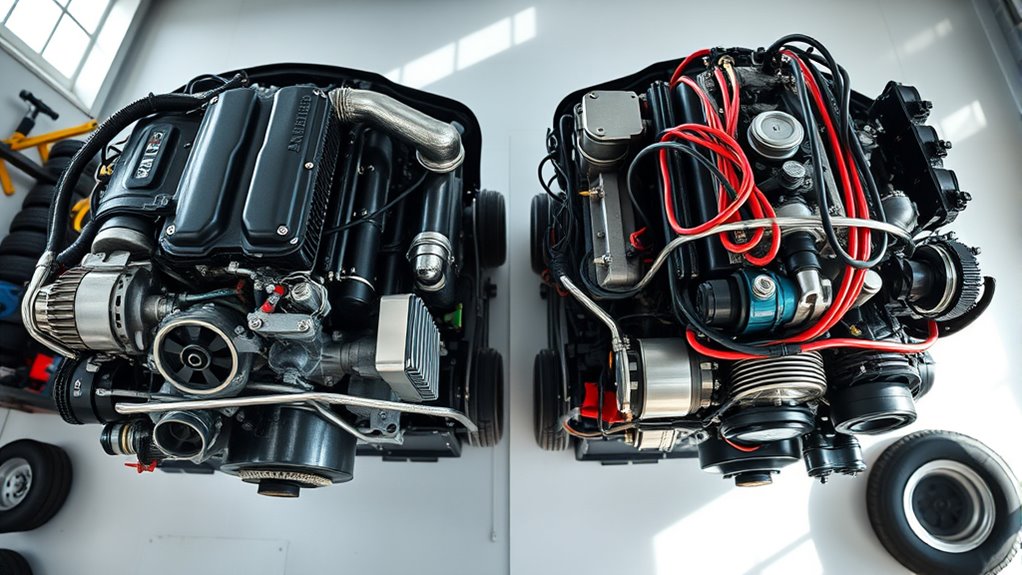
Diesel and petrol suit different drivers, and the better choice depends on driving habits, distance, and load. Diesel usually offers better fuel economy, stronger torque, and longer engine life, making it useful for highway travel and towing. Petrol is often cheaper to buy, smoother in city traffic, and better for short trips and stop-start use. Diesel can emit more nitrogen oxides and particulates, so local air quality matters. More details help narrow the right option.
Key Takeaways
- Diesel suits long motorway trips, towing, and heavy loads; petrol is better for short urban journeys and stop-start driving.
- Diesel engines usually deliver better fuel economy, while petrol cars are often cheaper to buy and maintain upfront.
- Diesel engines typically offer more torque at low RPM, giving stronger pulling power and better performance under load.
- Diesel vehicles can last longer and often exceed 250,000 miles, but petrol engines may need maintenance sooner at high mileage.
- Petrol generally produces less NOx and particulate pollution, making it a better choice for city air quality concerns.
Diesel vs Petrol: Which Fits You?
Choosing between diesel and petrol depends largely on how the vehicle will be used. Diesel often suits long-distance drivers, heavier loads, and high-mileage routines because its fuel efficiency tends to improve on highways.
Diesel often suits long-distance drivers and heavier loads, especially where highway efficiency matters most.
Petrol is usually the better fit for urban use, where responsive acceleration and shorter trips matter more. Driving habits consequently shape the decision: those covering fewer than 12,000 miles a year may find petrol more practical, while frequent travelers may benefit from diesel’s lower fuel costs over time.
Ownership costs also deserve attention. Diesel vehicles can carry a higher purchase price, yet their stronger mileage and longer service life may offset that expense for some owners.
Petrol models may cost less upfront and require less commitment for modest annual use. The most balanced choice is the one that aligns with distance, load, and budget, rather than habit alone.
What Makes Diesel and Petrol Different?
Diesel and petrol differ most clearly in how they burn fuel and the performance that results.
In diesel and petrol comparisons, energy density matters: diesel contains about 20% more energy per liter, often improving fuel efficiency on long journeys.
The two engines also favor different use cases. Diesel delivers stronger low-RPM torque and better thermal efficiency, which supports hauling, towing, and steady travel.
Petrol is usually lighter on its feet, offering quicker acceleration and sharper response for drivers who value agility and freedom in city traffic.
Diesel engines are commonly built for durability and can surpass 250,000 miles before major repairs.
Environmental impact also varies. Diesel tends to emit more nitrogen oxides and particulates, while petrol generally produces more CO2.
Each choice carries trade-offs, and neither is universally superior.
How Diesel and Petrol Engines Work
Diesel engines rely on compression ignition, compressing air to high temperatures before fuel is injected and ignites on its own.
Petrol engines use spark plugs to light a fuel-air mixture at lower compression ratios, creating a different combustion process.
These distinct methods influence efficiency, power delivery, and typical driving performance.
Diesel Combustion Process
Unlike petrol engines, which rely on a spark to ignite a premixed air-fuel charge, compression-ignition engines compress air to very high temperatures before fuel is injected, causing combustion to begin spontaneously.
This diesel combustion process depends on compression ignition, typically with ratios from 14:1 to 25:1, which supports higher thermal efficiency and stronger torque delivery.
Because diesel fuel has higher energy density, it can release about 20% more energy per liter than gasoline, aiding long-range use and heavy-duty work.
The combustion event is concentrated and effective at low RPMs, a trait valued for hauling and steady travel.
However, the process also generates more nitrogen oxides and particulates, so modern systems use advanced controls to reduce emissions while preserving performance and operational freedom.
Petrol Spark Ignition
Petrol engines use spark plugs to ignite a pre-mixed air and fuel charge, allowing combustion to begin at relatively low compression ratios. In petrol engines, air and fuel are blended before compression, then fired by the spark plugs, usually within 8:1 to 12:1 compression ratios. This setup supports quick throttle response and smooth acceleration, qualities valued by drivers seeking flexibility and control.
By contrast, diesel systems depend on high-pressure compression ignition and extract more energy per volume from fuel, often improving fuel efficiency over long distances. Petrol engines do not match diesel’s low-RPM torque, yet they remain lighter, simpler, and more immediate in feel.
For many buyers, that balance between freedom, responsiveness, and economy defines their appeal.
Fuel Economy: Which Saves More?
Concerning fuel economy, diesel engines are generally the more efficient option, often delivering 20–30% better mileage than petrol vehicles and, in some cases, up to 40% greater efficiency. This advantage comes from higher energy density and lower RPM operation, which let diesel vehicles extract more energy from each litre of fuel.
Diesel fuel’s calorific value, about 36.9 MJ/litre versus petrol’s 33.7 MJ/litre, also supports stronger range per tank.
For drivers whose driving patterns involve long motorway runs or frequent high-speed travel, diesel typically offers the clearest savings. The efficiency gap is smaller in city use and short trips, where petrol vehicles can be better matched to stop-start conditions.
In practical terms, the most liberated choice depends on how the vehicle is used: diesel tends to reward distance and steady cruising, while petrol may suit lighter, urban, and occasional driving.
Diesel vs Petrol Ownership Costs
Diesel vehicles often cost more to buy initially, yet their stronger fuel economy, longer engine life, and reduced wear can lower total ownership costs over time. For many drivers, diesel engines deliver savings through better mileage on long trips, which can offset the higher purchase price.
Their long lifespan also tends to reduce the need for early replacement, supporting a more economical ownership path. Although routine servicing, including oil changes, may cost more than for petrol models, lower wear can mean fewer repairs and steadier maintenance costs.
Petrol vehicles may seem cheaper at the start, but higher fuel use and earlier mechanical attention can raise expenses over time. Still, diesel ownership costs are not universally lower. Taxes, fuel prices, and environmental charges may be higher in some regions, reducing the advantage.
The balance depends on driving habits, annual mileage, and local pricing, so a careful comparison remains essential before choosing.
Which Engine Lasts Longer?
Diesel engines are generally regarded as longer-lasting, often reaching 250,000 to 300,000 miles or more because of their robust construction and lower operating speeds.
Petrol engines usually experience greater wear over time and may need major repairs sooner, sometimes around 150,000 miles.
Maintenance remains a key factor in both cases, with regular care helping either engine achieve a longer service life.
Diesel Engine Longevity
Typically, diesel engines outlast gasoline engines, often reaching 250,000 to 300,000 miles or more when maintained properly, while many petrol engines may need major repairs sooner. Their longevity reflects heavy-duty construction, higher compression, and robust combustion.
| Feature | Diesel Advantage |
|---|---|
| Lifespan | 250,000+ miles |
| Materials | Heavy-duty build |
| Design | Simpler mechanics |
| Efficiency | Higher fuel efficiency |
| Output | Strong energy output |
For drivers seeking autonomy through fewer replacements, diesel engines can offer notable durability. With proper care, many exceed 300,000 kilometers, making them practical for high-mileage use. Their blend of efficiency and endurance supports long-distance travel and steady performance, though maintenance remains essential to preserve that lifespan.
Petrol Wear And Tear
When comparing petrol and diesel engines for wear and tear, diesel units generally last longer because of their robust construction, lower RPM operation, and higher compression ratios.
In practice, diesel engines often reach 250,000 to 300,000 miles before major repairs, especially in high-mileage use. Their fuel consumption is also more efficient, and diesel fuel offers better lubrication, which helps reduce internal wear.
Petrol engines are usually lighter and smoother, yet their more complex parts can face earlier deterioration, with maintenance often becoming more frequent after about 150,000 miles. Petrol fuel is also more acidic, which may increase corrosion over time.
For drivers seeking long-term freedom from frequent repairs, diesel engines usually present stronger durability, while petrol engines may suit those prioritizing lower upfront cost and simpler everyday use.
Maintenance Impact On Lifespan
Maintenance has a significant impact on how long an engine lasts, and diesel units generally outlive petrol engines. Diesel engines, built for lower RPM operation and high compression, often achieve a longer lifespan, with many surpassing 250,000 miles before major repairs. Their fuel also provides better lubrication, reducing wear and supporting overall efficiency.
By contrast, petrol engines rely on more complex parts and tend to face greater stress, which can shorten service life. Regular maintenance remains essential for both, yet petrol engines usually need more frequent attention after about 150,000 miles.
Although diesel vehicles may cost more to buy and service, their durability can reward owners with fewer replacements and lower long-term costs, offering practical freedom through extended use and dependable performance.
Diesel vs Petrol for City and Highway Driving
For city and highway driving, the choice between diesel and petrol depends largely on how and where the vehicle is used.
Diesel engines typically deliver stronger fuel efficiency on highway driving, often using up to 40% less fuel at steady speeds, which suits long-distance travel and annual mileage above 15,000 miles.
Petrol engines, by contrast, are usually more responsive in city driving, with quicker acceleration and smoother handling in stop-start traffic, making them a practical option for drivers under 12,000 miles a year.
In urban settings, petrol vehicles also tend to produce lower CO2 emissions, while diesel engines can emit more nitrogen oxides and particulates.
The right choice thus depends less on status and more on use: highway commuters may gain from diesel economy, while urban drivers may prefer petrol’s flexibility and cleaner local profile.
Informed selection supports autonomy, efficiency, and lower running costs over time.
Diesel vs Petrol for Towing and Performance
Diesel engines are generally better suited to towing and heavy-duty performance because they produce higher torque at lower RPMs, which helps them move substantial loads with less strain and greater control. Diesel fuel’s higher energy density supports stronger towing performance, while fuel efficiency allows longer trips with fewer refuelling stops.
| Feature | Diesel | Petrol |
|---|---|---|
| Torque | Higher torque | Lower torque |
| Efficiency | Better fuel efficiency | Less efficient |
| Use case | Towing and endurance | Quicker acceleration |
In practice, diesel engines often maintain stability on steep grades and off-road surfaces, where sustained pulling matters more than rapid speed gain. Their endurance also suits repeated towing demands, with many vehicles exceeding 300,000 kilometres when maintained properly. Petrol engines can feel livelier in light-duty driving, yet their lower torque usually makes them less capable under heavy loads. For drivers seeking strength, range, and control, diesel remains the more capable option.
Which Fuel Is Better for You?
Choosing between diesel and petrol depends largely on driving habits and priorities. Diesel often suits drivers seeking fuel efficiency, stronger torque, and longer range for heavy loads or frequent highway travel. Its higher energy density can deliver about 15% more energy per liter, and vehicles may last beyond 250,000 miles with steady maintenance.
Diesel often suits drivers seeking fuel efficiency, stronger torque, and longer range for heavy loads or highway travel.
Petrol, by contrast, tends to feel more responsive, costs less upfront, and fits short trips and city routes where quick acceleration matters.
- Diesel: better for long-distance driving, towing, and lower running costs.
- Petrol: better for urban use, lighter driving needs, and smoother responsiveness.
The environment: petrol may be preferable in cities, while diesel can reduce CO2 per liter consumed.
The better choice is the one that aligns with driving needs, budget, and local air-quality concerns. Neither fuel grants freedom by itself; informed selection does.
Frequently Asked Questions
Is It Better to Buy a Petrol or Diesel Car?
It depends on driving needs: petrol suits short trips and lively driving, while diesel favors fuel efficiency, lower maintenance costs over time, stronger resale value, and better long-distance use, though environmental impact varies.
Should I Buy a Petrol or Diesel Car in 2026?
A practical theory holds that driving habits decide the choice: diesel suits high-mileage motorway use through better fuel efficiency, while petrol fits shorter trips with lower maintenance costs. Emissions standards and resale value should also influence purchase decisions.
What Are the Downsides of Owning a Diesel Car?
Diesel ownership can mean higher maintenance costs, stricter emissions standards, reduced resale value, and potentially higher taxes. Though fuel efficiency is often strong, noise levels can be greater, and urban restrictions may limit practical freedom.
Do Diesel Cars Last Longer Than Petrol?
Yes, diesel cars often last longer than petrol models, thanks to stronger engine longevity and fuel efficiency. However, higher maintenance costs and a different driving experience can affect resale value and long-term suitability.
Conclusion
In the end, the choice between diesel and petrol is less a verdict than a fit. Diesel often rewards long-distance drivers with better efficiency and stronger towing ability, while petrol usually suits city use and lower upfront costs. The question is not which engine is better in absolute terms, but which one matches the driver’s habits. As with any tool, the right fuel is the one that serves the journey best.

