
Apple does not disclose the exact marketing cost of a new iPhone release, so any precise current launch-budget figure is an estimate rather than a confirmed Apple number. The strongest public benchmark is company-wide: Apple reported $19.524 billion in selling and marketing expense for fiscal 2025, while iPhone net sales were $209.586 billion. Neither figure reveals what Apple spent on one iPhone launch.
A useful analysis therefore separates three things: confirmed company-wide spending, historical iPhone advertising disclosures, and unverified estimates. That distinction matters because advertising, launch events, retail execution, carrier promotions, public relations, product pages, localization, and customer support can all contribute to a launch without appearing as one public “iPhone marketing budget.”
Last updated: September 21, 2026 — refreshed with Apple’s FY2025 financial disclosures and current launch-channel evidence.
Quick Answer
Apple does not publish a product-specific marketing budget for a new iPhone release. For scale, Apple’s FY2025 segment reporting shows $19.524 billion in company-wide selling and marketing expense, up from $18.639 billion in FY2024. Those totals cover Apple’s broader business and cannot be assigned to a single iPhone generation.
Key Takeaways
- Apple does not reveal the exact marketing budget for each new iPhone release.
- Apple reported $19.524 billion in company-wide selling and marketing expense for FY2025, but that is not an iPhone-only figure.
- Historical court records disclosed U.S. iPhone advertising spend of $97.5 million in FY2008, $149.6 million in FY2009, $173.3 million in FY2010, and $226.6 million in FY2011.
- A launch can involve advertising, product pages, retail displays, carrier offers, public relations, launch events, localization, and creator or reviewer coverage.
- Treat any current per-launch dollar estimate as unverified unless it identifies a reliable source and clearly explains what costs are included.
Marketing Strategies for the New iPhone
Apple’s iPhone launch marketing typically combines product education, benefit-led storytelling, ecosystem positioning, and a direct purchase path. Depending on the model, official launch materials may emphasize camera capabilities, performance, battery life, durability, privacy, safety features, and integration with other Apple products and services.
The messaging usually translates technical changes into user outcomes. A camera upgrade can be presented through portraits, low-light photos, or video creation; a faster chip can be demonstrated through gaming, editing, or on-device features. This makes the launch understandable to buyers who may not compare component specifications in detail.
Pre-orders, delivery estimates, trade-in offers, financing, carrier promotions, and retail availability then move the message from awareness to purchase. These elements are part of the launch experience, but the public record does not show how much Apple spends on each one.
Ecosystem positioning is another recurring theme. A new iPhone is presented alongside services and products such as Apple Watch, AirPods, iCloud, Apple Pay, Apple Music, Apple TV+, AppleCare, and the App Store. That context helps existing Apple customers evaluate the phone as part of a connected device and service setup.
Note: Check every feature claim against the specific iPhone generation. Chip names, cameras, ports, display sizes, battery claims, safety tools, and software features change over time.
How Much Is the Marketing Cost of a New iPhone Release?

There is no verified public figure for the total marketing cost of one current iPhone launch. Apple’s financial reports disclose broader operating categories, not a product-by-product launch budget. The most relevant current public number is Apple’s company-wide selling and marketing expense reported in its FY2025 segment information.
| Verified Apple figure | FY2025 | FY2024 | What it means |
|---|---|---|---|
| Selling and marketing expense | $19.524 billion | $18.639 billion | Company-wide regional selling and marketing expense; not iPhone-only |
| SG&A expense | $27.601 billion | $26.097 billion | Broader selling, general, and administrative expense |
| iPhone net sales | $209.586 billion | $201.183 billion | Product revenue context; not marketing spend |
The table gives scale without pretending that company-wide expenses equal the cost of launching one iPhone. Apple’s FY2025 filing says its decision-makers use segment information when allocating resources for sales activities and marketing investments, but the filing does not break those investments down by iPhone model or campaign.
What you can conclude: Apple spends billions on selling and marketing across the company, but the public record does not support a precise current dollar figure for one iPhone release.
Historical iPhone Advertising Spend: The Best Public Benchmark
Historical litigation provides a rare product-specific benchmark. In an Apple v. Samsung court filing, Apple disclosed U.S. iPhone advertising expenses of $97.5 million in FY2008, $149.6 million in FY2009, $173.3 million in FY2010, and $226.6 million in FY2011. The filing also stated that Apple spent $747.2 million on U.S. iPhone advertising from FY2008 through the end of the first quarter of FY2012.
Those figures are useful because they are product-specific, but they are historical U.S. advertising costs. They should not be converted into a 2026 launch-budget estimate or treated as total global marketing spend. They exclude any costs outside the disclosed advertising category and do not tell us what Apple spends on today’s launch events, retail execution, public relations, localization, or partner activity.
The responsible answer is a range of evidence, not a made-up launch number: current company-wide spending shows scale, while historical iPhone advertising disclosures show that product-specific ad spending has previously reached hundreds of millions of dollars in the U.S.
[Amazon Products Picked for You]
![MixPad Multitrack Recording Software for Sound Mixing and Music Production Free [Mac Download]](https://m.media-amazon.com/images/I/51kaO82jYOL._SL500_.jpg)
Mix an audio, music and voice tracks
![WavePad Audio Editing Software - Professional Audio and Music Editor for Anyone [Download]](https://m.media-amazon.com/images/I/B1fcLEGCs6S._SL500_.png)
Full-featured professional audio and music editor that lets you record and edit music, voice and other audio recordings

【SET UP IN UNDER 30 SECONDS】Every ReviewBoost Card includes a unique activation code. Simply follow the setup instructions and video guides (create free account at premium reviewboost application review-boost.ai/register), enter your code on the ReviewBoost platform, and connect your business profile in minutes. No technical experience required.
Digital Marketing Campaigns
Digital channels are central to an iPhone launch because Apple can move a buyer from product discovery to comparison, trade-in, financing, pre-order, and purchase without leaving its own ecosystem. Apple.com and the Apple Store app provide official product information, specifications, comparisons, purchase options, and upgrade pathways.
| Launch stage | Observable Apple channel | What it supports |
|---|---|---|
| Announcement | Apple Events and Apple Newsroom | Feature education, launch narrative, press coverage |
| Consideration | Apple.com product and comparison pages | Specifications, feature comparison, upgrade evaluation |
| Conversion | Apple Store app, Apple.com, retail stores | Pre-orders, purchases, trade-ins, financing, setup |
| Partner conversion | Carrier and authorized-retailer offers | Installment plans, trade-in credits, wider retail reach |
This channel map is more useful than invented campaign metrics because it shows what can actually be observed. Public data does not reveal Apple’s internal impressions, click-through rates, conversion rates, customer-acquisition costs, or return on ad spend for a specific iPhone launch.
Apple also distributes launch films, product visuals, feature demonstrations, and campaign creative through digital media. Reviewers, news outlets, creators, carriers, and retailers extend that reach, but earned coverage and partner promotion should not automatically be counted as Apple-paid media unless the commercial relationship is known.
Search visibility matters as well. Official product pages are a direct source for model names, specifications, comparisons, trade-in information, and purchase-intent queries. For researchers estimating marketing impact, branded search interest and product-page activity can indicate attention, but they do not reveal Apple’s internal spend.
Pro Tip: Separate paid media, owned media, partner promotion, and earned media. Combining all four into one “advertising budget” produces misleading estimates.
[Amazon Products Picked for You]

4 Sizes 8 Pcs: Package includes 8 pcs clear acrylic stands in 4 sizes:7.87"*2.95"*1.18"、8.26"*2.95"*2.75"、8.66"*2.95"*3.93"、9.05"*2.95"*5.11", each size 2 pcs. The acrylic shelves are thicker than traditional acrylic risers display stands with a thickness of 0.4mm, will not bend out of shape. Unlike the other set 0f 3 sizes, we have 4 sizes with more combinations to give you a staggered display

【360° Adjustable Design】Rotating display stand can be adjusted 360 degrees in all directions according to usage needs, allowing for a dead-angle-free display of products and easy access.

Keep things organized: Tall 4 Tier acrylic display risers can keep your things organized, saves space. You can find them quickly and easily, no more searching messy drawers, all of your things. Acrylic risers for display shelves are easy to place, fit on your dresser, table organization, funko pop display case, and are also suitable for all colors or themes of the room
Traditional and Retail Marketing Channels
Offline exposure can still support a new iPhone launch through retail displays, in-store demos, outdoor creative, and video advertising. These channels reach buyers who may first encounter the product away from a search result or product page.
Apple’s own retail stores are especially important because customers can handle the device, compare models, ask questions, discuss trade-ins or financing, and receive setup help. Carrier stores and authorized retailers can extend that reach with their own displays, staff, installment plans, and service offers.
Video and display creative can also be reused across multiple touchpoints. Product imagery, short feature statements, launch films, store graphics, and digital placements reinforce the same product story even when the customer moves between Apple-owned channels and partner retail.
Because Apple does not disclose media-by-media iPhone spending, outside analysts should avoid assigning a percentage of the launch budget to television, outdoor, retail, or print without a documented source.
[Amazon Products Picked for You]

【Wireless Clip-on Microphone, Plug & Play】Our influencer kit includes 2 lavalier mics and a 3-in-1 receiver (USB-C/Lightning/3.5mm). 2-hour charge, 12-hour recording. Plug in, press power, the mic auto pairs—No Bluetooth, no app needed, just plug‑and‑play, recording range of up to 65ft(20 m). The windshields, the high-density foam, and the AI noise reduction delivers crystal-clear wireless audio.
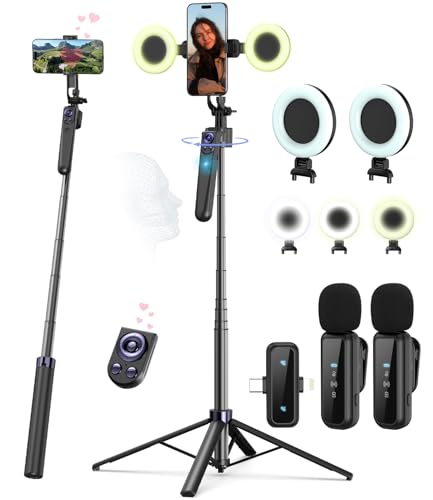
Complete Vlogging Kit: Designed for content creators, this kit includes a face-tracking tripod for iPhone, professional microphone, and dual LED lights. It helps with smooth, hands-free recording, clear audio, and professional lighting for high-quality content creation. Ideal for vlogging, live streaming, and social media videos

【CRYSTAL-CLEAR WIRELESS AUDIO – NO APP, JUST PLUG & PLAY】 Includes 1 transmitter + 2 lavalier mics with 3-in-1 receiver (USB-C/Lightning/3.5mm). Plug in, press power – auto pairing. No Bluetooth, no app, no Wi-Fi needed. AI noise reduction delivers studio-quality sound. Unplug receiver to save battery. 79ft range, 12h recording on 2h charge. A top wireless mic for iPhone and podcast microphone for iPhone for vlogs, interviews, voiceovers.
Reviewers, Creators, Carriers, and Retail Partners

Independent reviewers, photographers, filmmakers, and technology journalists can shape how buyers understand a new iPhone. Their hands-on videos and reviews often answer questions that official product pages do not, including camera comparisons, battery tests, gaming performance, durability, and day-to-day upgrade value.
That coverage should not automatically be labeled “influencer marketing.” Some content is independent editorial coverage, some may involve review units or event access, and some creator work may be commissioned. Unless a commercial relationship is disclosed, the safest description is creator and reviewer coverage rather than paid influencer advertising.
Carrier and retailer partnerships are easier to observe. Wireless providers commonly support new iPhone sales with trade-in offers, installment plans, and service-plan promotions. Apple also directs customers to carrier deals and supports purchases through its own online and retail channels.
International launches add another layer. Product pages, retail materials, financing, carrier support, and promotional messages may need localization by language, market, availability, and regulation. Those activities add complexity even though Apple does not publish a country-by-country iPhone launch budget.
Cost Analysis of Marketing Efforts
A cost analysis of a new iPhone release should include every major stage of the launch funnel. That means awareness, product education, purchase conversion, retail support, and post-launch retention. Looking only at ads would miss many costs that help turn attention into sales.
Digital advertising costs can vary based on audience targeting, region, format, competition, and timing. Video ads, search campaigns, social placements, and high-traffic homepage placements may each have different pricing models. Some campaigns focus on reach, while others focus on clicks, store visits, or completed purchases.
Traditional media costs can be more predictable, but they still depend on placement, timing, geography, production quality, and media demand. A premium television placement during a major event costs more than a smaller local placement. High-visibility outdoor ads in major cities can also require major spending.
Content production adds another cost layer. Apple’s campaigns require product photography, video shoots, editing, animation, copywriting, localization, legal review, accessibility checks, and technical accuracy review. Launch-event production can also involve staging, filming, streaming, executive presentations, product demos, and post-event content distribution.
Retail marketing carries its own costs. Apple and its partners need display units, signage, demo content, employee training, store-page updates, packaging materials, and support scripts. These details help customers understand the product and reduce friction during the buying process.
The most responsible way to analyze the cost is to separate confirmed public numbers from estimated campaign categories. Apple’s public financial reports can show company-wide SG&A trends, but they do not reveal the exact amount spent on a single iPhone campaign. Any article claiming a precise new iPhone marketing budget should explain its source and assumptions.
How to Evaluate ROI Without Apple’s Internal Data
Apple does not publish campaign-level return on investment for an iPhone launch, so outside analysis should avoid presenting internal ROI metrics as known facts. A defensible framework is to compare observable outcomes before, during, and after launch while clearly separating correlation from causation.
- Demand signals: pre-order availability, delivery lead times, store traffic, carrier promotions, and reported activations.
- Sales outcomes: iPhone revenue and year-over-year product performance in Apple’s financial reports.
- Upgrade behavior: trade-in activity, carrier upgrade offers, and model mix where reliable data is available.
- Attention: branded search interest, product-page traffic if disclosed, launch-video views, press coverage, and review engagement.
- Ecosystem effects: accessory, service, and device adoption can matter, but public data rarely isolates what came from one launch campaign.
For FY2025, Apple reported $209.586 billion in iPhone net sales, up 4% from FY2024. That is useful business context, but it is not proof of marketing ROI by itself because product mix, pricing, availability, macroeconomic conditions, carrier incentives, and product improvements can also affect sales.
The same caution applies to customer acquisition cost and lifetime value. Those are useful marketing concepts, but Apple does not disclose iPhone-launch CAC or customer lifetime value in its public financial reports. Any outside calculation should therefore label assumptions and data sources explicitly.
What Makes iPhone Marketing Expensive?
Several factors can make an iPhone launch expensive. First, Apple operates at global scale. A new iPhone release needs marketing assets for many countries, languages, carriers, retailers, and regulatory environments. That increases production, localization, coordination, and distribution costs.
Second, Apple uses premium creative production. Its ads, product images, launch videos, retail displays, and website pages are highly polished. This level of quality requires planning, creative teams, technical review, post-production, and consistent brand control.
Third, iPhone launches happen across many channels at once. Apple must coordinate its website, Apple Store app, physical stores, carrier partners, media outreach, social content, paid advertising, email, customer support, and product availability. The campaign is not one ad. It is a full launch system.
Fourth, the iPhone is a high-stakes product line. Apple’s iPhone revenue plays a major role in the company’s overall business. That gives Apple a strong reason to invest in careful launch messaging, clear product education, and smooth buying experiences.
How Apple Positions the iPhone Across Its Ecosystem
Apple’s iPhone marketing combines technical specifications with benefits that are easier to evaluate in everyday use. Camera hardware is connected to photography and video outcomes; chip performance is connected to apps, games, editing, and on-device features; and device security or privacy features are explained as part of the broader user experience.
Apple also controls the hardware, operating system, many services, first-party retail stores, online store, support, and accessories around the iPhone. That lets the company present purchasing, setup, data transfer, AppleCare, accessories, and services as one connected experience.
Trade-ins, financing, Apple Upgrade options, and carrier offers can lower the immediate cost of upgrading without revealing anything about Apple’s own marketing budget. For cost analysis, these purchase incentives should be treated as part of the conversion environment rather than evidence of a specific advertising spend.
Common Mistakes When Estimating iPhone Marketing Costs
One common mistake is treating Apple’s total SG&A expense as the iPhone marketing budget. SG&A includes broader selling, general, and administrative expenses across Apple’s entire business. Apple’s FY2025 segment note provides a more specific selling-and-marketing total, but even that is company-wide rather than iPhone-specific.
Another mistake is counting only paid ads. A launch can involve owned product pages, launch-event production, public relations, retail merchandising, localization, product education, partner activity, employee training, and customer-support preparation. Not every one of those costs is reported publicly or booked in the same way.
A third mistake is treating an estimated allocation table as if it were Apple data. Percentage splits for “digital,” “events,” “influencers,” or “retail” are not reliable unless the publisher identifies a source and methodology. The same applies to claims about a marketing cost per iPhone sold.
A fourth mistake is applying old advertising disclosures directly to a current launch. Historical figures from FY2008–FY2011 show that Apple spent heavily on U.S. iPhone advertising, but media markets, Apple’s installed base, retail footprint, launch methods, and geographic scale have changed substantially.
Warning: Avoid sources that state an exact current iPhone launch budget without a primary source or a transparent estimation method. Apple does not publicly break out marketing spend by individual iPhone model.
Bottom Line
The marketing cost of a new iPhone release is not publicly disclosed. Apple’s FY2025 company-wide selling and marketing expense of $19.524 billion provides scale, while historical court records provide rare product-specific U.S. iPhone advertising figures. Neither can be converted into an exact current launch budget.
For the most reliable analysis, separate confirmed Apple financial data from historical advertising disclosures and from third-party estimates. That approach gives readers a useful answer without turning assumptions into facts.
Related Guides
Frequently Asked Questions
What is the marketing cost of a new iPhone release?
Apple does not disclose an exact product-specific launch budget. The best current public scale figure is Apple’s $19.524 billion in company-wide selling and marketing expense for FY2025, but that includes far more than one iPhone launch.
How much does Apple spend on selling and marketing?
Apple reported $19.524 billion in selling and marketing expense for FY2025 and $18.639 billion for FY2024 in its segment information. Those are company-wide totals, not iPhone-only marketing budgets.
Is Apple’s SG&A expense the same as its iPhone marketing cost?
No. Apple reported $27.601 billion in SG&A expense for FY2025, but SG&A includes general and administrative costs as well as selling activity. It should not be treated as the cost of marketing one iPhone.
Has Apple ever disclosed iPhone advertising spend?
Yes. Historical Apple v. Samsung court records disclosed U.S. iPhone advertising expenses of $97.5 million in FY2008, $149.6 million in FY2009, $173.3 million in FY2010, and $226.6 million in FY2011. These are historical U.S. advertising figures, not current global launch budgets.
What costs can be part of an iPhone launch?
A launch can involve paid advertising, product-page production, launch-event content, public relations, retail displays, localization, carrier and retailer support, creator or reviewer activity, employee training, and customer-support preparation. Apple does not publish the exact allocation.
Can you estimate Apple’s iPhone marketing ROI from public data?
Only indirectly. You can compare public sales, demand, search, retail, and carrier signals, but Apple does not disclose campaign-level iPhone ROI, customer-acquisition cost, or return on ad spend. Outside estimates should state their assumptions clearly.
Sources
- Apple Investor Relations — official source for Apple annual reports and financial disclosures, including FY2025 selling and marketing, SG&A, and iPhone net sales.
- Apple 2024 Form 10-K, U.S. Securities and Exchange Commission — prior-year financial context.
- Apple Inc. v. Samsung Electronics Co. court filing (2012) — historical U.S. iPhone advertising expenses for FY2008–FY2011 and cumulative spend through Q1 FY2012.
- Apple iPhone — official source for current product positioning, comparisons, and purchase pathways.
- Apple Events — official source for Apple product-launch presentations.
