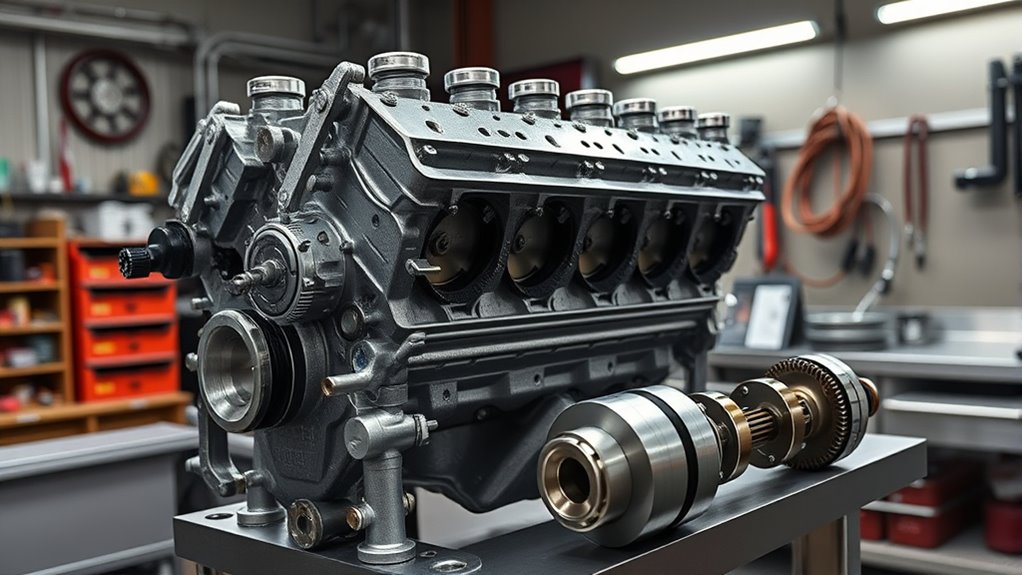
For a stock Big Block Chevy, cam lift is usually kept near .450 inch to stay within safe airflow and valvetrain limits. Stock heads, springs, and retainers often become the weak points before the cam itself does. Vortec-style heads can tolerate more, but only with proper clearance and spring upgrades. The real cutoff depends on compression, intended use, and component condition, which makes the next step less obvious than it first appears.
What Cam Works Best in a Stock 454?
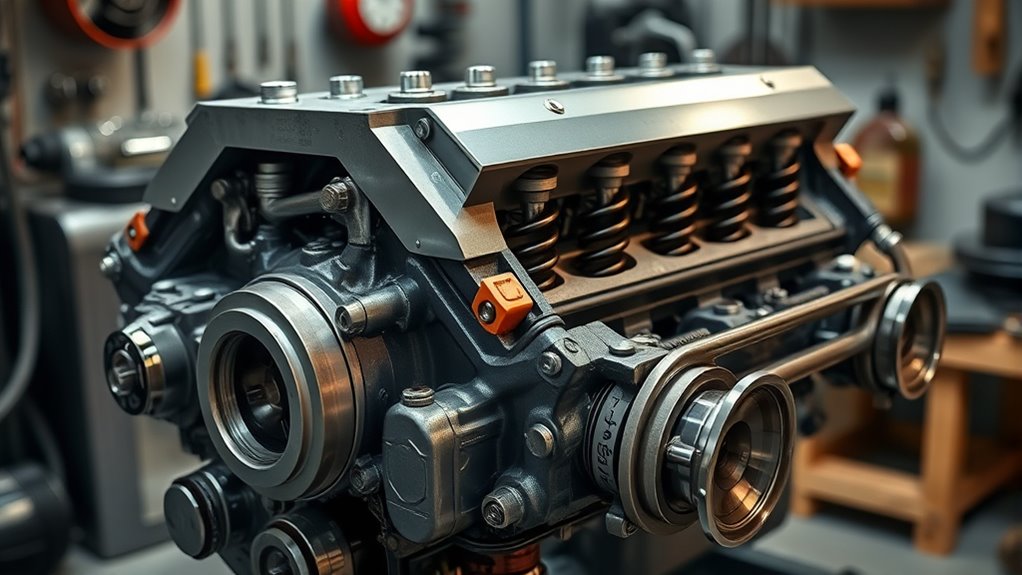
For a stock 454, the most effective camshaft is typically a hydraulic flat tappet with roughly .450 to .488 inch lift, as this range generally improves airflow and torque without overextending the engine’s stock compression or RPM capability.
In a stock engine, that specification preserves low- and midrange response while maintaining mechanical durability. A cam such as the Summit Energizer series at .454 lift can deliver measurable gains, but the tradeoff may include reduced drivability and a narrower torque curve.
To keep the combination balanced, the cam should align with factory compression and a practical ceiling near 6000 RPM. Higher-lift choices also require upgraded valve springs to control valve float and protect valvetrain stability.
For builders seeking mechanical autonomy, direct consultation with camshaft manufacturers remains the most reliable path, since tailored recommendations can match exact cylinder heads, gearing, and intended use.
What’s the Highest Lift for a Stock BBC?
A stock Big Block Chevy typically tolerates about .450 inches of valve lift without additional clearance verification, while Vortec-equipped heads can often reach roughly .525 inches before upgrades become necessary.
Beyond that range, retainer-to-guide clearance should be checked, with .060 inches considered a prudent minimum. Higher lift combinations usually require stronger springs and, in some cases, machining.
Cam selection at these limits becomes a tradeoff between airflow gains and valvetrain durability, since press-in studs and stock components may not reliably support elevated spring loads.
Stock Lift Limits
Stock big block Chevy cylinder heads have a practical lift ceiling that depends heavily on valve-spring hardware and available retainer-to-guide clearance. In stock lift limits analysis, a conservative ceiling is about .450 inch without direct clearance verification, preserving roughly .060 inch safety margin.
- Stock Vortec-style heads may reach about .525 inch.
- Some upgraded combinations exceed .600 inch when spring pressure and geometry are corrected.
- Press-in studs can become a failure point under elevated loads.
These data indicate that lift capability is not fixed; it is an engineered boundary. Proper spring selection governs stability, limits valve float, and preserves control at higher cam lift.
Verifying retainer-to-guide clearance remains essential for reliable, liberated operation.
Clearance And Springs
Clearance and spring pressure define the real lift limit on a stock Big Block Chevy, because the theoretical ceiling only matters if the valvetrain can physically travel without contact or loss of control. Stock BBC combinations typically peak near .450 lift, while some upgraded heads exceed .600 when spring control and geometry are verified. Retainer-to-guide clearance should remain about .060 for safety, especially with seal thickness in play. | Setup | Lift Support | Clearance Check |
| — | —: | — |
|---|---|---|
| Stock BBC | ~.450 | Baseline |
| Stock Vortec | ~.525 | Retainer to guide |
| Upgraded heads | >.600 | Spring and studs |
Upgraded springs are mandatory to prevent valve float. In some builds, screw-in studs and guide plates are required to maintain alignment and preserve mechanical freedom.
Cam Choice Tradeoffs
Cam selection on a stock Big Block Chevy is a tradeoff between lift, durability, and usable torque, with the practical ceiling typically around .450 inch lift unless the heads, springs, and hardware are upgraded. The cam choice tradeoffs are governed by valve-train geometry, spring control, and the freedom to avoid failure.
- A 206/218 duration cam with .430-.440 lift preserves low-speed torque and drivability.
- Stock Vortec heads usually stop near .525 lift, but only with verified retainer-to-guide clearance and compatible springs.
- Higher lift demands stronger springs and screw-in studs, because press-in studs can lose reliability as load rises.
A .060 clearance margin protects the assembly from interference and keeps the engine responsive rather than overworked.
How Much Lift Do Stock Vortec Heads Allow?
Stock Vortec heads typically accept about .525 inches of lift in stock form, while a conservative safe limit is closer to .450 inches without extensive inspection.
At higher lifts, retainer-to-guide clearance becomes critical, with .060 inches commonly cited as the minimum reliable separation.
Beyond these limits, spring upgrades and clearance verification are required, especially when lift exceeds .600 inches.
Stock Vortec Lift Limit
Vortec cylinder heads typically tolerate a maximum cam lift of about .525 inches in stock form, though a more conservative limit of roughly .450 inches is often recommended unless retainer-to-guide clearance has been verified.
For a stock street build, that range defines the practical ceiling for valve motion before risk rises.
- .450 inches: safer stock threshold for unmeasured assemblies.
- .525 inches: typical upper limit for stock Vortec geometry.
- .060 inches: minimum clearance target for interference avoidance.
Some high-performance heads exceed .600 inches, but only with compatible springs and measured clearance.
For the stock Vortec owner seeking liberation through airflow and torque, disciplined lift selection preserves reliability, prevents valve float, and keeps the valvetrain mechanically honest.
Retainer And Spring Clearance
Clearance must be verified at the retainer and guide before any lift increase is accepted, because stock Vortec heads typically reach their practical limit at about .525 inches of cam lift, while an unmeasured assembly is safer at roughly .450 inches. Retainer and spring clearance governs whether the valve train stays free or binds under load.
| Check | Value |
|---|---|
| Minimum retainer-to-guide | .060 in |
| Safe unmeasured lift | .450 in |
| Stock practical limit | .525 in |
| Valve seal effect | Significant |
Valve seal thickness alters geometry and can erase margin fast. When lift rises beyond stock limits, upgraded springs become mandatory to resist valve float and preserve control. Measured correctly, the valvetrain gains the freedom to move hard, clean, and reliably.
What Retainer-to-Guide Clearance Is Safe?
A safe retainer-to-guide clearance is typically at least .060 inches to guarantee the valve train does not contact the guide area during operation. This retainer-to-guide clearance standard provides a practical margin for thermal expansion, deflection, and assembly variation, preserving reliable motion under load.
On stock Vortec-style heads, cam lift near .525 inches often remains within acceptable limits, but verification is still required because valve seal thickness alters the effective clearance.
- Measure installed height before selecting lift targets.
- Include seal thickness in every clearance calculation.
- Confirm head design before assuming over-.600-inch capability.
When lift exceeds .525 inches, machining may become necessary to restore safe spacing and protect the freedom of the valvetrain from interference. Some head designs can tolerate over .600 inches only after appropriate retainer and spring modifications, so the exact geometry must be checked rather than assumed.
Precision measurement remains the governing standard.
Which Springs Handle Higher Lift Cams?
Stock Big Block Chevy engines typically rely on factory springs for only about .450 inch of lift, so higher-lift cams require upgraded springs to maintain control and prevent valve float.
For higher lift cams beyond roughly .525 inch, quality aftermarket springs are the practical choice because they are engineered for greater seat and open pressure, improved control, and sustained reliability at elevated rpm.
Spring selection should be matched directly to camshaft specifications, including advertised lift, intended operating range, and valve motion profile, so the valvetrain remains free rather than constrained by weak hardware.
Match spring choice to cam specs so the valvetrain stays free, controlled, and ready for the intended rpm range.
A proper installation also includes checking retainer-to-guide clearance; .060 inch is the recommended safety margin.
When the spring package is correctly matched, the engine can exploit added lift without losing stability, allowing the camshaft to deliver its intended airflow and power gains while preserving mechanical control under demanding conditions.
Do Stock Studs Handle Big Cam Lift?
When cam lift climbs into the higher range, the factory press-in studs in a Big Block Chevy become a weak link, especially with increased spring pressure from aggressive valve springs.
Stock studs may survive mild street duty, but high-lift cam profiles raise stress at the stud boss and can upset valvetrain stability. For stock Vortec heads, .525 inch lift is often treated as the upper practical limit, and even then retainer-to-guide clearance must be verified.
- Check .060 inch retainer-to-guide clearance before final assembly.
- Replace stock studs with screw-in studs when lift and spring load increase.
- Add proper guide plates to preserve rocker alignment and reduce deflection.
Some cylinder heads can tolerate lifts above .600 inch with upgraded springs, yet stock studs do not reliably provide the needed rigidity.
For builders seeking freedom from failure, the solution is a fortified valvetrain, not hope.
How Does Compression Affect Cam Choice?
Compression ratio strongly shapes cam selection because lift and duration must match the cylinder pressure an engine can support.
In a stock Big Block Chevy, the compression ratio is typically modest, so cam lift must stay conservative to preserve effective combustion. Data from common stock builds shows that lifts near .450 are generally the upper practical limit before output and reliability begin to decline.
Higher compression ratios expand the usable window, allowing larger lift and longer duration because cylinder pressure supports better air motion and stronger burn efficiency.
Higher compression ratios allow more lift and duration, improving airflow, burn efficiency, and overall camshaft potential.
When lift exceeds about .525, additional hardware such as stronger springs and careful clearance verification becomes necessary, especially with stock heads and low compression. Excessive lift in a low-compression setup can expose weak cylinder pressure rather than free horsepower.
The ideal cam is the one that matches the compression ratio, enabling clean power delivery, efficient combustion, and mechanical freedom without unnecessary compromise.
Will a Bigger Cam Hurt Drivability?
A larger camshaft can shift the torque curve upward, reducing low-end output and making idle quality less stable, especially in a stock big block with limited compression.
As duration and lift increase, the usable RPM range typically moves higher, which can improve peak power but reduce street responsiveness at normal cruising speeds.
For daily use, cam size must remain matched to the engine’s airflow, compression, and valvetrain capability or drivability will decline.
Torque Loss And Idle
A larger camshaft often trades low-end torque for higher-rpm power, and that shift can make a stock big block Chevy feel less responsive during initial acceleration and everyday street use.
This torque loss is measurable as reduced cylinder filling at low engine speed, especially with lift above .450, where idle quality and vacuum can deteriorate.
- Rough idle: high-lift profiles create unstable combustion at low rpm.
- Drivability: a stock cruiser may feel softer off the line.
- Hardware: cams beyond .450 usually need upgraded springs and clearance verification.
A cam over .525 can deliver more output, yet the compromise in response may outweigh the gain for a liberated street build.
Moderate lift typically preserves smoother operation while retaining usable performance.
RPM Range And Street Use
Although a bigger cam can increase high-rpm output, it often shifts the usable power band upward and can hurt street drivability in a stock big block Chevy. The highest lift cam for stock use is typically near .525, while lifts above .450 demand clearance checks and stronger springs. Street-friendly calibration keeps the engine within the 6000 RPM stock-bottom-end ceiling, preserving durability and liberated, responsive driving.
| Cam Lift | RPM Band | Street Effect |
|---|---|---|
| .400–.450 | Low-mid | Strong torque |
| .450–.525 | Mid-high | Balanced use |
| Above .525 | High | Clearance risk |
A larger cam may reduce low-end response, especially with low compression. Moderate selection maintains authority without sacrificing control, making the highest lift cam a measured choice rather than an indiscriminate upgrade.
Which Intake Works Best With a Stock BBC Cam?
For a stock Big Block Chevy cam, a dual-plane intake manifold is generally the best match because it supports stronger low- to mid-range torque, better throttle response, and more usable street drivability.
The intake should align with the cam specifications, preserving cylinder fill velocity and avoiding a mismatch that weakens power delivery. In practical terms, a dual-plane design maintains airspeed at modest rpm, which benefits a stock BBC’s conservative valve timing.
- Dual-plane intake: best overall balance for stock cams and everyday operation.
- Single-plane intake: typically delayed in torque response, better suited to higher-rpm combinations.
- System harmony: intake, camshaft, and exhaust must function as one calibrated package.
A Victor Jr.-style single-plane may show advantages only after later changes, but on an unmodified engine it often sacrifices low-speed efficiency.
For the stock setup, the liberation lies in choosing the manifold that supports broad, controlled, and accessible power.
What Upgrades Should Come First?
Before any high-lift cam goes into a stock big block Chevy, valve spring capacity comes first, because stock springs often cannot control the added lift and rpm without valve float. Upgrading the springs is the first rational step, since spring pressure and coil bind margin determine whether the valvetrain can survive real-world load.
For a stock motor, a cam with about .450 lift keeps demands within a safer range and preserves clearance. If lift climbs past .525, screw-in studs and guide plates become mandatory-level improvements for stability and geometry control.
Intake manifold choice should follow, because airflow capability must match cam timing or the engine will be constrained by a mismatched path.
After that, suspension upgrades deserve attention; a big block adds mass and torque that can unsettle chassis balance. Proper sequencing frees performance without sacrificing durability, letting power remain usable on the street or track.
Frequently Asked Questions
What Is the Best Cam for a Stock 454 Big Block?
The best cam for a stock 454 Big Block is typically a mild Performance Upgrade, such as the Comp Cams 12-231-2 or Summit K1103, because both preserve idle quality and drivability while improving torque.
Their .432-.465 lift range stays near the safe limit for stock valve gear.
For liberation from factory lethargy, a conservative hydraulic flat tappet with matched springs offers the strongest balance of reliability, efficiency, and measurable gains.
What Is Considered a High Lift Cam?
A camshaft is generally considered high lift when valve lift exceeds about .525 inch, with .600 inch and above regarded as aggressive.
Camshaft selection must account for spring pressure, retainer-to-seal clearance, and head geometry, because inadequate hardware causes instability and wear.
Data-driven assessment shows some stock heads tolerate only about .450 inch without modification.
Liberation from restrictive factory limits comes through verified clearances, upgraded springs, and matched valvetrain components.
What Is the Best Hydraulic Roller Camshaft for a 454 Engine?
For a 454, the best hydraulic roller camshaft is often a well-matched .525–.600-inch lift grind, like a 228/236-at-.050 Comp Cams profile at .600 lift.
Like a keyed gate opening a larger road, it frees airflow and torque.
Performance upgrades require upgraded valve springs, correct retainer-to-guide clearance, and matched geometry.
With precise component pairing, the engine gains reliable, data-backed performance without sacrificing durability or drivability.
What’s the Biggest Cam for a Stock 350?
For a stock 350, Cam Selection should stay near .450 inch lift, with .488 inch generally viewed as the upper practical limit before reliability drops.
A Comp Cams 12-231-2 or Summit K1103 fits conservative use, preserving torque and drivability.
Larger cams can induce valve float, require stronger springs, and demand clearance checks.
Liberation from compromise comes through balanced specification, not excess lift.
Precision preserves longevity, power, and control in stock applications.
Conclusion
For a stock Big Block Chevy, the practical upper limit for cam lift is typically about .450 inch, with Vortec-style heads sometimes tolerating up to .525 inch when upgraded properly. That difference matters: a .075-inch increase in lift can improve airflow, but only if spring pressure, retainer clearance, and valve-train stability are addressed. In a stock motor, conservative lift usually delivers the best balance of torque, reliability, and drivability without exceeding the engine’s factory limitations.

