Most roof cross bars should be spaced about 30 inches apart, measured center to center, unless the vehicle or cargo manufacturer specifies otherwise. Some vehicles allow less, such as a Chevy Bolt at 28 inches or a Tacoma at 24, while a RAV4 Hybrid may reach 33 inches. Longer items, including 16–18 foot kayaks or a Roofnest tent, benefit from wider spacing. The vehicle manual, rail type, and load limits determine the safest setup, with more guidance below.
How Far Apart Should Roof Cross Bars Be?
Spacing determines both fit and safety. For most roof racks, the practical minimum between cross bars is 30 inches, a baseline that supports secure installation for systems such as Roofnest. A specific vehicle may fall slightly above or below that mark: a Honda CRV Hybrid commonly uses 29 inches, while a Toyota RAV4 Hybrid often aligns at 33 inches.
Cross bar spacing shapes both safety and fit, with 30 inches serving as a reliable baseline for most roof rack setups.
These measurements should be verified against the rail geometry and manufacturer limits before loading.
Greater separation generally improves stability when carrying longer gear, giving travelers more control and less sway at speed. On a specific vehicle, placement also affects airflow and noise.
Moving the rear cross bar can reduce wind resistance and cabin disturbance without compromising support. When two kayaks are involved, the front bar is typically set far forward and the rear bar far back to maximize spread.
Correct spacing lets roof racks perform reliably, supporting movement with fewer restraints and more confidence.
What Crossbar Spacing Fits Your Cargo?
Cargo length and shape determine how much crossbar spread is needed. For Roof Rack Cargo, wider cross bars spacing usually delivers calmer, safer travel. A Roofnest setup should have at least 30 inches between bars for stable support. Long kayaks, especially 16 to 18 feet, benefit from the widest vehicle-allowed spread to reduce sway and free the driver from constant correction.
| Cargo type | Recommended spacing context |
|---|---|
| Roofnest tent | Minimum 30 inches |
| 16–18 ft kayak | As wide as vehicle permits |
| Shorter kayak | Moderate spread, secure tie-downs |
| Mixed utility loads | Match length, keep balanced |
Vehicle limits matter. A Honda CRV Hybrid may offer 29 inches fixed spacing, while a Toyota RAV4 Hybrid may provide 33 inches. Real-world use shows a Chevy Bolt at 28 inches and a Tacoma at 24 inches can still carry kayaks when secured correctly, though wider spacing remains the safer standard for liberation-minded travel.
How to Measure Crossbar Spacing
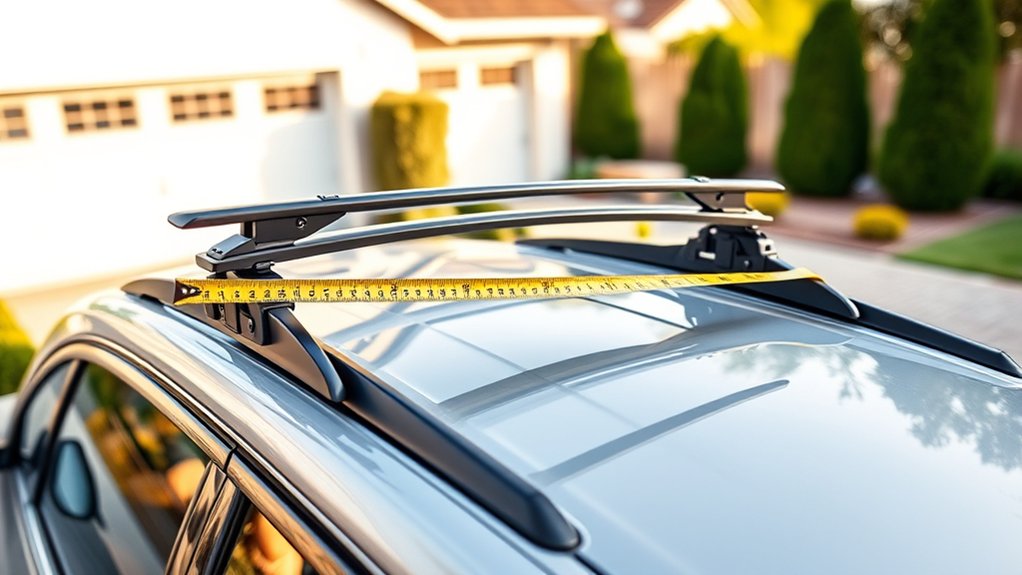
Measure crossbar spacing from the center of the front bar to the center of the rear bar, then confirm that the distance meets the cargo requirement and the vehicle’s rail geometry. This method lets the installer measure with precision and avoid guesswork. A practical baseline is 30 inches, which suits many cargo systems. Vehicle-specific targets may differ: a Honda CRV Hybrid commonly uses 29 inches, while a Toyota RAV4 Hybrid often works at 33 inches.
Placement along the rails also matters. The front cross bar is typically set 19-3/4 inches from the front of the side bar, and the rear cross bar 14 inches from the back. Wider spacing can improve stability for long loads; some Subaru Outback setups reach 42 inches for kayaks.
Before loading, the owner should verify the manual’s weight limits for rails and cross bars. Freedom on the road depends on secure measurements, disciplined installation, and cargo kept within rated capacity.
How Roof Rail Types Affect Bar Spacing
How the roof is equipped determines where the bars can be placed and how far apart they should sit. On vehicles with flush rails, the minimum distance between front and rear cross bars should be 70 cm, or 27.5 inches, to preserve stability and maintain system compatibility. That measured span gives cargo a more secure, freedom-ready foundation.
Raised rails provide more adjustment range, yet spacing near 30 inches is generally preferred for balanced weight distribution and stronger cargo retention. Bare roof systems also typically require at least 30 inches between cross bars for proper support under dynamic loads.
In every configuration, wider spacing can improve stability when carrying longer or bulkier gear.
Vehicle-specific guidance remains decisive. A Honda CRV Hybrid, for example, uses a factory-recommended crossbar spacing of 29 inches. Following the manufacturer’s figure protects load ratings, supports predictable handling, and helps each roof setup perform safely without limiting the driver’s ability to travel farther with confidence.
Crossbar Spacing Mistakes That Add Noise
Bars mounted too far forward on the roof rail can disturb airflow at the windshield line, increasing wind noise and, on some vehicles, reducing load stability at highway speed.
Uneven crossbar placement also creates turbulence, particularly when front-to-rear spacing falls outside the typical 27.5- to 42-inch range or drops below the 30-inch minimum recommended for many rack systems.
Noise control improves when bar spacing is measured evenly, fittings are retightened to specification, and empty crossbar slots are sealed with rubber strips.
Bars Too Far Forward
Even a slight forward bias in crossbar placement can increase wind noise, disturb airflow over the roofline, and reduce aerodynamic efficiency at speed.
On most passenger vehicles with raised rails, cross bars positioned excessively near the windshield encounter higher air pressure, which can trigger vibration and audible buffeting above 40 mph.
A minimum separation of 30 inches is commonly recommended to support stable cargo transfer and quieter operation.
When the front bar sits too far forward, shifting both bars rearward within the rail’s approved range often lowers wind resistance and restores a calmer cabin.
Proper positioning also improves load support by distributing cargo weight more effectively across the roof structure.
For drivers seeking open-road freedom without distraction, accurate measurement remains essential for safety, stability, and sustained highway comfort under varying conditions.
Uneven Crossbar Placement
Many roof-rack noise issues begin with uneven crossbar spacing, which disturbs airflow across the roof and can introduce vibration at highway speeds.
On most vehicles, cross bars should be positioned with at least 30 inches between them to reduce wind noise and maintain load stability. Greater spread may improve control, but only within factory rail limits and rated bar capacity. Proper alignment protects cargo, preserves rack hardware, and supports quieter, freer travel.
- Measure center-to-center spacing; keep a minimum 30 inches.
- Confirm both bars sit square to the side rails.
- Check torque and clamp tension before each trip.
- Reinspect after loading, especially near maximum rated weight.
When uneven crossbar spacing is ignored, vibration increases wear on rails, mounts, and transported gear.
Routine adjustment keeps movement controlled and highway travel less intrusive.
When Your Vehicle Manual Takes Priority
Although general spacing rules are useful, the vehicle manual takes priority because it specifies the correct crossbar distance for the roof structure, load limits, and attachment points of a given model. That guidance determines where cross bars should sit on the vehicle’s roof and removes guesswork for owners seeking confident, unrestricted travel.
Manufacturer recommendations vary by platform. Many specify at least 30 inches between bars for stability and accessory fitment, yet some vehicles require exact factory spacing. A Honda CRV Hybrid uses a fixed 29 inch distance, while a Toyota RAV4 Hybrid recommends 33 inches. These numbers are not interchangeable. The manual matches spacing to roof strength, rail geometry, and approved cargo limits.
Ignoring those measurements can shift weight incorrectly, reduce stability, and stress mounting points. Following the manual protects the roof, keeps loads balanced, and supports safer transport.
For vehicle specific freedom on the road, the printed specification remains the controlling standard.
Frequently Asked Questions
How Far Apart Should I Install Crossbars?
Crossbars should be installed 30 inches apart minimum; 29 inches suits fixed-spacing vehicles like the Honda CRV Hybrid, while 27.5 inches supports kayaks. Crossbar materials, installation tools, and load capacity determine the safest, most freeing vehicle-specific setup.
Do Crossbars Reduce Gas Mileage?
Yes—like Icarus nearing the sun, crossbars can reduce gas mileage through aerodynamic drag, especially above 55 mph; effects vary by vehicle stability, weight distribution, bar profile, and any mounted cargo, typically costing 1–5% efficiency.
Can You Use Roof Rails Without Cross Bars?
Yes, roof rails can be used without cross bars on some vehicles, though roof rail benefits and load limits vary. Crossbar materials and installation tips support safer, freer cargo mounting, especially where direct-fit adapters are vehicle-specific.
What Is the Recommended Spacing for Roof Rack Crossbars?
Like a bridge, recommended roof rack crossbar spacing is at least 30 inches, balancing load distribution, mounting techniques, and vehicle compatibility; fixed measurements vary by model, and wider spacing generally improves stability, security, and transport freedom.
Conclusion
Correct crossbar spacing depends on the vehicle roof rail design, the crossbar manufacturer’s limits, and the cargo’s required spread. In practice, the owner’s manual and rack instructions take priority over generic measurements. Bars set too close can reduce stability; bars set too far can exceed rail support points or increase noise. Measured correctly, the system works like a level bridge: balanced, quiet, and secure under load. Vehicle-specific fitment is the safest standard.

