A rugged work boot is more than a thick leather boot with an aggressive sole. A job-ready pair combines durable materials, secure construction, appropriate traction, comfortable support, and protection matched to the hazards you actually face. Depending on the job, that can include a tested safety toe, puncture resistance, electrical-hazard protection, waterproofing, metatarsal protection, or slip-resistant footwear.
Quick Answer
Rugged work boots use tough uppers, durable sole construction, supportive cushioning, and job-specific protection to withstand repeated wear. The best pair is not simply the heaviest boot: it should fit properly and carry the safety, slip, electrical, puncture, or waterproof features required for your actual workplace hazards.
Key Takeaways
- Choose work boots by jobsite hazard, not appearance, weight, or toe material alone.
- For safety-toe footwear, check the actual ASTM marking and your employer’s requirements.
- Leather, synthetic textiles, reinforced wear areas, strong sole attachment, and durable outsoles can all improve service life.
- Waterproofing, slip resistance, puncture protection, and electrical-hazard protection are separate features; one does not automatically provide the others.
- Good fit matters as much as toughness. A boot that causes painful pressure, uncontrolled heel movement, or cramped toes is the wrong fit.
- Inspect work boots regularly and replace or professionally repair them when wear begins to compromise protection, traction, or structural integrity.
What Rugged Build Means in Work Boots
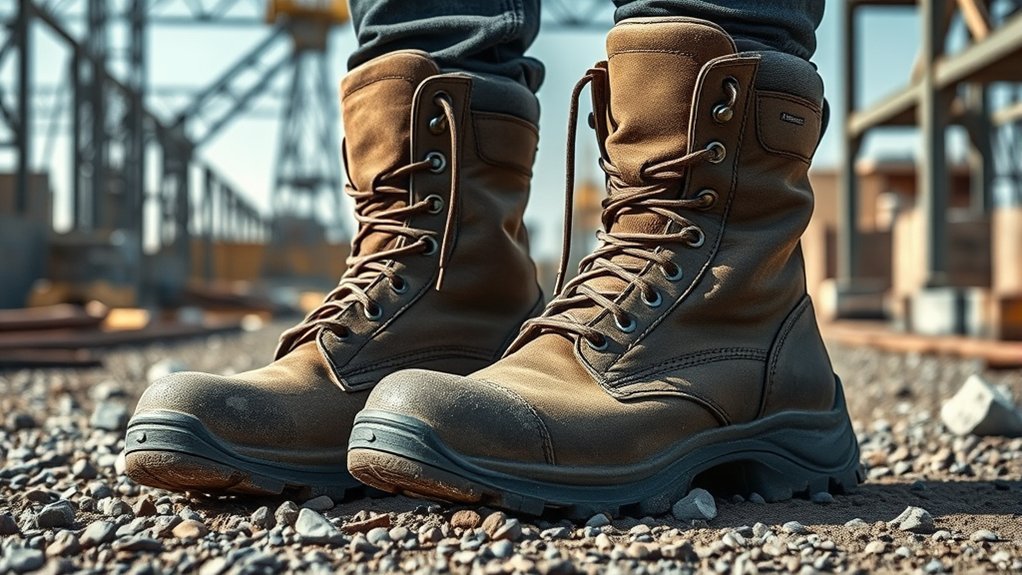
A rugged build means the boot can handle repeated bending, abrasion, moisture, rough surfaces, and the stresses created by standing and walking through long shifts without quickly losing its structure.
Durability begins with the upper. Full-grain or other work-grade leather is popular because it resists abrasion and can be conditioned as it ages. Synthetic textiles can reduce weight and improve ventilation, while rubber or synthetic reinforcement around high-wear toe and heel areas can reduce scuff damage.
Construction matters too. Welted, stitched, cemented, molded, and fused boots can all perform well when designed correctly. A Goodyear welt can make some boots easier to resole, while modern bonded or fused construction can reduce weight and improve flexibility.
A rugged boot is the one that keeps its fit, traction, structure, and required protection through the conditions of your actual job—not simply the boot that looks the heaviest.
Lab testing can provide useful durability information, but test numbers should always be tied to a specific manufacturer and method. For example, KEEN states that its Utility footwear must reach at least 50,000 flex cycles in its internal testing, while its Liberty boot reached one million cycles without the failures the company was checking for. Those figures are manufacturer-specific examples, not universal industry durability requirements.
Why Rugged Construction Matters on Site
Work boots are exposed to repeated stress that ordinary casual shoes may never encounter. Concrete, gravel, ladders, sharp debris, mud, oil, water, hot surfaces, and constant bending can wear down uppers, stitching, midsoles, and tread.
When construction is appropriate for the job, a boot is less likely to develop early sole separation, excessive flex, torn uppers, unstable heel support, or rapid tread loss. That can reduce interruptions caused by uncomfortable or damaged footwear.
Ruggedness, however, does not replace proper safety selection. A heavy leather boot without the required protective rating may be less appropriate than a lighter certified boot designed for the hazard.
Warning: Do not choose protective footwear by appearance or by the words “work boot,” “steel toe,” or “rugged” alone. Your employer’s hazard assessment, site rules, and required safety markings take priority.
Materials That Make Boots Last Longer
Material choice affects abrasion resistance, weight, breathability, drying time, flexibility, and maintenance. No single material is ideal for every trade.
Leather is common in heavy-duty boots because it can provide a strong balance of abrasion resistance, structure, and comfort once broken in. Proper cleaning and conditioning can help prevent excessive drying and cracking.
Synthetic mesh and textile uppers can make footwear lighter and more breathable. They are useful when mobility and heat management matter, although the actual abrasion resistance varies by material and design.
Rubber reinforcement around the toe or heel can protect high-wear areas. Underfoot, rubber and other engineered outsole compounds are chosen for characteristics such as abrasion resistance, grip, flexibility, chemical resistance, or heat resistance.
The sole-attachment method also affects durability and repairability. Welted construction mechanically attaches major components and can make some boots resoleable. Cemented and fused construction can create lighter, more flexible boots but repair options vary by model.
Safety Features That Protect on the Job
A rugged work boot should protect against the hazards identified for the job rather than trying to provide every possible feature. OSHA requires protective footwear in general-industry workplaces where employees face hazards such as falling or rolling objects, objects that could pierce the sole, or certain remaining electrical hazards. See OSHA 29 CFR 1910.136.
Common protective features include safety toes, puncture-resistant components, metatarsal protection, electrical-hazard or static-control properties, heat-resistant soles, and tested slip resistance.
Drop And Impact Protection
Safety-toe footwear is designed to protect the toe area from specified impact and compression hazards. Current ASTM F2413-24 covers performance requirements for protective safety-toe footwear.
| Feature | What It Addresses |
|---|---|
| Impact-rated safety toe | Objects that may fall onto the toe area |
| Compression-rated safety toe | Rolling or compressive loads around the toe |
| Metatarsal protection | Impact to the top of the foot |
Steel is only one safety-toe material. Composite, aluminum, carbon-based, and other designs can also be used when the finished footwear satisfies the applicable performance requirement. The certification of the complete boot matters more than simply whether the toe cap is steel.
Puncture And Debris Protection
Sharp nails, screws, wire, scrap metal, and similar debris create a different hazard from falling objects. A safety toe does not automatically make the sole puncture resistant.
ASTM footwear testing recognizes puncture resistance (PR) as a separate protective property. Workers exposed to sharp objects underfoot should look for footwear specifically rated for that hazard rather than assuming a thick outsole is enough.
Upper reinforcement can also reduce damage from abrasion and debris, but cosmetic rubber toe caps or heavy leather should not be confused with certified puncture or impact protection.
Electrical Hazard and Static Protection
Electrical properties require especially careful selection. ASTM footwear testing includes categories such as electrical hazard (EH), conductive properties, and static-dissipative performance. These categories address different hazards and are not interchangeable.
ASTM F2412-24 includes test methods for impact, compression, metatarsal, conductive, electrical-hazard, static-dissipative, and puncture-resistant footwear properties.
Never assume that a rubber outsole alone makes a boot safe for electrical work. Follow the employer’s electrical-safety program and use footwear specifically selected for the hazard.
Waterproofing and Grip for Harsh Conditions
Waterproofing and traction can make rugged work boots more useful in rain, mud, washdown areas, and other wet environments, but the two features should be evaluated separately.
A waterproof boot may use treated leather, a waterproof-breathable membrane, seam sealing, a gusseted tongue, or a combination of these features. Slip resistance depends primarily on the completed footwear, outsole compound, tread, surface, and contaminant.
Note: “Waterproof,” “slip resistant,” “chemical resistant,” and “electrical hazard” describe different performance needs. A boot advertised for one of them should not be assumed to provide the others.
Waterproof Material Performance
Waterproof work boots are useful when prolonged contact with rain, puddles, mud, wet grass, or wash water is part of the job. Treated leather can repel moisture, while waterproof membranes are designed to block liquid water while allowing some water vapor to escape.
That does not make every waterproof boot equally breathable or suitable for standing water. Boot height, membrane height, tongue construction, seams, and overall design can determine how easily water gets inside from above.
Waterproof membranes can also make footwear feel warmer than highly ventilated non-waterproof footwear. Workers in hot, dry conditions may prefer a more breathable design when waterproofing is unnecessary.
Slip-Resistant Outsole Design
A slip-resistant outsole is designed to improve traction, but no shoe can eliminate every slip hazard. Wet steel, oily tile, loose gravel, mud, ice, and smooth concrete behave differently underfoot.
Tread geometry, contact area, channels, compound hardness, and the contaminant on the floor can all affect grip. Deep lugs may work well in mud or loose soil, while other tread designs may be more appropriate on smooth indoor surfaces.
ASTM F3445-24 specifies minimum slip-resistance performance requirements when footwear is evaluated with the ASTM F2913 whole-shoe test method. When slip hazards are important, look for the manufacturer’s actual testing or marking rather than relying only on a generic “non-slip” description.
Wet Weather Traction
Wet-weather traction depends on both tread and surface conditions. Channels and lugs can help move water or soft material away from the contact area, while an appropriate rubber compound can help the outsole maintain useful friction.
Keep tread clean. Packed mud, concrete slurry, grease, metal chips, or other material can reduce the effectiveness of an otherwise capable outsole.
Inspect the heel and forefoot for uneven wear. Once tread has worn smooth in key contact areas, traction can decline even if the upper still looks serviceable.
Toe Protection Options for Tough Work
Toe protection should match the hazard assessment and required standard rather than a preference for one material.
- Steel safety toes are widely used and can provide certified impact and compression protection in appropriately tested footwear.
- Composite or carbon-based safety toes are non-metallic options that can also meet applicable safety-toe requirements. They may be useful when lower weight or reduced metal content matters.
- Aluminum or alloy toes can provide certified protection with a thinner or lighter cap in some designs.
- Soft-toe boots may be appropriate when impact/compression toe protection is not required. Soft toe does not mean a boot cannot offer other protective properties, but the required workplace hazard assessment comes first.
Do not assume one toe material is universally “stronger” or safer. Compare the complete footwear’s certification, fit, weight, temperature behavior, and job-specific features.
Comfort Features That Reduce Fatigue
Durability does little good if a boot fits poorly enough to cause pressure, rubbing, numbness, or unstable movement. Long shifts make fit, cushioning, support, weight, and breathability important.
| Feature | Practical Benefit |
|---|---|
| Cushioned midsole | Helps soften repeated loading on hard floors |
| Breathable lining or upper | Helps manage heat and moisture |
| Appropriate boot weight | Can reduce unnecessary bulk during constant walking or climbing |
| Secure heel fit | Limits excessive movement and rubbing |
| Roomy toe area | Allows natural toe movement without pressure against the cap |
Pro Tip: Try work boots with the socks you actually wear on the job. Check them while standing and walking. Your toes should not be crushed against the front or sides, and your heel should feel secure without painful pressure.
Design Details That Reduce Downtime
Small design details can determine how easy a work boot is to live with every day.
- Reinforced toe and heel areas can protect common abrasion points from premature wear.
- Strong eyelets, hooks, laces, and stitching reduce failures in components that are repeatedly loaded when the boot is tightened.
- Removable insoles can simplify drying, cleaning, and replacement when the manufacturer permits it.
- Resoleable construction can extend the useful life of certain models when the upper remains sound and repair does not conflict with safety certification.
- Easy-clean tread can make it faster to remove mud, stones, or jobsite debris that would otherwise reduce traction.
Inspect footwear before work when the job involves significant foot hazards. Cracked uppers, holes, sole separation, damaged laces or hardware, embedded sharp objects, heavily worn tread, exposed protective components, or a change in fit can all signal that the boot needs attention.
Boot Materials That Need Less Maintenance
Boot materials affect both service life and the amount of care required. Leather can last well but benefits from cleaning and conditioning. Synthetic uppers often dry faster and may need less conditioning, although they still require inspection and cleaning.
Outsole compounds such as rubber are widely used because they can provide a useful combination of abrasion resistance, flexibility, and traction. The right choice depends on the surface and contaminants found at work.
Full-Grain Leather Options
Full-grain leather is common in rugged work boots because the outer grain surface remains intact. Quality work-grade leather can resist abrasion and conform to the foot over time.
- Brush or wipe off dirt before it becomes heavily embedded.
- Let wet leather dry naturally rather than placing boots against intense direct heat.
- Use cleaners and conditioners appropriate for the manufacturer’s leather treatment.
Conditioning can help prevent excessive drying and cracking, but too much product can change the appearance or performance of some leathers. Follow the boot manufacturer’s care instructions.
Synthetic Uppers That Last
Synthetic uppers can provide lower weight, flexibility, and ventilation. Mesh and woven materials are especially common in athletic-style work footwear.
Performance varies widely. A lightweight mesh designed for ventilation will not necessarily resist sparks, sharp edges, chemicals, or heavy abrasion as well as a boot specifically built for those exposures.
Choose synthetic footwear by the hazards and test ratings it provides, not simply because synthetic materials are easy to clean.
Easy-Care Sole Materials
Rubber and engineered synthetic outsoles need relatively simple routine maintenance, but keeping them clean is important for traction and inspection.
- Remove packed mud, stones, metal chips, and other embedded debris.
- Check tread depth and uneven wear across the heel and forefoot.
- Inspect the bond or stitching where the sole joins the upper.
- Check for cracking, chunks missing from the tread, or permanent deformation.
Chemicals, oils, extreme heat, and solvents can damage some outsole compounds even when there is little visible damage at first. For specialized exposures, verify that the specific boot is designed for that environment.
Safety Ratings and Build Standards to Check
Safety standards are more reliable than broad marketing terms such as “industrial,” “rugged,” or “heavy duty.” In the United States, OSHA 29 CFR 1910.136 requires employers to ensure protective footwear is used when specified foot hazards are present.
The active ASTM standards provide more current footwear specifications and test methods:
- ASTM F2413-24: performance requirements for protective safety-toe footwear, including impact and compression plus specified additional hazard categories.
- ASTM F2412-24: test methods used to evaluate properties such as toe impact/compression, metatarsal protection, electrical properties, and puncture resistance.
- ASTM F3445-24: minimum slip-resistance performance requirements when evaluated with the ASTM F2913 whole-shoe method.
- ASTM F2892-24: covers specified protective properties for soft-toe occupational footwear where a protective safety toe is not part of the certification.
Read the actual label or marking on the footwear and compare it with the employer’s requirement. A steel toe by itself does not establish that the finished boot meets ASTM F2413.
Also remember that one certification does not imply every other protection. For example, toe impact protection does not automatically mean puncture resistance, and slip resistance does not automatically mean chemical resistance.
Warning: Protective footwear is only one layer of workplace safety. Follow your employer’s hazard assessment, PPE program, manufacturer instructions, and any trade-specific requirements. Never rely on boots as a substitute for required electrical, fall, chemical, or machine-safety controls.
Frequently Asked Questions
How Long Do Rugged Work Boots Typically Last With Daily Use?
There is no reliable universal lifespan. Service life depends on the trade, hours worn, walking surface, moisture, chemicals, heat, body weight, construction, rotation, and maintenance. Inspect boots regularly and replace or repair them when worn tread, sole separation, cracks, holes, damaged protective components, or loss of structural support compromises performance.
Are Rugged Work Boots Suitable for Hot Weather Environments?
Yes, if the boot provides the required workplace protection while managing heat appropriately. Lightweight construction, breathable uppers, moisture-managing linings, and appropriate socks can improve comfort. Waterproof membranes may feel warmer than highly ventilated footwear, so avoid unnecessary features when the job does not require them.
Can Rugged Work Boots Be Resoled Instead of Replaced?
Some welted work boots are designed to be resoled, but check the manufacturer’s repair policy first. This is especially important for certified protective footwear. ASTM F2413-24 notes that changes to original components, including resoling, can cause footwear to no longer meet the standard and can affect its ASTM marking. Use a manufacturer-approved repair process when safety certification must be maintained.
How Should Rugged Work Boots Fit for All-Day Wear?
They should feel secure around the heel and midfoot without painful squeezing. Your toes need enough room to move without repeatedly hitting the front or sides of the boot or safety cap. Try boots with your normal work socks and walk, bend, and climb a step if possible before deciding on the fit.
Do Rugged Work Boots Require a Break-In Period?
Some leather work boots feel stiff at first and become more comfortable with gradual wear, while other designs are comfortable immediately. A break-in period should not be used to justify severe pain, numbness, crushed toes, or major pressure points. Introduce stiff boots gradually and avoid damaging shortcuts such as soaking or aggressively heating them.
Conclusion
Rugged work boots combine durable construction, appropriate traction, supportive fit, and hazard-specific protection. Tough leather, reinforced textiles, strong sole attachment, cushioning, and durable tread can help a boot survive hard use, but appearance alone does not prove that footwear is safe for a particular job.
Start with the hazards. Check the required ASTM or employer specifications for safety toe, puncture, electrical, metatarsal, or slip protection. Then compare waterproofing, weight, breathability, construction, repairability, and fit. Regular inspection and proper care can help the boots remain dependable while making it easier to identify damage before it compromises protection.
Sources
- OSHA — 29 CFR 1910.136 Foot Protection — workplace hazards and protective-footwear requirements.
- ASTM International — ASTM F2413-24 — current performance requirements for protective safety-toe footwear.
- ASTM International — ASTM F2412-24 — test methods for impact, compression, metatarsal, electrical, static, and puncture protection.
- ASTM International — ASTM F3445-24 — footwear slip-resistance performance requirements.
- KEEN Utility — What to Look for in a Durable Work Boot — construction methods and manufacturer-specific flex testing.
- Timberland — How to Break In Work Boots — fit and gradual break-in guidance.