
Power surges can damage appliances, smart-home devices, HVAC equipment, computers, entertainment systems, and other electronics connected throughout your home. A whole-house surge protector, also called a whole-home surge protection device or panel-mounted SPD, adds a first layer of defense at the electrical panel so damaging voltage spikes are reduced before they reach individual circuits and outlets.
This guide focuses on panel-connected whole-house surge protectors for 120/240V residential electrical systems. After checking the products in the original roundup for current relevance and manufacturer status, the shortlist below focuses on the remaining suitable options and the buying details that matter most: electrical compatibility, surge-current capacity, SPD type, monitoring, enclosure, and installation requirements.
This roundup contains Amazon affiliate links. When you click through and make a qualifying purchase, we may earn a referral commission at no extra cost to you.
Quick Verdict
- Best Overall: EATON CHSPT2ULTRA Ultimate Surge Protection for homeowners who want a well-documented Type 2 whole-home SPD from an established electrical manufacturer.
- Budget Alternative: FHSPD108S Whole House Surge Protector for buyers comparing a lower-cost 120/240V option and willing to verify the current listing, certification, compatibility, and installation requirements before purchase.
Top Picks
- Best Overall: EATON CHSPT2ULTRA Ultimate Surge Protection
- Budget Alternative: FHSPD108S Whole House Surge Protector
How we narrowed the list: We prioritized products that directly match whole-home, panel-connected surge-protection intent. Current manufacturer status, electrical specifications, installation requirements, monitoring, and documentation quality matter more than a large advertised surge-current number by itself.
Quick Comparison
| Product | Image | Best For | Key Details | Pros | Cons | Amazon |
|---|---|---|---|---|---|---|
| EATON CHSPT2ULTRA Ultimate Surge Protection |
 |
Best overall whole-home pick | Type 2; 120/240V single-phase; 108 kA surge-current capacity; 20 kA nominal discharge current; NEMA 4 enclosure. | Strong manufacturer documentation, broad panel application, clear status indication, and limited lifetime product warranty. | Requires proper external installation and a dedicated 50A breaker according to Eaton guidance. | Check Product Details on Amazon |
| FHSPD108S Whole House Surge Protector |
 |
Budget alternative | Advertised for 120/240V, 60Hz whole-home use with up to 108,000A surge capacity and LED status indication. | Compact design and potentially lower-cost entry into panel-level surge protection. | Manufacturer documentation is less established; verify current certification, specifications, warranty, and installation requirements before buying. | Check Product Details on Amazon |
[Amazon Products Picked for You]

LAST LINE OF DEFENSE – THOMESURGEP surge protective device by ABB guards your home from electrical surges. Immediate and reliable protection for sensitive electronics and appliances.

Uses 2 Branch Circuit Spaces

COMPREHENSIVE PROTECTION – ABB's THQLSURGE2 is a Type 1 SPD designed to shield your entire home or office from harmful power surges, enhancing the longevity and reliability of all connected electronics.
How to Choose the Right Whole House Surge Protector
When selecting a whole-house surge protector, start with your electrical system rather than simply choosing the model with the largest advertised amp rating. The SPD needs to match your service voltage, panel configuration, available installation space, breaker requirements, grounding and bonding, and local electrical code.
- System voltage: Confirm that the SPD is intended for your home’s service configuration. The products in this shortlist are aimed at common 120/240V residential applications.
- SPD type: Type 1 and Type 2 devices have different permitted connection locations. Follow the manufacturer’s instructions and have an electrician confirm which configuration is appropriate for your service equipment.
- Surge-current capacity: A larger advertised kA number can indicate greater surge-handling capability, but it should not be considered in isolation.
- Nominal discharge current: When manufacturer documentation provides an In rating, use it as another useful comparison point alongside surge-current capacity and voltage-protection ratings.
- Panel and breaker requirements: Check whether the SPD needs a dedicated breaker, how many poles are required, and where it should be positioned in relation to the panel.
- Lead length: Panel-mounted SPDs generally perform best when installed according to the manufacturer’s instructions with appropriately short, direct conductors.
- Status indicators: LEDs or alarms help you identify when protection is operating normally or when the device needs inspection or replacement.
- Indoor or outdoor installation: Match the enclosure rating to the installation environment rather than assuming every whole-home SPD can be exposed to weather.
- Warranty and documentation: Review the current manufacturer warranty and installation sheet before purchasing.
- Professional installation: Because these devices connect at or near the electrical panel, most homeowners should use a qualified licensed electrician.
Safety note: A whole-house SPD can reduce the risk of damage from transient voltage surges, but no surge protector can guarantee protection from every electrical event. Sensitive electronics can benefit from layered protection using appropriate point-of-use surge protectors or UPS units in addition to panel-level protection.
EATON CHSPT2ULTRA Whole-Home Surge Protection Device

The EATON CHSPT2ULTRA is the strongest overall choice in this shortlist because its key electrical specifications and installation requirements are clearly documented by the manufacturer. Eaton identifies it as a Type 2 surge protection device for 120/240V single-phase residential systems, with 108 kA surge-current capacity and a 20 kA nominal discharge-current rating.
Its external design allows it to be used with many Eaton and non-Eaton load centers when installed correctly. Eaton specifies a NEMA 4 enclosure and a dedicated 50A breaker for this model, so breaker space and mounting location should be confirmed before purchase.
[Amazon Products Picked for You]
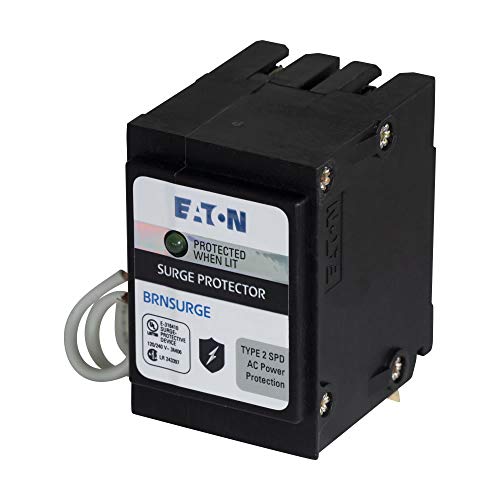
TYPE BR CIRCUIT BREAKER SURGE PROTECTIVE DEVICE, TWO POLE, SURGE PROTECTIVE DEVICE

Whole House Surge Protector: FHSPD108S is a compact whole-home surge protector that safeguards electrical devices connected to your home system

Fits into existing Siemens load centers
Why You’ll Like It
- Its 108 kA surge-current capacity provides substantial panel-level surge-handling capability.
- The 20 kA nominal discharge-current rating gives buyers another meaningful manufacturer-specified performance metric.
- The external design can work with many load-center brands when installed correctly.
- Status indication makes routine visual checks easier.
- The NEMA 4 enclosure provides flexibility for suitable installation environments.
Who Should Buy This
Choose the EATON CHSPT2ULTRA if you want a mainstream whole-home Type 2 SPD with clearly published electrical specifications, established manufacturer support, and broad residential panel application.
Who Should Avoid This
Skip it if your electrical panel cannot accommodate the required installation arrangement, if a dedicated 50A breaker cannot be provided, or if your electrician determines that another SPD type or connection method is more appropriate for your service equipment.
Key Benefits
- Type 2 whole-home surge protection
- 120/240V single-phase residential application
- 108 kA surge-current capacity
- 20 kA nominal discharge-current rating
- NEMA 4 enclosure
- Status indication for easier monitoring
- External design compatible with many residential load centers when properly installed
Check Product Details on Amazon
FHSPD108S Whole House Surge Protector

The FHSPD108S is a budget-oriented whole-house surge protector advertised for 120/240V, 60Hz residential electrical systems. Current product information describes a compact panel-level design, LED status indication, and an advertised surge capacity of up to 108,000 amps.
Its appeal is straightforward: it gives price-conscious shoppers another whole-home option without moving to a plug-in-only surge strip. However, the available manufacturer documentation is not as extensive as it is for the Eaton model, so do not rely on the large advertised surge-current number alone when making your decision.
[Amazon Products Picked for You]

Equal protection to circuits and receptacles throughout home

Whole Home Surge Suppressor: FHSPD36S is a compact whole-home surge protector that safeguards all electrical devices connected to your home system, including computers, security systems, TVs, kitchen appliances, HVAC systems, and smart home devices

Leviton surge protective devices (SPDs) divert damaging voltage transients, or surges, away from electronic equipment
Why You’ll Like It
- It is designed as a whole-home rather than single-outlet surge-protection device.
- The advertised 108,000A surge capacity is competitive on paper.
- The compact housing may simplify placement near some electrical panels.
- LED status indication provides a quick visual operating check.
Who Should Buy This
Choose the FHSPD108S if keeping purchase cost down is important and your electrician confirms that the current model, electrical specifications, installation method, and certification are appropriate for your home.
Who Should Avoid This
Skip it if you want the strongest available manufacturer documentation, clearly published installation specifications, or established long-term support. In that case, the Eaton CHSPT2ULTRA is the more straightforward choice in this shortlist.
Key Benefits
- Advertised for 120/240V, 60Hz whole-home applications
- Advertised surge capacity of up to 108,000 amps
- Compact housing
- LED status indication
- Lower-cost alternative for buyers comparing panel-level SPDs
Check Product Details on Amazon
Before You Buy: Whole-House Surge Protector Checklist
- Confirm the service configuration: Verify that the SPD matches your home’s voltage, phase, and wiring arrangement.
- Ask about breaker space: Determine whether the product requires a dedicated breaker and whether the correct breaker position is available.
- Check the SPD type: Type 1 and Type 2 devices have different permitted connection arrangements, so follow the manufacturer’s installation instructions.
- Check the enclosure: Indoor panels, outdoor panels, garages, utility rooms, and exposed locations can require different enclosure ratings.
- Review status monitoring: Make sure you know what the LEDs or alarms should show during normal operation and after a fault.
- Check documentation and warranty: Strong installation documentation and clearly stated warranty terms can make ownership easier.
- Consider layered protection: A whole-home SPD protects at the panel, while quality plug-in surge protection or UPS equipment can add another layer for computers, televisions, networking equipment, and other sensitive devices.
- Use a qualified electrician: Correct wiring, grounding, bonding, conductor routing, breaker selection, and code compliance are important to safe SPD performance.
FAQ
What Should I Consider When Buying a Whole House Surge Protector?
Start with electrical compatibility. Check your service voltage, phase, panel configuration, available breaker space, SPD type, surge-current capacity, nominal discharge-current rating when available, enclosure rating, status indicators, manufacturer documentation, and warranty. A large advertised surge-current rating should not be the only deciding factor.
Is a Higher kA Surge Rating Always Better?
Not by itself. Surge-current capacity is useful for comparison, but protection also depends on the device design, voltage-protection characteristics, installation location, grounding and bonding, conductor length, and whether the SPD is correctly matched to the electrical system. Compare the complete specification rather than choosing solely by the largest number printed on the listing.
What Is the Difference Between a Type 1 and Type 2 Whole-House Surge Protector?
The classifications affect where and how the SPD may be connected in the electrical system. Type 2 devices are commonly installed on the load side of the service disconnect, while Type 1 devices have different permitted connection options. The exact installation should follow the manufacturer’s instructions and applicable electrical code.
How Do I Know If My Surge Protector Is Working?
Whole-house SPDs commonly use status LEDs, and some models may include additional fault indicators or alarms. Check the manufacturer’s instructions so you know what normal operation looks like. If the indicator changes, goes out, or reports a fault, have the device and electrical system inspected as directed by the manufacturer.
Can I Install a Whole House Surge Protector Myself?
Most homeowners should use a qualified licensed electrician. Whole-house SPDs connect at or near the electrical panel, where improper wiring can create serious shock, fire, or equipment-damage risks. Professional installation also helps ensure the correct breaker, grounding, bonding, conductor routing, and code requirements are followed.
Do I Still Need Plug-In Surge Protectors?
They can still be useful for expensive or sensitive electronics. A panel-mounted SPD helps reduce incoming surges across the home’s electrical system, while appropriate point-of-use surge protection or a UPS can provide another layer for computers, televisions, routers, networking equipment, and home-office electronics.
How Long Does a Whole-House Surge Protector Last?
There is no single service-life number that applies to every SPD. Lifespan depends on the device design, installation conditions, and the number and severity of surge events it experiences. Check its status indicators periodically and follow the manufacturer’s inspection or replacement guidance, especially after a significant electrical event.
Wrapping Up
If you want a whole-house surge protector with strong manufacturer documentation and clearly published electrical specifications, the EATON CHSPT2ULTRA is the strongest choice in this shortlist. Its Type 2 classification, 120/240V single-phase design, 108 kA surge-current capacity, 20 kA nominal discharge-current rating, and documented installation requirements make it easier to evaluate before purchase.
The FHSPD108S remains an alternative for budget-focused buyers, but its current certification, installation requirements, warranty, and exact specifications should be confirmed carefully before ordering.
Final Recommendation
For most homeowners choosing between these two options, start with the EATON CHSPT2ULTRA and have an electrician confirm that your panel has the correct service configuration, breaker space, grounding, and mounting arrangement. Whatever model you choose, proper installation is just as important as the advertised surge rating.
This roundup contains Amazon affiliate links. When you click through and make a qualifying purchase, we may earn a referral commission at no extra cost to you.
