Affiliate disclosure: If this article includes retailer links, we may earn a commission at no extra cost to you. Our guidance stays focused on fit, safety, materials, and everyday usability.
Choose a stroller rain cover by fit, ventilation, face clearance, and access—not waterproofing alone. A properly matched cover can help shield your child from rain, wind, light snow, and sidewalk splashes, but it should never seal the stroller or block airflow. Check your exact stroller configuration, keep ventilation openings uncovered, and make sure the plastic stays clear of your child’s face, wheels, and brakes.
A stroller rain cover is a weather shield made from clear waterproof or water-resistant panels and, on many designs, fabric or mesh ventilation sections. A good cover fits the stroller securely, keeps the child visible, leaves dedicated airflow openings exposed, and allows quick access without removing the entire cover. “Universal” normally means designed to fit many strollers, not every stroller or every seat, bassinet, or car-seat configuration.
How this guide was updated: This is a research-based selection and safety guide using current manufacturer compatibility information and public stroller-safety guidance. It does not claim hands-on testing of every rain cover on the market.
Quick Verdict
Start with your exact stroller model and current configuration. A model-specific cover usually gives the most predictable attachment points, while a universal stroller rain cover can be practical if its dimensions and vent locations match your stroller. In either case, reject any setup that blocks ventilation, presses plastic toward the face, drags near the wheels, or prevents normal brake and access use.
- Best for everyday walks: A securely fitted cover with unobstructed side ventilation and quick front access.
- Best for lightweight strollers: A compact cover that does not hang near the wheels or ground.
- Best for jogging strollers: A cover explicitly sized for the wider or differently shaped frame.
- Best for travel: A foldable cover that packs small and can be installed without covering required vents.
- Most important safety check: Confirm airflow, face clearance, and wheel/brake clearance every time you install it.
Key Takeaways
- Universal does not mean every stroller: Match the cover to your stroller’s actual dimensions, canopy, seat direction, footrest, and accessories.
- Ventilation is essential: Keep mesh panels, side vents, and airflow holes open, and remove the cover when weather protection is no longer needed.
- Material claims are product-specific: Check what material the manufacturer identifies and any specific safety or chemical-compliance information it provides.
- Access matters: A front zipper, flap, or wide opening helps you check your child without removing the whole cover.
- Heat changes the decision: A waterproof plastic cover can reduce airflow and increase humidity, so warm conditions require extra caution and frequent checks.
What Does a Stroller Rain Cover Actually Do?

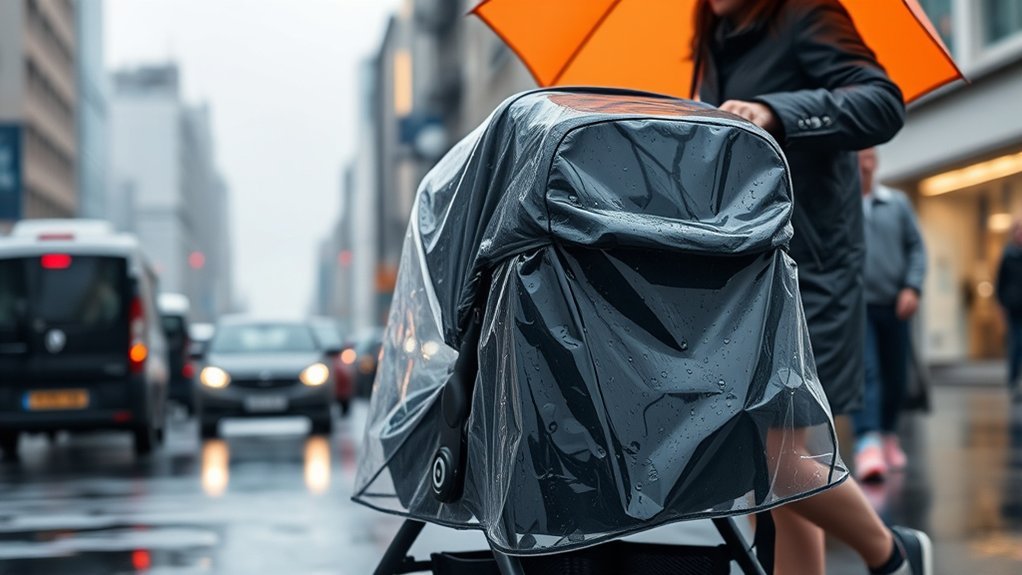
A stroller rain cover creates a barrier against rain, chilly wind, and splashback from wet paths. Unlike the stroller canopy, it can extend protection around the front and sides of the seat while keeping your child visible.
A well-fitted cover can also reduce repeated moisture exposure on stroller fabric during wet walks. That is most useful for families who walk frequently, travel with a stroller, or need weather protection ready for sudden showers.
Some rain covers advertise UV-resistant panels, but do not assume a clear weather shield is a sunshade unless the manufacturer specifically states the level of UV protection. In warm or sunny weather, preventing heat buildup and maintaining airflow matters more than maximizing plastic coverage.
What Features Matter Most in a Stroller Rain Cover?
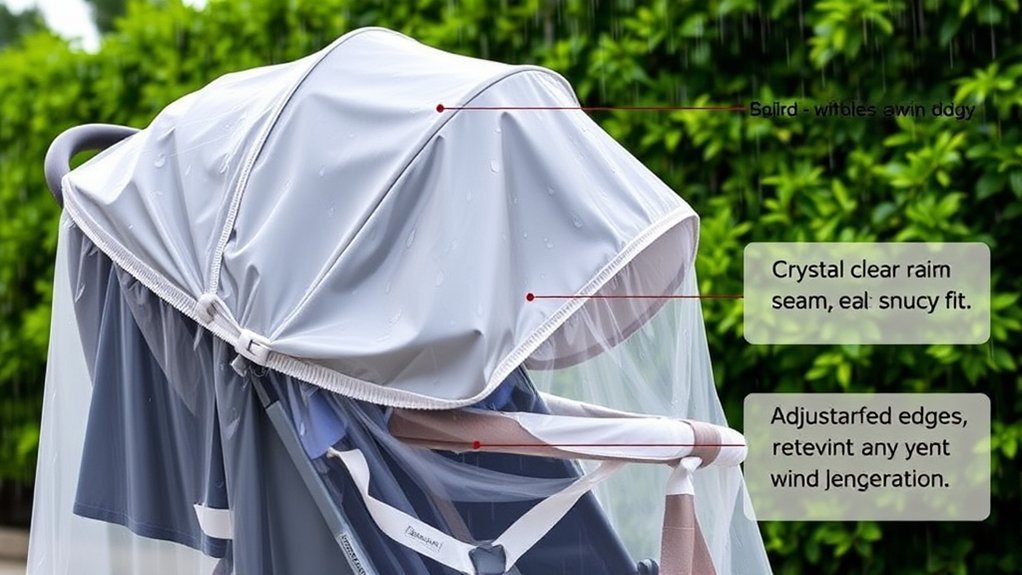
Focus first on fit, airflow, visibility, and access. A clear weather shield should cover the seating and foot area without forcing plastic inward toward your child or hanging loosely around moving parts.
Material descriptions can tell you what you are buying, but broad labels such as “non-toxic” or “child-safe” should not replace specific product information. EVA, PE/PEVA, PVC, polyester panels, and mixed-material designs are all used in this category. If claims such as BPA-free or phthalate-free matter to you, confirm them for the exact product rather than assuming they apply to every cover made from a similar material.
Ventilation holes, side vents, or mesh windows should remain exposed after installation. A snug fit should also keep the cover away from the wheels and brakes while maintaining enough room around the child and stroller seat.
[Amazon Products Picked for You]

ULTIMATE PROTECTION - Our high-quality stroller rain cover is designed to provide ultimate protection for your baby. Made with safe and resilient materials, including food-grade EVA, it shields your little one from rain, wind, snow, cold, and dust.

Seamless & Full Protection ·-· Our stroller rain cover is made of high-durability food-grade EVA material, thickened and tear-resistant, with seamless one-piece construction, providing complete protection against rain, wind, snow, and dust, giving your baby a 360° dry and comfortable space.
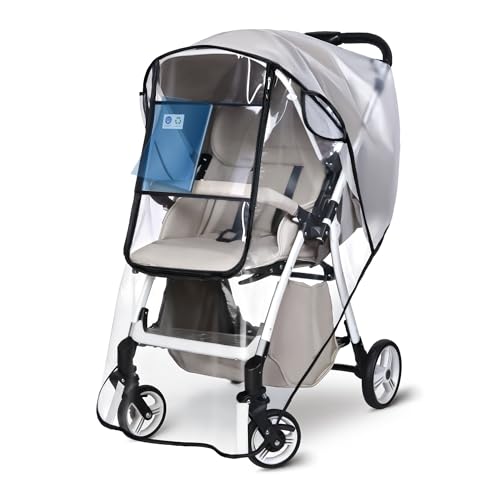
[Maximize Brightness and Clarity] Visually it is made of completely visible And special materials make it not easy to wrinkle, which maximizes brightness and clarity indoors or outdoors
Features That Make Daily Use Easier
- Front access panel: Lets you reach your child, adjust straps, or check the seat without removing the whole cover.
- Clear viewing window: Helps your child see out and lets you check their face quickly.
- Secure fasteners: Hook-and-loop tabs, snaps, elastic edges, or ties can help keep the cover positioned as designed.
- Compact storage: A foldable design is easier to keep in the stroller basket.
- Simple care instructions: A cover that can be wiped and dried easily is more practical after wet walks.
Buying tip: If two covers look similar, choose the one with clearer compatibility information, visible ventilation placement, secure attachment points, and practical front access. Those details are more useful than decorative trim.
How Do You Know if a Rain Cover Fits Your Stroller?
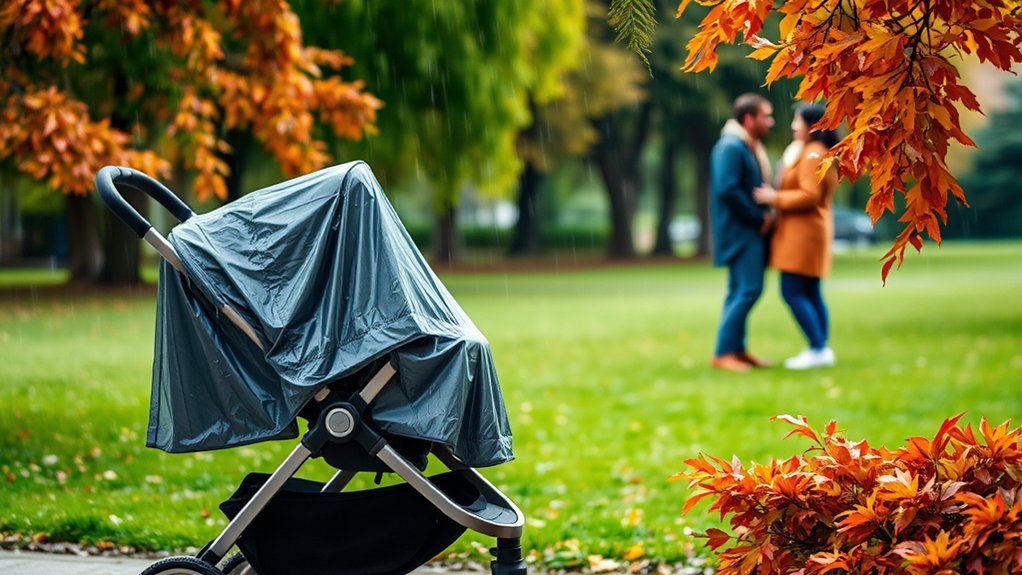
Start with the stroller, not the word “universal.” Record the brand, exact model, model generation if relevant, and the configuration you are actually using. A stroller with the seat reversed, a bassinet installed, or an infant car seat attached can require a different weather-shield setup from the same stroller in its standard forward-facing seat mode.
[Amazon Products Picked for You]

Solves the Leakage Problem: Designed with a protected zipper track to prevent rain from seeping in, addressing the common issue of babies getting wet in traditional covers. The 0.2mm thick food-grade EVA material is odorless and durable, ensuring a dry and safe environment for your child during sudden downpours

PREMIUM QUALITY: Boasting a food-grade EVA material and frosted PVC of half-clear part, IvyWind Stroller Rain Cover is odorless, soft and waterproof, ensuring both comfort and security; Utilize an enhanced 0.2mm thick EVA, offering unparalleled durability

RAINY DAY READY - Full weather protection for your stroller shields baby or toddler from wind, rain & more so walks & errands can continue. Side ventilation panels provide essential air-flow.
Stroller Type Compatibility
Full-size strollers may work with many universal covers, but lightweight, double, travel, bassinet, and jogging strollers often need a more deliberate match. Manufacturer examples that use the term “universal” typically describe compatibility with most strollers in a category rather than every possible frame. Confirm dimensions and attachment points instead of relying on the label alone.
| Stroller Type | Best Cover Style | What to Check |
|---|---|---|
| Full-size stroller | Universal or model-specific cover | Seat, canopy, footrest, vents, and attachment points |
| Umbrella or lightweight stroller | Compact fitted cover | No dragging near wheels or ground |
| Jogging stroller | Wide or jogging-specific cover | Frame shape, wheel clearance, attachment points, and airflow |
| Double stroller | Cover made for the seat layout | Full width, both seats, vents, and side-by-side vs tandem layout |
| Travel stroller | Compact compatible cover | Packed size, canopy shape, and secure attachment |
| Bassinet or infant car seat stroller setup | Cover explicitly listed for that configuration | No blocked vents, handles, harness access, or face area |
What Does a Proper Fit Look Like?
A proper fit keeps the weather shield stable without stretching it across the child or allowing loose material to hang near the wheels. Check all of the following:
- Coverage: The seating and foot area are protected without forcing the cover into the child’s space.
- Face clearance: Clear plastic does not rest against the mouth, nose, or face.
- Wheel and brake clearance: No loose panel, strap, or elastic edge reaches moving or braking parts.
- Vent placement: Mesh panels and ventilation holes remain open after installation.
- Access: You can still reach the harness, child, and approved stroller controls as intended.
Check the Exact Stroller Configuration
Read your stroller manufacturer’s accessory and weather guidance before buying. Confirm the exact seat, bassinet, or car-seat configuration you plan to cover. If your stroller has a snack tray, reversible seat, infant car seat adapter, extra-large canopy, or unusual handle geometry, confirm that those parts do not block the cover’s vents or attachment points.
Quick Fit Check Before the First Rainy Walk
Do the first installation at home instead of waiting for a downpour. This simple check catches most fit problems before you leave:
- Apply the stroller brake and install the cover according to its instructions.
- Look at both sides and confirm that every intended vent or mesh panel is exposed.
- Check the face area from the front and side. Plastic should not press inward toward the child.
- Inspect the wheels and brakes for hanging plastic, elastic, straps, or ties.
- Open the access panel and make sure you can reach your child and harness without destabilizing the cover.
- Test the stroller in its normal configuration, including the seat recline or direction you actually use, if the manufacturer permits those positions with the cover.
If changing the seat position, bassinet, car seat, canopy, or another accessory changes the fit, repeat the check before using the cover again.
How Do You Use a Stroller Rain Cover Safely?

Rain protection changes the airflow around a stroller, so ventilation deserves as much attention as waterproofing. The Australian Government-supported Pregnancy, Birth and Baby service notes that waterproof plastic rain covers can reduce airflow and increase humidity inside a pram. For product-safety alerts and stroller recalls in the United States, you can also check the CPSC recall database.
Safety note: Never use a rain cover as a sealed plastic enclosure. Keep its intended vents open, check your child regularly, and remove the cover when rain protection is no longer needed or if the stroller starts feeling warm or humid inside.
- Secure the fit: Make sure loose plastic or straps cannot move into the child’s space.
- Keep ventilation open: Do not cover mesh windows, side vents, or airflow holes with blankets, bags, or other accessories.
- Monitor comfort: Check your child for warmth, sweating, unusual fussiness, or other signs that the covered space is becoming uncomfortable.
- Keep the face area clear: The cover should never press against your child’s mouth or nose.
- Remove it when unnecessary: Take the cover off once weather protection is no longer required.
- Use the stroller brake: Lock the stroller before installing or adjusting the cover.
- Follow the maker’s instructions: Do not assume a cover is safe in a seat, bassinet, or car-seat configuration the manufacturer does not list.
[Amazon Products Picked for You]
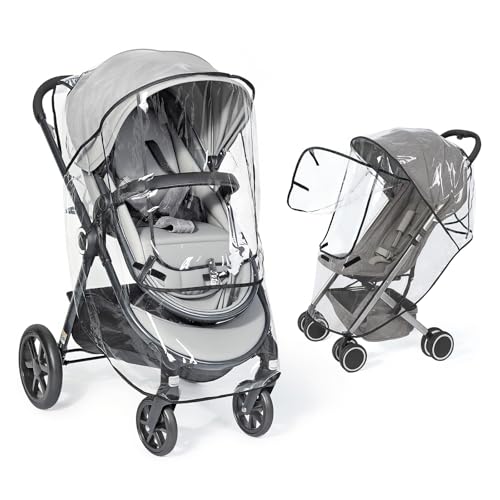
✅ 𝐏𝐑𝐄𝐌𝐈𝐔𝐌 𝐐𝐔𝐀𝐋𝐈𝐓𝐘 & 𝐒𝐀𝐅𝐄𝐓𝐘: IvyWind Stroller Rain Cover boasts a food-grade EVA material, renowned for its odorlessness, superior transparency, softness, and 100% waterproofing, ensuring both comfort and security during outings. Unlike common rain covers with thicknesses ranging from 0.08-0.12mm, IvyWind Rain Cover utilize an enhanced 0.2mm thick EVA, offering unparalleled durability.

Ventilation Design: Waterproof stroller cover zipper to stop rain from seeping in, there are air holes on both sides of the rain cover. Ventilation holes on both sides of the product make the air easier to circulate. Due to the sultry weather, this design can effectively reduce the difficulty of breathing in the stroller. In light rain, the lid can be rolled up and fully ventilated. Baby can breathe fresh air in the rain cover as well

MATERAL:The stroller rain cover are both made with high-quality materials for proper resilience,safe to child.Food Grade Materia EVA, safe to child. The plastic material is very smooth and soft to touch. Universal Stroller Rain Cover is a must-have item for parents to travel with their babies and give them the best care in a safe environment.
When Should You Remove or Skip the Rain Cover?
A rain cover is temporary weather protection, not an all-day enclosure. Remove it or do not use it when any of these conditions apply:
- The rain has stopped and the extra weather barrier is no longer needed.
- Ventilation holes or mesh panels cannot remain fully exposed.
- The clear panel touches or can blow against your child’s face.
- The cover, straps, or elastic interfere with wheels, brakes, handles, or other required controls.
- The stroller is indoors or in another sheltered place where the cover offers no weather benefit.
- Your child appears too warm or the inside becomes noticeably hot, humid, or heavily fogged.
Do not add a blanket, garbage bag, shower curtain, plastic sheet, or similar improvised layer over the stroller to imitate a rain cover or create extra shade. Extra coverings can obstruct ventilation and make it harder to monitor your child.
Universal vs Model-Specific Stroller Rain Covers
A universal stroller rain cover is designed to work with a range of frames; it is not a promise that the cover fits every stroller. A model-specific cover starts with a particular stroller shape and usually gives more predictable alignment around the canopy, foot area, openings, and attachment points.
| Cover Type | Best For | Main Limitation |
|---|---|---|
| Universal stroller rain cover | Occasional rain, travel, or families switching between compatible strollers | Requires careful checking of dimensions, vent placement, lower coverage, and attachment points |
| Model-specific stroller rain cover | Frequent use or strollers with unusual frame and canopy geometry | Usually limited to specified stroller models or configurations |
Who Should Choose a Model-Specific Cover?
- Parents who use the same stroller regularly in wet weather.
- Families whose stroller has an unusual canopy, frame, bassinet, or travel-system setup.
- Anyone who wants attachment points designed around one stated stroller model.
Who May Prefer a Universal Cover?
- Parents who need a packable backup for occasional showers.
- Families who have more than one stroller that falls within the cover’s listed compatibility range.
- Travelers who value compact storage and can verify the fit before the trip.
What Should You Check Before Buying?
Use this checklist before choosing a stroller rain cover online or in a store:
- Identify the exact stroller: Record the brand, model, and the seat, bassinet, or car-seat configuration you will use.
- Measure where necessary: Check canopy height, seat width, foot area, and any dimensions the cover manufacturer requests.
- Read compatibility wording: “Universal” or “fits most” still requires you to compare the stated fit with your stroller.
- Check airflow: Look for side vents, mesh panels, or clearly placed ventilation holes.
- Check face clearance: The shape should leave room around the child rather than pulling a clear panel inward.
- Look for easy access: A zipper or front flap makes quick checks easier.
- Read material details: Prefer products that clearly identify the materials and care instructions instead of relying only on broad marketing terms.
- Check storage: A cover that folds small is easier to keep ready in a stroller basket.
- Review cleaning instructions: Follow the maker’s directions so you do not damage clear panels, seams, coatings, or mesh.
- Check the return policy: Fit can be hard to judge online, so a clear return option reduces the risk of being stuck with an incompatible cover.
How Do You Clean and Store a Stroller Rain Cover?
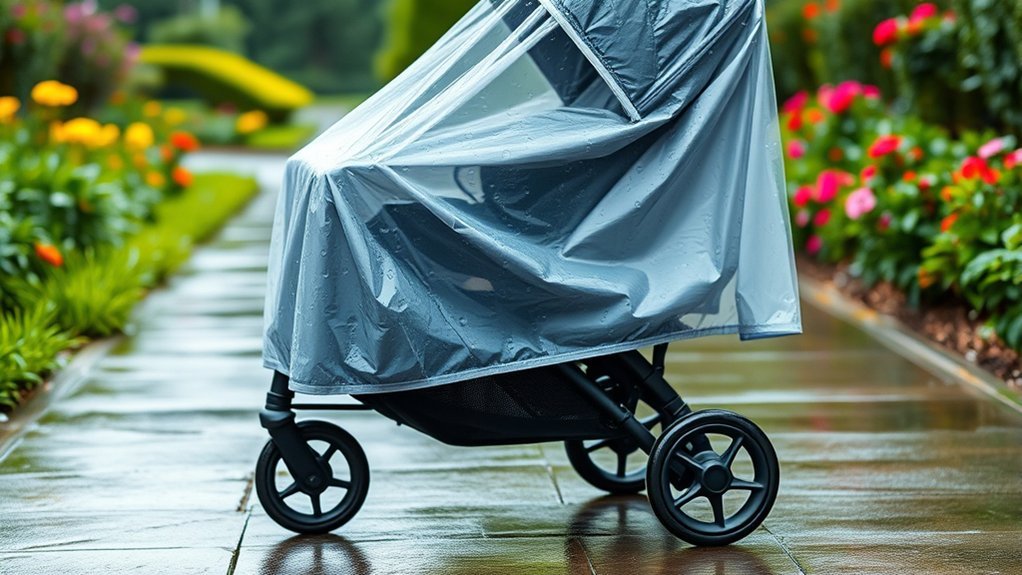
Care instructions differ by material and construction, so follow the manufacturer’s directions first. The goal is to put the cover away clean and fully dry without damaging clear panels, mesh, zippers, or attachment points.
- Dry before storage: Do not pack away a wet cover.
- Inspect before the next trip: Check zippers, snaps, hook-and-loop tabs, elastic edges, ties, and ventilation panels.
- Clean as directed: If the manufacturer recommends wiping with mild soap and water, avoid stronger chemicals unless the care instructions specifically allow them.
- Dry completely: Let the cover air-dry before folding and storing it.
- Avoid damaging clear panels: Fold or store the cover according to its instructions rather than sharply creasing or crushing it.
- Replace damaged covers: Stop using a cover if tears, failed fasteners, damaged vents, or distortion prevent a secure and ventilated fit.
Keeping the cover in the stroller basket can make it easier to reach during sudden rain, provided it is clean and dry. Before each use, repeat the basic fit and airflow check rather than assuming it is still positioned correctly.
Related Guides
Frequently Asked Questions
Can I use a stroller rain cover in snowy conditions?
Yes, a suitable rain cover can help with light snow as well as rain and wind. Keep ventilation openings clear of accumulating snow, follow the cover manufacturer’s weather guidance, and check your child regularly.
How do I clean my stroller rain cover effectively?
Follow the manufacturer’s care instructions. If mild soap and water are permitted, wipe the cover gently, rinse or wipe away residue as directed, and let it dry completely before folding and storing it.
Will a rain cover fit all stroller brands?
No. A “universal” cover is normally designed to fit many strollers, not every stroller or configuration. Check the listed dimensions or compatibility information against your exact stroller, seat direction, bassinet, or travel-system setup.
Can I use a rain cover during hot weather?
Use extra caution. Waterproof plastic rain covers can reduce airflow and increase humidity. Keep every intended vent open, monitor your child closely, avoid adding blankets or other coverings, and remove the rain cover as soon as weather protection is no longer necessary.
Is a rain cover necessary for all stroller types?
No. A rain cover is an optional weather accessory. It is most useful for families who expect to walk in rain, wind, or light snow and can use a cover that fits their stroller correctly without blocking airflow or access.
Is a universal stroller rain cover better than a model-specific cover?
Neither type is automatically better. A universal cover can be compact and flexible across compatible strollers, while a model-specific cover usually gives more predictable attachment and alignment. Choose according to your exact stroller, configuration, and frequency of use.
What material is best for a stroller rain cover?
There is no single material that is automatically best. Covers may use EVA, PE or PEVA, PVC, polyester, mesh, or mixed materials. Compare the manufacturer’s material information together with ventilation, visibility, fit, durability, care instructions, and any specific safety or chemical-compliance claims.
Can I use a stroller rain cover over an infant car seat?
Only use a rain cover whose manufacturer or stroller instructions allow that car-seat and stroller configuration. It should not block ventilation, handles, harness access, required attachment points, or the baby’s face area.
How do I stop a stroller rain cover from fogging up?
Fogging is a sign that moisture is collecting inside the covered space. Keep the designed ventilation openings unobstructed, avoid adding blankets over the cover, wipe condensation when necessary, and remove the cover once weather protection is no longer needed.
Can I use a blanket or plastic sheet instead of a stroller rain cover?
Do not improvise with a blanket, garbage bag, shower curtain, plastic sheet, or another unventilated covering. Use a purpose-made weather shield that fits the stroller, preserves airflow, stays clear of the child’s face, and follows the stroller and cover manufacturers’ instructions.
Conclusion
A useful stroller rain cover does more than keep water off the seat. It should match your stroller configuration, stay clear of the face and moving parts, provide visible ventilation, and let you reach your child quickly.
For occasional showers, a properly fitted universal cover may be enough. A model-specific option can make more sense when you use the same stroller frequently or its frame has unusual dimensions or attachment points. Whichever type you choose, verify the fit before the first wet-weather trip and remove the cover when it is no longer needed.
If you are ready to compare specific products rather than cover types and safety features, see our Best Stroller Rain Cover Picks for Winter Walks.
