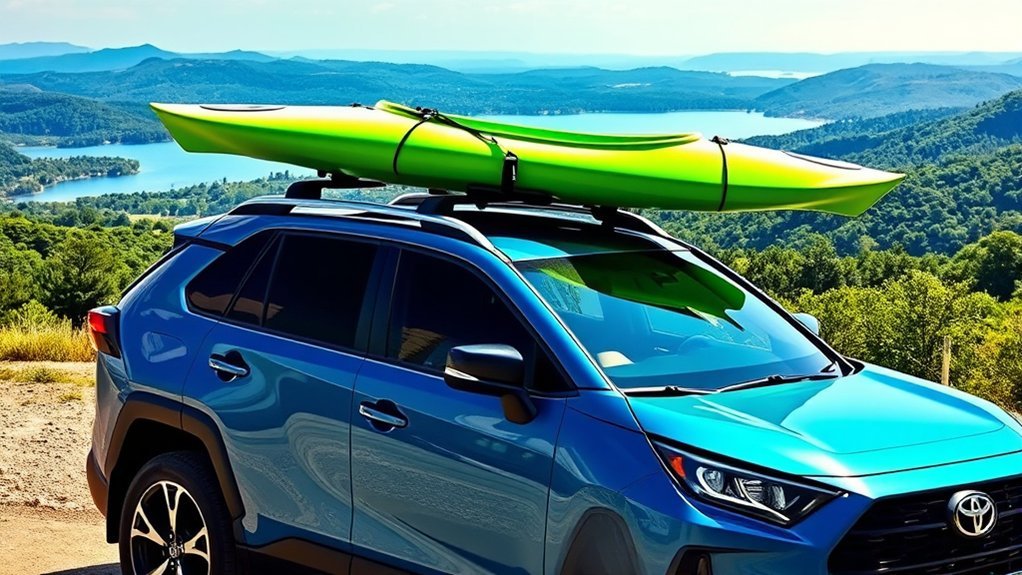
A 2026 Toyota RAV4 can carry a kayak, but the safe setup depends on your trim, roof equipment, kayak weight, and carrier. The 2026 model uses different roof configurations across the lineup, so you should not assume that a rack or fit kit made for an older RAV4 will fit the sixth-generation vehicle.
Quick Answer
Yes. A 2026 Toyota RAV4 can carry a kayak when you use a carrier and crossbar system approved for your exact trim and roof. Add the kayak, carrier, crossbars, and accessories, then keep the total below every listed limit. Use two hull straps plus bow and stern lines.
Key Takeaways
- Match the rack to your exact 2026 RAV4 trim, roof rails, crossbars, and moonroof or panoramic-roof configuration.
- Your usable capacity is the lowest rating among the vehicle roof, crossbars, towers, kayak carrier, and related hardware.
- Secure the kayak with two hull straps and manufacturer-approved bow and stern lines, then recheck the setup shortly after departure.
- A trailer may be easier for heavy kayaks, multiple boats, or anyone who cannot safely lift a kayak to the roof.
At a Glance
| Time Required | About 20 to 30 minutes for the first setup, then 10 to 15 minutes with practice |
| Difficulty | Moderate; use a helper or lift-assist carrier for a heavy or long kayak |
| Tools Needed | Compatible crossbars and carrier, two cam straps, bow and stern lines, tape measure, and a stable step stool |
| Cost | Varies by existing roof equipment and whether you choose saddles, J-cradles, lift assist, or a trailer |
Can the 2026 Toyota RAV4 Carry a Kayak?
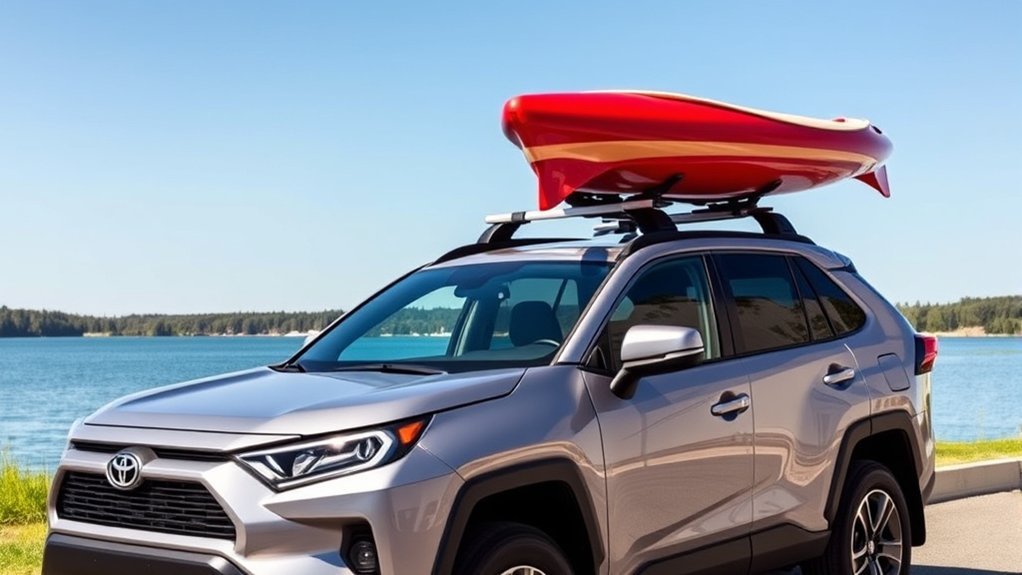
Yes, but you need to identify your roof configuration before buying a carrier. Toyota lists low-profile roof rails on the 2026 LE and raised rails with crossbars on the Woodland. Toyota also lists a power moonroof on the XSE and a panoramic glass roof on the Limited, so clearance and fit can differ by trim. You can review Toyota’s current grade details in its 2026 RAV4 product release.
The roof’s visual shape does not tell you whether a rack fits. A system must match the rail type, mounting points, crossbar shape, allowed bar spread, and roof-glass clearance. Confirm the exact trim, powertrain, roof package, and market because equipment can differ outside the United States.
Note: A rack listed for a 2022 or 2025 RAV4 is not automatically compatible with the redesigned 2026 model. Check the rack maker’s current vehicle fit guide and installation instructions before ordering.
Check Your Roof Configuration
- Low-profile rails: You may need trim-specific towers, feet, crossbars, and a fit kit.
- Raised rails with crossbars: Confirm that the factory bars support the carrier’s clamp style, required bar spread, and total load.
- Moonroof or panoramic glass roof: Verify carrier clearance and keep the glass closed while loaded unless both Toyota and the rack maker expressly allow operation.
- Temporary soft or inflatable rack: Use it only when the manufacturer approves the exact vehicle and strap route. Through-door straps must not interfere with airbags, weather seals, or safe door operation.
Calculate the Total Roof Load Before You Buy
Do not use a single generic RAV4 number. Open the 2026 RAV4 owner-manual page, find the roof-luggage or roof-carrier section for your exact vehicle, and compare it with every rack component’s limit.
Add the weight of the crossbars, towers or feet, kayak carrier, kayak, and any paddles or accessories placed on the roof. Your safe working limit is the lowest rating in the complete system, not the highest number printed on one product.
Usable roof capacity equals the lowest rated component minus the weight of every rack part and accessory already on the roof.
Use the vehicle’s dynamic roof-load limit for road travel. A higher static rating advertised for a parked rooftop tent does not increase the amount you can safely carry while driving.
Top Roof Rack Choices for Kayak Transport
The best setup depends on your kayak’s weight and width, how often you paddle, and whether you load alone. Use this comparison to narrow the options, then confirm exact 2026 RAV4 fitment with the manufacturer.
| Carrier Type | Best For | What to Check |
|---|---|---|
| Saddles or horizontal cradles | Stable support and simple loading from the rear | Hull shape, bar spread, hatch clearance, and total roof load |
| J-style cradles | Saving crossbar width or carrying a second approved carrier | Higher lifting height, side clearance, combined load, and garage height |
| Stacker | Two narrow, lighter kayaks when every component permits the setup | Carrier capacity, crossbar width, individual straps, and bow and stern lines for each boat |
| Lift-assist carrier | Solo loading or a heavier kayak | Compatible projecting crossbars, carrier weight, kayak limit, and vehicle roof capacity |
| Temporary inflatable or soft rack | Occasional use when no fitted rack is installed | Exact vehicle approval, strap path, door seals, airbags, paint protection, and speed restrictions |
| Kayak trailer | Heavy boats, multiple kayaks, or reduced lifting | Exact towing rating, hitch, wiring, tongue weight, trailer load, registration, and local law |
A lift-assist system can reduce strain, but its own weight counts against the roof limit. For example, the Thule Hullavator Pro lists a 75-pound kayak capacity and assists with 40 pounds of the boat’s weight. Its instructions also require compatible load bars and sufficient total roof-load capacity.
Do not assume the older Thule Evo Fixpoint 710701 setup fits the 2026 RAV4. The 2026 model is a new generation, and a correct system may require different feet, bars, or fit hardware. Likewise, a Malone HandiRack or similar inflatable system should be used only after the current manufacturer guidance confirms the exact vehicle and roof configuration. A product’s general capacity never overrides Toyota’s limit.
[Amazon Products Picked for You]
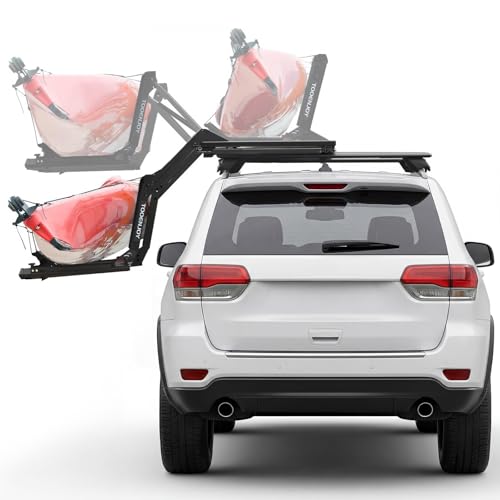
Important Notice: Verify Crossbar Compatibility Before Purchase! 1. Requires extended and adjustable crossbars. Your crossbar distance should be adjustable to approximately 29.76 inches to use this lift rack. 2. If your existing crossbars are fixed/non-extend, purchase our Accessory Adapter together. This accessory solves compatibility issues for many fixed crossbar setups

Important Notice: Verify Crossbar Compatibility Before Purchase! 1. Requires extended and adjustable crossbars. Your crossbar distance should be adjustable to approximately 29.76 inches to use this lift rack. 2. If your existing crossbars are fixed/non-extend, purchase our Accessory Adapter together. This accessory solves compatibility issues for many fixed crossbar setups

⛵【Why Slight Shaking】Due different car rear windows have different radians, so this kayak roller is specially designed for the slight shaking between the metal tube that fits inside the suction device to make the suction cup better fit the angle of the glass automatically therefore to achieve the best suction effect
Alternative Solutions for Kayak Transportation
A small kayak trailer is the most practical alternative when roof loading is difficult. Toyota publishes a maximum towing capacity of up to 3,500 pounds for certain 2026 RAV4 configurations, but the rating varies by grade, drivetrain, equipment, and market. Check the exact rating in Toyota’s 2026 RAV4 specifications and owner manual before choosing a hitch or trailer.
A trailer also shifts the main weight away from the roof, lowers loading height, and can carry more than one kayak. You still need to account for the trailer’s loaded weight, tongue weight, hitch rating, wiring, tie-down points, and local registration rules.
A kayak cart is not a road-transport substitute. It helps you roll a kayak between the parking area and the water after the kayak has been removed from the vehicle or trailer. Do not tow a kayak cart behind the RAV4 on public roads.
Folding or modular kayaks may fit inside the cargo area when fully disassembled and secured. Never carry a rigid kayak inside with an open liftgate, blocked mirrors, or an unsafe projection unless the vehicle manual and local law clearly permit the arrangement.
[Amazon Products Picked for You]
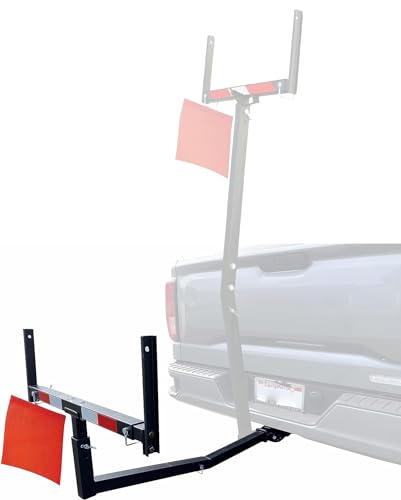
Extends your truck bed for carrying longer payloads, designed to fit 2-Inch hitch receivers

Load Capacity: The maximum load capacity of truck bed extender is 750 lbs, allowing it to safely transport heavy items such as kayaks, canoes, ladders, and lumber, ensuring stability and safety when hauling large items

Rugged Steel Build: Crafted from high-strength steel with a durable black powder-coated finish, this kayak hitch rack resists rust and corrosion. With a max load capacity of 150 lbs, it offers long-lasting reliability for outdoor use.
Essential Features for Choosing a Kayak Roof Rack
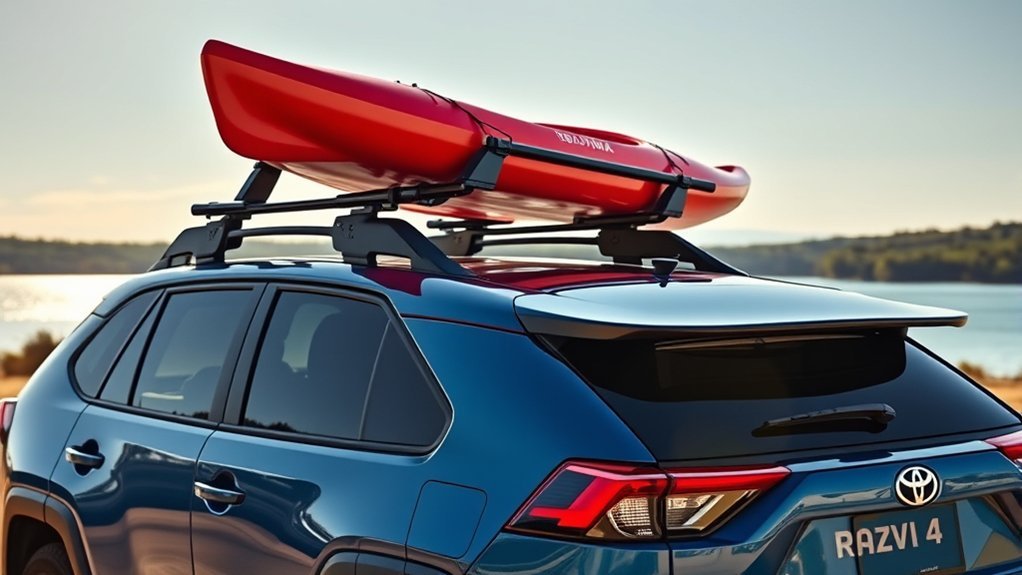
Start with compatibility, then compare load capacity, support style, installation, and security. A convenient carrier is not useful if it does not fit the rails or leaves too little capacity for the kayak.
| Feature | Why It Matters | What to Verify |
|---|---|---|
| Rack compatibility | Provides a secure attachment to the exact vehicle roof | Model year, trim, rail type, roof glass, bar shape, and fit-kit number |
| Weight capacity | Protects handling, roof structure, and rack hardware | Vehicle, bars, feet, carrier, kayak, and accessory weights |
| Bar spread | Supports the hull and keeps the carrier stable | Minimum and maximum spacing in the carrier instructions |
| Aerodynamics | Can reduce wind noise and unnecessary drag | Correct bar position, covered channels, secured strap ends, and carrier orientation |
| Hull support | Prevents pressure points and movement | Padding, cradle width, contact points, and compatibility with the kayak’s hull material |
| Security | Discourages theft during stops | Lockable rack parts and a separate kayak cable that does not replace transport straps |
| Installation | Reduces the chance of loose or damaged hardware | Required tools, torque values, recheck intervals, and whether professional installation is recommended |
[Amazon Products Picked for You]

KAYAK CAR TOP CARRIER A simple, A practical solution to carrying your kayak solution to carrying your kayak QUANTITY: 2 PAIRS.

Durability & Strong Support: PIRIPARA Kayak roof rack are made of sturdy and high quality alloy steel. Come with 2 Pairs(4pcs) kayak rack, can hold 2 kayaks. Total load capcity up to 150 lbs.

BETTER THAN THE ORIGINAL OEM ONE .Optimized re-designed from the original OEM new RAV4 crossbar by added metal mechanism lock system ,this upgrade offers durable and 100% secure for anti-theft. (Not Fit 2024 LE/ Adventure/TRD Off-Road/Hybrid Woodland Edition)
Roof Rack Compatibility Checklist
- Confirm the vehicle is a 2026 RAV4 and record the exact trim and roof package.
- Check whether the vehicle has low-profile rails, raised rails, existing crossbars, a moonroof, or a panoramic glass roof.
- Verify the rack maker lists your exact vehicle and provides a current fit-kit or installation guide.
- Compare the required bar spread and crossbar overhang with your vehicle’s available mounting positions.
- Calculate the complete roof load before buying the carrier.
- Confirm the rear liftgate can open without striking the kayak or carrier.
- Check whether locks are included and remember that locks do not replace load straps.
Proper Kayak Loading and Securing Techniques
Load the kayak on level ground with enough space around the vehicle. Follow the carrier’s instructions because hull orientation, strap routing, and attachment points vary by design.
Warning: Never rely on bungee cords, a single strap, loose factory rails, or an unverified tow point. A separated kayak can cause a crash, serious injury, or death.
- Inspect the system. Check crossbar feet, carrier bolts, pads, straps, buckles, and tie-down lines for looseness, cuts, corrosion, or missing parts.
- Prepare the vehicle. Close the moonroof or panoramic roof, remove loose rooftop items, and protect painted contact areas as the carrier maker directs.
- Confirm the bar position. Measure the crossbar spread and install the carrier at the specified spacing and torque.
- Lift the kayak safely. Use a helper, lift-assist rack, or rear-loading method. A clean blanket over the rear edge can reduce scratches when the carrier permits rear loading.
- Seat the kayak in the carrier. Center it front to rear and place the hull in the exact orientation required by the cradle, saddle, or stacker.
- Add two hull straps. Route one strap at each crossbar through the carrier and around a structural crossbar as instructed. Use cam-buckle straps unless the carrier maker specifies another type.
- Add bow and stern lines. Attach them to approved vehicle tie points or properly installed hood and hatch loops. The Thule Hullavator instructions, for example, require both ends of the boat to be tied to suitable vehicle points.
- Finish with a shake test. Tighten straps until the kayak cannot slide, but do not crush the hull. Secure loose strap tails, measure total height, and recheck everything after the first 5 to 10 miles.
Pro Tip: Practice loading in your driveway before a trip. Use a stable step stool on flat ground, keep your back straight, and stop if the kayak’s weight or wind makes the lift feel uncontrolled.
Driving Tips for Kayak Roof Transport
A roof-mounted kayak changes the RAV4’s height, wind response, noise, and fuel use. Drive smoothly, leave more following distance, and follow the lowest speed restriction listed by Toyota or any rack component manufacturer.
Securing Your Kayak Safely
- Stop early: Recheck straps, rack feet, bow line, and stern line after the first 5 to 10 miles.
- Check during long trips: Inspect the setup at fuel, charging, food, or rest stops and after heavy rain or a sharp temperature change.
- React to new noise: A sudden whistle, slap, or vibration can signal a loose strap or shifting boat. Pull over safely and inspect it.
- Slow for wind: Crosswinds and passing trucks can push against the kayak. Reduce speed and avoid abrupt steering.
- Remove the setup when unused: Taking off the carrier or bars when practical can reduce noise, drag, and weather exposure.
Navigating Height Clearance Issues
Measure the total height from the ground to the highest part of the loaded kayak. Write the number on a removable dashboard note so you remember it during the trip.
Avoid parking garages, drive-thrus, low tree branches, car washes, and other restricted-clearance areas unless the posted height safely exceeds your measured height. Do not guess, especially with J-cradles or stacked kayaks.
Check rear-hatch clearance before leaving. A long kayak or rear-mounted cradle can contact the liftgate when it opens, even if the boat looks centered from the side.
Related Guides
Frequently Asked Questions
What is the maximum weight capacity for kayak transport on the RAV4?
Do not use one blanket number for every 2026 RAV4. Find the dynamic roof-load limit in the owner manual, then compare it with the crossbars, towers, carrier, and hardware. Add all rooftop components and the kayak. The lowest listed limit controls the complete setup.
Can I use a kayak cart instead of a roof rack?
No. A kayak cart helps you move the boat between your parked vehicle and the water. It does not secure a kayak for road travel. Use a compatible roof carrier, approved temporary rack, or properly equipped trailer for vehicle transport.
Are there kayak transport options for a RAV4 without crossbars?
Yes. You can install a vehicle-specific crossbar system, use a temporary soft or inflatable rack only when its maker approves the exact vehicle, or tow a kayak trailer within the RAV4’s exact towing limits. Do not attach a carrier directly to decorative or unrated rails.
How do I determine the right size kayak for my RAV4?
Check the kayak’s weight, width, length, hull shape, and the carrier’s approved range. Confirm that the complete roof load stays within every limit, the hull sits securely on the support points, and the front and rear overhang comply with local law.
Can I transport multiple kayaks on the RAV4 roof?
Only when the vehicle, crossbars, carrier, and available bar width all support the combined setup. Count every carrier and both kayaks in the total load. Strap each kayak as the carrier maker directs and use separate bow and stern control where required.
Can I open the moonroof or panoramic roof with a kayak loaded?
Keep it closed unless Toyota and the rack maker both confirm safe clearance for your exact setup. A moving glass panel can strike bars, clamps, straps, or the kayak, and an open roof may increase noise or allow water to enter.
Do I need bow and stern tie-downs?
Follow the carrier instructions, but many kayak-carrier makers require both. Bow and stern lines limit pitching and help control the boat if a main strap or rack part loosens. Attach them only to approved vehicle points or purpose-made tie-down loops.
Conclusion
You can safely transport a kayak on a 2026 Toyota RAV4 when every part of the system matches the exact trim and stays within its rated load. Start with the roof type, verify current fitment, calculate the complete rooftop weight, and use a carrier designed for your kayak’s hull.
Take time to load the boat correctly, add bow and stern control, measure your new height, and inspect the straps during the trip. Choose a trailer instead when the kayak is too heavy, the roof setup is not approved, or lifting cannot be done safely.
Sources
- Toyota USA Newsroom: 2026 RAV4 Arrives This Winter — confirms the sixth-generation model, trim-specific roof rails, crossbars, roof glass, and towing details.
- Toyota: 2026 RAV4 Overview — confirms current U.S. trims and the Woodland’s raised rails with crossbars.
- Toyota: 2026 RAV4 Specifications — provides current equipment, weight, capacity, and configuration information.
- Toyota: 2026 RAV4 Manuals and Warranties — provides the vehicle-specific manual needed to verify roof and towing limits.
- Thule Hullavator Pro and installation instructions — provide carrier capacity, lift-assist, bar, load, and bow and stern tie-down requirements.
