
The Toyota RAV4 can handle plowed roads, light snow, and many everyday winter conditions well, especially when it has all-wheel drive and suitable tires. However, AWD cannot create grip where none exists. Your tires, speed, visibility, snow depth, and driving technique have a greater effect on braking and cornering safety.
Quick Answer
Yes. A Toyota RAV4 can handle normal winter roads well, especially when equipped with AWD and four proper winter tires. AWD improves acceleration and helps reduce wheel spin, but it does not shorten braking distance. Tire grip, speed, visibility, snow depth, and driver technique remain more important than the badge or drive mode.
Key Takeaways
- AWD helps a RAV4 accelerate and maintain momentum, but it does not give the vehicle shorter stopping distances on ice.
- Four dedicated winter tires provide the strongest cold-weather grip for frequent snow and icy-road driving.
- Drive modes, AWD systems, trims, safety technology, and ground clearance vary by model year.
- The 2026 Woodland is the most winter-oriented current U.S. trim, but its all-terrain tires are not the same as dedicated winter tires.
- Deep, drifted, or unplowed snow can exceed the RAV4’s capability, regardless of drivetrain.
How Well Does the RAV4’s AWD Work in Snow?
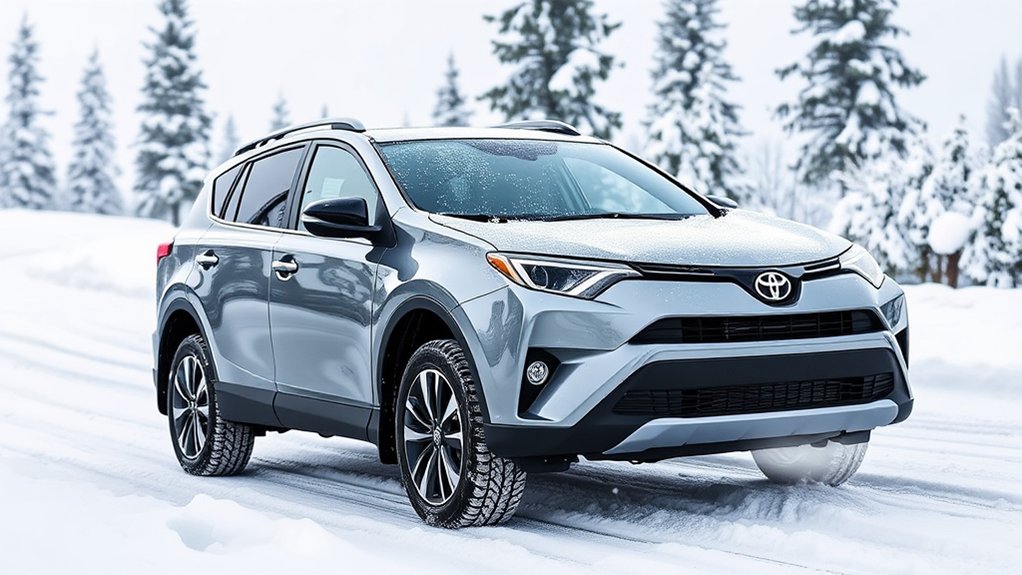
The RAV4’s available AWD systems can send drive force to the rear wheels when extra traction is useful. This can reduce front-wheel spin when you pull away from a stop, climb a snowy hill, or accelerate on a slippery road.
System design depends on the model year and powertrain. For example, the 2025 gas RAV4 offered conventional AWD or Dynamic Torque Vectoring AWD, depending on the grade. The 2025 hybrid used an independent rear electric motor that could apply rear torque when beneficial.
The redesigned 2026 RAV4 uses electronic on-demand AWD on equipped hybrid models. Toyota says these vehicles have a dedicated rear electric motor rather than a mechanical driveshaft connecting the front and rear axles.
AWD can help you get moving in snow, but your tires and speed still determine how well you stop and turn.
AWD does not increase the friction available between the tires and the road. All four tires still rely on the same slippery surface when you brake or steer. That is why an AWD RAV4 with worn all-season tires may have less winter grip than a front-wheel-drive RAV4 fitted with high-quality winter tires.
What Features Matter Most for Winter Driving?
The features below can make winter travel easier, but each one has limits:
- All-wheel drive: Helps distribute drive force and reduce wheel spin during acceleration.
- Traction and stability control: Can reduce engine output or apply individual brakes when the system detects wheel slip or a loss of directional stability.
- Antilock brakes: Help prevent wheel lock during hard braking. Follow the owner’s manual and apply firm, continuous pressure when ABS activates.
- Ground clearance: Helps reduce contact with shallow snow, ruts, and uneven surfaces, but does not prevent high-centering in deep or packed snow.
- Heated mirrors and windshield deicers: Can improve visibility by reducing frost and ice buildup.
- Winter tires: Improve cold-weather braking, cornering, and acceleration by providing a rubber compound and tread pattern designed for low temperatures.
Note: Toyota Safety Sense can support the driver, but it is not a snow-traction system. Snow, ice, road spray, or blocked sensors may also affect driver-assistance performance. Keep sensors and cameras clear and remain ready to brake or steer.
Does Every Toyota RAV4 Have Snow Mode?
No. You should not assume that every RAV4 has a dedicated Snow Mode. The available controls and their names depend on the model year, drivetrain, market, and trim.
| U.S. Model | AWD and Drive-Mode Details | Safety System |
|---|---|---|
| 2025 gas RAV4 | FWD or AWD was available. AWD models included Multi-Terrain Select for low-traction surfaces. Toyota listed Sport, Eco, and Normal drive modes. | Toyota Safety Sense 2.5 |
| 2025 RAV4 Hybrid | Electronic on-demand AWD was standard. Toyota listed Eco, EV, Sport, Normal, and Trail modes rather than a dedicated Snow Mode. | Toyota Safety Sense 2.5 |
| 2026 RAV4 | Hybrid grades may use FWD or electronic on-demand AWD, depending on the grade. PHEV models have AWD. Toyota’s U.S. specifications list Normal, Eco, Sport, and Custom modes, plus EV mode on the hybrid. | Toyota Safety Sense 4.0 |
Some older RAV4 configurations or vehicles sold in other markets may use different terrain controls. Before winter arrives, review the drive-mode section of the owner’s manual for your exact model year.
Warning: A snow, trail, or terrain mode cannot make an unsafe road safe. These modes adjust vehicle response, but they cannot overcome ice, poor visibility, excessive speed, deep snow, or unsuitable tires.
Which RAV4 Trims Offer the Best Winter Features?
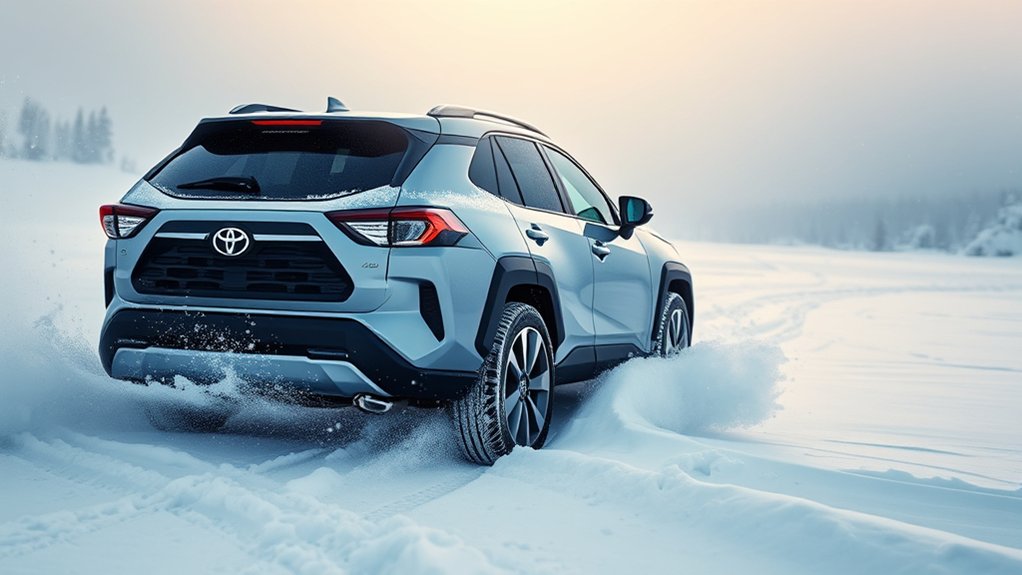
For the current 2026 U.S. lineup, the Woodland is the most winter-oriented factory configuration. Toyota equips it with standard AWD, all-terrain tires, 8.5 inches of ground clearance, a windshield deicer, heated mirrors, rain-sensing wipers, and rugged exterior equipment.
However, all-terrain tires and winter tires serve different purposes. An all-terrain tire may work well on loose snow, gravel, and unpaved surfaces, while a dedicated winter tire is designed specifically for low-temperature grip on snow and ice.
The 2026 Limited also includes standard AWD, a windshield deicer, rain-sensing wipers, a heated steering wheel, heated front seats, and heated rear outboard seats. These features improve comfort and visibility, but the tires still have the greatest direct effect on winter grip.
For a used 2025 RAV4, the Hybrid Woodland combines standard electronic AWD with Trail mode. Toyota did not offer the gas Adventure or TRD Off-Road grades for model year 2025, so articles that recommend those as current trims are outdated.
For most drivers, the best value is not automatically the most expensive trim. A suitable RAV4 with four quality winter tires may be a better winter setup than a higher trim left on ordinary all-season tires.
How Do Tires Affect Winter Performance in the RAV4?
Tires are the RAV4’s only contact points with the road. They affect acceleration, braking, steering, and stability, so AWD cannot make up for worn or unsuitable tires.
Transport Canada advises that all-season and summer tires begin losing traction below 7°C, or about 45°F. Its comparison testing also demonstrated longer stopping distances on ice with all-season tires than with winter tires.
Dedicated Winter Tires
Dedicated winter tires are usually the strongest choice when you regularly drive in freezing temperatures, packed snow, slush, or ice. Their rubber remains more flexible in the cold, while their tread contains edges and channels designed to grip and evacuate snow or water.
3PMSF-Certified All-Season Tires
A tire carrying the three-peak mountain snowflake symbol has met a defined snow-traction test. It may be a practical year-round option for occasional or moderate winter conditions, but it is not automatically identical to a dedicated winter tire.
For example, Michelin classifies the CrossClimate2 as a 3PMSF-certified all-season tire. Michelin says drivers who frequently travel on snow-covered and icy roads should still consider dedicated winter tires.
Ordinary All-Season Tires
Ordinary all-season tires can manage light, occasional snow when they have adequate tread, but their cold-weather braking and cornering may fall behind dedicated winter tires. Check the sidewall rather than assuming every tire labeled “all-season” carries the 3PMSF symbol.
Pro Tip: Install four matching winter tires rather than replacing only the driven axle. A mixed-grip setup can create an imbalance between the front and rear of the vehicle during braking or cornering.
Check tire pressure when the tires are cold and use the pressure printed on the driver-door placard, not the maximum pressure molded into the tire sidewall. Cold temperatures lower tire pressure, which can affect handling, tire wear, and efficiency.
What About Studded Tires, Chains, or Cables?
Studded-tire laws vary by region and season. Their benefit also depends on the surface, with studs generally intended for persistent ice or hard-packed winter roads rather than every type of snow.
Only install chains, cables, or other traction devices that are permitted for your exact tire size and RAV4 model. Follow the owner’s manual and local road regulations because incorrect devices or installation can damage the tires, body, brakes, steering, or suspension.
Can a Front-Wheel-Drive RAV4 Handle Snow?
Yes, a front-wheel-drive RAV4 can handle plowed roads and moderate winter weather when it has suitable tires and is driven carefully. The engine’s weight over the front axle can also help the driven tires maintain traction.
AWD provides an advantage when starting on steep hills, pulling away in deeper snow, or maintaining momentum on uneven slippery surfaces. However, FWD with dedicated winter tires can provide stronger braking and cornering grip than AWD with worn or basic all-season tires.
Choose AWD when your routes regularly include steep grades, poorly cleared roads, rural areas, or frequent heavy snow. For mostly flat, well-plowed city roads, investing in winter tires may produce a larger safety benefit than choosing AWD while keeping unsuitable tires.
How Much Snow Can a RAV4 Handle?
No single snow-depth number is safe for every RAV4. Fresh powder, heavy wet snow, frozen ruts, compacted snow, and windblown drifts affect the vehicle differently.
For 2026 U.S. models, Toyota lists 8.1 inches of ground clearance for the LE, XLE Premium, SE, and XSE; 8.5 inches for the Woodland; and 7.5 inches for the GR SPORT. Earlier RAV4 generations have different measurements.
Ground clearance should not be treated as a maximum safe snow depth. Snow can build under the floor, around suspension parts, or ahead of the bumper. Packed snow can lift the tires away from the road and leave the vehicle high-centered.
Avoid entering deep or drifted snow when you cannot see the road surface, estimate the depth, maintain momentum safely, or confirm that there is a clear exit. Turn around before the vehicle becomes stuck rather than relying on AWD to recover it.
How Should You Drive a RAV4 in Snow and Ice?
- Clear the entire vehicle. Remove snow and ice from the windshield, roof, hood, lights, mirrors, cameras, radar areas, and license plates.
- Use the appropriate mode. Select the mode described in your owner’s manual, but return to normal settings when road conditions no longer require it.
- Accelerate gradually. Sudden throttle inputs can overwhelm available tire grip and trigger wheel spin.
- Steer smoothly. Avoid abrupt lane changes or sharp inputs that can upset the vehicle on a low-grip surface.
- Brake early. Begin slowing sooner than normal and leave substantially more space ahead.
- Use ABS correctly. If the brake pedal pulses during an emergency stop, maintain firm, continuous pressure rather than rapidly releasing the pedal.
- Avoid cruise control on slippery roads. Keep direct control of acceleration and deceleration when traction changes quickly.
- Preserve visibility. Use winter washer fluid, defrosters, headlights, and suitable wiper blades.
NHTSA recommends checking weather and traffic conditions before leaving. When roads are in poor condition, postpone nonessential travel until they have been cleared.
RAV4 Winter Preparation Checklist
- Inspect tire pressure, tread, sidewalls, and the spare tire or inflation kit.
- Test the 12-volt battery and charging system before severe cold arrives.
- Confirm that the heater, defrosters, heated mirrors, and windshield deicer work.
- Fill the washer reservoir with winter-rated fluid and replace worn wiper blades.
- Check coolant strength and level according to Toyota’s maintenance guidance.
- Verify that headlights, brake lights, turn signals, and emergency flashers work.
- Keep the fuel tank reasonably full or maintain sufficient hybrid/PHEV charge.
- Carry an ice scraper, snow brush, shovel, flashlight, jumper cables, phone charger, blankets, water, food, first-aid supplies, and an abrasive material such as sand.
If you become stuck, avoid prolonged wheel spin because it can dig the tires deeper and overheat components. Clear snow from around the tires and exhaust outlet, straighten the wheels, apply gentle throttle, and use an approved traction aid. Seek assistance when recovery would require entering traffic or working in an unsafe location.
How Does Cold Weather Affect RAV4 Fuel Economy?
Cold weather can reduce the fuel economy of gas, hybrid, and plug-in hybrid RAV4 models. The engine takes longer to reach an efficient temperature, cold fluids create more friction, tire pressure falls, cabin heating uses energy, and snow-covered roads increase resistance.
The U.S. Department of Energy reports that conventional gasoline vehicles commonly lose about 10% to 20% of city fuel economy in cold conditions. Hybrids may lose roughly 20% to 40% in city driving, with larger reductions possible on short trips. These are general test ranges, not guaranteed RAV4-specific results.
You can reduce the penalty by combining short trips, checking tire pressure, limiting unnecessary idling, removing unused roof accessories, and driving gently. With a plug-in hybrid, preheating the cabin while connected to external power can preserve more battery energy for driving.
Related Guides
Frequently Asked Questions
Is the RAV4 reliable in extreme winter weather?
A properly maintained RAV4 can operate in cold climates, but vehicle reliability does not make extreme weather safe. Tire condition, battery health, visibility, road treatment, snow depth, and emergency access all matter. Postpone travel during severe storms or when authorities advise drivers to stay off the roads.
How does the RAV4 handle icy roads compared with snow?
Ice generally provides less tire grip than packed snow, particularly when it is polished or covered by a thin layer of water. AWD can help the RAV4 accelerate, but it does not eliminate sliding or shorten braking distance. Winter tires, lower speed, smooth inputs, and added following distance are essential.
What maintenance improves the RAV4’s winter performance?
Check cold tire pressure and tread, test the 12-volt battery, use winter washer fluid, inspect wipers and lights, verify coolant protection, and keep cameras and sensors clear. Carry basic emergency supplies and follow the maintenance schedule for your model year.
Can the RAV4 drive safely on unplowed snowy roads?
It may handle shallow, predictable snow with suitable tires, but an unplowed road is not automatically safe. Do not continue when snow is deep or drifted, the surface is hidden, visibility is poor, the road has a steep drop or grade, or you cannot turn around or obtain help.
What is the RAV4’s fuel efficiency in winter?
Actual winter fuel economy varies with temperature, trip length, tires, road conditions, heating use, and powertrain. Government testing across vehicle types shows that cold-weather losses can be substantial, especially for hybrids and short trips. Check tire pressure, combine trips, and avoid unnecessary idling to reduce the loss.
Do you need AWD to drive a RAV4 in snow?
Not always. A front-wheel-drive RAV4 with four winter tires can work well on flat, regularly plowed roads. AWD becomes more useful on hills, rural roads, deeper snow, and routes that receive slower snow removal. AWD should complement suitable tires rather than replace them.
Does every RAV4 have Snow Mode?
No. Available drive modes differ by year, powertrain, trim, and market. Some RAV4s use Multi-Terrain Select or Trail mode instead. Toyota’s U.S. specifications for the 2026 RAV4 list Normal, Eco, Sport, and Custom modes, with EV mode on hybrid models, rather than a dedicated Snow Mode.
Are all-season tires enough for a RAV4 in winter?
They may be adequate for occasional light snow, but dedicated winter tires are the stronger choice for repeated freezing temperatures, snow, and ice. A 3PMSF-certified all-season tire offers tested snow traction, although it may still trail a dedicated winter tire in demanding conditions.
Conclusion
The Toyota RAV4 can be a capable winter crossover when its equipment matches the conditions. AWD helps the vehicle accelerate and maintain momentum, while suitable tires provide the grip needed for braking and steering. Check the specifications for your exact model year, prepare the vehicle before winter, and avoid treating drive modes or safety technology as a substitute for cautious driving.
For frequent snow and ice, four dedicated winter tires should be the priority. Avoid deep or drifted snow, leave extra stopping distance, and postpone nonessential travel when visibility or road conditions become unsafe.
Sources
- Toyota USA Newsroom: 2026 RAV4 — current powertrains, AWD availability, trims, drive modes, ground clearance, and Toyota Safety Sense 4.0.
- Toyota USA Newsroom: 2025 RAV4 — 2025 AWD systems, Trail mode, Multi-Terrain Select, trims, and Toyota Safety Sense 2.5.
- Transport Canada: Winter Driving — low-temperature tire guidance and winter-versus-all-season braking information.
- National Highway Traffic Safety Administration: Winter Driving Tips — tire inspection, battery, visibility, emergency supplies, ABS, and trip-planning guidance.
- U.S. Department of Energy: Fuel Economy in Cold Weather — cold-weather fuel-economy effects and efficiency tips.
- Michelin USA: CrossClimate2 — all-season and 3PMSF classification and guidance for frequent winter conditions.
