Yes, the Toyota RAV4 Prime uses gasoline. It is a plug-in hybrid electric vehicle, so it combines a gasoline engine with electric drive components and a rechargeable battery. You can complete many trips on electricity, but the vehicle automatically operates as a gasoline-electric hybrid when usable EV charge is low or additional engine power is needed.
Quick Answer
Yes. The Toyota RAV4 Prime uses regular gasoline and electricity because it is a plug-in hybrid, not a battery-only EV. It can drive on battery power for many trips, then operate as a gasoline-electric hybrid when usable EV charge is depleted. You can keep driving without stopping to recharge.
Key Takeaways
- The RAV4 Prime uses regular gasoline as well as electricity.
- You do not have to plug it in to keep driving, but regular charging lets you use more electric miles and less gasoline.
- The 2021–2025 generation offers up to 42 miles of electric range; the redesigned 2026 SE is EPA-estimated at up to 54 miles.
- Toyota renamed the RAV4 Prime the RAV4 Plug-in Hybrid for model year 2025.
- The federal clean-vehicle purchase credits are not available for vehicles acquired after September 30, 2025, although state or utility incentives may differ.
What Is a Plug-In Hybrid Powertrain?
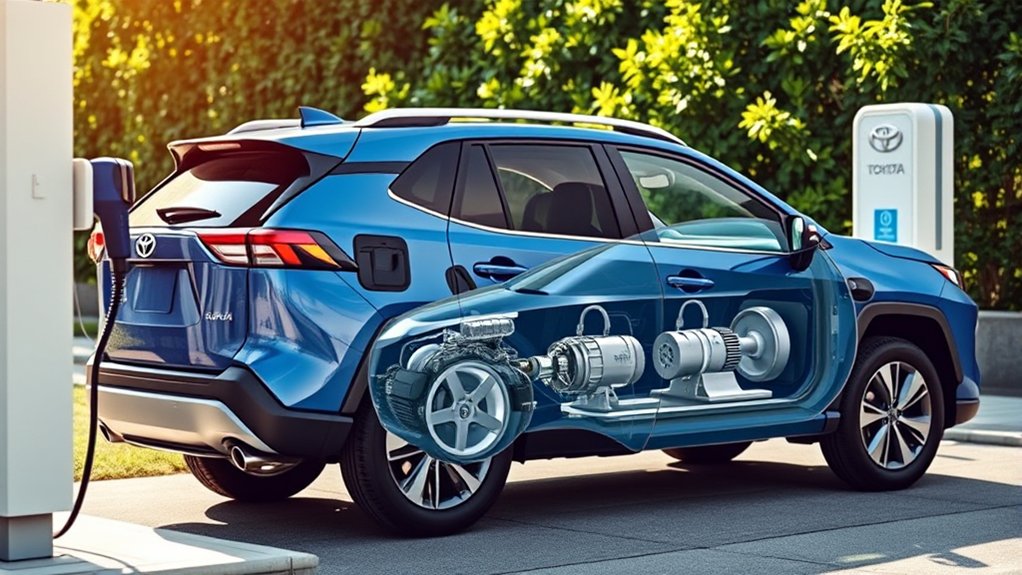
A plug-in hybrid electric vehicle, or PHEV, combines two energy sources:
- A rechargeable high-voltage battery that supplies electricity to the drive motor or motors
- A gasoline engine that can power the vehicle and work with the electric system
The larger battery separates a plug-in hybrid from a conventional hybrid. You can charge it from an external electricity source and use that stored energy for everyday driving. When the usable EV charge is depleted, the RAV4 continues operating as a conventional gasoline-electric hybrid.
The electric system also recovers some energy during deceleration through regenerative braking. Instead of wasting all of the vehicle’s motion as heat at the brakes, the system converts part of that energy into electricity and stores it in the traction battery.
Note: Toyota used the RAV4 Prime name in the United States for model years 2021–2024. For 2025, it changed the name to RAV4 Plug-in Hybrid. The two names refer to the same type of gasoline-electric plug-in SUV, although the vehicle was fully redesigned for 2026.
How Does the RAV4 Prime Use Gas?
The RAV4 Prime uses gasoline to run its internal-combustion engine. In hybrid operation, the vehicle automatically manages the engine, electric drive system, and battery to balance power and efficiency.
With sufficient charge, EV mode allows the vehicle to travel primarily on electricity. After the usable EV charge is depleted, the vehicle changes to hybrid operation. It does not stop or require an immediate visit to a charger.
The gasoline engine can also run before the EV-range display reaches zero. This may happen when you select a mode that allows automatic engine assistance, request strong acceleration, drive under demanding conditions, or when the system needs to manage temperature and component operation.
What Happens When the Electric Range Reaches Zero?
A zero-mile EV estimate does not mean the entire high-voltage battery is physically empty. The control system maintains a protected battery reserve so the vehicle can continue working as a hybrid and can accept energy from regenerative braking.
You can keep driving as long as gasoline remains in the tank. The main change is that the vehicle will rely more heavily on gasoline until you connect it to an external power source again.
Plugging in is optional for continuing your trip, but it is essential if you want to restore the vehicle’s full electric-driving range.
Charging the RAV4 Prime: What You Need to Know
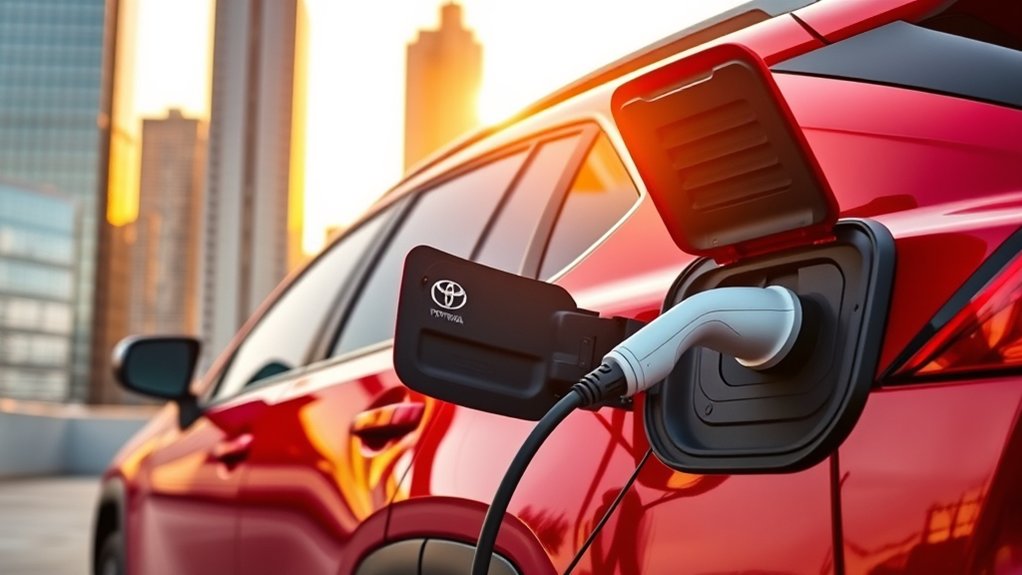
You can charge the RAV4 Prime or RAV4 Plug-in Hybrid at home or at a compatible public charging location. Charging hardware and maximum charging speed vary by model year and trim, so one charging-time figure does not apply to every vehicle.
Charging Options Available
The main charging choices are:
- Level 1 AC charging: Uses a suitable 120-volt household outlet. It is the slowest option but may be sufficient for overnight charging.
- Level 2 AC charging: Uses a 240-volt charging source. It is significantly faster and is the most practical home-charging choice for many owners.
- DC fast charging: Available only on selected 2026 trims. It is not available on previous-generation RAV4 Prime models.
For the previous generation, Toyota stated that the 6.6-kW onboard charger could recharge the battery in approximately 12 hours from a standard 120-volt outlet or about 2.5 hours at 240 volts and 32 amps under ideal conditions.
For 2026, Toyota lists different equipment by trim. The XSE and Woodland receive an 11-kW onboard AC charger and CCS1 port with DC fast-charging capability. Under ideal conditions, Toyota estimates approximately 30 minutes to charge from 10% to 80% on a compatible DC charger. The SE and GR SPORT use a 7-kW onboard charger and J1772 port, with Toyota estimating roughly four hours from 10% to 80% on Level 2 charging.
Warning: Do not rely on an extension cord, damaged outlet, loose receptacle, or improvised adapter for routine vehicle charging. Have a qualified electrician inspect or install home charging equipment when required, and follow the charging instructions for your exact model year.
Battery Lifespan Considerations
Normal Level 1 or Level 2 charging is part of the vehicle’s intended operation. You do not need to avoid charging simply to protect the battery. The vehicle manages charging limits and battery temperature to help protect the system.
For long-term care:
- Follow the charging and storage guidance in the owner’s manual.
- Avoid exposing charging connectors to damage, standing water, or contamination.
- Allow extra charging time during very hot or cold weather.
- Have warning messages or repeated charging interruptions inspected rather than repeatedly resetting the system.
Toyota states that hybrid batteries in applicable current vehicles are covered by a 10-year or 150,000-mile limited warranty, whichever comes first, subject to the warranty’s terms and exclusions.
Onboard Charger Functionality
The onboard charger converts alternating-current electricity from a Level 1 or Level 2 source into the direct-current electricity stored by the traction battery. The vehicle’s onboard charger—not merely the charging station’s advertised output—helps determine the maximum AC charging speed.
Regenerative braking can return some energy to the battery while you slow down, but it cannot recover all of the energy used to accelerate and move the vehicle. Likewise, using gasoline to generate electricity involves conversion losses. External charging is normally the most efficient way to restore plug-in electric range.
The Role of Electric Motors in the RAV4 Prime
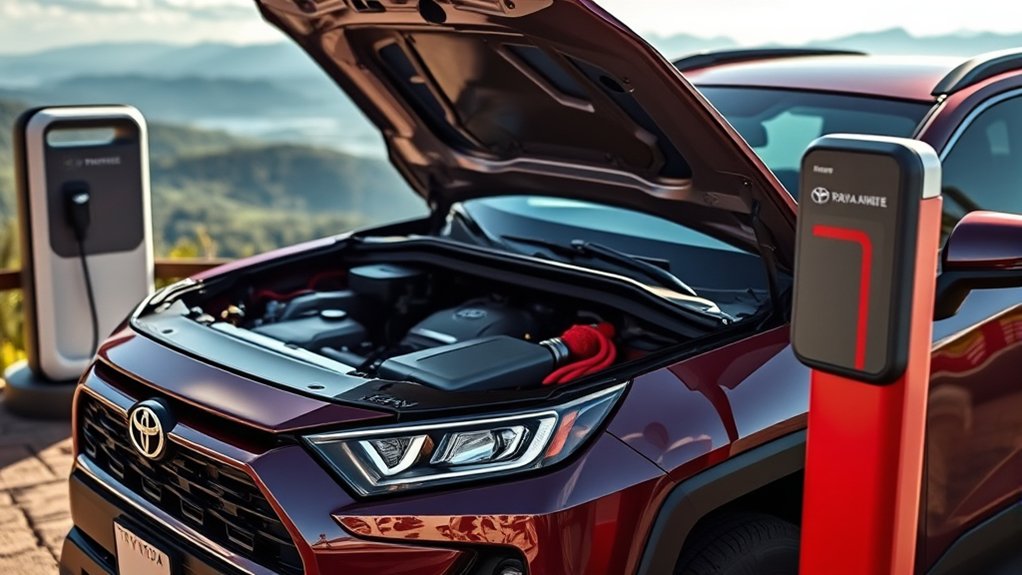
The electric components help move the vehicle, generate electricity, recover braking energy, start the gasoline engine, and provide all-wheel-drive capability. The exact layout and output differ between generations.
Electric Motor Functionality
Rather than focusing on a single motor count, it is more useful to understand the main functions:
- Electric propulsion: A drive motor supplies immediate torque to move the vehicle in EV and hybrid operation.
- Power generation: A motor-generator can produce electricity and help coordinate engine operation.
- Rear-wheel assistance: A dedicated rear electric motor provides Electronic On-Demand All-Wheel Drive without a conventional mechanical driveshaft connecting the engine to the rear axle.
- Regenerative braking: The electric system recovers some energy while the vehicle slows.
The redesigned 2026 system uses a 2.5-liter four-cylinder gasoline engine, front motor-generators, and a dedicated rear electric motor for its standard all-wheel-drive system.
Performance Enhancements Provided
Electric motors can deliver torque immediately, which helps the RAV4 accelerate quickly without waiting for engine speed to rise. The gasoline engine can then contribute power during harder acceleration or sustained higher-load driving.
Power output depends on model year:
- 2021–2025 RAV4 Prime/RAV4 Plug-in Hybrid: 302 net combined horsepower
- 2026 RAV4 Plug-in Hybrid: 324 net combined horsepower
Toyota lists a 0–60-mph estimate of 5.5 seconds for the 2025 model and 5.4 seconds for the 2026 model. These manufacturer estimates should be treated as performance comparisons rather than guaranteed acceleration times in every condition.
RAV4 Prime Driving Modes: All-Electric vs. Hybrid
Driving-mode names and availability can vary by year, but the main powertrain modes generally serve the following purposes:
- EV mode: Prioritizes battery-electric operation while sufficient usable charge remains and operating conditions permit it.
- AUTO EV/HV mode: Uses electric operation but can start the gasoline engine when the system determines that engine assistance is appropriate.
- HV mode: Operates the vehicle as a gasoline-electric hybrid and can be selected to preserve EV charge for later.
- Charge mode on applicable previous-generation models: Uses the gasoline engine to increase battery charge while driving. Because this consumes gasoline and involves energy-conversion losses, it is not normally the most economical replacement for plugging in.
Some drivers preserve battery charge during sustained highway travel and use EV mode later in slower urban traffic. Whether that strategy saves energy depends on the route, temperature, speed, and charging access.
Pro Tip: For most daily driving, charge at home, begin in EV mode, accelerate smoothly, and let the vehicle manage the transition to hybrid operation. Manually generating battery charge with gasoline is usually less efficient than charging from the grid.
Battery Capacity and Electric Range
The previous-generation RAV4 Prime uses an 18.1-kWh lithium-ion battery pack. Its EPA-rated electric range is 42 miles. The redesigned 2026 model has a new plug-in hybrid system, and Toyota’s current U.S. product page lists an EPA-estimated 54-mile electric range for the SE grade.
Electric range is not the same as gasoline MPG or MPGe:
- Electric range estimates how far the vehicle can travel using its plug-in charge.
- MPG measures gasoline fuel economy after the vehicle is operating on gasoline.
- MPGe converts electricity consumption into a gasoline-energy equivalent so electrified vehicles can be compared using a common unit.
| Model year | U.S. name | Electric range | System power |
|---|---|---|---|
| 2021–2024 | RAV4 Prime | 42 miles EPA-estimated | 302 net combined hp |
| 2025 | RAV4 Plug-in Hybrid | 42 miles EPA-estimated | 302 net combined hp |
| 2026 | RAV4 Plug-in Hybrid | Up to 54 miles EPA-estimated on SE; other grades vary | 324 net combined hp |
Your actual electric range may be lower or higher than the estimate. Temperature, highway speed, rapid acceleration, elevation changes, tire pressure, cargo, climate-control use, and wheel or tire configuration can all affect energy consumption.
Top Reasons to Choose the RAV4 Prime Over Other Plug-In Hybrids
The RAV4 Prime and RAV4 Plug-in Hybrid combine meaningful electric range with gasoline backup, standard all-wheel drive, and useful passenger and cargo space. That combination can suit drivers who want electric commuting without relying entirely on charging during long trips.
Useful All-Electric Range
The previous generation’s 42-mile EPA estimate can cover many daily commutes when the vehicle begins with a full charge. The 2026 SE increases the EPA-estimated figure to 54 miles, giving owners more opportunity to complete routine trips without gasoline-engine operation.
Electric range should still be compared with your actual round-trip mileage and charging access. A PHEV provides its greatest gasoline savings when it is charged regularly rather than driven primarily as a gasoline hybrid.
Electronic All-Wheel Drive
The RAV4 plug-in hybrid uses a dedicated rear electric motor to assist the rear wheels. The system can adjust front and rear propulsion based on acceleration, traction, and driving conditions.
All-wheel drive can improve traction, but it does not shorten stopping distances on slippery surfaces. Appropriate tires, safe speed, and sufficient following distance remain essential.
Versatile Charging Options
Previous-generation vehicles support Level 1 and Level 2 AC charging. The 2026 lineup continues to support home AC charging, while selected trims add DC fast-charging capability.
This flexibility lets you charge slowly from a suitable home outlet, install faster Level 2 equipment, or use compatible public charging where available. Public charger speed may still be limited by the vehicle, battery temperature, charger condition, and current battery level.
What Makes the RAV4 Prime Unique in Its Class?
The main appeal is not that the vehicle avoids gasoline entirely. It is that you can use electricity for shorter trips while retaining the fast refueling and long-distance flexibility of a gasoline vehicle.
| Feature | 2021–2025 generation | 2026 generation |
|---|---|---|
| Gasoline engine | Yes | Yes |
| External charging | Level 1 and Level 2 AC | Level 1 and Level 2 AC; DC fast charging on selected trims |
| Maximum listed EV range | 42 miles | 54 miles on SE |
| Net combined horsepower | 302 hp | 324 hp |
| All-wheel drive | Standard | Standard |
The tradeoff is complexity: the vehicle carries an engine, fuel system, electric drive components, charging hardware, and a larger battery. Buyers should compare purchase price, charging access, expected daily mileage, insurance, and local energy costs rather than choosing solely from an MPGe figure.
Tips for Maximizing Efficiency With the RAV4 Prime
- Charge regularly: A plug-in hybrid saves the most gasoline when its larger battery is actually charged.
- Accelerate smoothly: Rapid acceleration increases energy demand and may cause the engine to assist in modes that permit it.
- Use regenerative braking naturally: Look ahead and slow gradually when traffic allows instead of accelerating toward a stop.
- Control cabin-energy use: Heavy heating, cooling, or defrosting can reduce electric range.
- Maintain tire pressure: Underinflated tires increase rolling resistance.
- Combine short trips: Consolidating errands can reduce repeated warm-up and climate-control loads.
- Use HV mode strategically: Preserving EV charge may make sense when you know you will need it later, but there is no universal route strategy that works best for every trip.
- Track electricity and gasoline separately: MPG alone can look unusually high when electric miles are included. Include charging energy when calculating your actual operating cost.
For previous-generation models, the EPA lists 94 MPGe in combined electric-and-gas operation and 38 MPG when operating on gasoline after the plug-in charge is depleted. For 2026, Toyota lists trim-specific combined ratings ranging from 36–40 MPG and 86–101 MPGe.
Charging Time for the RAV4 Prime: What to Expect
Charging time depends on the model year, trim, charging voltage, available current, battery temperature, starting charge, and whether the estimate measures a full charge or only 10% to 80%.
| Vehicle | Charging source | Toyota estimate under ideal conditions |
|---|---|---|
| Previous-generation RAV4 Prime | 120-volt Level 1 | Approximately 12 hours for a full charge |
| Previous-generation RAV4 Prime | 240 volts at 32 amps | Approximately 2.5 hours for a full charge |
| 2026 SE and GR SPORT | Level 2 AC | Approximately four hours from 10% to 80% |
| 2026 XSE and Woodland | Compatible DC fast charger | Approximately 30 minutes from 10% to 80% |
Charging normally slows as the battery approaches a high state of charge, especially during DC charging. A 10%–80% estimate therefore cannot be directly compared with a full 0%–100% estimate.
Related Guides
Frequently Asked Questions
What is the fuel economy of the RAV4 Prime?
For the previous generation, the EPA lists 94 MPGe in combined electricity-and-gas operation and 38 MPG after the plug-in charge is depleted and the vehicle is operating on gasoline. The redesigned 2026 model has trim-specific ratings: Toyota lists 40 MPG/101 MPGe for the SE, 40 MPG/96 MPGe for the XSE, 37 MPG/94 MPGe for the Woodland, and 36 MPG/86 MPGe for the GR SPORT.
How far can the RAV4 Prime travel on electric power alone?
The 2021–2025 generation is EPA-estimated for up to 42 electric miles. Toyota lists an EPA-estimated 54-mile electric range for the 2026 SE. Actual range varies with speed, temperature, terrain, climate-control use, tires, and driving style.
Can the RAV4 Prime run on gas without charging?
Yes. When usable plug-in charge is unavailable, it operates as a gasoline-electric hybrid. You can continue driving and refuel it like a conventional gasoline vehicle, although failing to plug it in means you will not receive the full gasoline-saving benefit of its larger battery.
What type of gasoline does the RAV4 Prime require?
The RAV4 Prime is designed to use regular unleaded gasoline. Confirm the required fuel on the vehicle’s fuel-door label and in the owner’s manual for your exact model year, especially when operating outside the United States.
Can the gasoline engine start when the battery is charged?
Yes. In a mode that permits automatic hybrid assistance, the engine may start when you request strong acceleration or when operating conditions require it. EV mode prioritizes electric driving, but engine operation can still depend on the mode, system temperature, available charge, and other conditions described in the owner’s manual.
Does a zero-mile EV display mean the battery is completely dead?
No. It means the usable plug-in portion is depleted. The system retains a protected reserve for hybrid operation, component protection, and regenerative braking. The vehicle can continue driving as long as it has gasoline.
Are tax incentives available for purchasing a RAV4 Plug-in Hybrid?
As of July 2026, federal new, previously owned, and commercial clean-vehicle credits are not available for vehicles acquired after September 30, 2025. State, local, utility, charging-equipment, or dealer programs may still be available and can change, so verify current eligibility through official government and utility sources before purchasing.
Conclusion
The Toyota RAV4 Prime does use gasoline, but it gives you control over how often that gasoline is needed. Charge it regularly and many everyday trips can be completed primarily on electricity. When the usable EV charge runs out—or when the selected mode or driving conditions call for engine assistance—the vehicle continues as a gasoline-electric hybrid.
For used or earlier models, remember the familiar 42-mile, 302-horsepower specifications. When shopping for a new vehicle, look for the RAV4 Plug-in Hybrid name and check the exact 2026 trim because electric range, efficiency, charging hardware, and DC charging capability now vary across the lineup.
Sources
- Toyota: 2026 RAV4 Plug-in Hybrid — current horsepower, EPA-estimated range, MPG, MPGe, trims, and capability.
- Toyota USA Newsroom: 2026 RAV4 details — powertrain layout, onboard chargers, charging ports, and estimated charging times.
- Toyota USA Newsroom: 2025 RAV4 Plug-in Hybrid naming change — RAV4 Prime rename, 42-mile range, 302 horsepower, hybrid MPG, and warranty information.
- FuelEconomy.gov: 2025 Toyota RAV4 PHEV AWD — official EPA vehicle efficiency information.
- U.S. Department of Energy Alternative Fuels Data Center — how plug-in hybrid vehicles use batteries, gasoline engines, external charging, and regenerative braking.
- Internal Revenue Service: Form 8936 instructions — current federal clean-vehicle credit cutoff and eligibility rules.

