
When the gas light comes on in your Toyota RAV4, treat it as a prompt to find the nearest practical fuel station. Toyota does not publish one guaranteed number of miles for every RAV4 because the warning threshold, fuel economy, road slope, model year, and powertrain can all affect how far the vehicle will travel.
Quick Answer
A Toyota RAV4 may still have several dozen miles of potential range when the gas light appears, but no fixed distance is guaranteed. Older manuals list about 2.4 gallons at the warning point for some models, while newer powertrains differ. Refuel at the nearest safe opportunity instead of testing the limit.
Key Takeaways
- The RAV4 low-fuel light is a refueling warning, not a guaranteed reserve-mileage indicator.
- Warning thresholds and restart procedures vary by model year, market, and powertrain.
- Speed, traffic, hills, temperature, vehicle load, and recent fuel economy can shorten the remaining range.
- Repeatedly running the tank almost dry may increase wear on some in-tank fuel pumps, but one warning-light event does not automatically cause damage.
- Refuel promptly, and use your exact RAV4 owner’s manual as the final authority.
Understanding the Low Fuel Light in a Toyota RAV4
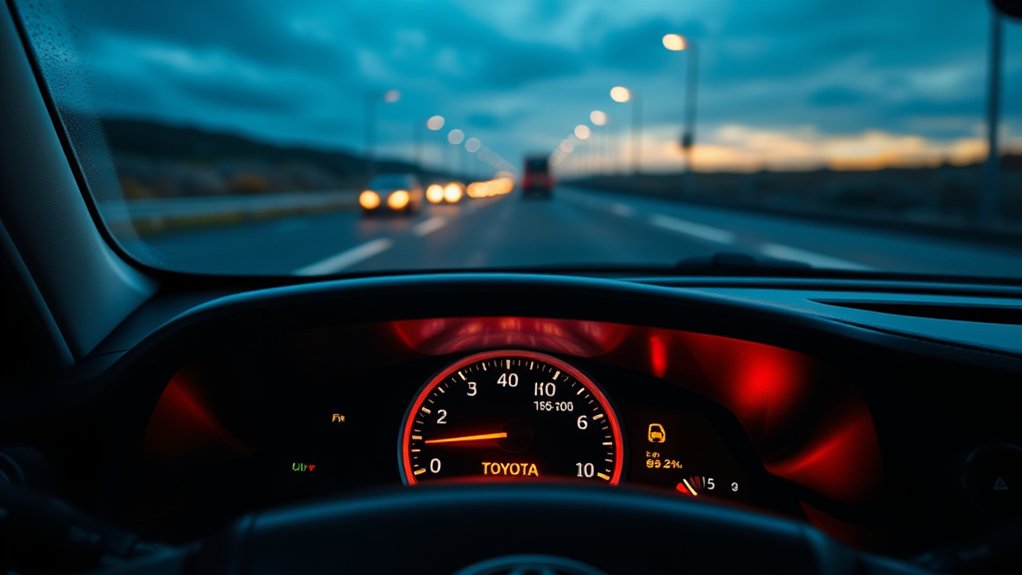
The low-fuel light means the quantity in the tank has fallen below the warning threshold programmed for your RAV4. Toyota’s general warning-light guidance tells drivers to refuel when this indicator appears.
The light does not mean the vehicle has switched to a separate reserve tank. It also does not promise that every remaining drop is usable under every condition. Parking or driving on a slope can move fuel within the tank and change when the warning appears.
Note: Use the owner’s manual for your exact model year and powertrain. A figure published for an older gasoline RAV4 should not be assumed to apply to a newer Hybrid or Plug-in Hybrid.
How Much Fuel Is Left When the RAV4 Gas Light Comes On?
The amount varies. Toyota has published different figures and instructions across RAV4 generations, so the commonly repeated 2.4-gallon number is not universal.
| RAV4 example | Published information | What it means |
|---|---|---|
| 2011 RAV4 | The 2011 Toyota RAV4 owner’s manual lists approximately 2.4 gallons or less when the warning activates. | This supports the figure for that generation, not every RAV4. |
| 2025 RAV4 Hybrid | After fuel depletion, the 2025 Toyota RAV4 Hybrid owner’s manual uses about 2.3 gallons as the standard amount needed for the warning to go out on level ground. | A small splash of fuel may not be enough to restart or clear the warning after running out. |
Newer models also require more powertrain-specific guidance. Toyota announced that the 2026 U.S. RAV4 lineup consists of Hybrid and Plug-in Hybrid models, so advice based only on older gasoline versions is no longer complete.
The low-fuel light is a request to refuel, not a promise of a specific number of remaining miles.
Estimating Your Drivable Miles After the Fuel Light Activates
You may see estimates of 35 to 40 miles after the RAV4 gas light comes on, and some vehicles may travel farther. However, Toyota does not guarantee that range. A shorter distance is possible if the warning appears during steep climbs, cold weather, congestion, towing, heavy loading, or inefficient driving.
Your distance-to-empty display is also an estimate based partly on recent operation. On some RAV4s, it may stop showing a numerical distance and display “Refuel” when the system can no longer calculate a dependable value. The 2021 RAV4 digital manual specifically explains this behavior.
You can use recent average fuel economy to understand why two drivers may get different results, but you should not calculate a theoretical maximum and attempt to use every mile. The exact warning threshold, usable fuel, road angle, and driving conditions remain uncertain.
Warning: Do not continue driving simply to test how far your RAV4 can go after the light appears. Running out in an intersection, active traffic lane, extreme weather, or an isolated area can create a much greater risk than an inconvenient fuel stop.
Key Factors Impacting Your Fuel Reserve Range
The distance available after the warning depends on more than the quantity shown by the gauge. The following conditions can reduce your effective range:
- Hard acceleration and braking: Frequent speed changes consume more fuel than smooth operation.
- High speed: Aerodynamic resistance increases as speed rises.
- Stop-and-go traffic: Idling and repeated acceleration use fuel without adding much distance.
- Hills and road grade: Climbing requires more energy, while a slope can also affect the fuel-level reading.
- Vehicle load: Passengers, cargo, roof boxes, and trailers increase the energy needed to move the vehicle.
- Cold or severe weather: Temperature, wind, precipitation, heating, and defrost use can reduce efficiency.
- Mechanical condition: Low tire pressure, overdue maintenance, or a running problem can reduce fuel economy.
The U.S. Department of Energy’s gas-saving guidance confirms that driving behavior, speed, load, idling, vehicle condition, and environmental conditions can all change fuel economy.
The Risks of Driving on Low Fuel

The most immediate risk is becoming stranded or losing engine power in an unsafe location. Repeatedly operating with almost no fuel may also increase stress on some fuel-system components.
Fuel Pump Damage Risks
Many modern vehicles use an electric fuel pump inside the tank. Fuel can help cool and lubricate the pump, so repeatedly running the tank extremely low or completely dry may increase heat and wear. AAA discusses this concern in its low-fuel guidance.
That does not mean the pump is damaged every time the warning light appears. The safer conclusion is that regularly running out of fuel creates unnecessary risk and should not become a normal habit.
Safety Concerns While Driving
If the fuel supply becomes too low, the engine may hesitate, lose power, or stop. Use the following responses instead of trying to stretch the remaining fuel:
| Situation | Safer response |
|---|---|
| The engine begins sputtering or losing power | Signal, leave the traffic lane when safe, turn on the hazard lights, and call roadside assistance. |
| You are on a highway or in a remote area | Use navigation or roadside assistance before the vehicle begins losing power. |
| Emergency fuel must be transported | Use an approved closed container, secure it upright, drive directly to the vehicle, and remove the container immediately afterward. |
Warning: Do not keep a gasoline container permanently in your trunk or passenger compartment. The U.S. Consumer Product Safety Commission advises using an appropriate container, keeping it closed and upright, and removing it from the vehicle immediately after transport.
Costly Repairs Ahead
Running out of fuel can lead to towing or roadside-service costs. Repeated fuel starvation may also add avoidable wear to the fuel pump. Those risks are more defensible than claiming that low fuel routinely pulls sediment into injectors or automatically causes an expensive repair.
In a Hybrid or Plug-in Hybrid, adding only a tiny amount after the gasoline supply is exhausted may not be enough for the vehicle to restart. Follow the refueling quantity and restart steps in your exact owner’s manual.
What Should You Do When the Fuel Light Activates?
Take these steps when the warning appears:
- Find the nearest practical station. Choose a safe nearby stop rather than driving farther for a preferred brand or lower price.
- Check the route. Consider traffic, hills, construction, weather, and the distance to the next station.
- Drive smoothly. Avoid hard acceleration, unnecessary idling, and rapid speed changes, but do not drive abnormally slowly or create a traffic hazard.
- Reduce avoidable demand. Remove unnecessary roof cargo when practical and avoid extra detours.
- Respond early to power loss. If the engine hesitates or sputters, move out of traffic while you still have control and call for help.
If Your RAV4 Runs Out of Fuel
Turn on the hazard lights, move as far from traffic as safely possible, and use roadside assistance. Do not stand beside the vehicle in an exposed traffic lane. If you must leave the vehicle because of fire, smoke, or another immediate danger, move to a protected location away from traffic.
If a RAV4 Hybrid or Plug-in Hybrid Runs Out of Gas
Do not assume a small emergency splash will be enough. Toyota’s 2025 RAV4 Hybrid manual says approximately 2.3 gallons is the standard quantity needed after fuel depletion for the low-fuel warning to go out when the vehicle is on level ground. Your model may differ, so follow its manual before attempting repeated restarts.
A Plug-in Hybrid may still have electrical energy available in some circumstances, but you should not use that possibility as a reason to ignore the gasoline warning. Operating modes, battery charge, temperature, and system protections affect what the vehicle can do.
How to Manage Your Fuel Efficiently
Refueling near one-quarter tank is a conservative habit, not a universal Toyota requirement. It can still be useful when you drive in remote areas, severe weather, heavy traffic, or places where stations are widely spaced.
You can manage fuel more reliably by checking the gauge before each long trip, using the trip odometer, monitoring your real-world average fuel economy, keeping the tires at the door-placard pressure, and avoiding unnecessary cargo or idling.
Pro Tip: Reset one trip meter after each fill-up. Comparing miles driven with gallons added will show your RAV4’s real fuel economy and help you plan stops without relying entirely on the distance-to-empty display.
When the Fuel Gauge or Warning Light Seems Wrong
Some movement in the gauge or estimated range is normal after parking on a slope, changing driving conditions, or refueling. Have the system inspected if you notice any of the following:
- The gauge does not rise after adding a substantial amount of fuel and restarting the vehicle.
- The warning remains on after adequate refueling on level ground.
- The gauge repeatedly jumps between widely different readings while driving on level roads.
- The low-fuel light never illuminates, even when the gauge is near empty.
- The displayed range changes dramatically without a matching change in driving conditions.
A Toyota dealer or qualified repair facility can check the fuel-level sender, wiring, instrument display, diagnostic trouble codes, and applicable service information for your model.
Related Guides
Frequently Asked Questions
How many miles can a Toyota RAV4 drive after the gas light comes on?
No fixed mileage is guaranteed. Some drivers may see several dozen miles, but model year, powertrain, fuel economy, slope, traffic, load, and weather can shorten the range. Use the light as a signal to visit the nearest safe station.
Can I rely on the reserve range for a long trip?
No. The warning threshold and distance-to-empty display are estimates, not emergency trip-planning tools. Refuel before entering a remote area, severe weather, heavy congestion, or a route with long gaps between stations.
How accurate is the fuel gauge in a RAV4?
The gauge is designed to help you monitor fuel, but it is not a laboratory measurement. Road slope, fuel movement, recent driving, and display logic can affect the reading. Repeated abnormal behavior should be inspected.
Why does the display say zero miles or “Refuel” when fuel may remain?
The system may stop calculating a numerical range when the remaining distance is too uncertain. Zero or “Refuel” does not prove the tank is completely dry, but it does mean you should stop relying on the estimate and refuel immediately.
What happens if I run out of gas?
The engine can lose power and stop. Move out of traffic while you still have control, turn on the hazard lights, and call roadside assistance. A Hybrid may require more than a small amount of gasoline before it will restart.
Does the low-fuel amount change between RAV4 models?
Yes. The threshold and refueling instructions can differ by model year, market, tank design, and gasoline, Hybrid, or Plug-in Hybrid powertrain. Check the warning-light section of your exact owner’s manual.
Will driving on low fuel damage my RAV4?
One low-fuel warning does not mean damage has occurred. Repeatedly running almost empty or completely dry may increase heat and wear on an in-tank fuel pump and can leave you stranded, so refueling promptly is the safer habit.
Conclusion
Your Toyota RAV4 may continue driving after the gas light comes on, but the remaining distance is not fixed or guaranteed. Model year, powertrain, road slope, recent fuel economy, traffic, weather, and vehicle load all affect the result. Use the warning as Toyota intends: find a safe nearby station, refuel promptly, and follow the specifications in your exact owner’s manual.
Sources
- Toyota 2011 RAV4 Owner’s Manual — supports the approximately 2.4-gallon warning example for that model year.
- Toyota 2025 RAV4 Hybrid Owner’s Manual — supports hybrid fuel-depletion and refueling guidance.
- Toyota 2021 RAV4 Digital Manual — explains the “Refuel” display and limits of the remaining-distance calculation.
- U.S. Department of Energy Gas-Saving Tips — supports the effects of driving behavior, speed, idling, load, and operating conditions.
- AAA Low-Fuel Guidance — supports cautious fuel-pump cooling and wear guidance.
- U.S. Consumer Product Safety Commission Fuel Container Guidance — supports safe gasoline-container transport and storage practices.
