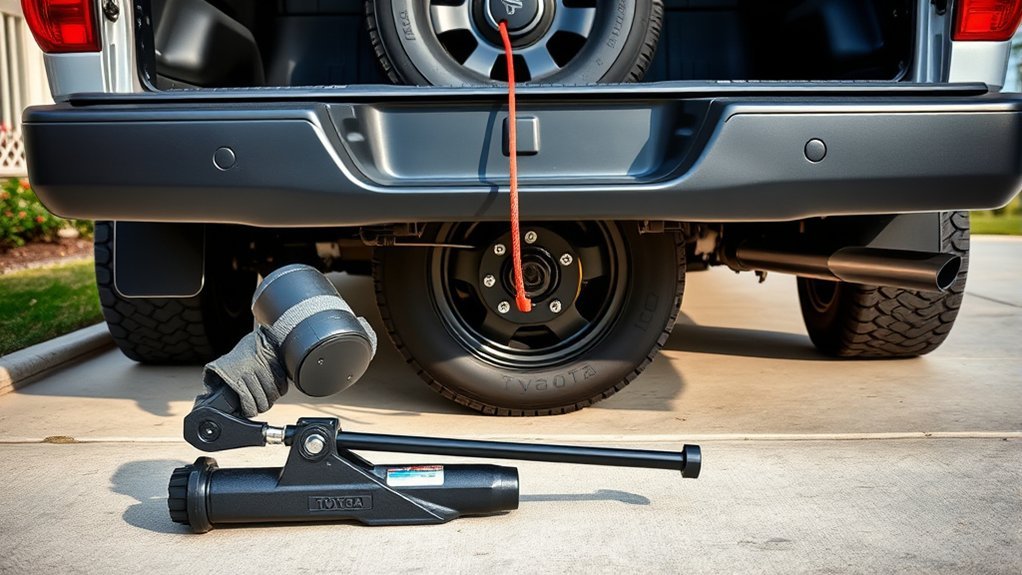
Lowering the spare tire on a Toyota Tundra is straightforward once you find the factory tools and the rear spare-tire access point. The key is to work safely: park on level ground, set the parking brake, chock the wheels, lower the spare fully, inspect it, and use the correct jack point before removing the flat tire.
Quick Answer
To lower a Toyota Tundra spare tire, assemble the factory jack-handle rods, insert the hooked end through the rear bumper access hole above or near the license plate, and turn the tool counterclockwise. Keep turning until the spare rests on the ground, then slide the retainer through the wheel center.
Key Takeaways
- Use the factory jack-handle rods and lug wrench from your Tundra tool kit.
- Park on a firm, level surface, set the parking brake, and chock the opposite wheels before you start.
- Turn the spare-tire hoist tool counterclockwise until the spare sits flat on the ground with cable slack.
- Check the spare tire’s pressure, tread, age, cracks, and sidewall condition before installing it.
- Use your model-year Toyota owner’s manual or wheel manufacturer’s instructions for the correct lug-nut torque.
At a Glance
| Time Required | 10–20 minutes if the spare hoist, tire, and factory tools are in good condition |
| Difficulty | Beginner to moderate |
| Tools Needed | Factory jack, jack-handle rods, lug wrench or tire iron, wheel chocks, gloves, flashlight, tire pressure gauge, and torque wrench |
| Cost | $0 if your spare and factory tools are ready; more if you need a replacement tool kit, tire repair, or roadside service |
Warning: Never crawl under a Tundra supported only by the factory jack. Use the jack only at the approved lift point shown in your model-year owner’s manual, and call roadside assistance if the truck is on a slope, soft ground, or a dangerous shoulder.
Gather Your Toyota Tundra Spare Tire Tools
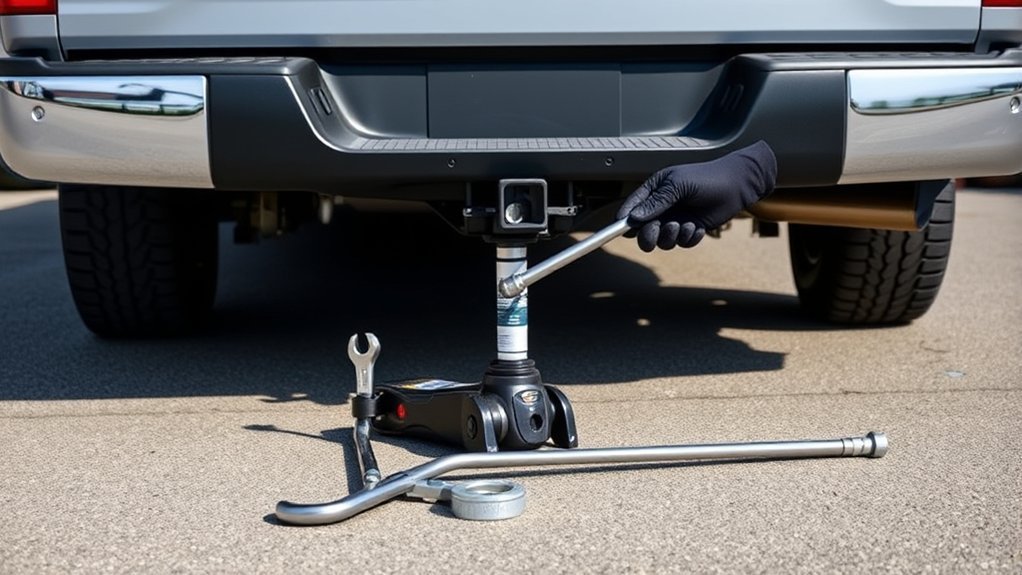
Before you can change the tire, find the factory jack and tool bag. On many Toyota Tundra models, these tools are stored under or behind the rear seat, but the exact location can vary by cab style and model year. If you do not see them right away, use the Toyota owner’s manual page to find the manual for your exact Tundra.
Your kit should include the jack, a lug wrench or tire iron, and several handle rods. One rod usually has a hooked end that reaches the spare-tire hoist, and another rod locks into it with a ball or spring-style connection. Put the rods together until they form one long handle.
Slide the tire iron or lug wrench through the end of the assembled rods. This gives you enough leverage to turn the spare-tire hoist from the rear bumper area.
- Factory jack
- Jack-handle rods or extension poles
- Lug wrench or tire iron
- Wheel chocks or sturdy tire blocks
- Gloves and flashlight
- Tire pressure gauge
- Torque wrench for final lug-nut tightening
Note: If your Tundra has aftermarket wheels, locking lug nuts, a lift kit, or a non-original spare, confirm that your factory tool kit still fits before you need it in an emergency.
[Amazon Products Picked for You]
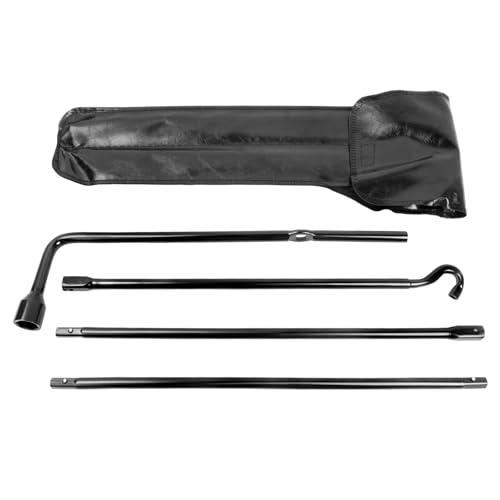
Durable strong rustproof automotive grade steel, tubing instead of soil designed

【Applicable Models】:Compatible with 2007-2021 Tundra, 2008-2021 Sequoia
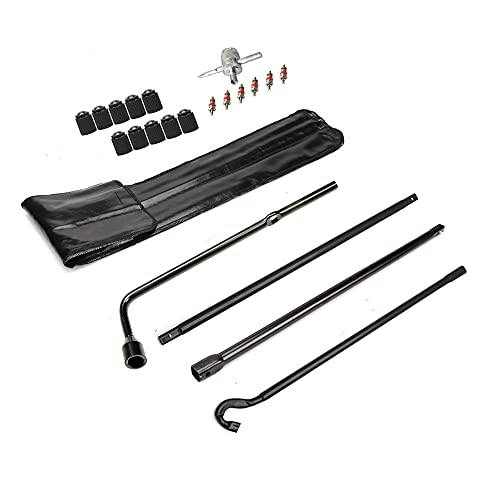
Premium OEM Upgraded Quality Spare Tire Tool: Stable strong rustproof automotive grade steel,tubing instead of soil designed made it more light,not only stong but also convenient.
Set Up the Truck Before Lowering the Spare
Park on a firm, level surface away from traffic. Turn on the hazard lights, shift to Park, set the parking brake, and keep passengers out of the truck while you work.
Place wheel chocks on the tires opposite the flat tire. If a front tire is flat, chock the rear wheels. If a rear tire is flat, chock the front wheels. This helps keep the truck from rolling while you lower the spare and use the jack.
Look under the rear bed before lowering the spare. Check for heavy rust, mud, debris, or a bent hoist cable. If the cable looks damaged or the spare appears jammed against the frame, do not force the tool hard enough to twist or break the hoist.
Lower the Spare Tire from Under the Bed
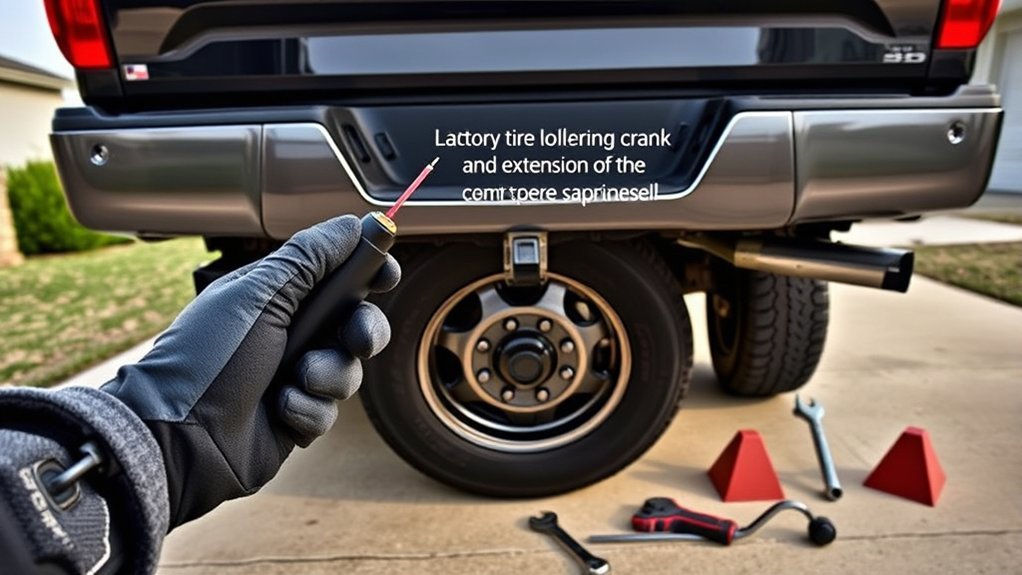
The Toyota Tundra spare tire is held under the rear bed by a cable hoist. The access hole is usually in the rear bumper area above or near the license plate. You will use the assembled handle rod to reach the hoist socket.
- Assemble the jack-handle rods into one long tool.
- Insert the hooked end through the rear spare-tire access hole above or near the license plate.
- Feel for the hoist socket and make sure the tool seats fully.
- Attach the lug wrench or tire iron to the outer end of the rod for leverage.
- Turn the tool counterclockwise to lower the spare tire.
- Keep turning until the tire rests flat on the ground and the cable has slack.
- Slide the retainer plate sideways through the center hole of the wheel.
- Pull the spare out from under the truck.
Pro Tip: Lower the spare all the way until the cable goes slack. If you stop too early, the retainer plate can bind against the wheel center and make the spare feel stuck.
[Amazon Products Picked for You]

Wrench Size:The Socket Size is 21mm,pls kindly confirm if the size is the same before order.

Wrench Size:The Socket Size is 21mm,pls kindly confirm if the size is the same before order.

Comes as a 4 piece set, for changing your spare tire
Inspect the Spare Before Installing It
Do not install the spare just because it came down from the hoist. Under-bed spares collect dirt, water, and road salt, and they can lose air while sitting unused.
The National Highway Traffic Safety Administration recommends checking the pressure of all tires, including the spare, at least once a month when the tires are cold. NHTSA also notes that tires age over time and that spare tires are prone to aging because they seldom get replaced.
- Check the spare tire pressure with a gauge.
- Use the pressure listed on your tire placard or owner’s manual, not the maximum pressure molded on the tire sidewall.
- Look for cracks, cuts, bulges, exposed cords, or sidewall damage.
- Check the tread. NHTSA says tires should be replaced when tread reaches 2/32 inch.
- Check the DOT Tire Identification Number if you need to estimate tire age.
- Search for tire or vehicle recalls through the NHTSA recalls page if you suspect a safety issue.
NHTSA reported 511 motor vehicle traffic fatalities in tire-related crashes in 2024, so tire pressure, tread, and spare-tire condition are worth checking before you drive.
Remove Your Flat Tire Safely
Removing a flat tire requires careful attention to safety and technique. First, loosen the lug nuts by turning them counterclockwise while the tire is still on the ground. Do not remove them completely yet. This keeps the wheel from spinning while you break the nuts loose.
Next, place the factory jack at the approved lift point shown in your model-year Toyota owner’s manual. Raise the truck only until the flat tire clears the ground. Keep your hands, feet, and body out from under the truck while it is lifted.
| Step | Action | Safety Note |
|---|---|---|
| 1. Break lug nuts loose | Turn counterclockwise while the tire is still on the ground | Do not remove the nuts yet |
| 2. Position the jack | Use the correct Toyota lift point for your model year | Do not guess or lift from thin body panels |
| 3. Raise the truck | Lift until the flat tire clears the ground | Stay out from under the vehicle |
| 4. Remove the flat tire | Remove the lug nuts fully, then pull the wheel straight off | Place lug nuts where they cannot roll away |
Install the Spare Tire for a Secure Fit
With the flat tire removed, lift the spare onto the wheel studs and push it flush against the hub. Start each lug nut by hand to avoid cross-threading. The tapered side of the lug nut should seat into the wheel unless your aftermarket wheels use a different lug-nut style.
Snug the lug nuts in a star pattern while the truck is still lifted. Do not fully tighten one nut before the others. Even tightening helps the wheel sit flat against the hub.
- Place the spare wheel on the studs.
- Install every lug nut by hand.
- Snug the nuts in a star pattern.
- Lower the truck until the tire touches the ground and cannot spin.
- Use a torque wrench and the correct model-year Toyota specification for final tightening.
- Lower the truck fully and remove the jack.
Warning: Do not rely on a generic online torque number for final tightening. Use the specification in your Toyota owner’s manual or the wheel manufacturer’s instructions, especially if your Tundra has aftermarket wheels.
Raise and Store the Flat Tire Under the Bed
After the spare is installed, store the flat tire so it does not slide around in the bed or cab. If the flat tire fits the under-bed spare location, place it under the rear of the truck with the valve stem positioned as shown in your owner’s manual.
Slide the hoist retainer through the wheel center and make sure it sits flat against the wheel. Turn the spare-tire tool clockwise to raise the tire. Keep turning until the tire is snug against the underside of the bed and does not swing or rattle.
Do not overtighten the hoist. Once the wheel is secure, remove the tool from the rear access hole and store the jack, rods, lug wrench, wheel chocks, and lock key back in the truck.
Perform Final Checks After Changing Your Tire
Before driving, walk around the truck and check your work. Confirm that every lug nut is installed, the jack is removed, the flat tire is secured, and no tools are left near the wheels or under the truck.
- Confirm the spare tire is inflated enough for safe temporary use.
- Check that the wheel sits flush against the hub.
- Verify that the lug nuts were tightened in a star pattern.
- Recheck final torque with a torque wrench as soon as possible.
- Drive slowly at first and listen for vibration, clunking, or rubbing.
- Repair or replace the damaged tire promptly.
If your Tundra uses a temporary spare, follow the speed and distance limits printed on the spare tire and listed in your owner’s manual. Even with a full-size spare, avoid towing, heavy loads, or high-speed driving until you confirm the spare matches your normal tire size, load rating, and condition.
Troubleshooting: Spare Tire Won’t Lower
If the spare tire will not lower, do not force the tool until something breaks. Under-bed spare systems can bind because of rust, packed dirt, a twisted cable, or a stuck retainer plate.
- The tool spins but the spare does not move: The rod may not be seated in the hoist socket. Pull it out, realign it, and try again.
- The tire lowers a little, then stops: Lower it until the cable slackens, then push up slightly on the tire to free the retainer.
- The hoist feels frozen: Check for mud, corrosion, or a bent cable. Do not use extreme force.
- The spare is flat or cracked: Do not install it for normal driving. Call roadside assistance or use a safe tire-repair option.
- The jack or lug wrench is missing: Do not improvise with unsafe tools. Use roadside service or get the correct replacement tool kit.
Note: Practice lowering and raising the spare at home once a year. That quick check helps you find a seized hoist, missing tool, or low spare before you are stuck on the roadside.
[Amazon Products Picked for You]
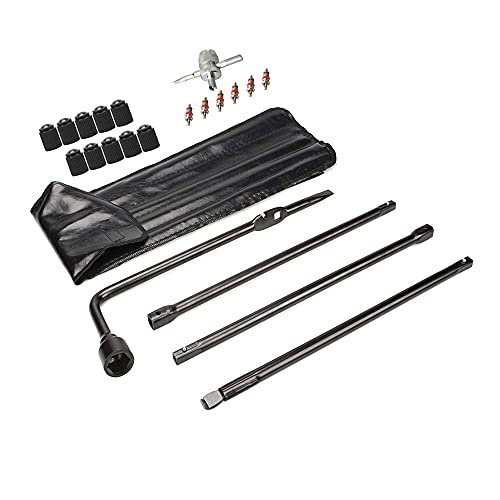
Premium OEM Upgraded Quality Spare Tire Tool: Stable strong rustproof automotive grade steel,tubing instead of soil designed made it more light,not only stong but also convenient.

Material: Heavy Duty Powder Coated Steel with Convenient Carrying Case

Material: Heavy Duty 45# Carbon Steel Heat Treatment with Convenient Carrying Case
Related Guides
Frequently Asked Questions
How do you get a Toyota Tundra spare tire down?
Assemble the factory jack-handle rods, insert the rod through the rear spare-tire access hole above or near the license plate, seat it in the hoist socket, and turn counterclockwise. Keep turning until the spare rests on the ground and the cable has enough slack to remove the retainer plate from the wheel center.
Where are the Toyota Tundra spare tire tools?
On many Tundra models, the jack and spare-tire tools are stored under or behind the rear seat. The exact storage spot can vary by cab style, trim, and model year, so check your owner’s manual if you do not see the jack, rods, and lug wrench right away.
How do you remove the spare tire on a 2017 Toyota Tundra?
For a 2017 Tundra, locate the factory tools, assemble the handle rods, insert the tool through the rear bumper access hole, and turn counterclockwise to lower the under-bed spare. Once the tire is on the ground, turn a little more for slack and slide the retainer plate through the wheel center.
What should I do if my Tundra spare tire will not lower?
First, make sure the tool is fully seated in the hoist socket. If it still will not lower, check for rust, a twisted cable, packed dirt, or a stuck retainer plate. Do not use extreme force. If the hoist is seized or the cable looks damaged, call roadside assistance or a repair shop.
Can I drive normally on a Toyota Tundra spare tire?
Not always. If your spare is temporary, follow the speed and distance limits printed on the tire and in your owner’s manual. If it is a full-size spare, still check pressure, age, tread, and load rating before driving normally, towing, or carrying heavy cargo.
Do I need a torque wrench after changing a Tundra tire?
Yes. The factory lug wrench can help you in an emergency, but final tightening should be done with a torque wrench using the correct specification for your model year and wheel type. Recheck the lug nuts after a short drive or at the next safe service stop.
Conclusion
Lowering a Toyota Tundra spare tire comes down to three steps: use the correct factory tool, turn the rear hoist counterclockwise until the tire reaches the ground, and keep the truck stable while you work. The spare is only useful if it is inflated, undamaged, and secured correctly after the tire change.
Before your next trip, take a few minutes to find your jack tools, lower the spare, check its pressure, and raise it back into place. That simple practice run can save time, stress, and risk when a flat tire happens away from home.
Sources
- Toyota Manuals and Warranties — model-year manual access for jack, spare tire, and torque guidance.
- NHTSA TireWise — tire pressure, tread depth, tire aging, and spare tire maintenance guidance.
- NHTSA Recalls — recall lookup for vehicles, tires, and equipment.