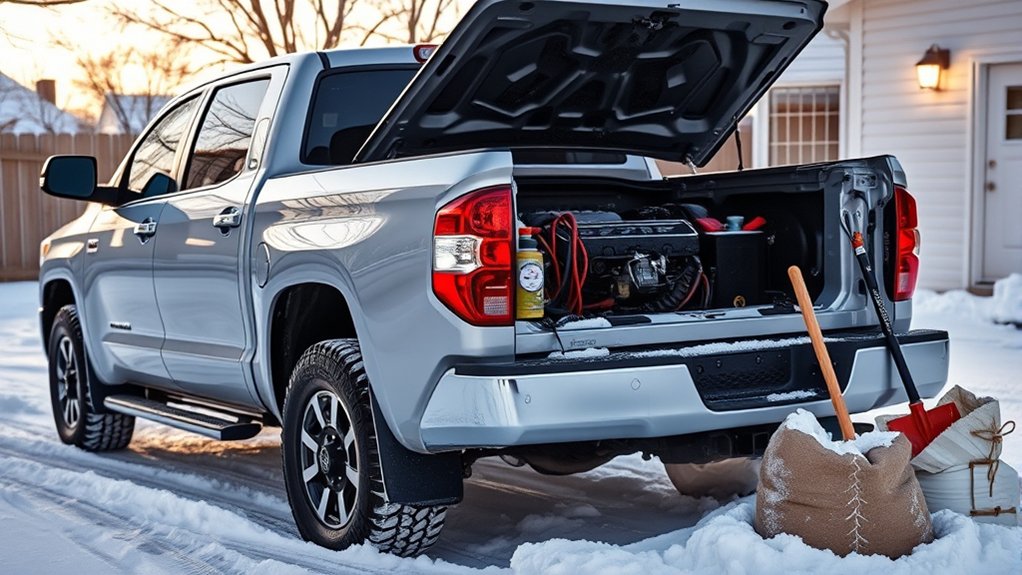
To winterize your Toyota Tundra, start with the items that affect cold-weather safety most: the battery, tires, coolant, washer fluid, brakes, wipers, lights, and emergency supplies. Use the tire pressure and fluid specifications for your exact model year instead of a generic number, and check your Toyota owner’s manual before changing oil, coolant, tires, or chains.
Quick Answer
Winterize a Toyota Tundra by testing the battery, setting all tires to the cold pressure on the vehicle placard, checking winter tire condition, verifying coolant and washer-fluid freeze protection, inspecting brakes and wipers, removing snow and ice before driving, protecting exposed bodywork from road salt, and carrying a winter emergency kit.
Key Takeaways
- Use the driver-door Tire and Loading Information label for cold tire pressure. Do not use a generic PSI range or the maximum PSI printed on the tire sidewall.
- Use the engine oil, coolant, tire, wheel, and chain specifications for your exact Tundra model year.
- Winter tires can improve cold-weather grip, but they do not eliminate the need to slow down, leave extra stopping distance, and use smooth steering and braking inputs.
- Check the battery before severe cold because low temperatures reduce available battery power.
- Carry warm clothing, a flashlight, phone charger, shovel, traction material, water, food, first-aid supplies, and properly rated recovery equipment.
At a Glance
| Time Required | About 45–90 minutes for basic checks; longer if tires, battery service, rust protection, or repairs are needed. |
| Difficulty | Easy for inspections and fluid top-offs; professional service is appropriate for battery faults, brake problems, tire installation, coolant service, or corrosion repair. |
| Tools Needed | Accurate tire-pressure gauge, flashlight, gloves, soft battery-terminal brush if appropriate, windshield scraper, basic cleaning supplies, and your Tundra owner’s manual. |
| Cost | Little or nothing if the truck is already maintained and you own the supplies; substantially more if it needs a battery, winter tires, brake work, undercoating, or other repairs. |
Note: Toyota Tundra specifications vary by model year, trim, tire size, drivetrain, and equipment. Use your exact Toyota owner’s manual and the labels on your truck whenever a specification in a general guide differs from vehicle-specific information.
Check the Battery and Electrical System Before Cold Weather
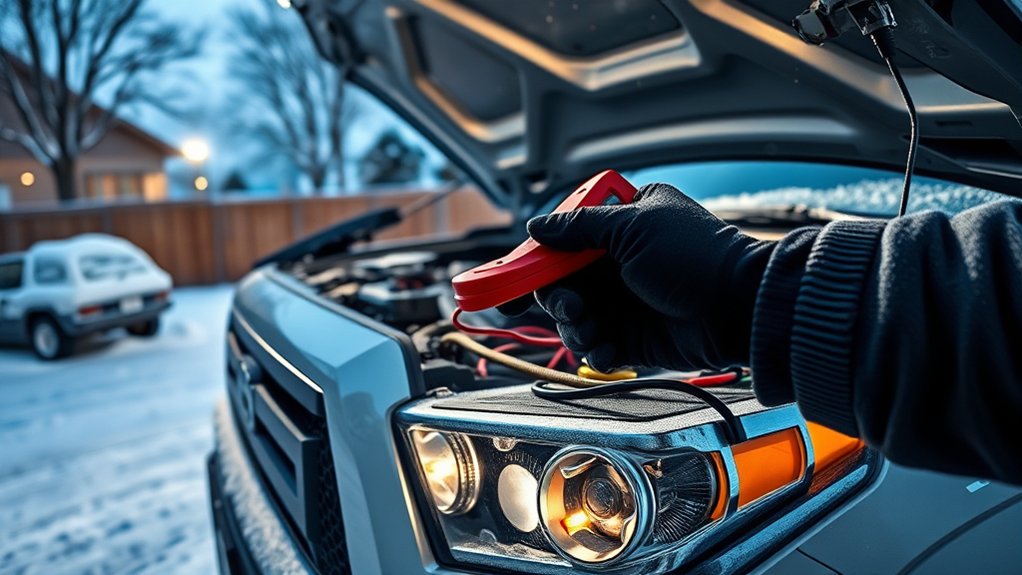
When winter hits, your battery and electrical system become especially important. Cold temperatures reduce a conventional 12-volt battery’s available output while the engine may require more power to start. If the battery is weak before winter, a cold morning may expose the problem.
Inspect the battery case and cables for obvious damage, loose connections, or corrosion. If you see heavy corrosion, repeated slow cranking, dim lights, or other electrical symptoms, have the battery and charging system tested rather than relying on voltage alone. Toyota’s winter-driving guidance also recommends having battery condition checked before severe winter use.
Warning: Battery terminals can short if a metal tool bridges the positive terminal to ground. Wear eye protection, keep sparks and flames away from the battery, and follow the service procedure for your exact Tundra. If you are not comfortable working around a vehicle battery, have it serviced professionally.
Tightening loose battery connections and correcting damaged cables can help prevent unexpected starting problems. A compatible smart battery maintainer may also help a truck that sits unused for long periods, but use only equipment suitable for the battery type and follow both the charger and vehicle instructions.
Tire Safety: Pressure, Tread, Winter Tires, and Chains
Tires are one of the most important parts of winter preparation because acceleration, steering, and braking all depend on the grip available at the road surface. Follow these checks before cold weather arrives:
- Check pressure when the tires are cold: Use the recommended cold pressure on your Tundra’s driver-door Tire and Loading Information label or exact owner’s manual. The National Highway Traffic Safety Administration advises checking cold tire pressure regularly and warns against using the maximum pressure molded into the tire sidewall as the vehicle’s recommended setting.
- Inspect tread and damage: Check all four tires for cuts, cracking, bulges, punctures, uneven wear, and low tread. NHTSA states that tires should have at least 2/32 inch of tread, but winter performance can deteriorate well before a tire reaches the minimum.
- Check the spare: Verify that the spare tire, jack, wheel tools, and any locking-wheel-key equipment are present and usable.
- Consider winter tires: In regular snow, slush, ice, and sustained cold, a properly matched set of winter tires can provide better cold-weather traction than tires not designed for those conditions.
- Verify chain compatibility: Do not assume every wheel-and-tire package accepts chains. Check the owner’s manual for your exact model year, wheel size, chain type, axle location, clearance limits, and maximum chain speed before installation.
Pro Tip: Check tire pressure early in the morning before driving. Toyota and NHTSA define an accurate cold reading as a tire that has been sitting long enough to cool rather than one that has just been driven and warmed.
Your Tundra’s correct winter road pressure is the cold pressure specified for the vehicle—not a universal 36, 40, or 45 PSI number.
How to Keep Your Tundra’s Exterior Safe From Winter Damage
As winter approaches, protecting your Toyota Tundra’s exterior can reduce damage from road salt, brine, sand, moisture, and grime. Wash the truck regularly when conditions allow, paying extra attention to wheel wells, rocker areas, lower body seams, and the underbody where road treatment chemicals can collect.
Applying a suitable wax, sealant, or other paint protectant before winter can make contamination easier to remove. In regions that use large amounts of road salt, an appropriate corrosion-protection or undercoating treatment may also be useful. Follow the product instructions carefully and do not coat brake friction surfaces, exhaust components that should remain uncovered, sensors, drainage openings, or other areas the manufacturer says to avoid.
Inspect and clean your headlights and taillights frequently because slush and road film can reduce visibility. Check door seals, exterior trim, and exposed paint chips as well. Repairing damaged paint before salt exposure can reduce the chance of corrosion starting at bare metal.
Key Fluids to Check Before Winter Driving
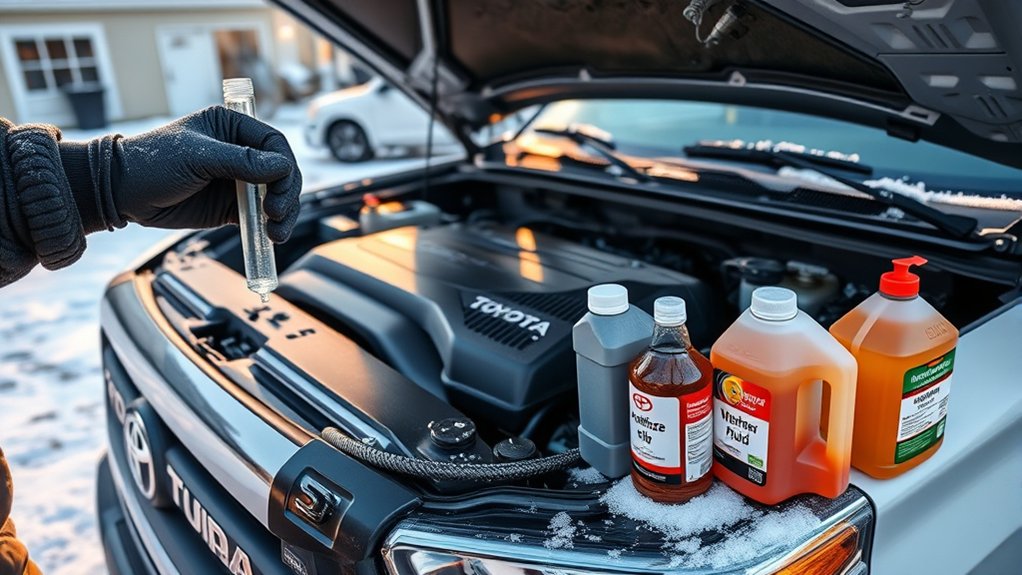
Before winter driving, check the key fluids in your Toyota Tundra. Do not substitute a fluid, coolant mixture, or oil viscosity simply because it is marketed for cold weather. Use the specification for your exact truck in the Toyota owner’s manual.
- Coolant: Check the level when the system is cool and verify that the coolant type and freeze protection are appropriate for the expected temperatures. Never open a hot cooling system.
- Engine Oil: Use the viscosity and performance specification Toyota lists for your model year and engine. A modern multigrade oil already has cold-temperature characteristics built into its viscosity rating, so do not automatically switch to a different “winter-grade” oil.
- Windshield Washer Fluid: Fill the reservoir with washer fluid rated for temperatures below the coldest conditions you expect. Plain water can freeze in the reservoir, hoses, or nozzles.
- Brake Fluid: Check the reservoir level and investigate unexplained fluid loss. Do not treat topping off as a substitute for diagnosing worn brake components or a leak.
Also inspect for visible leaks under the truck. Fluid loss that is unusual, recurring, or accompanied by a warning light should be diagnosed before a winter trip.
Check Wipers, Defrosters, Lights, and Snow-Clearing Equipment
Good visibility is as important as traction. Inspect the wiper blades for cracking, splitting, or streaking, and replace them if they cannot clear the windshield cleanly. Confirm that the front and rear defrost/defog functions, heater fan, washer nozzles, headlights, brake lights, turn signals, and hazard lights work properly.
Before driving after snowfall, clear snow and ice from the windshield, mirrors, windows, lights, roof, hood, and areas around the wheels. Remove packed snow that can interfere with steering, brakes, sensors, or airflow. Do not force a frozen wiper across the windshield; free it carefully first.
Adjust Your Driving for Snow and Ice
A well-prepared Tundra still cannot overcome the limits of tire grip. Accelerate gently, steer smoothly, leave substantially more following distance, and begin slowing earlier than you would on dry pavement. Avoid abrupt throttle changes, sharp steering, and hard braking whenever the road is slippery.
Four-wheel drive can improve the ability to move away from a stop or maintain forward progress, but it does not give the tires unlimited grip and does not cancel the longer stopping distances caused by snow and ice. Use the drivetrain and traction features only as described in the owner’s manual for your model year.
Warning: If authorities advise drivers to stay off the road during a winter storm, the safest winter-driving technique is not to make the trip. FEMA recommends avoiding winter-storm travel when possible.
Essential Emergency Supplies for Winter Driving
Having essential emergency supplies in your Toyota Tundra can make a major difference if you become stranded. FEMA’s vehicle emergency-preparedness guidance recommends keeping useful roadside and survival supplies in the vehicle.
Pack jumper cables or a suitable jump pack, a flashlight with spare batteries, a phone charger or power bank, an ice scraper and snow brush, a sturdy shovel, reflective warning equipment, a first-aid kit, warm clothing, gloves, blankets, bottled water, and non-perishable food. Traction material such as sand can also help in some situations.
A tow strap or recovery rope can be useful only when it is properly rated and attached to recovery points approved for the vehicle and recovery method. Never attach a recovery strap to a tow ball, suspension component, or an unidentified point under the truck. Recovery equipment can store enormous energy when loaded and can cause serious injury if it fails.
Keep winter washer fluid available if you routinely travel long distances in road spray. For severe-weather trips, also consider a tire inflator, tire repair equipment appropriate for your tires, basic hand tools, medication you may need, and a printed or offline route plan where cell coverage is unreliable.
Check Recalls and Service Campaigns
Before a long winter trip, check your Tundra’s VIN for unresolved safety recalls or service campaigns. Toyota provides an official Safety Recalls and Service Campaigns lookup. This is more useful than relying on a generic list of “good” or “bad” model years because recall status and repair history are vehicle-specific.
Related Guides
Frequently Asked Questions
Is a Toyota Tundra good in the snow?
A Toyota Tundra can be capable in snow when it has appropriate tires, correct tire pressure, adequate tread, and a driver who adjusts speed and following distance for conditions. Four-wheel-drive versions can improve propulsion, but 4WD does not shorten icy-road stopping distances by itself. Tire grip remains the key limitation.
What is the 7 7 rule for winter tires?
The commonly used 7-and-7 guideline refers to installing winter tires when temperatures remain around or below 7°C (45°F) for about seven consecutive days, then changing back after temperatures remain above that range. It is not a 7/32-inch tread-depth rule. NHTSA says tires should have at least 2/32 inch of tread, although deeper tread generally gives more margin in snow and slush.
How long should I let my Tundra run before driving in winter?
Follow the instructions for your exact model year. Modern gasoline vehicles generally do not need a long stationary warm-up. After starting, make sure the windshield and windows are clear enough for safe visibility, allow the engine to stabilize, and drive gently until the powertrain reaches normal operating temperature. Never run the engine for an extended period in an enclosed garage because carbon monoxide can accumulate.
What year Toyota Tundra should I avoid?
There is no single Tundra model year that every buyer should automatically avoid. For a used truck, check the VIN for recalls and service campaigns, review maintenance records, inspect the frame and body for corrosion, confirm that warning lights and four-wheel-drive systems work correctly, and obtain a pre-purchase inspection. The condition and history of the individual truck matter more than a blanket year list.
Should I lower my Toyota Tundra tire pressure for winter road driving?
Do not intentionally lower road pressure just to create more traction unless Toyota or the tire manufacturer specifically instructs you to do so for that application. For normal paved-road use, set the tires to the recommended cold pressure on the vehicle’s Tire and Loading Information label and recheck them as temperatures change.
Conclusion
A well-winterized Toyota Tundra starts with accurate, vehicle-specific preparation rather than generic winter numbers. Test the battery, use the correct cold tire pressure, inspect tire condition, verify fluids, keep the windshield and lights clear, protect the body from salt, check the brakes and wipers, and carry emergency supplies. Then match your speed and driving style to the road conditions. Those steps protect both the truck and the people riding in it.
Sources
- Toyota Owners — Manuals and Warranties — vehicle-specific fluid, tire, maintenance, and operating information.
- Toyota Owners — Safety Recalls and Service Campaigns — VIN-based recall and campaign information.
- NHTSA — Winter Weather Driving Tips — tire-pressure, tread, winter-tire, and winter-driving safety guidance.
- NHTSA TireWise — tire tread, pressure, inspection, and replacement guidance.
- FEMA Ready.gov — Car Safety and Emergency Supplies — emergency-kit and vehicle-preparedness guidance.