For the 2026 Toyota Tundra, rotate the tires every 5,000 miles or six months, whichever comes first. Toyota’s 2026 maintenance chart lists tire rotation at each 5,000-mile service point. The correct pattern still depends on the tire design, tire size, wheel setup, and model-year instructions. After rotation, set the correct cold pressures for the new axle positions and follow the TPMS initialization procedure required for your Tundra.
Last updated: September 11, 2026
Quick Answer
For the 2026 Toyota Tundra, rotate the tires every 5,000 miles or six months, whichever comes first. Other model years may have different instructions, so check the maintenance guide for your truck. Use a rotation pattern approved for your tire type and wheel setup, set the correct cold pressures after moving the tires, initialize the tire-pressure warning system as required by your model year, and tighten the wheel nuts to the exact specification for your truck and wheels.
Key Takeaways
- Toyota’s 2026 Tundra maintenance schedule places tire rotation at each 5,000-mile service, with scheduled maintenance due every six months if mileage is lower.
- Directional tires normally move front to rear on the same side; non-directional, same-size tires may use a crossing pattern when the vehicle and tire manufacturers permit it.
- There is no single wheel-nut torque specification for every Tundra. Model year, wheel type, and aftermarket hardware can change the required value.
- For the 2026 Tundra, Toyota requires tire-pressure warning system initialization after tire rotation.
- Rotation does not correct alignment, balance, damaged tires, or worn suspension parts.
- Check cold pressure, tread depth, tire condition, and service records at every rotation.
At a Glance
| Time Required | Varies with equipment and experience; allow enough time for safe lifting, inspection, pressure setting, and final torque |
| Difficulty | Moderate; safe lifting and correct torque are essential |
| Tools Needed | Wheel chocks, properly rated jack, jack stands, correct socket, breaker bar, calibrated torque wrench, tire-pressure gauge, and tread-depth gauge |
| Cost | DIY cost depends on the tools you already own; shop pricing varies, and eligible scheduled rotations may be covered by ToyotaCare within plan limits |
Why Should You Rotate Your Toyota Tundra Tires?
Tires do not carry identical loads or experience identical forces at every wheel position. Steering, braking, drive torque, payload, road crown, alignment settings, and turning habits can make one position wear faster than another.
Moving the tires to approved positions helps distribute that wear across the set. According to the National Highway Traffic Safety Administration’s TireWise guidance, rotation, correct inflation, balancing, and alignment can help tires last longer.
More uniform tread depth can also support predictable traction and handling. This is especially useful on a pickup that may alternate between unloaded driving, towing, heavy payloads, dirt roads, winter conditions, and highway travel.
Rotation does not physically adjust wheel alignment or repair suspension components. Instead, it provides an opportunity to compare tread depths and identify patterns that may point to incorrect pressure, imbalance, misalignment, worn shocks, damaged wheels, or loose steering and suspension parts.
Keep the date, mileage, tire positions, cold pressures, and tread-depth measurements with your maintenance records. Those details make it easier to identify developing wear and may also help document compliance with the separate warranty supplied by your tire manufacturer.
How Often Should You Rotate Toyota Tundra Tires?
For the 2026 U.S.-market Toyota Tundra, Toyota schedules maintenance every 5,000 miles or six months, whichever comes first. The 2026 Tundra Warranty & Maintenance Guide lists tire rotation at every 5,000-mile service point shown in its maintenance chart. Owners of other model years should confirm the schedule in their own warranty and maintenance guide because requirements have changed across Tundra generations.
For a 2026 Tundra, rotate at 5,000 miles or six months—not only when uneven wear becomes visible.
Low-mileage owners should not wait indefinitely to reach 5,000 miles. Six months is the scheduled service point in Toyota’s 2026 guide. Drivers who tow, carry heavy loads, travel off-road, encounter potholes, or frequently drive on rough surfaces should inspect their tires more often even when the scheduled rotation interval does not change.
Rotate or inspect the tires sooner when you find a meaningful front-to-rear tread-depth difference, irregular wear, a pressure problem, or damage. However, do not use rotation to hide a mechanical problem. Correct the underlying cause first or at the same visit.
Note: ToyotaCare covers normal factory-scheduled maintenance for eligible new Toyota vehicles for 2 years or 25,000 miles, whichever comes first, and scheduled services can include tire rotation. Prepaid plans, tire-store packages, and dealer promotions have separate terms.
What Tire Rotation Pattern Should You Use on a Toyota Tundra?
The correct pattern depends on whether all four tires are the same size, whether the tread is directional, and whether the wheels or tires have position restrictions. Check the tire sidewall and your model-year manual before moving anything.
Decision Rule: Choose the pattern in this order: first follow the Toyota instructions for your model year; next obey directional, inside/outside, size, and tire-manufacturer restrictions; then follow any requirements for aftermarket wheels or lug hardware. Use a generic drivetrain-based rotation pattern only when those higher-priority instructions allow it.
| Tire or Wheel Setup | Typical Approach | Important Check |
|---|---|---|
| Same-size, non-directional tires | A crossing pattern may be permitted; a rearward-cross pattern is commonly recommended for suitable rear-wheel-drive and four-wheel-drive vehicles. | Use the pattern specified by Toyota or the tire manufacturer for the exact setup. |
| Directional tires | Move front to rear on the same side. | The direction arrow must point forward when the truck moves. |
| Different front and rear tire sizes | Front-to-rear rotation may not be possible. Side-to-side rotation may be possible only for suitable non-directional tires. | Confirm tire size, wheel width, offset, and directional markings. |
| Matching full-size spare | A five-tire rotation may be possible. | Include it only when size, construction, load rating, tread, wheel, and manufacturer guidance are compatible. |
| Aftermarket wheels or lug hardware | Follow the wheel and hardware manufacturer’s instructions. | Factory torque, nut style, and seating requirements may no longer apply. |
The Michelin tire-rotation guide confirms that directional tires normally remain on the same side and move front to rear. Crossing a directional tire would reverse its designed rolling direction unless the tire were professionally demounted, remounted, and balanced.
[Amazon Products Picked for You]

1.Accurate and Efficient: Different colors on the bar represents different scopes, the red range on bar: 0 - 3/ 32; Yellow range on bar: 3/ 32 - 6/ 32; Green range on bar: 6/ 32 - 32/ 32, allowing you easy and fast to read and calibrated

🚕 Widely Used: The jack can be suitable for cars, SUVs, large off-road trucks, mobile buses and vehicles with wheel bolts and nuts

🚗2023 UPDATED FOR WIDER COMPATIBILITY: Specifically designed to work with most GM vehicles 2006-2023 (Chevy / Buick / GMC / Opel /Cadillac and more) equipped with 315/433 MHz. Your vehicle deserves the best tire pressure sensor reset tool.(It is not suitable for heavy trucks with more than 4 tires or vehicles with an external TPMS system.)Tip:Based on factory and customer-tested models shown in A+, please refer to the car model list to confirm compatibility with the VXDAS TPMS tool.
How Do You Verify Tire Markings Before Choosing a Pattern?
Look for a direction arrow, the words “Rotation,” “Outside,” or “Inside,” and the full tire size on each sidewall. An asymmetric tire marked “Outside” is not automatically directional; it may still be crossed if the approved pattern keeps the outward side facing outward. A tire with a directional arrow must continue rolling in the indicated direction.
What Wheel-Nut Torque Should You Use?
Do not assume every Toyota Tundra uses 97 lb-ft. Toyota specifications have varied by model year and wheel type, and aftermarket wheels may require different nuts, seats, thread engagement, or torque.
Find the exact value in the owner’s manual for your model year and wheel configuration. Start each nut by hand to prevent cross-threading, tighten gradually in a crisscross pattern, and complete final tightening with a calibrated torque wrench. Do not rely solely on an impact wrench.
Warning: Incorrect wheel-nut torque can damage studs, nuts, wheels, or brake components and may allow a wheel to loosen. Do not apply oil, grease, or anti-seize to the threads unless the vehicle or wheel manufacturer specifically instructs you to do so.
How Do Directional and Non-Directional Tires Change the Pattern?
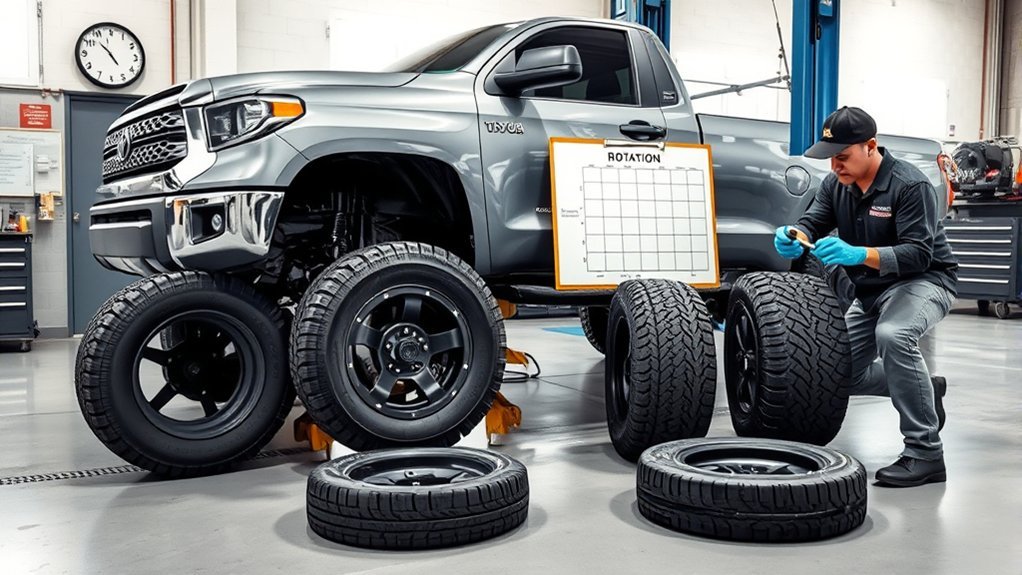
Directional tires use a tread designed to roll in one direction. They normally stay on the same side of the truck and move between the front and rear axles. Non-directional tires offer more pattern flexibility, but the vehicle manual, tire instructions, sizing, and wheel fitment still control the final choice.
| Tire Type | Rotation Flexibility | How to Identify It |
|---|---|---|
| Directional | Normally front to rear on the same side | A rotation arrow appears on the sidewall |
| Non-directional, symmetric | Several approved crossing or straight patterns may be available | No rolling-direction arrow or inside/outside marking |
| Asymmetric, non-directional | May usually be crossed when sizes match | Sidewall is marked “Outside” and “Inside” but has no direction arrow |
Some winter and performance tires are directional, while many highway and all-terrain tires are not. Do not assume the design from the brand or product family alone; inspect the exact tire mounted on your truck.
[Amazon Products Picked for You]

Aggressive Lateral Tread Design

Already a National Championship Winner!

All-new Ground up Design for Maximum Performance
How Do You Rotate Toyota Tundra Tires Safely?
A shop with a vehicle lift can complete this service quickly. DIY rotation is also possible when you have properly rated lifting equipment, know the approved lift and support points, and can verify the wheel-nut torque for your exact truck.
Warning: Never place any part of your body beneath a truck supported only by a jack. Work on a firm, level surface, chock the wheels, use the parking brake, and support the Tundra with properly rated jack stands at manufacturer-approved locations.
- Confirm the pattern. Check tire sizes, sidewall arrows, inside/outside markings, wheel fitment, and the model-year manual.
- Measure before moving the tires. Record each tire’s position, cold pressure, and tread depth across the inner, center, and outer grooves.
- Prepare the truck. Park on a solid, level surface, shift into Park, apply the parking brake, switch off the engine, and place wheel chocks securely.
- Loosen the wheel nuts slightly. Break them loose while the tires remain on the ground, but do not remove them yet.
- Lift and support the truck. Use the approved lift points and stands described in the owner’s manual. The jack and stands must be rated for the load they support.
- Inspect each assembly. Look for punctures, cracks, bulges, exposed cords, embedded objects, bent wheels, uneven wear, and damaged studs or nuts.
- Move the wheels to their approved positions. Keep directional arrows facing forward and maintain any front/rear fitment restrictions.
- Install and tighten correctly. Start the nuts by hand, snug them in a crisscross pattern, lower the truck as directed, and apply the exact final torque with a calibrated wrench.
- Set cold inflation pressure. Use the driver-door placard or owner’s manual, not the maximum pressure molded into the tire sidewall. Front and rear specifications may differ.
- Initialize TPMS and verify operation. Follow the model-year tire-pressure warning system procedure, confirm the displayed pressures or warning status as applicable, listen for unusual noise, and stop promptly if the truck develops vibration, pulling, or looseness.
Pro Tip: Mark each tire’s old and new position in your service record. Comparing the same three tread-depth points every 5,000 miles makes alignment, pressure, and suspension-related wear easier to spot.
[Amazon Products Picked for You]

Lightweight jack stands are used to support your vehicle after lifting with a jack; Wide pyramid foot base provides added strength and stable support

Pair of 3 Ton (2.7 metric Ton) jack stands with 6,000-pound capacity

【3 Ton Double Locking Jack Stands】:This Heavy Duty Vehicle Support has a 3-ton (6,600 lb) capacity per stand, with a lifting range of 11.22" (min) to 16.77" (max) and a net weight of 14.3 lbs. It fits most 3-ton automobiles but is not for large pick-ups, trucks, or oversized SUVs with a chassis height over 16".
What Should You Do With TPMS After a Tundra Tire Rotation?
For the 2026 Tundra, Toyota requires the tire-pressure warning system to be initialized after tire rotation. Set all tires to their specified cold pressures first, then use the procedure in the owner’s manual so the system can identify the wheel positions correctly. Exact controls and initialization steps can differ among Tundra model years, so do not apply a reset procedure from another generation. Use the Toyota Manuals and Warranties portal to select the manual for your exact truck.
Sensor replacement and seasonal wheel sets can involve additional ID-code registration or wheel-set procedures beyond a normal rotation. If individual wheel positions remain incorrect or the warning light indicates a malfunction after you follow the correct procedure, have the TPMS inspected rather than repeatedly resetting it.
When Do Tundra Tires Need Rotation or Further Inspection?
Visible differences in tread wear can show that rotation is due, but vibration, noise, pulling, pressure loss, or unusual wear may indicate a problem that rotation alone cannot fix. Use the tire condition—not just the odometer—to decide whether the truck also needs alignment, balancing, suspension, wheel, or tire diagnosis.
| What You Find | Is Rotation the Main Action? | Best Next Step |
|---|---|---|
| Normal front-to-rear tread difference with no damage or abnormal pattern | Usually, when the scheduled interval is due | Rotate using the approved pattern, set cold pressures, and record tread depth |
| One-shoulder wear, feathering, pulling, or an off-center steering wheel | No; rotation alone will not correct the cause | Check alignment and inspect steering, suspension, pressure, and tire condition |
| Cupping, speed-related vibration, thumping, or irregular tread | No; diagnosis is also needed | Inspect balance, tire construction, wheel condition, suspension, and wheel hardware |
| Bulge, exposed cord, major cut, damaged bead, or repeated/rapid pressure loss | No | Have the tire professionally evaluated for repair or replacement before relying on it |
What Does Uneven Tire Wear Mean?
Measure tread depth in the inner, center, and outer grooves of all four tires. A consistent front-to-rear difference may indicate normal position-related wear that rotation can help equalize.
Wear concentrated on one shoulder, feathered tread blocks, cupping, center wear, or wear on both shoulders needs diagnosis. Possible causes include misalignment, incorrect inflation pressure, worn suspension components, imbalance, damaged wheels, overloading, or repeated use on rough roads.
If one tire reads 9/32 inch and another reads 12/32 inch, the difference is worth recording and investigating, but those numbers alone do not prove that rotation is the only required service.
What Causes Vibration After or Before a Tire Rotation?
A mild vibration at a specific speed may come from wheel imbalance or irregular tread wear. It can also result from mud or ice packed inside a wheel, an impact-damaged rim, a separated tire belt, loose wheel hardware, or worn steering and suspension parts.
Warning: Stop driving as soon as it is safe when vibration begins suddenly, becomes severe, follows a pothole impact, or occurs with a bulge, pressure loss, thumping sound, steering change, or suspected loose wheel.
Rotating the tires may move or change a vibration, but it does not identify or correct the cause. Have the truck inspected when the symptom persists.
Why Can Tire Road Noise Increase?
A gradual increase in humming or droning can accompany cupping, heel-and-toe wear, or an aggressive tread pattern. It may also come from a wheel bearing or another vehicle component.
Compare tread texture and depth around the full circumference of every tire. When the wear is irregular, correct the cause before expecting rotation to reduce the noise. Severe cupping may remain audible even after the mechanical issue is repaired.
What Tire Damage Requires More Than Rotation?
Do not rotate a tire as a substitute for evaluating a puncture, crack, cut, bulge, exposed cord, damaged bead, or repeated pressure loss. These conditions may require professional repair or replacement.
Does Tire Rotation Improve Tundra Handling and Tire Life?
Regular rotation supports more consistent tread depth across the set. That consistency helps each tire respond more similarly during braking, steering, acceleration, and wet-weather driving.
Can Rotation Extend Tire Life?
Rotation can extend useful tire life by redistributing position-related wear, but it cannot guarantee a particular mileage. Tire compound, tread design, inflation, alignment, balance, payload, towing, road surface, temperature, driving style, and maintenance all affect longevity.
Uniform wear also makes it less likely that one tire will reach its replacement point while the others retain substantially more tread. That can simplify set replacement and help maintain balanced handling.
Can Rotation Improve Vehicle Handling?
Similar tread depths help produce more predictable front-to-rear grip. Unevenly worn tires can respond differently during rain, snow, emergency braking, or an abrupt lane change.
Rotation works together with correct cold pressure, sound suspension, proper alignment, and wheel balance. It does not replace any of those services.
Four-wheel drive does not eliminate the need for rotation. Keeping tire size, pressure, and tread depth reasonably consistent is particularly important when all four wheels participate in delivering drive torque.
What Tire Maintenance Should You Do Beyond Rotation?
Tire rotation is only one part of tire care. Regular pressure, tread, damage, alignment, and balance checks are necessary to maintain predictable handling and identify problems before they become severe.
| Maintenance Task | Recommended Timing | What to Check |
|---|---|---|
| Cold tire pressure | At least monthly and before towing, heavy loads, or long trips | Use the driver-door placard or owner’s manual, not the tire sidewall maximum |
| Tread and damage inspection | Monthly, before long trips, and after hard impacts or off-road use | Measure several grooves and inspect sidewalls, shoulders, beads, and the full circumference |
| Tire rotation | Every 5,000 miles or six months for the 2026 Tundra; verify other model years | Confirm model-year schedule, tire type, fitment, pressure, TPMS procedure, and exact wheel-nut torque |
| Wheel alignment | When wear is abnormal, the truck pulls, the steering wheel is off-center, or after a significant impact | Alignment angles and damaged or worn steering and suspension parts |
| Wheel balancing | When vibration appears, after tire installation or repair, or when weights are missing | Balance, wheel runout, tire uniformity, and impact damage |
| Tire replacement | At the applicable legal or manufacturer limit, or sooner when damaged or unsuitable for conditions | NHTSA says tires should be replaced when tread reaches 2/32 inch; state or local legal requirements may differ, and wet or winter performance can decline sooner |
NHTSA’s tire-safety guidance advises checking pressure, tread, and damage regularly and replacing tires when tread reaches 2/32 inch. The U.S. Tire Manufacturers Association also recommends checking tire pressure at least monthly and following the vehicle manufacturer’s rotation interval.
Check pressure while the tires are cold. The pressure molded into the tire sidewall is a tire limit, not the normal pressure recommendation for your Tundra. Use the specification on the vehicle placard and adjust it when a tire moves to an axle with a different specified pressure.
Frequently Asked Questions
How often should I rotate my Toyota Tundra tires?
For the 2026 Tundra, use 5,000 miles or six months, whichever comes first. Confirm the exact schedule in the warranty and maintenance guide for other model years and follow any more specific tire-manufacturer warranty requirement.
Does Toyota recommend tire rotation every 5,000 miles?
Yes for the 2026 Tundra. Toyota’s 2026 maintenance chart lists rotation at every 5,000-mile service point shown, and scheduled maintenance is due every six months when the truck has not yet traveled 5,000 miles.
How often should tires be rotated on a 4×4 Tundra?
For a 2026 4×4 Tundra, the scheduled interval remains 5,000 miles or six months. Four-wheel drive does not eliminate the need for rotation; use the pattern approved for your exact tire and wheel setup.
Is rotating Tundra tires every 10,000 miles enough?
Not for a 2026 Tundra under Toyota’s normal schedule. A 10,000-mile interval skips every other rotation shown in the 5,000-mile maintenance chart. Follow the maintenance guide for your exact model year if it specifies a different interval.
What rotation pattern should I use on a Toyota Tundra?
Use the pattern in your model-year manual and tire instructions. Same-size, non-directional tires may permit a crossing pattern. Directional tires normally move front to rear on the same side, while staggered or otherwise restricted fitments may have limited rotation options.
What is the Toyota Tundra lug-nut torque?
There is no safe universal answer for every Tundra. Specifications vary by model year, wheel type, and aftermarket hardware. Use the exact value and tightening instructions in the owner’s manual or wheel-manufacturer documentation.
Do I need to initialize the TPMS after rotating Tundra tires?
For the 2026 Tundra, yes. Toyota instructs owners to initialize the tire-pressure warning system after rotation so the system can determine the wheel positions correctly. Set the tires to the specified cold pressures first and use the exact initialization procedure for your model year.
Can I include the full-size spare in the rotation?
Only when the spare matches the road tires in size, construction, load rating, compatible wheel, and intended use, and the vehicle and tire manufacturers permit a five-tire pattern. Temporary, differently sized, or restricted-use spares should not enter the normal rotation.
Does tire rotation fix alignment problems or vibration?
No. Rotation can redistribute normal position-related wear and may change where a vibration is felt, but it does not correct misalignment, wheel imbalance, tire damage, bent wheels, loose hardware, or worn steering and suspension parts. Diagnose the underlying cause when abnormal wear, pulling, or vibration persists.
Conclusion
For a 2026 Toyota Tundra, plan a tire rotation every 5,000 miles or six months. Match the pattern to the tire design and wheel setup, use properly rated lifting equipment, set the correct cold pressures after moving the tires, initialize the tire-pressure warning system as Toyota specifies, and tighten the wheel nuts to the exact specification for your truck.
Rotation helps control position-related wear, but it cannot repair misalignment, imbalance, tire damage, or worn suspension components. Treat abnormal wear, sudden vibration, pressure loss, and visible damage as inspection signals rather than problems that rotation will automatically solve.
Sources
- Toyota 2026 Tundra Warranty & Maintenance Guide — scheduled-maintenance timing, tire-rotation intervals, and maintenance requirements
- Toyota Manuals and Warranties — model-year owner’s manuals and vehicle-specific operating procedures
- Toyota Tire Rotation Guide — owner-manual and tire-manufacturer guidance
- NHTSA TireWise — pressure, tread, rotation, balance, alignment, and tire-life guidance
- NHTSA Summer Driving and Tire Safety Tips — pressure, damage, and tread-depth inspections
- Michelin Tire Rotation Guide — directional, RWD, 4WD, and staggered-fitment rotation considerations
- U.S. Tire Manufacturers Association Tire Care Essentials — monthly pressure checks, tread wear, alignment, and rotation guidance
