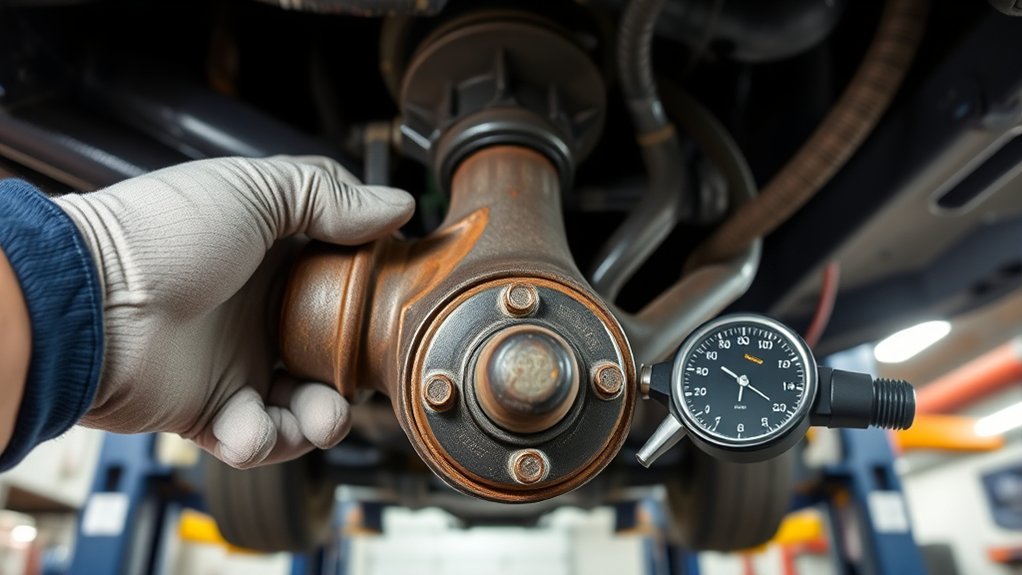
Common Toyota Tundra ball joint symptoms include clunking over bumps, loose or wandering steering, irregular front-tire wear, steering that binds, vibration, and a torn or leaking joint boot. None of these signs confirms a failed ball joint by itself because wheel bearings, tie-rod ends, bushings, tires, and other suspension parts can create similar symptoms. A model-specific inspection should confirm excessive looseness, binding, damage, or contamination before replacement.
Last updated: September 19, 2026. This update adds the affected Tundra model-year range for Safety Recall 70B, clarifies VIN recall lookup limitations, and improves symptom-triage guidance.
Quick Answer
Replace a Toyota Tundra ball joint when a model-specific inspection finds excessive looseness, binding, physical damage, or contamination that makes the joint unsafe. There is no single replacement mileage for every Tundra. Certain 2004 through late-2006 Tundras were also included in Toyota Safety Recall/Special Service Campaign 70B for the front lower ball joints, so recall eligibility should be checked by VIN. Severe steering changes, a visibly displaced wheel, grinding, or suspected joint separation call for towing rather than continued driving.
Key Takeaways
- Clunking, loose steering, and uneven tire wear can indicate ball-joint wear, but they can also come from other steering, suspension, wheel, or tire faults.
- Do not rely on a universal 90,000- or 100,000-mile replacement interval; use the maintenance and inspection information for your exact Tundra year and configuration.
- Toyota Safety Recall/Special Service Campaign 70B covered certain 2004 through late-2006 Tundras for the front lower ball joints; eligibility and completion remain VIN-specific.
- A visual inspection is useful for finding boot or hardware damage, but a technician must isolate the joint and measure movement using the correct procedure.
- After replacement, verify all retaining hardware, inspect the rest of the front suspension, and check wheel alignment.
At a Glance
| Clunking or Loose Steering | Arrange a prompt front-suspension inspection. These symptoms can come from a ball joint, but tie rods, bushings, sway-bar links, wheel bearings, tires, and other parts can produce similar signs. |
| Torn or Leaking Boot | Inspect the joint for contamination, corrosion, rough movement, and looseness. Boot damage alone does not reveal how much internal wear is present. |
| Wheel Displaced or Steering Changes Suddenly | Stop driving and arrange towing. A visibly shifted wheel, major grinding, violent shaking, or sudden steering change can indicate a serious suspension failure. |
| 2004–Late-2006 Tundra | Check the VIN with Toyota and NHTSA for Safety Recall/Special Service Campaign 70B. The campaign covered certain trucks in this model-year range, not every Tundra automatically. |
What Ball Joints Do in a Toyota Tundra
Ball joints form movable connections between the steering knuckle and the front suspension control arms. They allow the front wheels to steer while moving up and down with the suspension. Depending on the Tundra generation and suspension design, the upper and lower joints may use different mounting methods, loads, inspection procedures, and replacement parts.
Why Upper and Lower Ball Joints Are Not Interchangeable
The upper and lower joints do not necessarily carry the same loads, use the same mounting design, or follow the same inspection limits. Toyota Safety Recall/Special Service Campaign 70B concerned the front lower ball joints on certain 2004 through late-2006 Tundras; it was not a blanket recall of every upper and lower joint on every Tundra model year. Use the procedure and specification for the exact joint being inspected.
This variation is why a procedure or specification for one Tundra year should not automatically be applied to another. Use the manuals for your exact vehicle through the Toyota Manuals and Warranties portal. Repair professionals can obtain model-specific procedures, fastener requirements, and specifications through the Toyota Technical Information System.
Common Symptoms of Worn Toyota Tundra Ball Joints
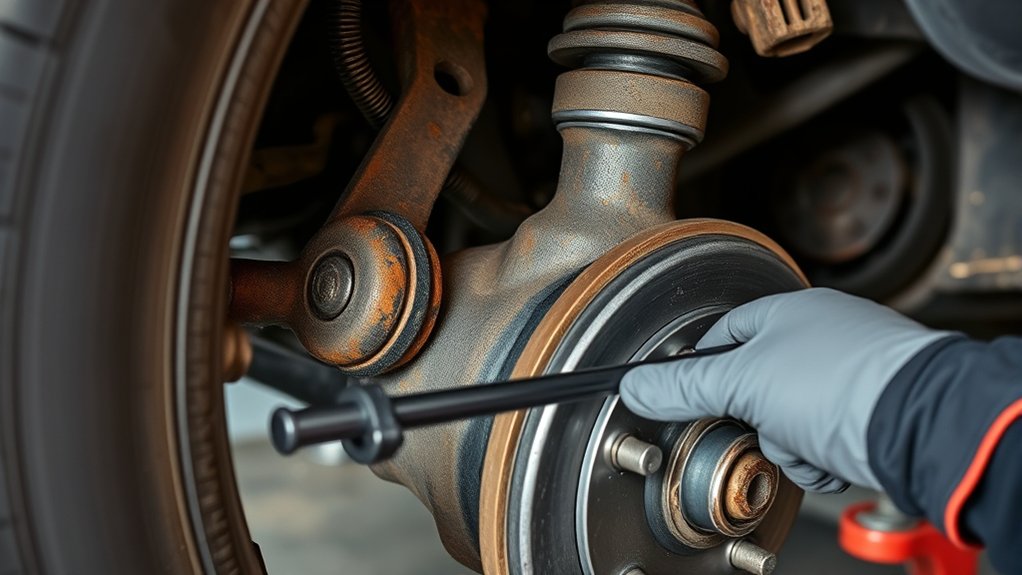
A worn ball joint may produce one or more of the following symptoms:
- Clunking or knocking over bumps: Excess movement in a joint can create a dull impact sound as the suspension changes direction.
- Loose or wandering steering: The truck may need frequent corrections or feel less precise than usual.
- Uneven front-tire wear: A loose suspension pivot can allow wheel angles to change, contributing to irregular wear on an inner or outer shoulder.
- Steering that binds or fails to return smoothly: Internal corrosion or a damaged joint can restrict movement, although steering components and alignment can cause similar behavior.
- Vibration or shaking: This may accompany looseness, but it is not specific to ball joints and can also come from tires, wheels, bearings, brakes, or driveline parts.
- A split, missing, or leaking dust boot: Boot damage allows water and grit to reach the joint. It warrants inspection even when looseness is not yet obvious.
- Visible wheel-angle change: A wheel that appears tilted, shifted, or out of position is an urgent warning and should not be treated as normal alignment wear.
Note: Noise alone does not identify the failed part. Sway-bar links, control-arm bushings, shock mounts, tie-rod ends, wheel bearings, loose hardware, and damaged tires can all create similar symptoms.
When to Stop Driving a Tundra With Ball-Joint Symptoms
Arrange prompt inspection whenever steering feel changes or front-suspension noise becomes persistent. Stop driving and arrange towing when you notice any of these high-risk conditions:
- A front wheel is visibly leaning, displaced, or contacting the body.
- The steering changes suddenly or the truck becomes difficult to control.
- There is heavy grinding, repeated metal-on-metal impact, or violent shaking.
- A ball-joint stud, retaining nut, control arm, or steering knuckle appears loose or damaged.
- A technician has already identified excessive joint movement, separation, or a safety-recall condition that requires immediate repair.
Warning: A ball joint is a steering and suspension safety component. Do not keep driving merely to see whether the noise becomes worse. If the wheel position or steering changes suddenly, have the Tundra transported to a qualified repair facility.
What Risks Come With Ignoring Ball Joint Issues?
As a ball joint wears, the wheel may no longer remain firmly controlled in its intended position. This can reduce steering precision, alter alignment while driving, and place extra stress on tires and nearby suspension components.
In a severe failure, the joint can separate from the steering knuckle or control arm. The wheel may fold or move out of position, making the truck difficult or impossible to steer safely. Secondary damage can affect the tire, wheel, brake hose, axle, steering knuckle, control arm, and surrounding bodywork.
Earlier inspection is usually less disruptive than waiting for obvious instability. It also gives the technician a better chance to determine whether the noise comes from the ball joint or another component before additional parts are damaged.
Which Toyota Tundra Years Had the Lower-Ball-Joint Recall?
Toyota Safety Recall/Special Service Campaign 70B covered certain 2004 through late-2006 model-year Tundras for the front suspension lower ball joints. Toyota’s campaign notice states that excessive wear and looseness could increase steering effort, reduce vehicle self-centering, create front-suspension noise, and in the worst case allow the lower ball joint to separate. You can review the Toyota campaign notice hosted by NHTSA.
Being within that model-year range does not by itself prove that a specific truck has an open recall. Check the 17-character VIN through the Toyota Safety Recall and Service Campaign Lookup. You can also search the NHTSA recall database by VIN or by year, make, and model.
Pro Tip: NHTSA’s VIN lookup reports unrepaired recalls. A campaign that was completed previously may therefore no longer appear as open. If an older Tundra’s campaign history is unclear, confirm it through Toyota or a Toyota dealer.
If the VIN shows an open safety recall, contact a Toyota dealer before paying for the covered repair. If you believe the truck has a safety defect that is not listed, you can submit a report through the NHTSA safety-problem portal.
When to Replace Worn Ball Joints
There is no dependable mileage at which every Toyota Tundra ball joint must be replaced. Service life varies with the model, part design, road conditions, impacts, corrosion, water intrusion, vehicle loading, suspension modifications, tire size, and off-road use.
Replacement is appropriate when the correct inspection finds one or more of these conditions:
- Movement exceeds the specification for the exact joint and model.
- The joint binds, seizes, or does not move smoothly.
- The stud, socket, mounting flange, or retaining hardware is damaged.
- The dust boot is torn and contamination has caused wear, corrosion, looseness, or rough movement.
- The joint has begun to separate or cannot retain the steering knuckle securely.
- A recall or manufacturer campaign requires replacement.
A damaged boot should not be ignored, but boot condition alone does not reveal the amount of internal wear. Some designs permit separate boot service under limited conditions, while others require replacing the joint or its complete control-arm assembly. Follow the procedure for the truck’s VIN and installed component.
Should You Replace One Ball Joint or Both Sides?
Do not automatically replace all upper and lower joints because one joint has failed. The technician should inspect every front ball joint and document which parts are loose, binding, contaminated, damaged, or near their limit.
Replacing both sides may make sense when the matching joints have similar mileage and wear, when the opposite side is also deteriorating, or when the assembly design and labor overlap make paired service practical. A sound joint does not always require replacement solely because another joint failed.
How Do You Inspect a Toyota Tundra Ball Joint?
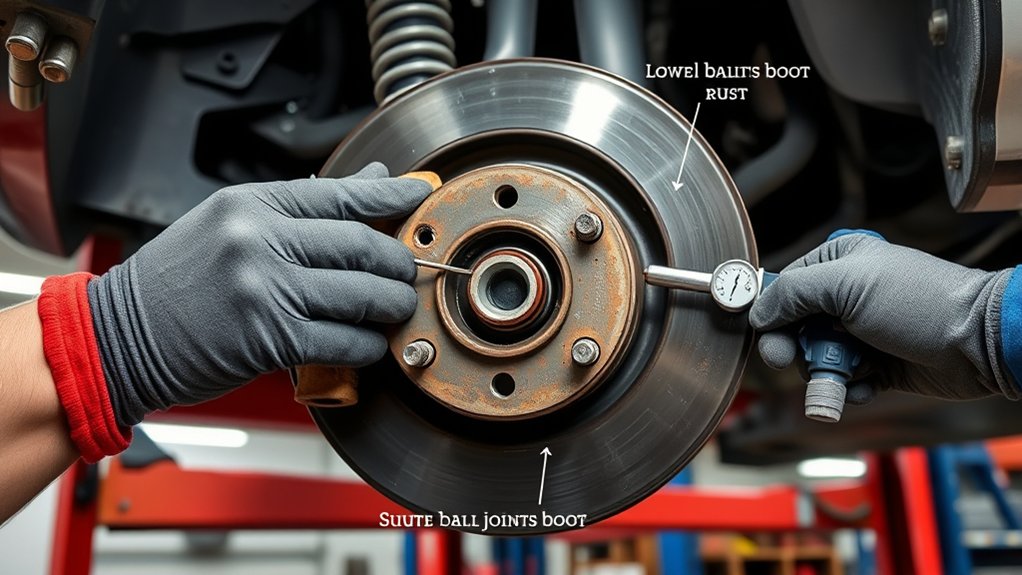
A basic inspection can identify obvious damage, but confirmation requires the correct loading method and movement specification for the Tundra’s suspension design.
- Park safely. Use a firm, level surface. Shift into Park, apply the parking brake, and chock the wheels that will remain on the ground.
- Inspect before lifting. Use a flashlight to look for torn boots, escaping grease, corrosion, impact marks, loose fasteners, damaged control arms, or an abnormal wheel angle.
- Use the correct lift points. Consult the owner or repair information for the truck. If the vehicle must be raised, support it with properly rated jack stands on approved support points.
- Check nearby components. Inspect tie-rod ends, control-arm bushings, sway-bar links, shock mounts, wheel bearings, tires, and wheel hardware because they can mimic ball-joint symptoms.
- Measure the joint correctly. A qualified technician should load or unload the suspension as Toyota specifies, isolate the joint, and measure axial or radial movement with the appropriate tools.
- Compare with the correct specification. The acceptable procedure and movement can differ by joint position, suspension design, and model year.
Warning: Never place any part of your body beneath a Tundra supported only by a hydraulic or mechanical jack. A jack raises the vehicle; rated stands support it.
Wiggling a raised wheel may reveal movement, but it does not identify the source by itself. Play at different hand positions can come from a wheel bearing, steering linkage, or suspension joint. The components must be observed and isolated while the wheel is moved.
What Else Can Cause Similar Symptoms?
Before authorizing ball-joint replacement, ask the technician to rule out these common alternatives:
- Tie-rod ends or steering linkage: Can cause looseness, wandering, clunks, and changes in toe.
- Wheel bearings: May create wheel play, humming, grinding, vibration, or uneven tire wear.
- Control-arm bushings: Can allow the wheel to shift during braking, acceleration, or bumps.
- Sway-bar links and bushings: Frequently produce clunks on uneven roads without causing ball-joint looseness.
- Shock absorbers or mounts: Can cause poor control, bouncing, knocking, or irregular tire wear.
- Tire or wheel problems: Belt separation, imbalance, bent wheels, low pressure, and incorrect alignment can cause vibration or pulling.
- Loose or damaged hardware: Fasteners, wheel nuts, skid plates, and suspension brackets can create noise that resembles joint wear.
A written inspection report that identifies the exact loose or damaged component is more useful than replacing parts based on noise alone. For a broader look at other front-end wear points, see our Toyota Tundra suspension wear-points guide.
Best Practices for Replacing and Maintaining Ball Joints
Ball-joint replacement affects steering retention and suspension geometry. Use a part specified for the exact Tundra VIN, model year, drive configuration, and suspension setup. Toyota Genuine Parts are one option; a reputable aftermarket component may also be suitable when it meets the correct application and quality requirements.
- Follow model-specific instructions. Joint orientation, removal method, torque values, and suspension loading at final tightening can vary.
- Use the required retaining hardware. Replace single-use nuts, cotter pins, clips, or bolts whenever the procedure or part instructions require it.
- Inspect mating parts. A damaged steering-knuckle taper, control-arm bore, or mounting surface can prevent a new joint from seating securely.
- Check the opposite side. Compare boot condition, movement, corrosion, and age rather than assuming it is automatically good or bad.
- Verify brake-hose and sensor routing. Make sure no hose or wire is twisted, stretched, pinched, or rubbing after the repair.
- Check alignment. Measure alignment after repair when suspension geometry was disturbed or when the tires show irregular wear, pulling, or an off-center steering wheel.
- Road-test carefully. Confirm quiet operation, normal steering return, stable tracking, and proper brake operation before returning to normal use.
Lubricating Replacement Ball Joints
Many OE-style ball joints are sealed and have no routine grease service. Do not puncture a sealed boot or force grease into a joint that was not designed for it.
Some aftermarket ball joints include a grease fitting. Service those only with the lubricant, quantity, and interval specified by the part manufacturer. Overfilling can swell or damage the boot, while underfilling a serviceable joint can shorten its life.
When to Inspect More Often
Inspect the front suspension sooner after a hard pothole or curb impact, off-road use, collision, torn boot, new steering looseness, or unexplained tire wear. Lift kits, altered control arms, wheel spacers, and substantially different tire sizes can change suspension geometry or loading, so the modification manufacturer’s inspection requirements also matter.
Frequently Asked Questions
What are the symptoms of bad Toyota Tundra ball joints?
Common symptoms include clunking over bumps, loose or wandering steering, irregular front-tire wear, steering that binds, vibration, or a torn or leaking dust boot. These signs are not unique to ball joints, so the joint should be isolated and inspected before replacement.
Is it safe to drive with a bad Toyota Tundra ball joint?
A confirmed loose, separating, or binding ball joint should be repaired before normal driving. Tow the truck if the wheel is visibly displaced, steering changes suddenly, heavy grinding or impact noises occur, or a technician considers the joint unsafe. Mild unexplained noise still deserves prompt inspection because symptoms alone cannot show how much wear is present.
Which Toyota Tundra years had the lower-ball-joint recall?
Toyota Safety Recall/Special Service Campaign 70B covered certain 2004 through late-2006 model-year Tundras for the front lower ball joints. Eligibility and completion are VIN-specific, so check Toyota’s recall and service-campaign lookup and the NHTSA recall database.
How long do Toyota Tundra ball joints last?
There is no fixed lifespan that applies to every Tundra. A joint may remain serviceable for a long time under mild conditions or wear sooner after impacts, water intrusion, corrosion, off-road use, heavy loading, or suspension modifications. Replace it when the correct inspection finds unacceptable wear, binding, or damage.
What happens when a ball joint is worn out?
The wheel may move outside its intended position, causing poor steering response, changing alignment, noise, and irregular tire wear. If the joint separates, the wheel can fold or shift abruptly, leading to loss of control and damage to the suspension, tire, brake hose, axle, or bodywork.
Can a wheel alignment fix a bad ball joint?
No. Alignment adjusts wheel angles but does not remove looseness, repair a damaged boot, or restore a binding joint. Worn suspension parts must be repaired first so the alignment can be measured and set accurately.
Should both sides be replaced when one ball joint fails?
Not automatically. Inspect the matching joint and the remaining front suspension. Replacing both sides may be reasonable when they have similar wear or deterioration, but a sound joint does not always need replacement solely because the opposite side failed.
Can bad ball joints cause vibration?
They can contribute to shaking when looseness allows the wheel to move, but vibration is not a ball-joint-specific symptom. Tire imbalance or damage, bent wheels, wheel bearings, brakes, steering parts, and driveline components should also be checked.
Conclusion
Toyota Tundra ball-joint problems should be handled according to measured condition, not a universal mileage estimate. Treat clunking, steering looseness, damaged boots, and irregular tire wear as reasons to inspect the complete front suspension. Stop driving if the wheel position or steering changes suddenly. Owners of certain 2004 through late-2006 Tundras should also verify Safety Recall/Special Service Campaign 70B status by VIN. Use the correct Toyota procedure when diagnosis or replacement is required.
Sources
- Toyota Safety Recall/Special Service Campaign 70B Notice — official Toyota customer notice hosted by NHTSA covering certain 2004 through late-2006 Tundras.
- Toyota Safety Recalls and Service Campaigns — VIN-specific Toyota recall and campaign lookup.
- National Highway Traffic Safety Administration Recall Lookup — VIN and year/make/model recall searches and recall guidance.
- Toyota Manuals and Warranties — model-year-specific owner and maintenance information.
- Toyota Technical Information System — official Toyota repair procedures and technical service information.
- NHTSA Report a Safety Problem — official portal for reporting suspected vehicle safety defects.