
Last Updated: September 22, 2026
Engaging 4LO on a Toyota Tundra depends on the truck’s four-wheel-drive control. On button-equipped and later electronic-control Tundras, the normal low-range sequence is to stop completely, keep the brake applied, shift the transmission to Neutral, and select 4L or 4LO. Some early lever-equipped Tundras use a different procedure, especially with a manual transmission, so identify the control fitted to your truck before shifting ranges.
Quick Answer
For most button-equipped and electronic-control Toyota Tundras, select 4H first if required, stop completely, hold the brake, shift the transmission to Neutral, then select 4L/4LO. Keep the brake applied until the low-range indicator stays on without flashing. Early lever-equipped Tundras can use a different H4-to-L4 procedure, so follow the section below that matches your control type.
Key Takeaways
- Use 4LO/4L for low-speed situations that need maximum torque, control, or engine braking.
- Button-equipped and later electronic-control Tundras normally require a complete stop, the brake held, and Neutral when changing between high and low range.
- Some early lever-equipped Tundras use different procedures depending on whether the truck has a manual or automatic transmission.
- Do not rely on low range until the 4LO or 4L indicator confirms the shift and is no longer flashing.
- Do not change ranges while the wheels are spinning or use part-time 4LO on dry, high-traction pavement.
Tundra 4LO Controls at a Glance
| Control Type | Low-Range Procedure | Important Detail |
|---|---|---|
| Early lever + manual transmission | Toyota documented H4→L4 with the truck stopped or below 5 mph (8 km/h), accelerator released, clutch depressed, then the transfer lever moved to L4. | Do not substitute the electronic-control sequence for a lever/manual truck. |
| Early lever + automatic transmission | Stop, hold the brake, shift the transmission to Neutral, then move the transfer lever between H4 and L4. | Use the exact owner’s manual for the model year. |
| Button-equipped | Stop, hold the brake, select Neutral, confirm 4HI, then press the 4LO button. | A flashing 4LO light with a buzzer means the requested change did not complete. |
| Later rotary selector | Stop, hold the brake, shift to Neutral, push the selector if required, and turn from 4H to 4L. | Wait for the 4LO indicator to confirm engagement. |
| Current-generation electronic selector | Stop completely, keep the brake depressed, shift to Neutral, then push and shift the control from 4H to 4L. | Toyota uses 4H/4L terminology on current-generation controls. |
Step-by-Step Guide to Engaging 4LO

Before using any procedure, identify the four-wheel-drive control fitted to your Tundra. Toyota has used transfer levers, separate 2WD/4HI and 4LO buttons, rotary selectors, and newer electronic selectors. Labels can include H2/H4/L4, 2WD/4HI/4LO, or 2H/4H/4L.
If you need a broader explanation of the modes before changing ranges, see the Toyota Tundra 4WD system guide.
When to Use 4LO
Use 4LO or 4L when you need maximum torque and precise low-speed control. Suitable situations include steep off-road climbs, controlled descents, rocks, deep mud, loose sand, deep snow, or other difficult terrain where low gearing is more useful than road speed.
Use 4H instead when you need added traction at normal or moderate speeds on an appropriate low-traction surface. Do not use 4LO as a general road-driving mode.
Warning: Do not change transfer modes while the wheels are spinning. On button-equipped and later electronic-control Tundras, do not request 4LO/4L while the truck is moving or the transmission is in Drive or Reverse. Avoid part-time 4LO on dry, high-traction pavement because the driveline can bind.
Prepare the Truck
For button-equipped and later electronic-control trucks, use this preparation sequence before requesting low range:
- Move to a stable location where the truck can remain fully controlled.
- Bring the Tundra to a complete stop.
- Keep your foot firmly on the service brake.
- Shift the transmission into Neutral.
- Keep the brake applied until the transfer-range change is complete.
Do not apply this sequence automatically to an early lever-equipped manual-transmission Tundra. Those trucks have a separate procedure described below.
Early Lever-Equipped Tundras
Some early Tundras use a mechanical front-drive control lever rather than separate push buttons or a dashboard selector. Toyota’s early Tundra owner’s manual documents different H4-to-L4 procedures for manual- and automatic-transmission trucks.
Lever with manual transmission:
- Stop the truck or reduce speed to less than 5 mph (8 km/h), as specified by the manual for this control design.
- Take your foot off the accelerator.
- Depress the clutch pedal.
- Move the front-drive control lever from H4 to L4.
- Confirm the four-wheel-drive indication before relying on low range.
Lever with automatic transmission:
- Stop the truck.
- Keep the brake applied.
- Shift the transmission to Neutral.
- Move the front-drive control lever between H4 and L4.
- Confirm the requested range before driving.
Important: Early lever-type procedures vary with transmission and model year. Do not assume that a later button or rotary-selector instruction applies to a lever-equipped truck.
Button-Equipped Tundras
Some first-generation Tundras use a 2WD/4HI button and a separate 4LO button. Toyota’s 2003 Tundra owner’s manual documents this sequence:
- Stop completely and hold the brake.
- Shift the transmission to Neutral.
- Confirm that 4HI is selected. Press the 2WD/4HI button if needed.
- Press the 4LO button.
- Wait for the 4LO indicator to stop flashing and remain illuminated.
- After engagement is confirmed, shift into Drive or Reverse and move slowly.
If the 4LO indicator flashes and the buzzer sounds after you request low range, Toyota’s manual states that the transfer mode did not complete the requested 4LO change.
Rotary-Selector Tundras
Many second-generation Tundras use a rotary four-wheel-drive selector. Toyota’s 2010 Tundra Quick Reference Guide, for example, instructs the driver to stop, shift to Neutral, then push and turn the selector to 4L.
- Bring the truck to a complete stop and hold the brake.
- Shift the transmission into Neutral.
- Push the selector inward if required by your control.
- Turn the selector from 4H to 4L.
- Keep the brake applied while the system changes range.
- Wait until the 4LO indicator confirms engagement and is no longer flashing.
- Shift into Drive or Reverse only after the transfer-range change is complete.
Current-Generation Tundras
Current-generation Tundras use 2H, 4H, and 4L terminology. Toyota’s 2023 Tundra Quick Reference Guide gives the following 4H-to-4L sequence:
- Stop the truck completely.
- Continue depressing the brake pedal.
- Shift the transmission to Neutral.
- Push and shift the four-wheel-drive control switch to 4L.
- Wait for the 4L indicator to confirm the range change.
- Only then select Drive or Reverse.
Note: Switch labels, indicator names, allowable shift conditions, and retry procedures vary by model year. Check your exact Tundra through Toyota’s official owner’s manual portal.
Do not rely on low range until the 4LO or 4L indicator has confirmed the shift and is no longer flashing.
How to Disengage 4LO
On button-equipped and later electronic-control Tundras, use the same controlled stop-and-Neutral process when returning from low range to high range:
- Stop the truck completely on a stable surface.
- Keep your foot on the brake.
- Shift the transmission into Neutral.
- Select 4HI or 4H using the control fitted to your model.
- Wait until the high-range indicator confirms the change and the low-range indicator is off.
- Shift into Drive only after the range change is complete.
- If your model permits it and conditions are suitable, return from 4H/4HI to 2H/2WD according to the model-specific manual.
Early lever-equipped Tundras can use different exit procedures, especially with a manual transmission. Follow the lever-type instructions in the exact model-year manual rather than assuming the electronic-control sequence applies.
Troubleshooting 4LO Engagement Issues
If 4LO does not engage, do not force the control or drive as though low range is active while the indicator continues flashing. On an electronic-control Tundra, first confirm that the truck is stopped, the brake is applied, the transmission is fully in Neutral, and the previous transfer-mode change has finished.
Common Engagement Problems
| Symptom | Likely Meaning | Safe Action |
|---|---|---|
| 4LO/4L indicator keeps flashing | The transfer-range change has not been confirmed. | Keep control of the truck and follow the exact retry instruction in the model-year manual. |
| Flashing indicator with warning buzzer | The required shift conditions may not be met or the requested change did not complete. | Check vehicle speed and transmission position. Do not drive as though low range is engaged. |
| 4HI/4LO indicators flash rapidly on a later electronic system | Toyota documentation for later systems identifies rapid flashing as a possible 4WD-system malfunction. | Stop using repeated switch attempts and arrange qualified diagnosis. |
| Control does not respond | The operating sequence may be incorrect, or the system may have an electrical or mechanical fault. | Retry the manual-specified procedure once. Arrange diagnosis if the problem continues. |
| Truck feels bound after leaving 4LO | The driveline may be loaded or the requested range change may not have completed. | Move to an appropriate loose surface if safe, stop, confirm the indicators, and repeat the proper disengagement procedure. |
Safe Retry Sequence
For an electronic-control Tundra that requires a stop-and-Neutral low-range change, check the sequence in this order:
- Keep control of the truck and stop completely.
- Press and hold the brake pedal.
- Confirm that the transmission display shows Neutral.
- Make sure the current 4WD mode has finished changing before requesting another mode.
- Select 4LO/4L using the correct control action for the model.
- Keep the brake applied and wait for confirmation before selecting Drive or Reverse.
Safety Warning: On later Tundras, Toyota warns that moving the transmission selector before the transfer-range change finishes can leave the transfer system incompletely engaged. Keep the service brake applied and complete the range change before moving the transmission out of Neutral.
If the internal transfer-case gears are not aligned, the requested change may remain incomplete. Do not force the selector or repeatedly cycle it.
Pro Tip: If your model’s manual instructs you to move the truck after an incomplete shift, select Drive or Reverse, move a short distance under full control, stop again, hold the brake, return to Neutral, and repeat the specified range-change procedure.
When Mechanical or Electrical Diagnosis Is Required
Repeated engagement failure can point to a problem beyond the operating sequence. Possible areas include the selector or switch, transfer-case actuator, position sensing, wiring, fuses, or the four-wheel-drive control system.
Before arranging service, record:
- The model year and the type of 4WD control.
- Which transfer mode the truck started in.
- Whether the indicator flashed normally, flashed continuously, flashed rapidly, or turned solid.
- Whether a warning buzzer or dashboard message appeared.
- Whether the truck can return to 2H/2WD or 4H/4HI.
A basic engine-code reader may not access all four-wheel-drive or transfer-control modules. Use a compatible diagnostic tool or have a qualified technician inspect the system when warnings remain or the truck repeatedly refuses to change range.
For a deeper diagnostic path focused specifically on warning lights, see Toyota Tundra 4LO Light Flashing: Causes & Fixes.
What to Avoid When Engaging 4LO
Most preventable problems occur when a range change is requested under the wrong conditions or the driver moves before the transfer case has confirmed the new position.
Using the Wrong Shift Procedure
Do not assume every Tundra uses the same 4LO sequence. Button-equipped and later electronic systems normally use a stop-and-Neutral procedure, while some early lever-equipped manual-transmission trucks have different operating instructions.
Never change transfer modes while the tires are spinning. Regain control and stop wheelspin before moving a lever, pressing a 4WD button, or operating an electronic selector.
Ignoring Indicator Lights
The dashboard indicators tell you whether an electronically controlled range change has completed. A normally illuminated low-range indicator confirms the selected mode. Continuing or rapid flashing requires attention before you rely on the requested range.
Do not assume a warning buzzer confirms engagement. On older button-equipped Tundras, Toyota documents a flashing 4LO indicator with a buzzer as an unsuccessful low-range change.
Skipping the Owner’s Manual
Control design and operating limits changed during the Tundra’s production run. An instruction for a button-equipped first-generation truck does not automatically apply to an early lever-equipped truck, a second-generation rotary-selector truck, or a current-generation model.
Use Toyota’s manual lookup page to find the instructions for your exact model year before using low range for the first time.
Using 4LO on Dry Pavement
Part-time four-wheel drive connects the front and rear driveline so they work together. During a turn, the front and rear wheels naturally travel different distances. Loose ground allows tire slip to relieve this difference. On dry, high-traction pavement, the tires may grip too strongly, producing driveline windup or binding.
Use 4LO where the surface and owner’s manual permit it. Return to an appropriate high-range mode before normal dry-road driving.
Essential Tips for Successfully Engaging 4LO

- Identify the transfer-control type before you need low range on the trail.
- Read the model-specific procedure before practicing the change.
- For electronic controls that require Neutral, keep the brake pressed until the range change is complete.
- Watch the low-range indicator rather than assuming the switch position equals engagement.
- Use slow, smooth throttle inputs after low range engages.
- Return to the appropriate high-range mode before normal dry-pavement driving.
- Do not repeatedly cycle the switch if the system refuses to respond.
Low range multiplies torque and increases engine braking. The truck will respond differently to throttle inputs than it does in high range, so use smooth steering, braking, and accelerator movements.
Factors Influencing 4LO Engagement
Several conditions can affect whether the transfer case completes the requested change:
- Model year and control design: Lever, button, rotary, and current electronic selectors do not all use the same procedure.
- Transmission type: Early lever-equipped manual- and automatic-transmission trucks have different low-range instructions.
- Transmission position: Electronic stop-and-Neutral systems require the transmission to be fully in Neutral.
- Vehicle movement: Button-equipped and later electronic-control systems require the truck to be stopped for 4H-to-4L changes.
- Wheelspin: Toyota warns against operating the 4WD control while the wheels are slipping or spinning.
- Driveline load: A loaded driveline or high-traction surface can make a transfer-range change harder to complete.
- Gear alignment: Internal components may occasionally need a short controlled vehicle movement before a retry, when the model-specific manual directs it.
- System condition: A failed actuator, switch, sensor, circuit, or control unit can prevent engagement.
Flat, stable ground can make a range change or troubleshooting attempt easier, but it does not replace the exact operating sequence in the owner’s manual.
Maintenance Tips for Your 4WD System
Toyota manuals for multiple Tundra generations advise periodic four-wheel-drive use to keep front-drive components lubricated. For example, some manuals specify at least 10 miles (16 km) of four-wheel-drive operation each month. Follow the exact recommendation and permitted surface conditions in your own model-year manual.
- Exercise the 4WD system when and where the model-specific manual recommends it.
- Check transfer-case and differential fluids according to the required maintenance schedule.
- Investigate leaks, warning messages, grinding sounds, or repeated shift failures promptly.
- Use tires of the correct size and keep tread depth reasonably matched across the four positions.
- Set tire pressures according to the vehicle placard rather than a generic internet recommendation.
- Do not continue normal driving while a transfer-range warning remains unresolved.
The 2021 Tundra owner’s manual includes generation-specific four-wheel-drive operation and lubrication guidance.
Why 4LO May Take a Moment to Engage
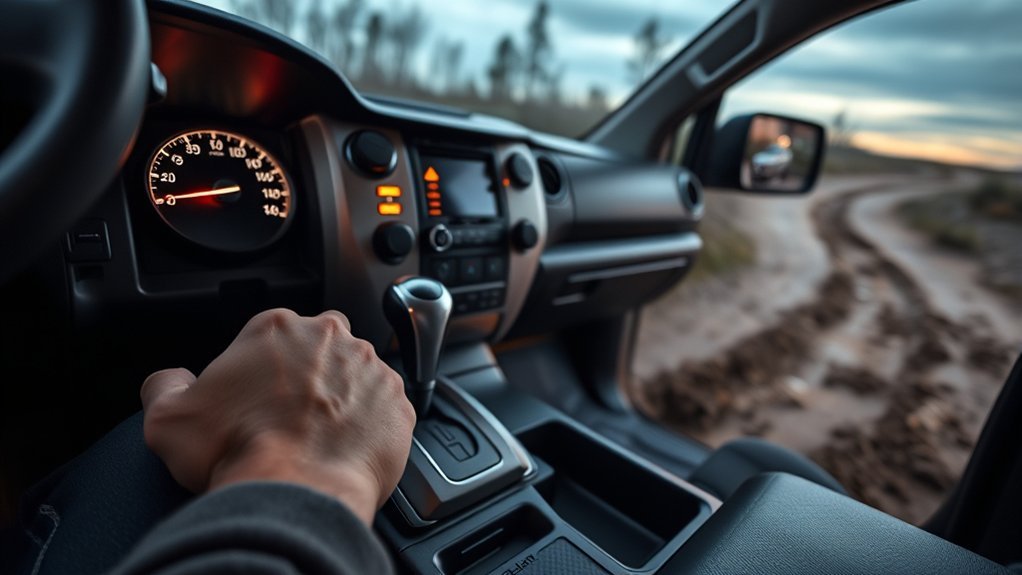
An electronic transfer case may not confirm the requested mode immediately. The delay can occur because the required vehicle or transmission condition has not been met, the previous transfer-mode change is still completing, or the internal gears are not aligned for the requested position.
- The transmission may not be fully in Neutral.
- The truck may not be completely stopped when the system requires a stop.
- The previous 4WD change may still be in progress.
- The transfer-case components may not be aligned for the requested position.
- A control-system fault can prevent the actuator from confirming the range.
A brief transition is different from a warning that continues. Keep the truck controlled, follow the indicator or multi-information display, and use the model-specific retry instruction if the requested mode does not confirm.
Where to Get Help if 4LO Will Not Engage
Start with Toyota’s model-specific operating instructions before relying on forum posts, videos, or generalized advice. Community reports can help identify patterns, but they should not override the procedure Toyota specifies for the exact transfer-control system.
Use this order when researching a persistent problem:
- Read the four-wheel-drive section of the exact model-year Toyota manual.
- Check Toyota service and recall information for the vehicle.
- Review the dedicated Tundra 4LO flashing-light troubleshooting guide if warning indicators remain active.
- Compare community reports only from trucks with the same generation, drivetrain, and control design.
- Have a qualified technician confirm the diagnosis before replacing transfer-case or control-system parts.
Be cautious with advice that tells you to force the selector, repeatedly cycle an unresponsive switch, ignore a continuing warning, or use part-time 4LO on dry pavement.
Which Tundra 4WD Mode Should You Use?
| Situation | Typical Mode | Reason |
|---|---|---|
| Normal dry paved driving | 2H / 2WD | Normal high-range operation on a high-traction surface. |
| Snow, ice, loose dirt, gravel, or suitable off-road travel at moderate speed | 4H / 4HI | Adds four-wheel traction without low-range gearing. |
| Steep climb or descent, rocks, deep mud, loose sand, or other slow difficult terrain | 4L / 4LO | Provides low gearing for maximum torque and low-speed control. |
| 4LO/4L indicator continues flashing | Do not assume the requested mode is active | Complete the model-specific retry procedure or diagnose the 4WD system. |
Frequently Asked Questions
How do you engage 4LO on a Toyota Tundra?
On most button-equipped and electronic-control Tundras, select 4H if required, stop completely, hold the brake, shift the transmission into Neutral, and select 4L or 4LO. Wait until the low-range indicator confirms the change before selecting Drive or Reverse. Early lever-equipped trucks can use a different procedure.
Do all Toyota Tundras have to be stopped to engage 4LO?
No. Button-equipped and later electronic-control Tundras require a stop for the 4H-to-4L change, but Toyota documented a different procedure for some early lever-equipped manual-transmission trucks. Check the exact model-year manual and control type.
Do you have to be in Neutral to switch a Tundra to 4WD?
Neutral is required when changing between high and low range on button-equipped and later automatic-transmission Tundra systems documented here. It is not a universal requirement for every 2H-to-4H change or every early lever-equipped manual-transmission system.
Does 4H need to be selected before 4L?
On the electronic-control Tundra systems covered by Toyota’s manuals, the normal low-range change is made from 4H or 4HI. Follow the exact switch sequence shown for your model year.
What does a flashing 4LO light mean on a Toyota Tundra?
A continuing flashing 4LO or 4L indicator means the requested transfer-range change has not been confirmed. Check the required vehicle and transmission conditions and follow the model-specific retry procedure. Rapid flashing on some later systems can indicate a malfunction.
Do three beeps mean 4LO is engaged?
No. Toyota documentation for older button-equipped Tundras describes a warning buzzer with a flashing 4LO indicator as an unsuccessful requested range change. Confirm engagement from the proper low-range indicator, not the buzzer.
How do you disengage 4LO on a Toyota Tundra?
On button-equipped and later electronic-control trucks, stop completely, hold the brake, shift to Neutral, and select 4H or 4HI. Wait until the low-range indicator turns off and the high-range change is confirmed before driving. Early lever-equipped trucks may use a different procedure.
Can you use 4LO on dry pavement?
Avoid using part-time 4LO on dry, high-traction pavement. The front and rear driveline can bind because the tires cannot slip enough to relieve the speed difference that occurs while turning.
Sources
- Toyota Early Tundra Owner’s Manual — lever-equipped manual and automatic procedures, button-type controls, indicators, and four-wheel-drive lubrication guidance.
- Toyota 2003 Tundra Owner’s Manual — button-equipped 4HI/4LO procedure and unsuccessful-shift warning behavior.
- Toyota 2010 Tundra Quick Reference Guide — rotary-selector 4H/4L procedure.
- Toyota 2021 Tundra Owner’s Manual — later second-generation 4WD controls, indicators, and maintenance guidance.
- Toyota 2023 Tundra Quick Reference Guide — current-generation 2H/4H/4L operation and stop-and-Neutral low-range procedure.
- Toyota Warranty and Owner’s Manuals — official model-year manual lookup.
Conclusion
For most button-equipped and electronic-control Toyota Tundras, entering 4LO or 4L means selecting 4H if required, stopping completely, holding the brake, shifting to Neutral, and requesting low range. Keep the brake applied until the indicator confirms the change. Early lever-equipped trucks are the important exception because their procedure can differ by transmission.
Use low range for slow, difficult terrain rather than normal road driving. If the low-range indicator keeps flashing, a buzzer sounds, or the system repeatedly refuses to change range, stop repeated attempts, check the model-specific Toyota procedure, and diagnose the 4WD system before relying on it.