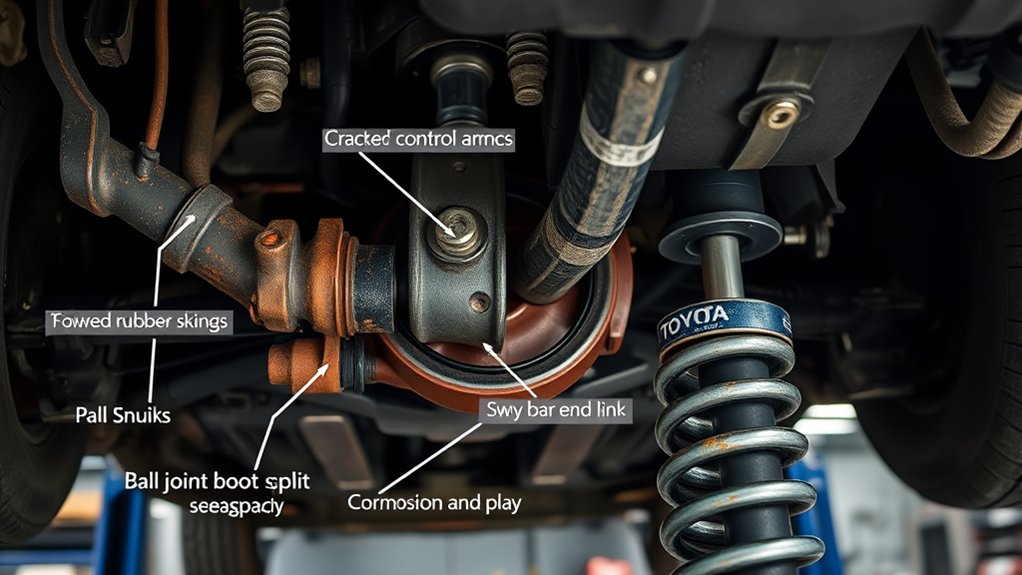
Toyota Tundra suspension wear can show up as loose steering, clunks over bumps, repeated bouncing, a low corner, or abnormal tire wear. Those symptoms can also come from tires, wheel bearings, brakes, alignment, or driveline problems, so start with tire pressure and a visual check, then confirm the failed component before buying parts or installing upgrades.
Quick Answer
Toyota Tundra suspension wear commonly shows up as loose steering, clunks, leaking shocks, repeated bouncing, an uneven ride height, or irregular tire wear. Check cold tire pressure, tread condition, loading, and visible components first. Then have steering and suspension joints, shocks, bushings, springs, bearings, and alignment checked as needed. Stop driving and arrange towing if steering suddenly becomes unsafe, a wheel shifts position, a joint may have separated, a spring breaks or moves out of position, or a tire rubs against the truck.
Key Takeaways
- Check tire pressure, tread wear, and visible damage before assuming the suspension has failed.
- Clunks, steering play, fluid leaks, repeated bouncing, and an uneven stance deserve prompt inspection.
- Repair loose or damaged parts before performing an alignment or installing a lift or leveling kit.
- Suspension design varies by model year, especially between earlier leaf-spring trucks and 2022-and-newer Tundras.
- Certain 2022–2023 Tundra HV TRD Pro trucks were included in Toyota Limited Service Campaign 24TD01 for premature outside-shoulder tire wear related to the original front toe setting; the free campaign period ended March 20, 2025.
- Use Toyota’s VIN lookup and dealer service history to check applicable recalls, campaigns, and previously completed work.
Last updated: September 22, 2026
Editorial note: This guide was rechecked against Toyota maintenance information and Toyota/NHTSA campaign documents. It is a symptom-screening guide, not a substitute for a hands-on inspection of a specific truck.
At a Glance
| Time Required | 15 to 20 minutes for a ground-level screening; a complete shop inspection may take longer |
| Difficulty | Easy for visual screening; advanced for loaded-joint testing and repairs |
| Tools Needed | Flashlight, tire-pressure gauge, tread-depth gauge, gloves, and a tape measure |
| Cost | No cost with tools on hand; professional diagnosis, alignment, tires, and repairs vary by model year and local labor rates |
Warning: Never crawl beneath a Tundra supported only by a jack. Use approved lifting points, properly rated jack stands, wheel chocks, and a level surface. Leave ball-joint, tie-rod, wheel-bearing, and loaded-suspension play testing to a qualified technician if you lack the correct equipment or procedure.
How to Identify Suspension Wear and Choose the Next Repair in Your Toyota Tundra
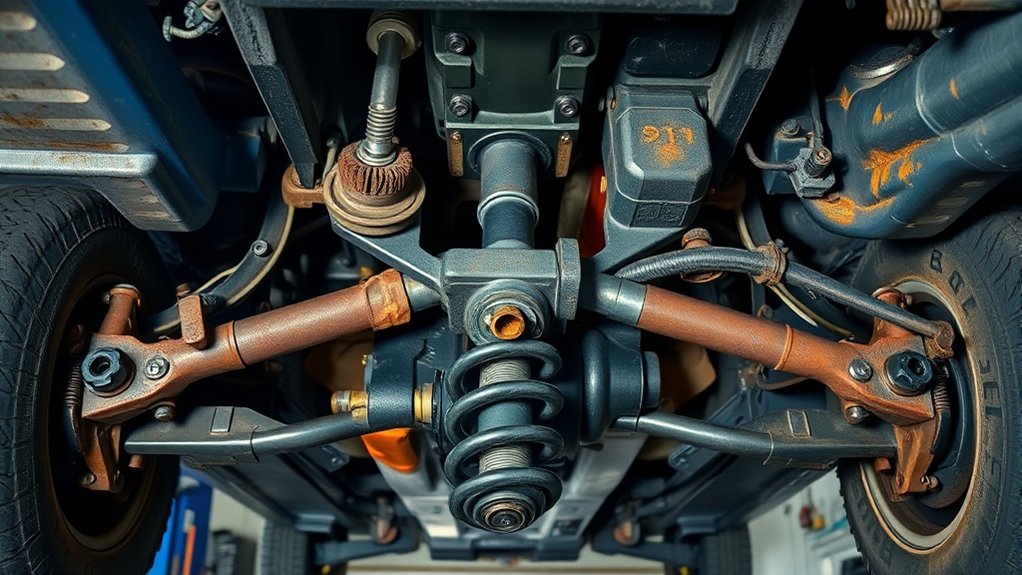
Start with a simple screening rather than guessing which part has failed. Several tire, brake, wheel-bearing, and driveline problems can feel similar to suspension wear.
1. Check Tire Pressure and Tread
Park on level ground and check all four tires when they are cold. Use the pressure listed on the driver-side door placard, not the maximum pressure molded into the tire sidewall.
Inspect each tread for cuts, bulges, exposed cords, uneven depth, feathered edges, and scalloped or cupped areas. The NHTSA TireWise guide explains that proper pressure, balancing, alignment, and rotation all affect tire safety and service life.
2. Confirm When the Symptom Occurs
Note whether the problem happens over bumps, while braking, during turns, under acceleration, or only at a certain speed. This detail helps separate suspension wear from tire imbalance, brake problems, or driveline vibration.
- Clunk over bumps: Possible shock mount, stabilizer-bar link, bushing, ball joint, control arm, or loose hardware.
- Steering wander: Possible tire-pressure difference, alignment issue, tie-rod wear, ball-joint wear, or wheel-bearing play.
- Repeated bouncing: Possible weak shock damping, incorrect tire pressure, or excessive load.
- Pulling while braking: Check brakes and tires as well as alignment and suspension.
- Speed-related vibration: Check wheel balance, tire damage, wheel runout, and driveline components before blaming the suspension.
3. Perform a Ground-Level Visual Check
Use a flashlight to look through the wheel openings and beneath the truck without placing any part of your body under it. Compare the left and right sides.
Look for an active oil trail on a shock absorber, torn rubber boots, cracked bushings, broken or displaced springs, damaged leaf packs on applicable older models, bent parts, loose hardware, or tire contact marks. On trucks with rear air suspension, watch for one side dropping after parking or repeated compressor operation.
4. Compare Ride Height
Unload unnecessary cargo and park on a flat surface. Measure from the center of each wheel to the corresponding fender opening, then compare left and right readings on the same axle.
A noticeable difference may indicate uneven loading, spring damage, an air-suspension leak, previous body damage, or a suspension problem. Small differences can result from fuel, accessories, road slope, or manufacturing tolerance, so a measurement alone does not identify the failed part.
5. Have Steering and Joints Tested
Toyota’s 2025 Tundra Warranty & Maintenance Guide calls for checking suspension and steering ball joints for looseness or damage and inspecting their dust covers. Toyota also states that a qualified technician should perform these operations.
A technician can test ball joints, inner and outer tie rods, control-arm bushings, wheel bearings, stabilizer links, shock mounts, and steering free play using the correct loaded or unloaded procedure for your model.
6. Repair Worn Parts Before Aligning
An alignment cannot hold its settings when a ball joint, tie rod, bearing, bushing, or mounting point has excessive movement. Replace damaged components first, confirm that ride height is correct, and then perform an alignment when the repair or modification affects wheel angles.
Pro Tip: Ask the shop for the before-and-after alignment printout. The measurements can show whether camber, caster, or toe was outside specification and whether the final settings fall within the correct range for your model.
What Repair Follows Each Confirmed Finding?
Do not replace parts only because a symptom seems to match. Once the failed component or system has been confirmed, use the repair information for the truck’s exact model year and equipment.
| Confirmed Finding | Repair Direction |
|---|---|
| Shock is actively leaking or has lost damping | Replace the affected shock or matched components as specified for the application, and inspect mounts, bushings, springs, and tires for related damage. |
| Ball joint or tie rod has excessive play | Replace the worn joint using the model-specific procedure, inspect adjacent steering parts, and align the truck when the repair affects wheel geometry. |
| Control-arm bushing or control arm is damaged | Repair the serviceable bushing or replace the appropriate assembly according to Toyota repair information, then verify ride height and alignment. |
| Spring is broken, displaced, or producing abnormal unloaded ride height | Correct loading first, then repair or replace the damaged spring components using the applicable model-specific procedure and recheck ride height. |
| Factory rear air suspension drops, rides abnormally, or cannot control height correctly | Diagnose the air system, sensors, lines, compressor operation, and applicable Toyota service information rather than assuming the shock absorber alone has failed. |
Know Your Tundra’s Suspension Design
Tundra components vary by generation, drivetrain, trim, and option package. Earlier models generally use a rear leaf-spring arrangement, while the third-generation Tundra introduced a multi-link rear suspension with coil springs.
Toyota’s description of the redesigned 2022 Tundra suspension identifies a double-wishbone front design, a multi-link coil-spring rear design, and twin-tube shock absorbers. Some newer configurations also offer rear air suspension or Adaptive Variable Suspension.
2022 rear-air-suspension note: Toyota issued T-SB-0070-22 for a rough-ride condition over uneven roads, bumps, or dips on some 2022 Tundra and Tundra HV vehicles equipped with rear air suspension. The bulletin is condition-specific; it does not mean every rough ride is caused by the same height-control-sensor setting, so applicability should be confirmed before parts are replaced.
Note: Parts and diagnostic procedures can differ even within the same model year. Confirm the VIN, drivetrain, cab, bed, suspension package, and option codes before ordering components.
Signs Your Tundra’s Suspension Needs Attention
Suspension wear rarely produces one universal symptom. Use the pattern of symptoms, tire wear, recent repairs, impacts, loads, and model-specific design to narrow the cause.
| Symptom | Possible Areas to Check | Next Step |
|---|---|---|
| Clunk or knock over bumps | Shock mounts, stabilizer links, bushings, ball joints, control arms, or loose hardware | Arrange a chassis inspection before the noise becomes worse |
| Excessive bouncing or floating | Shock absorbers, tire pressure, springs, or excessive load | Check loading and pressure, then inspect damping and springs |
| Loose steering or poor self-centering | Tie rods, ball joints, steering components, wheel bearings, tires, or alignment | Limit driving and obtain a professional inspection promptly |
| Truck leans or sags | Uneven cargo, damaged spring, leaf-spring problem, air leak, or altered ride height | Unload the truck, remeasure, and inspect the affected side |
| Uneven or rapid tire wear | Pressure, alignment, balance, worn joints, weak damping, or tire damage | Correct mechanical looseness before aligning or replacing tires |
| Fluid on a shock body | Shock seal or body damage | Have the shock inspected for active leakage and loss of damping |
A tire-wear pattern is a clue, not a complete diagnosis. Pressure, balance, alignment, tire construction, worn joints, weak damping, and driving conditions can produce overlapping symptoms.
What Tire-Wear Patterns Can Tell You
| Wear Pattern | Possible Contributors |
|---|---|
| Both shoulders worn | Low tire pressure, heavy loading, or prolonged use while underinflated |
| Center worn | Excessive pressure or a tire and wheel application issue |
| One shoulder worn | Camber or toe error, worn parts, bent parts, or repeated cornering loads |
| Feathered tread edges | Toe misalignment or looseness that allows toe to change while driving |
| Cupped or scalloped areas | Balance, tire runout, weak damping, worn components, or alignment problems |
Why Are the Outside Shoulders of Some 2022–2023 Tundra TRD Pro Tires Wearing Quickly?
Toyota issued Limited Service Campaign 24TD01 for certain 2022–2023 Tundra HV TRD Pro vehicles. Toyota stated that the original factory front-wheel toe setting on affected trucks could cause excessive and premature wear of the outside tire shoulders. The campaign covered approximately 8,800 vehicles and called for a front-wheel alignment adjustment plus replacement of qualifying tires when Toyota’s inspection criteria were met.
The free campaign period ended March 20, 2025. Do not assume that a truck still qualifies for free work or that every 2022–2023 Tundra with outer-edge wear is part of this campaign. Check the VIN, review dealer campaign history, and have the tires, alignment, and suspension inspected to identify the current cause.
When to Stop Driving
Stop driving and arrange towing if the steering suddenly becomes loose or difficult, a wheel appears shifted in the opening, a ball joint or tie rod may have separated, a spring is broken or displaced, or a tire rubs against the body or suspension.
You should also stop if the truck drops rapidly on an air-suspension corner, a loud structural clunk follows an impact, or the vehicle cannot track safely in a straight line. Continuing to drive can damage tires, brakes, steering parts, and surrounding components.
Top Causes of Suspension Component Failures in Toyota Tundras
Tundra suspension wear depends on age, mileage, environment, maintenance, loading, modifications, and road conditions. No single component fails first on every truck.
- Normal joint and bushing wear: Ball joints, tie rods, stabilizer links, control-arm bushings, and shock mounts move whenever the suspension or steering operates.
- Damaged protective boots: A torn boot can allow dirt and water to reach a joint and can let lubricant escape.
- Rough-road and off-road use: Potholes, washboard roads, rocks, and repeated high-impact travel increase stress on tires, shocks, joints, mounts, and alignment settings.
- Overloading or poor load distribution: Exceeding ratings or placing too much weight behind the rear axle can change ride height and handling while increasing stress on tires and suspension components.
- Incorrect tire pressure: Underinflation or overinflation changes tire behavior and wear, which can make suspension symptoms harder to diagnose.
- Impacts and misalignment: Potholes, curbs, collisions, bent parts, and ride-height changes can alter wheel angles.
- Corrosion: Road salt and moisture can damage fasteners, mounts, spring hardware, frames, and cross-members, especially on older trucks.
- Incorrect modifications: Incompatible lifts, spacers, wheels, tires, or control arms can reduce clearance, alignment range, travel, or component life.
- Installation errors: Incorrect torque, damaged hardware, wrong parts, or improper assembly can create movement, noise, or premature wear.
Heavy towing within the truck’s ratings does not automatically mean the suspension has failed. However, frequent towing or heavy loading increases the importance of following the model-year maintenance guide, checking tire pressure, inspecting the chassis, and addressing changes in ride height or handling.
If corrosion is visible around frame rails, cross-members, suspension mounts, brake-line supports, or other structural areas, see the Toyota Tundra frame rust repair guide before treating the problem as ordinary suspension wear.
Upgrades to Combat Suspension Wear in Your Tundra
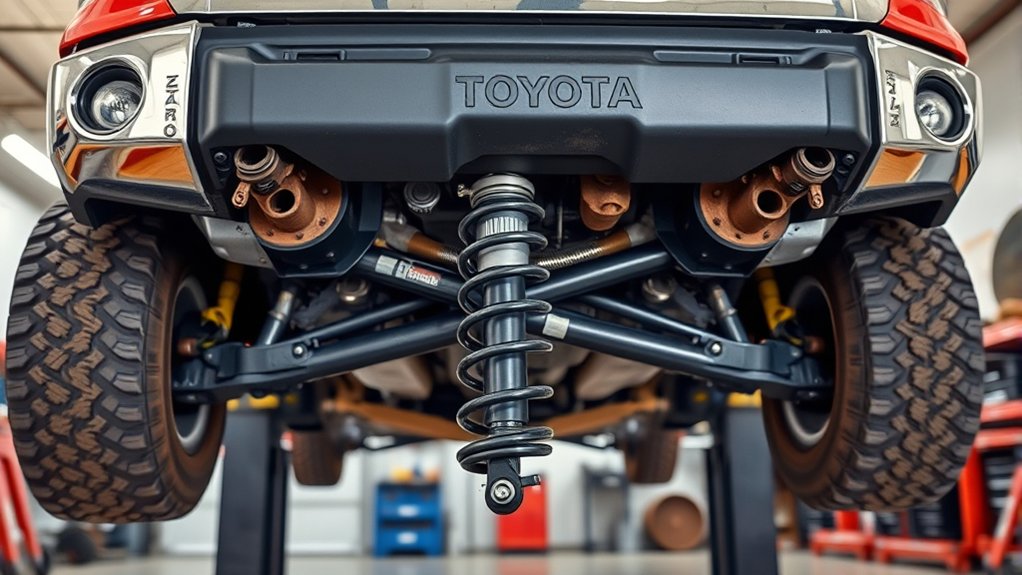
An upgrade can change ride, load control, damping, clearance, or off-road performance, but it cannot repair a loose joint, torn bushing, broken spring, leaking air line, bent component, or damaged mounting point. Diagnose and repair existing faults first.
Do not use a lift, leveling spacer, heavier spring, or air helper as a substitute for repairing worn parts or correcting an overloaded truck.
Replacement Shock Absorbers
Choose shocks designed for your exact model, ride height, suspension package, and use. A shock intended for a stock-height street truck may not provide the correct travel or damping for a lifted off-road setup.
Replace a damaged mount, bushing, bump stop, or spring when inspection shows that it also contributed to the problem. Follow the component and vehicle manufacturers’ installation and torque procedures.
Load-Support Products
Model-specific helper springs or air-helper systems may improve loaded ride-height control when used within the truck’s ratings. They do not increase the Gross Vehicle Weight Rating, Gross Axle Weight Rating, payload rating, tire rating, or published towing limit.
Uneven or excessive cargo should be corrected before adding hardware. A persistent unloaded sag needs diagnosis rather than load-support equipment.
Lift and Leveling Kits
A lift or leveling kit changes ride height and may affect alignment angles, shock travel, control-arm position, brake-line clearance, sensor operation, tire clearance, and handling. It does not automatically improve suspension geometry.
Use a complete package designed for your model and intended lift height. Arrange a professional alignment after installation and recheck fasteners according to the kit manufacturer’s instructions. If the truck has already passed its suspension inspection and you are comparing modification options, see the Toyota Tundra leveling kit guide.
Upper Control Arms
Aftermarket upper control arms may help restore alignment range or joint movement on some lifted configurations. They are not necessary for every Tundra and do not guarantee correct alignment or longer tire life.
Select them only when the suspension designer or installer confirms that they suit the lift height, wheel offset, tire size, joint angle, and intended use.
Factory-Style Suspension Options
Owners of newer Tundras should account for factory air suspension, Adaptive Variable Suspension, TRD dampers, sensors, and electronic controls. Replacing these systems with incompatible parts may trigger warnings or remove functions the truck originally used for ride and load control.
Why Regular Maintenance Keeps Your Tundra’s Suspension in Top Shape
Follow the maintenance guide for your exact model year rather than using one universal replacement interval. Toyota schedules inspections according to mileage, time, and special operating conditions.
Toyota’s 2025 Tundra Warranty & Maintenance Guide includes scheduled inspections of ball joints, dust covers, steering linkage, boots, tires, chassis hardware, and related components. It also identifies additional maintenance items for applicable operating conditions such as dirt-road use, road-salt exposure, towing, and heavy vehicle loading. Use the guide for your exact model year because schedules and equipment can differ.
Use This Maintenance Checklist
- Check cold tire pressure regularly and before towing or carrying a heavy load.
- Inspect tread depth and wear patterns at least monthly.
- Rotate tires according to the owner’s manual and tire configuration.
- Request an inspection after a hard pothole or curb impact.
- Inspect visible boots, bushings, shocks, springs, and hardware during routine service.
- Correct steering play, clunks, leaks, or ride-height changes promptly.
- Perform an alignment after ride-height changes or repairs that affect steering and suspension geometry.
- Recheck tire wear after repairs to confirm that the problem has stopped progressing.
- Wash road salt and packed mud from accessible underbody areas without directing high pressure at electrical connectors or damaged seals.
- Check recalls, service campaigns, and dealer campaign history by VIN when buying an older Tundra or investigating a model-specific concern.
Rotation can help tires wear more evenly, but it will not correct a loose joint, weak shock, bent component, or incorrect alignment. Repair the cause rather than moving a damaged wear pattern to another position.
Related Guides
Frequently Asked Questions
What is the most common Toyota Tundra suspension problem?
No single suspension problem is most common across every Tundra generation. Age, road conditions, towing, off-road use, corrosion, modifications, and maintenance affect which part wears first. Common inspection areas include shocks, ball joints, tie rods, control-arm bushings, stabilizer links, springs, wheel bearings, tires, and alignment.
How do I know if my Toyota Tundra shocks are bad?
Possible signs include active shock leakage, repeated bouncing after bumps, excessive floating or body movement, damaged shock mounts, and tire cupping. Those symptoms are not proof of a failed shock by themselves, so also check tire pressure, loading, springs, bushings, joints, balance, and tire condition before replacing the dampers.
Why does my Toyota Tundra clunk over bumps?
A clunk over bumps can come from a shock mount, stabilizer-bar link, control-arm bushing, ball joint, spring component, loose hardware, or another chassis part. Note which corner the sound comes from and whether it changes during steering or braking, then have the affected area inspected rather than replacing parts based on the noise alone.
Why are the outside shoulders of my 2022–2023 Tundra TRD Pro tires wearing quickly?
Toyota Limited Service Campaign 24TD01 covered certain 2022–2023 Tundra HV TRD Pro vehicles whose original factory front toe setting could cause excessive and premature wear of the outside tire shoulders. The free campaign period ended March 20, 2025. Check the VIN and dealer campaign history, then have the current alignment, tires, and suspension inspected rather than assuming every outer-shoulder wear case has the same cause.
What part of my suspension is making my tires wear out?
Uneven tire wear can result from incorrect pressure, alignment, wheel balance, tire damage, worn ball joints, loose tie rods, damaged bushings, weak shock damping, wheel-bearing play, or bent components. Repair looseness or damage before aligning the truck, then monitor the tires to confirm that the wear has stopped.
What is the worst year for Toyota Tundra suspension problems?
No model year can be called the worst without defining the problem and using reliable condition, complaint, and repair data. When evaluating a Tundra, check its VIN for recalls, review service and modification records, inspect the frame and suspension, examine tire wear, and judge the individual truck rather than relying on a broad model-year label.
What years of Toyota Tundra had a frame-corrosion recall?
NHTSA campaign 09V-444 involved certain 2000 through 2003 Tundras with excessive rear cross-member corrosion associated with cold climates and road-salt use. The condition could affect the spare-tire carrier and nearby rear brake components. Check your VIN through Toyota’s recall lookup and review dealer campaign history because model year alone does not confirm a truck’s eligibility or whether campaign work was previously completed.
Were any Toyota Tundras recalled for lower ball joints?
Yes. NHTSA campaign 07V-013 covered certain 2004–2006 Tundras for front lower-ball-joint wear and looseness. An earlier campaign, 05V-225, covered certain 2002 through early-2004 Tundras. Recall coverage depends on the VIN, so use Toyota’s official lookup rather than assuming every truck from those model years is included.
Can I keep driving with worn suspension parts?
Minor ride changes still deserve inspection, but severe steering looseness, a shifted wheel, a suspected separated joint, tire rubbing, a broken spring, rapid air-suspension collapse, or an inability to track safely requires you to stop driving. Arrange towing rather than risking loss of control or additional damage.
Does a Tundra need an alignment after suspension repair?
An alignment is normally appropriate after replacing tie rods, ball joints, control arms, certain bushings, springs, or other parts that affect wheel position. It is also recommended after changing ride height. A shock-only replacement may not change alignment, but the technician should follow the repair manual and inspect tire wear and steering position.
Conclusion
Toyota Tundra suspension wear should be diagnosed in a clear order. Start with tire pressure, tread condition, loading, and visible damage. Then have a qualified technician test steering and suspension joints, shocks, springs, bushings, bearings, and alignment.
Repair worn or damaged parts before installing upgrades or attempting an alignment. Model-year differences, factory suspension options, previous modifications, recall history, and model-specific service information all matter. Confirm the truck’s VIN and exact configuration, and for applicable 2022–2023 Tundra HV TRD Pro models, review whether Limited Service Campaign 24TD01 appears in the vehicle’s campaign history.
Sources
- Toyota 2025 Tundra Warranty & Maintenance Guide — maintenance schedules and ball-joint, dust-cover, steering, and chassis inspection guidance
- Toyota: Next-Generation 2022 Tundra — third-generation suspension design, shock absorbers, and available suspension systems
- NHTSA TireWise — tire pressure, tread, balancing, alignment, rotation, and tire-safety guidance
- Toyota Safety Recall and Service Campaign Lookup — VIN-based recall and campaign checks
- Toyota Limited Service Campaign 24TD01 — premature outside-shoulder tire wear and front toe-setting information for certain 2022–2023 Tundra HV TRD Pro vehicles
- Toyota T-SB-0070-22 — rear-air-suspension rough-ride diagnostic and adjustment information for applicable 2022 Tundra and Tundra HV vehicles
- NHTSA Campaign 07V-013 — front lower-ball-joint recall information for certain 2004–2006 Tundras
- NHTSA Campaign 05V-225 — earlier front lower-ball-joint recall information covering certain 2002 through early-2004 Tundras
- NHTSA Campaign 09V-444 — rear cross-member corrosion recall information for certain 2000–2003 Tundras
