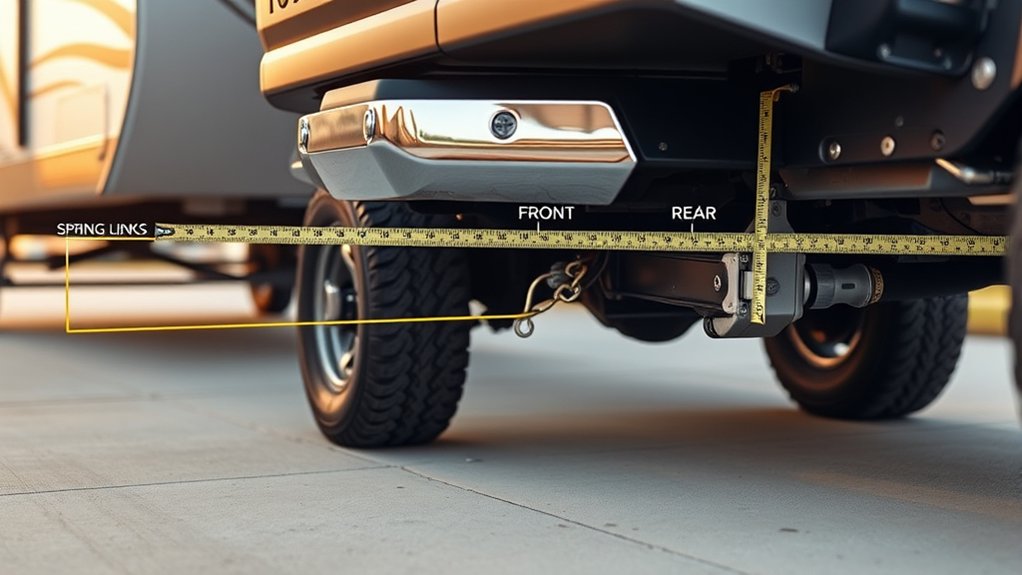
Setting up a weight distribution hitch on a Toyota Tundra is not simply a matter of making the truck and trailer look level. A safe setup starts with the actual travel-ready weights, the ratings and towing instructions for your exact Tundra model year, accurate measurements on level ground, and the adjustment procedure specified by the hitch manufacturer.
Quick Answer
Set up a weight distribution hitch on a Toyota Tundra by loading the truck and trailer for travel, verifying every weight rating, measuring the truck and level trailer on flat ground, setting ball height, applying spring-bar tension exactly as the hitch manual directs, and then rechecking axle loads, clearances, torque, brakes, lights, and handling. Toyota’s 2022 Tundra manual specifies 9%–11% tongue weight for conventional towing, requires a sufficient-capacity weight-distributing hitch when gross trailer weight is over 5,000 lb, and directs WDH users to return the front axle to its pre-trailer weight or front-fender height. Check the manual for your exact model year because older Tundra guidance can differ.
Key Takeaways
- Use the owner’s manual for your exact Tundra model year and configuration; towing limits and weight-distribution procedures are not identical across all Tundras.
- Toyota’s 2022 and 2024 Tundra manual guidance uses a 9%–11% conventional tongue-weight target and calls for returning the front axle to its pre-trailer weight or front-fender height when a WDH is used.
- A weight distribution hitch transfers part of the rear-axle load change toward the Tundra’s front axle and the trailer axles. It does not increase any weight rating.
- Choose the hitch and spring bars using the trailer’s actual loaded tongue weight, not its advertised dry hitch weight.
- Head angle, washer count, chain links, bracket height, bar position, lubrication, and torque are hitch-specific.
- Verify the completed setup with repeatable fender measurements and, when practical, three controlled axle-scale readings before highway travel.
At a Glance
| Time Required | Varies by hitch design; allow time for repeated measurements, torque checks, adjustment cycles, and a separate scale verification |
| Difficulty | Intermediate; professional installation is appropriate when ratings, measurements, component compatibility, or torque procedures are uncertain |
| Tools Needed | Tape measure, wheel chocks, level, sockets and wrenches, a torque wrench with the required range, hitch manual, tire gauge, and access to a suitable scale |
| Cost | Varies by hitch design, required hardware, local scale fees, and whether professional installation or adjustment is needed |
Understanding the Basics of Weight Distribution Hitches
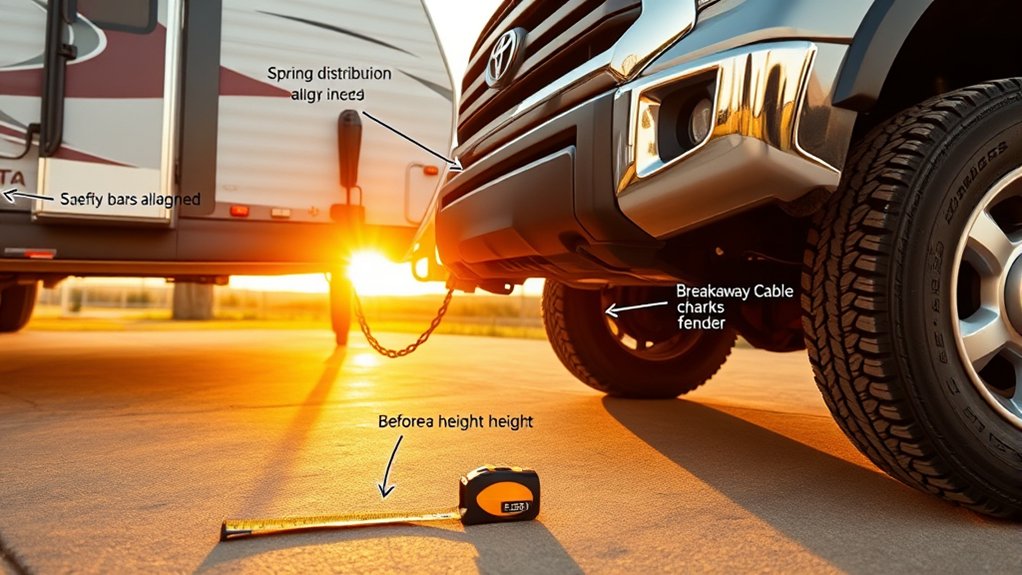
A conventional trailer’s tongue weight presses downward behind the Tundra’s rear axle. That leverage adds load to the rear axle and can remove some load from the front axle. The truck may squat at the rear, rise at the front, steer less precisely, and aim its headlights too high.
A weight distribution hitch uses spring bars to apply opposing leverage. When adjusted correctly, the system transfers part of the load change from the rear axle toward the Tundra’s front axle and the trailer axles. The goal is controlled axle loading and predictable handling—not making every axle carry the same weight.
A WDH does not reduce the trailer’s actual loaded weight, eliminate tongue weight, increase payload, or raise the ratings of the truck, receiver, ball, coupler, hitch head, spring bars, tires, or trailer. The complete combination must remain within every applicable rating.
Weight Distribution Versus Sway Control
Weight distribution and sway control are related but different functions. Weight distribution changes how the tongue load affects the tow vehicle and trailer axles. Sway control resists or helps damp side-to-side trailer movement. Some hitches combine both functions, while other systems require a separate sway-control device.
No hitch can correct a trailer that is overloaded, improperly loaded, mechanically defective, traveling too fast for conditions, or running with unsuitable tire pressure. Begin with correct loading and sound equipment before adjusting the hitch.
Warning: A weight distribution hitch does not increase the Toyota Tundra’s payload, GVWR, GAWR, GCWR, trailer-weight rating, receiver rating, or tire capacity. Never use spring-bar tension to disguise an overloaded truck or trailer.
Verify the Tundra, Trailer, and Hitch Ratings First
Before measuring ride height or assembling the hitch, find the limits for your exact towing combination. Use the certification label on the Tundra, the receiver label, the trailer certification label, and the manuals for all towing components.
Toyota provides model-specific manuals through its official Manuals and Warranties portal. Select the exact model year and vehicle rather than relying on a maximum towing figure or setup rule published for a different cab, drivetrain, axle, trim, powertrain, equipment package, or Tundra generation.
When Does a Toyota Tundra Need a Weight Distribution Hitch?
Toyota’s 2022 Tundra owner’s manual says a weight-distributing hitch with sufficient capacity is required when gross trailer weight is over 5,000 lb (2,268 kg). The same manual calls for a sway-control device with sufficient capacity when gross trailer weight is over 2,000 lb (907 kg). These are model-year-specific Toyota requirements; verify the manual for your exact Tundra before applying them to another year.
| Toyota Manual Example | Conventional Tongue Weight | WDH Front-Axle Target | Why It Matters |
|---|---|---|---|
| 2022 Tundra, OM0C029U | 9%–11% of gross trailer weight | Return the front axle to the same weight as before trailer connection; if using fender height, return it to the original height without pulling it below the original measurement | Provides a documented Toyota target instead of a generic restoration percentage |
| 2024 Tundra short manual, OM0C065U | 9%–11% of gross trailer weight | Return the front axle to its pre-trailer weight or front-fender height; do not reduce the front-fender height below the original measurement | Confirms the same basic measurement method in another current-generation manual |
| Older Tundra manuals | Can differ by model year and hitch type | Use the exact owner’s manual | Do not apply current-generation percentages or adjustment targets universally |
Why the model-year check matters: Toyota’s older OM34413U Tundra manual used different tongue-load guidance, including 15% for the weight-distributing-hitch application shown in that manual. The correct number is therefore the one published for the truck you actually own.
- GVWR: Maximum permitted weight of the loaded Tundra, including occupants, cargo, accessories, hitch equipment, and the portion of trailer weight carried by the truck.
- Front and rear GAWR: Maximum permitted load on each Tundra axle.
- GCWR: Maximum permitted combined weight of the loaded truck and loaded trailer, when specified.
- Trailer-weight rating: Maximum trailer weight allowed for the exact Tundra configuration and operating conditions.
- Receiver ratings: Check both the weight-carrying and weight-distributing limits printed on the receiver or listed by Toyota.
- Hitch-component ratings: The shank, head, ball, spring bars, brackets, pins, and coupler must each be rated for the application.
- Tire and wheel limits: Confirm the load capacity and required cold inflation pressure for the Tundra and trailer tires.
The lowest applicable rating controls the setup. A hitch rated for more weight does not override a lower truck, receiver, tire, or trailer limit.
Determine Loaded Trailer and Tongue Weight
Set up the hitch for the trailer as it will actually travel. Load propane, batteries, water, food, tools, camping equipment, spare tires, and other cargo in their normal positions. Load the Tundra with the expected passengers, bed cargo, accessories, and hitch equipment.
Do not size the spring bars from a brochure’s dry tongue weight. The actual tongue load can change significantly when batteries, propane cylinders, water, and cargo are added. For a 2022 Tundra, Toyota specifies 9%–11% tongue weight for conventional towing. The NHTSA’s general trailer guidance describes roughly 10%–15% for conventional trailers, but generic guidance does not override the Toyota manual for your exact truck or the requirements of the trailer and hitch manufacturers.
Choose the Correct Spring-Bar Rating
Select a hitch whose operating range includes the trailer’s measured travel-ready tongue weight. Some hitch manufacturers also instruct owners to account for cargo carried behind the Tundra’s rear axle when selecting or adjusting the spring bars.
Bars that are rated too low may not provide enough load transfer. Bars rated far above the actual application can create a harsh ride, make adjustment difficult, and place unnecessary stress on the trailer frame or hitch components. Use the hitch manufacturer’s sizing chart rather than choosing the highest available rating.
If Toyota’s instructions and the hitch manufacturer’s procedure appear to conflict, do not choose an arbitrary compromise. Stop the adjustment and confirm the correct procedure with Toyota and the hitch manufacturer before towing.
Measuring Your Toyota Tundra for Weight Distribution Hitch Setup
Accurate measurements help show how the trailer changes the Tundra’s stance and how much of the front-end rise is corrected by the WDH. Perform the measurements on firm, level ground with the truck and trailer loaded for travel.
Prepare the Truck and Trailer
- Inflate the Tundra and trailer tires to the cold pressures specified for the vehicle, trailer, tires, and load.
- Load the truck and trailer as they will travel, including passengers or equivalent ballast where practical.
- Park in a straight line on level pavement and chock the trailer wheels.
- Place the Tundra at its normal operating ride height.
- Level the trailer from front to rear before measuring the coupler height.
Note: If the Tundra has rear air suspension or automatic load leveling, follow Toyota’s model-specific towing procedure and the hitch manufacturer’s instructions. Automatic leveling can hide rear squat and may change when measurements or adjustments should be made.
Measuring Truck Height Accurately
Choose repeatable points directly above the center of the front and rear wheel hubs. Measure vertically from the ground through the hub center to the lower edge of the fender opening. Mark the points with removable tape so every reading is taken at the same location.
| Condition | Front Fender | Rear Fender | Purpose |
|---|---|---|---|
| Truck loaded, trailer disconnected | Record | Record | Establishes the loaded but unhitched baseline |
| Trailer coupled, spring bars not applying tension | Record | Record | Shows the effect of tongue weight without distribution |
| Trailer coupled, WDH engaged | Record | Record | Shows the result after spring-bar adjustment |
Do not use a generic target such as “restore 50% to 100%” unless it is actually specified for your truck and hitch. Toyota’s 2022 Tundra manual directs WDH users to return the front axle to the same weight as before trailer connection. If direct axle weighing is unavailable, Toyota says to return the front-fender height to its pre-trailer measurement and not reduce it below that original height. Check the manual for your exact model year before setting the target.
Assessing Trailer Coupler Height
With the trailer level and disconnected, measure from the ground to the top or inside seating surface of the coupler as directed by the hitch manual. Use that measurement to establish the initial ball height and determine whether the shank must be installed in the rise or drop position.
After the loaded trailer is coupled and the WDH is engaged, the trailer should normally remain close to level unless its manufacturer specifies a different attitude. If the trailer nose is noticeably high or low, change the hitch-head position on the shank rather than trying to correct all height error with additional spring-bar tension.
Installing a Weight Distribution Hitch: Step by Step
The following sequence applies broadly to weight distribution hitches, but the hitch manufacturer’s dimensions, fastener grades, bracket positions, lubrication points, and torque values control the installation.
1. Install the Shank and Hitch Head
Insert the correctly rated shank into the Tundra’s receiver in the rise or drop orientation needed for the measured coupler height. Secure it with the specified hitch pin and retaining clip or locking device.
Mount the hitch head at the initial height and angle stated in the hitch instructions. Only some systems use spacer washers to establish head tilt. Do not add or remove washers unless the design specifically calls for them.
2. Install and Torque the Hitch Ball
Use a ball with the correct diameter for the trailer coupler, the correct shank dimensions for the hitch head, and a rating at least as high as the loaded trailer weight. Tighten the ball nut and all hitch-head hardware to the manufacturer’s torque specifications with a suitable torque wrench.
3. Position the Frame Brackets
Measure the bracket location from the coupler or hitch ball exactly as instructed by the hitch manufacturer. Check for interference with propane trays, batteries, wiring, breakaway equipment, frame-mounted accessories, or structural welds.
Do not drill, weld, clamp, or relocate brackets in a way the hitch or trailer manufacturer prohibits. Some trailer-frame designs require special brackets or approval from the trailer manufacturer.
4. Couple the Trailer
- Back the Tundra squarely toward the trailer.
- Lower the coupler fully onto the hitch ball.
- Close and secure the coupler latch.
- Raise the tongue jack enough to confirm that the coupler is locked onto the ball.
- Connect the electrical plug, safety chains, and breakaway cable without wrapping the cable around a chain.
5. Attach and Tension the Spring Bars
Install the spring bars in the orientation required by the hitch design. If the trailer-jack and hitch manufacturers permit it, raise the coupled trailer tongue and rear of the Tundra together enough to reduce the force needed to engage the chains or frame brackets. Do not exceed the jack’s capacity or the procedure specified by the equipment manufacturers.
Pro Tip: Where the equipment instructions permit it, using the tongue jack to unload some spring-bar tension can make engagement and release easier. Keep clear of the bars and brackets, use the manufacturer’s lifting tool where required, and never place yourself in the path of stored spring force.
Set the initial chain link, bracket height, bar position, or tension setting specified in the hitch manual. “Bars parallel to the frame” is not a universal rule. Different systems require different loaded angles and clearances.
6. Lubricate Only Approved Points
Apply the specified lubricant only where the hitch manufacturer directs, such as certain ball sockets, pivots, or trunnion contact points. Do not grease friction surfaces used for integrated sway control unless the manufacturer expressly permits it.
7. Lower the Jack and Remeasure
Retract the tongue jack fully, allow the suspension to settle, and repeat the front and rear fender measurements. Compare the results with the Tundra and hitch instructions. For the 2022 Tundra, Toyota’s documented target is to return the front axle to its pre-trailer weight or, when weighing is unavailable, return the front fender to its original height without pulling it lower.
If more or less load restoration is required, adjust only one increment at a time. Depending on the design, that may involve head tilt, chain length, bracket height, or another manufacturer-defined setting. Retorque any fasteners disturbed during adjustment.
8. Check Trailer Attitude and Clearance
Confirm that the loaded trailer is level or at the attitude specified by its manufacturer. Check the spring bars, brackets, tongue jack, safety chains, electrical cable, breakaway cable, and sway-control parts through the expected range of turns and driveway angles.
Nothing should bind, drag, contact the frame incorrectly, or disconnect during a tight turn. Verify sufficient ground clearance beneath the hitch head and spring bars.
Verify the Setup With Axle Weights
Fender measurements are useful for initial setup, but axle weights provide the clearest picture of how the combination is loaded. A public scale that reports steer, drive, and trailer-axle groups can show whether the Tundra and trailer remain within their ratings.
For a useful three-pass comparison, keep passengers, fuel, cargo, tank levels, and removable hitch hardware in the same locations for every reading:
- Tundra alone: Loaded as it will travel, without the trailer attached.
- Trailer attached, spring bars not distributing: Shows the axle changes caused by the tongue load.
- Trailer attached, WDH engaged: Shows how the adjusted hitch transfers axle load.
If a scale operator or hitch manufacturer recommends a different weighing sequence, follow that procedure. CAT Scale publishes a general vehicle weighing guide, and other suitable multi-platform scales may provide equivalent axle-group readings.
Three-Pass Scale Worksheet
| Pass | Front / Steer | Rear / Drive | Trailer Axles | Total |
|---|---|---|---|---|
| A: Loaded Tundra only | Record | Record | — | Record |
| B: Trailer attached, bars off | Record | Record | Record | Record |
| C: Trailer attached, WDH engaged | Record | Record | Record | Record |
When the loading and hitch hardware remain consistent, the three passes allow several useful calculations:
- Loaded Tundra weight: Pass A front axle + Pass A rear axle.
- Loaded trailer weight: Pass B combined total − Pass A loaded Tundra total.
- Bars-off tongue load carried by the truck: (Pass B front + Pass B rear) − Pass A loaded Tundra total.
- Front-axle load removed by coupling: Pass A front − Pass B front.
- Front-axle load restored by the WDH: Pass C front − Pass B front.
Front-Axle Load Restoration
When the vehicle or hitch instructions specify front-axle load restoration, it can be calculated from the axle-scale readings:
Front-axle load restoration = (front axle with WDH − front axle hitched without WDH) ÷ (front axle unhitched − front axle hitched without WDH) × 100
A calculated 100% means the WDH returned the front axle to the loaded, unhitched baseline. For the 2022 Tundra, that matches Toyota’s stated target. Do not exceed the front GAWR, tire limits, or Toyota’s instruction not to pull the front fender below its original measurement. Use another target only when the manual for your exact Tundra and the hitch instructions support it.
Avoid These Common Weight Distribution Hitch Setup Mistakes
Improper Hitch Height Adjustment
Hitch-head height and spring-bar tension solve different problems. Head height establishes the trailer’s basic towing attitude. Spring-bar adjustment controls load transfer. Trying to correct a nose-high or nose-low trailer only by adding tension can create poor geometry and excessive component stress.
Reposition the head on the shank when ball height is incorrect. Adjust spring-bar tension only after the basic trailer attitude is close to the manufacturer’s target.
Ignoring Weight Distribution Balance
A level-looking truck can still be overloaded. Rear air springs, helper springs, and automatic leveling may raise the body without restoring the correct front-axle load or reducing the actual weight carried by the truck.
Check actual loaded tongue weight, Tundra payload, rear GAWR, receiver rating, and trailer loading. Cargo in the truck bed is not automatically unsafe, but its weight counts against payload and its position—especially behind the rear axle—can affect hitch adjustment.
Neglecting Regular Inspections
Inspect the complete system before every trip and again after the first short drive following installation or adjustment. Look for loose hardware, elongated holes, bent brackets, worn pins, damaged spring bars, cracked welds, abnormal coupler wear, or missing retaining clips.
Recheck torque at the interval stated by the hitch manufacturer. Paint settling, bracket movement, and normal break-in can reduce clamp load after the first trips.
Using the Wrong Spring-Bar Rating
Undersized bars may not restore the required load. Excessively stiff bars can produce a harsh ride and may overload hitch or trailer-frame components. Reweigh and reassess the bar range whenever the travel-ready tongue weight changes materially.
Assuming More Tension Is Safer
Excessive tension can transfer too much load to the Tundra’s front axle and the trailer axles, unload the rear axle more than intended, reduce traction, create a harsh ride, or overstress components. Stop increasing tension once the Toyota and hitch-manufacturer measurement targets are reached.
How to Fine-Tune Your Weight Distribution Hitch for Better Performance
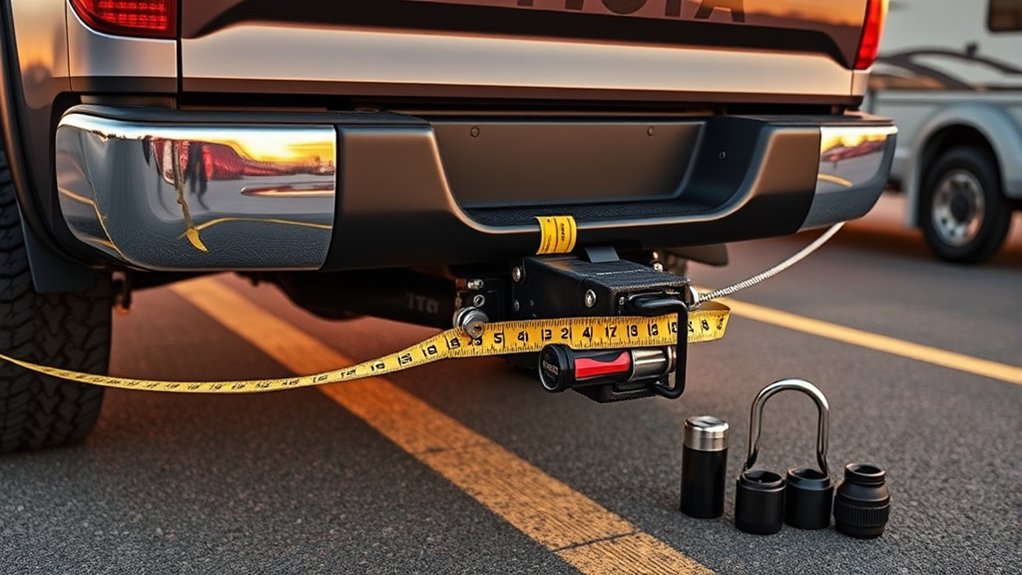
Fine-tune the hitch only after the trailer is fully loaded, the truck is at its normal travel load, the basic ball height is correct, and all tires are properly inflated.
- Record the three fender-height conditions or obtain the recommended axle-scale readings.
- Compare the front-end or front-axle result with the Toyota and hitch instructions for your exact equipment.
- Change one adjustment increment at a time.
- Settle the suspension and repeat every measurement after each change.
- Confirm the trailer attitude and all turning clearances.
- Retorque disturbed hardware to the specified value.
- Perform a controlled road test before entering highway traffic.
Signs of Too Little Tension
- The Tundra’s front rises more than the permitted amount.
- The rear squats excessively.
- Steering feels light or vague.
- Headlights aim noticeably upward.
- Scale readings show insufficient front-axle load restoration for the Toyota and hitch target.
Signs of Too Much Tension
- The front is pulled below the permitted measurement or front-axle load exceeds the intended baseline or rating.
- The rear axle is unloaded more than intended.
- The ride becomes unusually harsh or bouncy.
- Spring bars or brackets approach their travel or clearance limits.
- The trailer frame, brackets, or hitch components show abnormal stress or movement.
Conduct a Controlled Road Test
Begin in a large, open area at low speed. Check steering response, braking, trailer tracking, unusual noise, and turning clearance. Test the trailer brakes according to the brake-controller instructions. Increase speed gradually only when the combination behaves normally.
If sway begins, reduce speed smoothly and avoid abrupt steering. Follow the Tundra owner’s manual and trailer-brake-controller instructions for sway response. Investigate loading, tongue weight, tire condition, hitch adjustment, and mechanical condition before continuing the trip.
Maintaining Your Weight Distribution Hitch for Longevity
Regular care keeps the hitch operating as designed and helps reveal damage before it becomes a road hazard.
- Clean dirt, road salt, and debris from the hitch after use.
- Inspect bars, sockets, brackets, chains, pins, clips, welds, and fasteners for wear, deformation, or corrosion.
- Lubricate only the points specified in the hitch manual.
- Keep friction sway-control surfaces in the condition required by their manufacturer.
- Check hardware torque at the required intervals.
- Replace worn or damaged parts with correctly rated components approved for the hitch.
- Store removable components in a dry location and protect machined surfaces from corrosion.
- Repeat the setup measurements after changing tires, suspension height, hitch components, trailer loading, batteries, propane equipment, or water-tank use.
Essential Safety Tips for Towing With Your Toyota Tundra
Before every departure, complete a full walk-around inspection rather than checking only the spring bars.
- Confirm the coupler is fully seated, latched, and secured.
- Verify the receiver pin, hitch-head pins, spring-bar retainers, bracket pins, and clips are installed.
- Cross the safety chains beneath the tongue when required by the applicable instructions or law, leaving enough slack for turns without allowing them to drag.
- Attach the breakaway cable to the tow vehicle as directed by the trailer and breakaway-system manufacturers.
- Test brake lights, turn signals, running lights, hazard lights, and electric trailer brakes.
- Check Tundra and trailer tire pressures when cold and inspect tread and sidewalls.
- Retract and secure the tongue jack and stabilizers.
- Secure doors, steps, awnings, cargo, tanks, batteries, and loose equipment.
- Confirm the trailer is at its intended towing attitude and that no component has lost ground clearance.
- Use towing mirrors that provide the visibility required by local law and safe operation.
Allow more following distance, brake earlier, take turns wider, and reduce speed for wind, rain, rough pavement, downhill grades, and passing traffic. Comply with all applicable trailer-brake, breakaway, lighting, mirror, and speed requirements in the jurisdictions where you travel.
What Information Should You Record Before Asking for Setup Help?
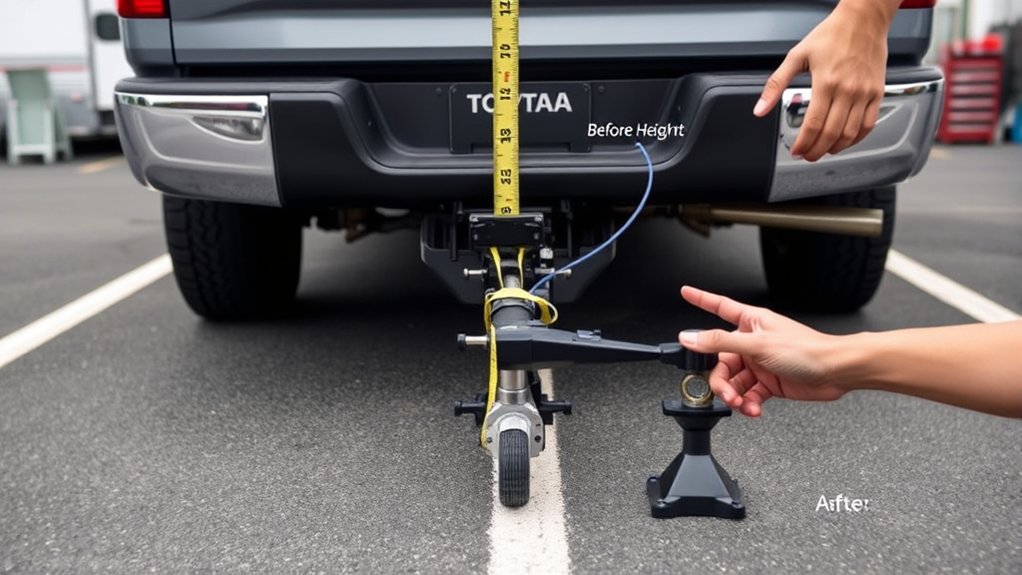
Owner groups, hitch installers, dealers, and towing communities can help diagnose an unusual setup, but their advice should supplement—not replace—the Toyota, trailer, receiver, and hitch manuals.
For useful feedback, record specific information rather than only sharing a photograph:
- Tundra model year, cab, drivetrain, powertrain, and suspension type
- Truck GVWR and front and rear GAWR
- Receiver’s weight-distributing rating
- Trailer GVWR and actual loaded trailer weight
- Actual loaded tongue weight
- Hitch manufacturer, model, and spring-bar rating
- Unhitched, bars-off, and bars-engaged measurements
- Steer, drive, and trailer-axle scale readings when available
Be cautious with advice that recommends a fixed number of chain links, washers, bracket holes, or pounds of tension without accounting for the exact hitch model, Tundra model year, loaded tongue weight, and measurements.
Related Guides
Frequently Asked Questions
How do you properly size a weight distribution hitch?
Use the trailer’s actual travel-ready tongue weight and loaded trailer weight. Confirm that the receiver, shank, head, ball, spring bars, brackets, and coupler are all appropriately rated. Some hitch manufacturers also require cargo carried behind the truck’s rear axle to be considered when choosing the spring-bar range.
When does a Toyota Tundra need a weight distribution hitch?
Toyota’s 2022 Tundra owner’s manual requires a weight-distributing hitch with sufficient capacity when gross trailer weight is over 5,000 lb. Requirements can differ by model year, so verify the owner’s manual, receiver rating, trailer instructions, and hitch instructions for your exact combination.
How tight should weight distribution bars be?
There is no universal chain-link count, washer count, bracket position, or spring-bar tension. Apply only enough tension to meet the front-axle or fender-height target specified by Toyota for your model year and the adjustment method specified by the hitch manufacturer.
How do you properly set up a weight distribution hitch?
Load the truck and trailer for travel, verify every rating, measure the loaded truck and level trailer on flat ground, set the ball height and hitch-head geometry, attach and tension the spring bars according to the hitch manual, remeasure the truck, verify axle loads when practical, check clearances and torque, and complete a controlled test drive.
Can you put too much tension on weight distribution bars?
Yes. Excessive tension can transfer too much load to the front and trailer axles, reduce rear-axle load more than intended, create a harsh ride, reduce traction, or stress the hitch and trailer frame. Stop adjusting when the Toyota and hitch-manufacturer targets are met.
Do rear airbags replace a weight distribution hitch?
No. Rear airbags or automatic leveling can raise the truck’s body and reduce visible squat, but they do not perform the same axle-load transfer as a WDH. They also do not increase payload, axle, receiver, or tire ratings.
Can a weight distribution hitch eliminate trailer sway?
Not by itself. Some WDH systems include integrated sway resistance, but no system can compensate for incorrect tongue weight, poor cargo placement, excessive speed, unsuitable tire pressure, worn suspension parts, or an overloaded combination. Correct the cause of persistent sway before continuing to tow.
Should spring bars remain attached while backing up?
It depends on the hitch design and the maneuver. Some systems permit normal backing with the bars and integrated sway control engaged; other sway-control devices must be disconnected before reversing or making very tight turns. Follow the instructions for the exact hitch and sway-control system.
Sources
- Toyota Manuals and Warranties — official portal for selecting the exact Tundra model year and owner’s manual
- Toyota 2022 Tundra Owner’s Manual — conventional tongue-weight guidance, WDH and sway-control thresholds, front-axle restoration, and towing limits
- Toyota 2024 Tundra Owner’s Manual, Short Version — conventional tongue-weight and front-axle/fender-height guidance
- Toyota Tundra Owner’s Manual OM34413U — example showing why older Tundra tongue-load guidance must be checked by model year
- National Highway Traffic Safety Administration: Trailer Towing — general trailer loading, tongue-weight, equipment, and towing-safety guidance
- SAE J2807 — standardized performance requirements used in determining tow-vehicle combination and trailer-weight ratings
- CAT Scale: How to Weigh — general instructions for obtaining axle-group weights at a public scale
Conclusion
A properly configured weight distribution hitch can help restore the axle loading Toyota specifies and improve the towing behavior of a Toyota Tundra, but only when the truck, trailer, receiver, hitch, tires, and cargo remain within all applicable ratings. Start with the owner’s manual for your exact model year, use travel-ready weights, establish repeatable baseline measurements, follow the hitch-specific adjustment procedure, and verify the result with axle-scale readings when practical. Record the final measurements and settings so you can repeat the check after meaningful changes to cargo, tanks, suspension height, tires, hitch hardware, or trailer equipment.
