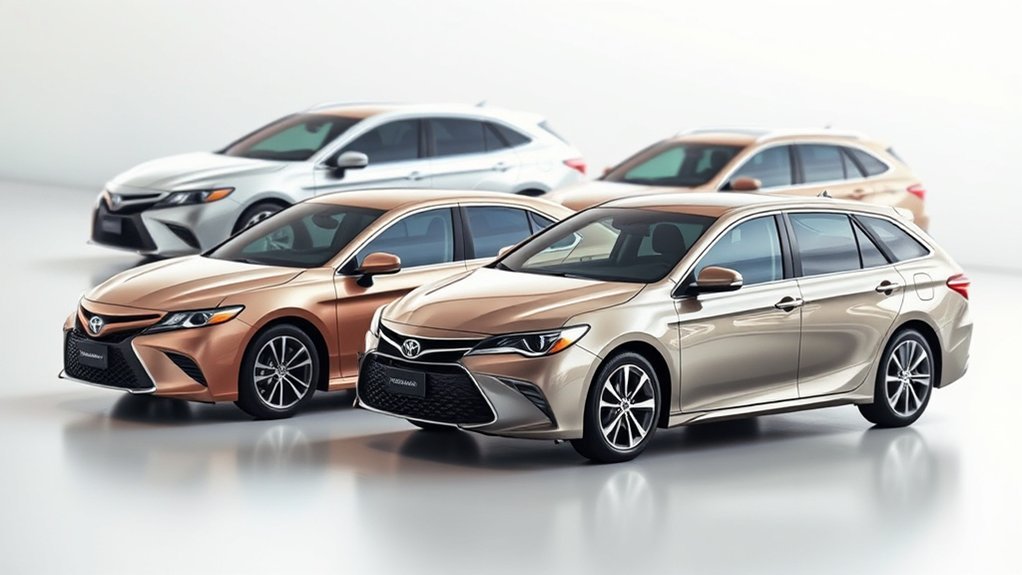
The Toyota Camry has changed from a compact front-wheel-drive sedan and liftback into the midsize, four-door hybrid sedan sold today. Along the way, U.S. buyers saw a wagon, a two-door Camry coupe, and the related Camry Solara coupe and convertible. This guide uses North American model years because Camry body styles and generation dates differed in Japan and other markets.
Quick Answer
The U.S. Toyota Camry arrived for 1983 as a sedan and five-door liftback. A wagon joined for 1987, and a coupe followed for the 1994 model year. The U.S. Camry became sedan-only for 1997, while the separate Camry Solara later carried the coupe and convertible idea through 2008.
Key Takeaways
- The first U.S.-market Camry was offered as a four-door sedan and five-door liftback for the 1983 model year.
- The Camry wagon was sold in the United States from the 1987 through 1996 model years.
- A two-door Camry coupe appeared for 1994–1996; the related Camry Solara coupe arrived for 1999, followed by a convertible.
- Since the 1997 model year, the U.S. Camry itself has remained a four-door sedan.
- The ninth-generation 2025 Camry became hybrid-only in North America, but that powertrain change did not create a new body style.
The Evolution of Toyota Camry Body Styles
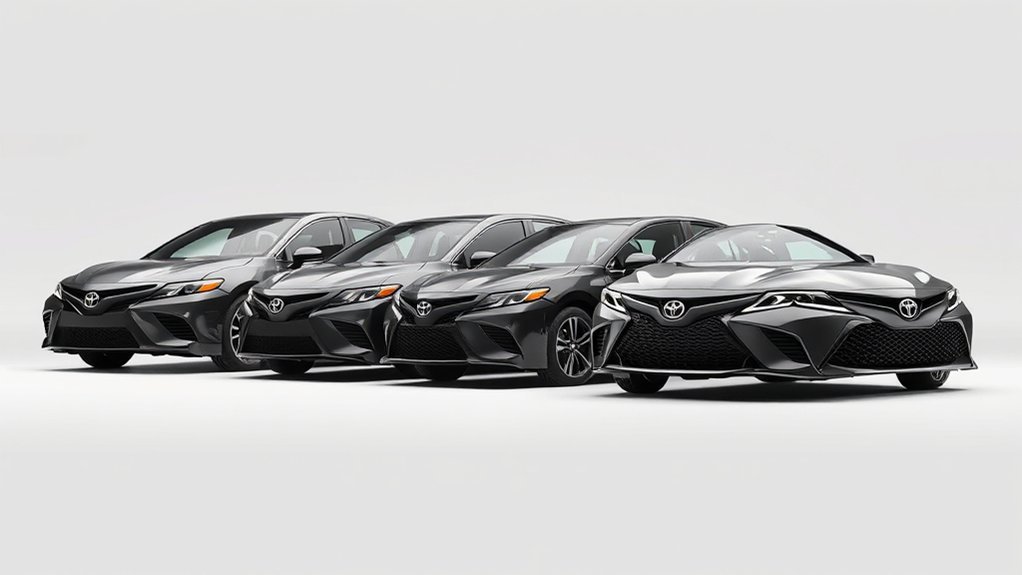
Toyota launched the front-wheel-drive Camry in Japan on March 24, 1982, and began exporting it to the United States in January 1983. The early U.S. lineup included a sedan and a five-door liftback. Later generations added a wagon and coupe as Toyota expanded the Camry from a compact car into a larger midsize family vehicle.
The widest range of U.S. Camry body styles appeared in the 1990s. The third generation offered a sedan, wagon, and coupe. For 1997, the U.S. Camry returned to a sedan-only lineup. Toyota then introduced the Camry Solara as a separately marketed, Camry-derived coupe for the 1999 model year; a convertible followed for 2000.
From 2007 onward, changes such as hybrid power, all-wheel drive, the TRD trim, and the Nightshade Edition altered the Camry’s performance or appearance without changing its basic four-door sedan body.
Note: Generation dates below follow U.S. model years. Toyota sold different Camry lineages and body styles in some international markets, so a global timeline may not match the North American one exactly.
| Generation | U.S. Model Years | Camry Body Styles | Major Change |
|---|---|---|---|
| First | 1983–1986 | Sedan, five-door liftback | Front-wheel-drive Camry reaches the U.S. |
| Second | 1987–1991 | Sedan, wagon | Wagon replaces the liftback |
| Third | 1992–1996 | Sedan, wagon, coupe | Camry grows into the midsize class; coupe joins for 1994 |
| Fourth | 1997–2001 | Sedan | U.S. Camry becomes sedan-only; Solara arrives separately |
| Fifth | 2002–2006 | Sedan | Taller, roomier sedan; Solara remains a separate model |
| Sixth | 2007–2011 | Sedan | First Camry Hybrid |
| Seventh | 2012–2017 | Sedan | Sharper styling and newer multimedia features |
| Eighth | 2018–2024 | Sedan | Lower TNGA-based shape, TRD trim, and available AWD |
| Ninth | 2025–present | Sedan | Hybrid-only North American lineup with available AWD |
First Generation (1983–1986): Sedan and Liftback
The first front-wheel-drive Camry was launched in Japan in March 1982, while U.S. sales began for the 1983 model year. American buyers could choose a conventional four-door sedan or a five-door liftback with a large rear hatch.
The transverse-engine, front-wheel-drive layout created useful passenger space in a compact footprint. Four-cylinder engines emphasized fuel economy and everyday reliability rather than high performance. This generation established the formula that would define the Camry for decades: easy driving, practical packaging, and low operating demands.
The liftback matters because it was the Camry’s first cargo-friendly alternative to the sedan. It was not a wagon, though; its rear roofline sloped more sharply, and its hatch opened with the rear glass.
Second Generation (1987–1991): The Wagon Replaces the Liftback
For 1987, Toyota redesigned the Camry and replaced the five-door liftback with a station wagon. The wagon had a longer, more upright cargo area, making it better suited to families and drivers who needed extra carrying capacity.
The second-generation range also expanded beyond the basic four-cylinder, front-wheel-drive formula. A V6 became available, and selected models offered Toyota’s All-Trac all-wheel-drive system. Those were powertrain and drivetrain choices rather than separate body styles, but they broadened the Camry’s appeal in snow-belt markets.
| Feature | Details |
|---|---|
| Body styles | Four-door sedan and five-door station wagon |
| Engine choices | Four-cylinder engines, plus an available 2.5-liter V6 in North America |
| Drivetrain | Front-wheel drive; All-Trac all-wheel drive on selected models |
| Practicality change | The wagon’s upright rear body provided more useful cargo room than the outgoing liftback |
Third Generation (1992–1996): Sedan, Wagon, and Coupe
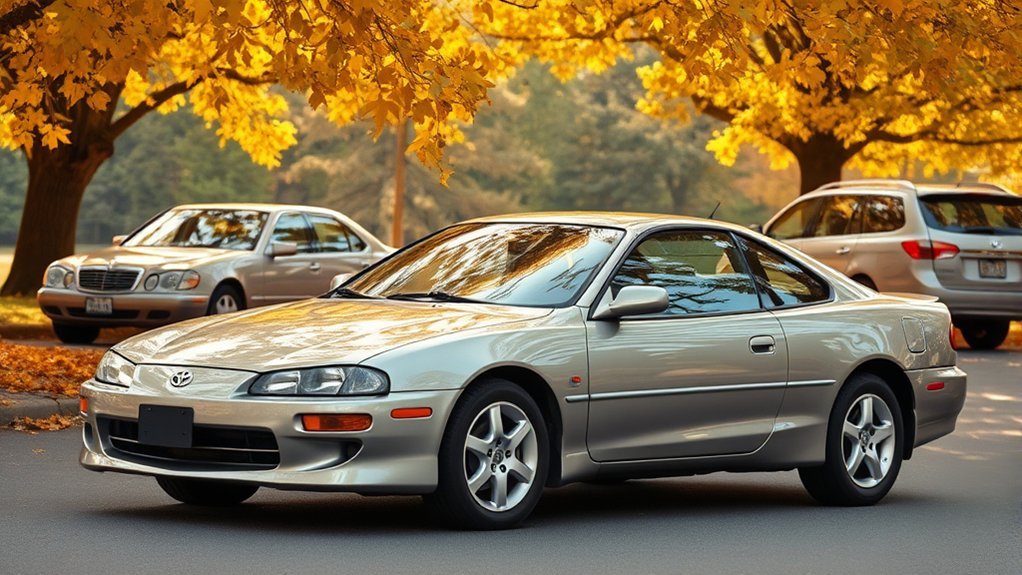
The third-generation Camry grew wider and moved firmly into the midsize class in North America. It also offered the broadest body-style range in U.S. Camry history: a four-door sedan, five-door wagon, and two-door coupe.
Coupe Design Features
The two-door Camry coupe joined the U.S. lineup for the 1994 model year. It shared the sedan’s platform and much of its practical character, but used a lower-looking roofline, longer front doors, and two-door proportions to attract buyers who wanted a sportier appearance.
The coupe was more of a comfortable personal car than a dedicated sports car. It retained usable seating and familiar Camry controls, which made it an easy transition for buyers who liked the sedan but preferred two doors.
Engine Options Offered
Depending on model and trim, the third-generation Camry used a 2.2-liter four-cylinder or an available 3.0-liter V6. The V6 provided stronger acceleration, while the four-cylinder remained the value and efficiency choice. Both engines were available in the wider Camry family, so the coupe’s identity came mainly from its body rather than a unique powertrain.
Market Reception and Legacy
The coupe gave Toyota a direct two-door entry in the midsize market, while the wagon served families who needed more cargo room. Neither matched the sedan’s sales volume, and both disappeared from the U.S. Camry lineup after the 1996 model year.
The short-lived coupe still mattered: it created a bridge to the Camry Solara, which Toyota developed as a more distinct coupe for the end of the decade.
Fourth Generation (1997–2001): Sedan-Only Camry and the Solara
The redesigned 1997 U.S. Camry was sold only as a four-door sedan. Toyota did not offer a North American Camry wagon or regular Camry coupe in this generation, although wagons continued in some other markets.
For the 1999 model year, Toyota introduced the Camry Solara, a separately marketed coupe based on Camry mechanical components. The Solara used a more expressive exterior and a different name to establish a stronger identity than the previous Camry coupe. A Solara convertible joined for the 2000 model year.
Available four-cylinder and V6 engines gave Solara buyers a choice between lower running costs and stronger performance. The important distinction is that the Solara was related to the Camry, but it was not simply another trim level of the four-door Camry sedan.
| Feature | Camry Sedan | Camry Solara |
|---|---|---|
| U.S. introduction | 1997 model year | 1999 model year |
| Body styles | Four-door sedan | Two-door coupe; convertible from 2000 |
| Positioning | Mainstream midsize family car | More style-focused Camry-derived personal car |
| Relationship | Core Camry model | Separate nameplate sharing Camry roots |
Fifth Generation (2002–2006): A Taller, Roomier Sedan
The fifth-generation U.S. Camry remained a four-door sedan. Its taller roof, longer wheelbase, and more rounded shape created a roomier cabin and improved ease of entry compared with the lower-looking fourth generation.
Base, LE, SE, and XLE grades let buyers choose between value, sportier styling, and additional comfort features. Four-cylinder and V6 engines continued, but those choices did not alter the body shell.
The Camry Solara also continued as a separate coupe and convertible, receiving its own second generation for the 2004 model year. This parallel lineup let Toyota keep the high-volume Camry focused on sedan buyers while serving two-door customers with the Solara.
When the Camry Wagon, Coupe, and Solara Disappeared
- Camry liftback: Last offered in the United States for the 1986 model year, then replaced by the wagon.
- Camry wagon: Last offered in the United States for the 1996 model year.
- Camry coupe: Offered for the 1994–1996 model years.
- Camry Solara: Continued the coupe idea from the 1999 model year and added a convertible for 2000; U.S. production ended after the 2008 model year.
These dates explain why a “Camry wagon” or “Camry coupe” search can produce different answers. Some sources discuss calendar-year production, some use model years, and others include body styles sold outside North America.
Sixth Generation (2007–2011): New Shape and the First Camry Hybrid
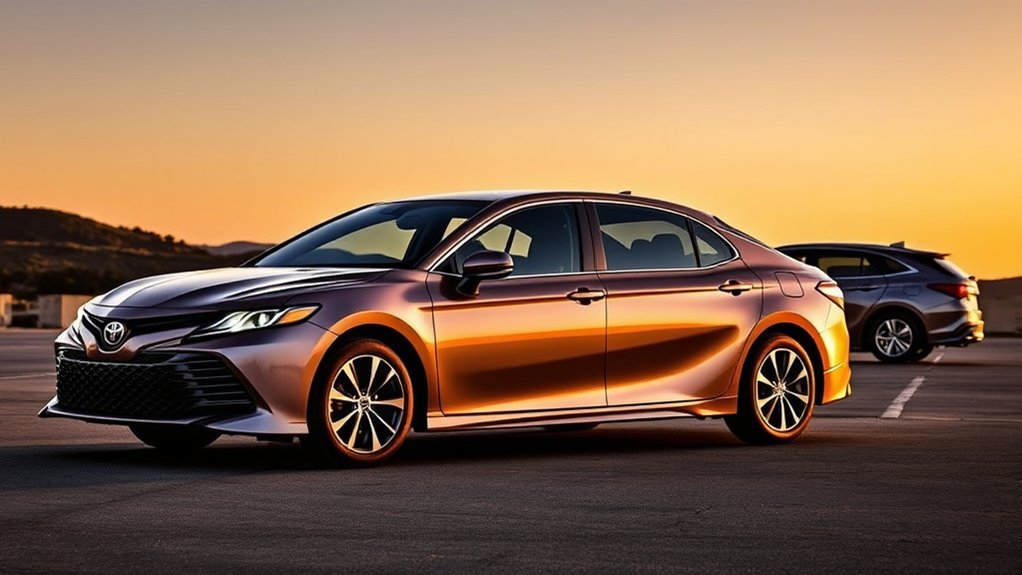
The sixth-generation Camry kept the four-door sedan body but adopted a more swept-back profile, a shorter-looking deck, and a more pronounced grille. The lineup included four-cylinder and V6 models, while the new Camry Hybrid added an electric motor and battery to improve fuel economy.
[Amazon Products Picked for You]

Replacement Batteries for a 2007-2011 Toyota Camry and Camry Hybrid Smart Key with a low or dead battery.

Fitment:Compatible for Camry 2007-2011,OEM Part Number:7440406040

OEM-Compatible Hybrid Battery Module - Specifically designed for Hybrid vehicles, ensuring a perfect fit and seamless integration.
Enhanced Engine Options
The available 3.5-liter V6 produced 268 horsepower in U.S. specifications, giving the Camry much stronger acceleration than the base four-cylinder. The more important long-term development was the 2007 Camry Hybrid, the first hybrid version of the model. Toyota began Camry Hybrid production in January 2006 for the new model-year launch.
Stylish Interior Design
The cabin emphasized space, simple controls, and broad trim choices. Higher grades offered upgraded audio, navigation, leather seating, and additional convenience features. Toyota’s Entune multimedia system does not belong to the core sixth-generation story: Toyota unveiled Entune in January 2011, and it became associated with the next-generation 2012 Camry.
Improved Safety Features
Anti-lock brakes, stability control, traction control, brake assist, and multiple airbags became important parts of the Camry’s safety package during this era. Crash-test results should always be checked by exact model year and configuration because test procedures and ratings can change; one broad rating should not be applied to every 2007–2011 Camry.
Seventh Generation (2012–2017): Sharper Styling and a Major Refresh
The 2012 Camry remained a sedan but introduced crisper body lines, a more angular front end, and a lighter-looking cabin design. Toyota offered four-cylinder, V6, and hybrid powertrains, while available Entune multimedia connected compatible phones with navigation, information, and entertainment functions.
For 2015, Toyota completed an unusually extensive mid-cycle update. Most exterior panels changed, the cabin received revisions, and the sport-oriented XSE grade joined the lineup. The update made the car look substantially newer without creating a new body style or a separate generation.
The seventh generation shows why “body style” and “styling” should not be treated as the same thing. The sheet metal changed dramatically in 2015, but every U.S. model remained a four-door sedan.
Eighth Generation (2018–2024): Lower Proportions, TNGA, and Sport Trims
The eighth-generation Camry moved to Toyota’s TNGA-based GA-K platform. It retained a four-door sedan body but used a lower roofline, wider stance, and more sculpted surfaces to create a sportier appearance.
LE and XLE grades emphasized comfort, while SE and XSE versions used more aggressive fascias and sport-themed details. The TRD model went further with aerodynamic add-ons, suspension tuning, larger brakes, and a V6, but TRD was still a trim of the same sedan—not a coupe or separate body style.
Four-cylinder, V6, and hybrid powertrains were available during this generation. Toyota also returned all-wheel drive to the gasoline Camry lineup for the 2020 model year. Again, drivetrain choice did not change the body configuration.
[Amazon Products Picked for You]
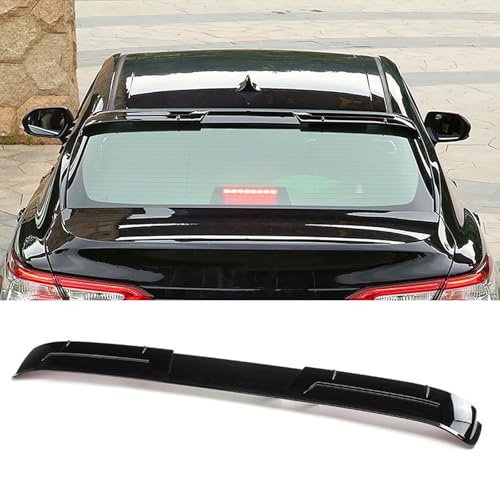
Accurate Fitment:Our roof spoiler is compatible with Toyota Camry LE SE XLE XSE 4-Door Sedan Models 2024 2023 2022 2021 2020 2019 2018.

COMPATIBILITY: Specifically designed to fit 2018-2024 Toyota Camry SE, XSE models for a perfect factory-style installation

【Precise Fit & Direct Replacement】 Specifically designed for 2018 2019 2020 2021 2022 2023 2024 Toyota Camry SE XSE TRD (Note:Not fit LE XLE )|OEM Replacement:52166-06030, 52165-06030, 5216506030, 5216606030|Partslink Number: TO1139104,TO1138104
Ninth Generation (2025–Present): Hybrid-Only, Still a Sedan
The ninth-generation Camry debuted for the 2025 model year as a four-door sedan with revised front and rear styling, a redesigned cabin, and Toyota’s fifth-generation hybrid system. In North America, every grade is a hybrid. Front-wheel-drive versions produce a combined 225 horsepower, while available electronic on-demand all-wheel drive raises combined output to 232 horsepower.
This was not the first Camry Hybrid—the hybrid dates to the 2007 model year. What changed for 2025 was that hybrid power became standard across the North American Camry lineup, and all-wheel drive became available with the hybrid system.
The LE and XLE grades retain a more traditional appearance, while SE and XSE models use sportier front styling, wheels, and chassis tuning. For 2026, Toyota added a Nightshade Edition based on the SE with black exterior details and bronze-finished wheels. None of these grades changes the Camry’s basic sedan body.
The modern Camry’s biggest change is under the skin: the ninth-generation North American lineup is exclusively hybrid, yet the car remains a conventional four-door sedan.
Body Style vs. Trim, Powertrain, and Drivetrain
Camry descriptions often mix four different terms. Keeping them separate makes generation comparisons much clearer:
- Body style: The vehicle’s basic shape and door/cargo layout, such as sedan, wagon, liftback, coupe, or convertible.
- Trim: An equipment or appearance grade, such as LE, XLE, SE, XSE, TRD, or Nightshade.
- Powertrain: The engine and propulsion system, such as four-cylinder gasoline, V6, or hybrid.
- Drivetrain: Which wheels receive power, such as front-wheel drive or all-wheel drive.
A Camry Hybrid, Camry XSE, or Camry AWD may look or drive differently from another version, but each can share the same four-door sedan body style.
Pro Tip: When shopping for a used Camry, identify the exact model year, trim, engine, and VIN instead of relying only on the generation name. Equipment, safety ratings, recalls, and common repairs can vary within one generation.
[Amazon Products Picked for You]

O.D.(outside diameter): 24 mm / 0.94 inch , I.D.(inside diameter): 18 mm / 0.71 inch , Thickness: 2 mm / 0.08 inch

📨【Pre-Purchase Notes】 Please confirm the fitment of your vehicle's year, model, radiator size and radiator type by using the owner's manual or actual measurements. Double check with the applicable model information and Amazon Fitment provided by us to confirm that there is no error before placing your order to avoid not being able to use it after purchase.

TAILORED UPHOLSTERY - This OEM-style armrest skin cover is expertly designed for Toyota Camry 2012 2013 2014 2015 2016 2017, fits just like the original part. (NOT SLIP-ON COVER, Adhesive Not Included)
Related Guides
Frequently Asked Questions
What year did the Toyota Camry body style change?
The Camry received full U.S. generation changes for 1987, 1992, 1997, 2002, 2007, 2012, 2018, and 2025. The most important body-type changes were the wagon replacing the liftback for 1987, a coupe joining for 1994, and the U.S. Camry becoming sedan-only for 1997. Mid-cycle redesigns, such as the extensive 2015 update, changed the styling without changing the body type.
When did Toyota stop making the Camry wagon?
For the U.S. market, the final Camry wagon was the 1996 model. The redesigned 1997 Camry was sedan-only in North America. Toyota continued to sell related Camry wagons in some other countries, which is why global sources may show later dates.
What are the different generations of the Toyota Camry?
Using U.S. model years, the generations are 1983–1986, 1987–1991, 1992–1996, 1997–2001, 2002–2006, 2007–2011, 2012–2017, 2018–2024, and 2025–present. Japanese and other international Camry lineages do not always use the same dates.
What Toyota Camry model years should you avoid?
There is no responsible universal “avoid” list based only on model year. A well-maintained example from a less-favored year may be a better purchase than a neglected car from a highly rated year. Check the VIN for open recalls, review maintenance records, scan for diagnostic codes, inspect for collision or flood damage, and arrange an independent pre-purchase inspection.
Was there ever a Toyota Camry hatchback?
Yes. The first U.S.-market front-wheel-drive Camry was available as a five-door liftback for the 1983–1986 model years. A liftback is a hatchback-style body with a sloping rear roofline. Toyota replaced it with a more upright station wagon for 1987.
Is the Camry Solara a regular Camry coupe?
The Solara was a Camry-derived model, but Toyota marketed it under the distinct Camry Solara name. It succeeded the 1994–1996 Camry coupe, arrived for the 1999 model year, and later offered both coupe and convertible body styles.
Conclusion
The Toyota Camry’s body-style history is more varied than its current sedan-only lineup suggests. U.S. buyers once had liftback, wagon, and coupe choices, while the Camry Solara extended the two-door idea with coupe and convertible versions. Since 1997, however, the core U.S. Camry has stayed a four-door sedan.
Recent labels such as Hybrid, AWD, TRD, XSE, and Nightshade describe powertrains, drivetrains, or trims—not new body styles. The 2025 redesign therefore represents a major mechanical shift to a hybrid-only North American lineup while preserving the familiar sedan format.
Sources
- Toyota Motor Corporation: Development of Front-Wheel-Drive Vehicles — verifies the March 1982 Japanese launch and January 1983 start of U.S. exports.
- Toyota Motor Corporation: Tsutsumi Plant History — documents front-wheel-drive Camry production and the January 2006 start of Camry Hybrid production.
- Toyota USA Newsroom: Entune Announcement — establishes that Entune was unveiled in January 2011, not at the beginning of the 2007–2011 generation.
- Toyota USA Newsroom: 2025 Camry Reveal — verifies the ninth generation’s hybrid-only North American lineup, available AWD, and 225/232-horsepower outputs.
- Toyota USA Newsroom: 2026 Camry — verifies the Nightshade Edition and current trim updates.
- National Highway Traffic Safety Administration: Recall Lookup — provides VIN-specific open-recall information for used-vehicle research.
