The Toyota Camry has changed a lot since it became its own model line in the early 1980s. What started as a compact, efficient family car grew into one of the best-known midsize sedans in the U.S., then moved into its current hybrid-only era. If you are comparing used Camrys or trying to understand the latest model, the easiest way to follow the story is by generation.
Last Updated: July 4, 2026
Quick Answer
The Toyota Camry has nine main U.S. model-year generations: 1983–1986, 1987–1991, 1992–1996, 1997–2001, 2002–2006, 2007–2011, 2012–2017, 2018–2024, and 2025–present. The newest generation is hybrid-only in the U.S. and continues for the 2026 model year.
Key Takeaways
- The Camry moved from a compact sedan into a mainstream midsize family car during the 1990s.
- The fifth generation, sold for the 2002–2006 U.S. model years, is a key era that should not be skipped.
- The sixth generation introduced the Camry Hybrid to U.S. shoppers for the 2007 model year.
- The eighth generation was the last U.S. Camry generation to offer a V6 engine.
- The ninth generation, starting with 2025, uses an all-hybrid U.S. lineup with available electronic on-demand all-wheel drive.
Note: Camry generation years can vary by country, production date, and source. The timeline below uses common U.S. model-year ranges because most shoppers search Camry generations by U.S. used-car listings.
The Evolution of the Toyota Camry: A Timeline of Generations
The Camry name became a stand-alone Toyota model line in the early 1980s. In the U.S., buyers usually group the Camry into nine main model-year generations. Each one reflects a shift in what family-sedan shoppers wanted at the time, from basic efficiency to comfort, safety tech, stronger engines, and now hybrid efficiency.
| Generation | U.S. Model Years | What Changed |
|---|---|---|
| First | 1983–1986 | Front-wheel-drive layout, efficient four-cylinder engines, sedan and liftback body styles. |
| Second | 1987–1991 | More rounded styling, available wagon, available V6, and growing U.S. production. |
| Third | 1992–1996 | A wider, more refined midsize Camry that helped define the car’s family-sedan identity. |
| Fourth | 1997–2001 | Cleaner styling, strong reliability reputation, and the Camry’s first year as America’s best-selling passenger car. |
| Fifth | 2002–2006 | Larger cabin, smoother ride, updated four-cylinder and V6 choices, and a more comfort-focused feel. |
| Sixth | 2007–2011 | Camry Hybrid arrived, giving shoppers a fuel-saving option beside gas four-cylinder and V6 models. |
| Seventh | 2012–2017 | More angular styling, improved interior packaging, continued hybrid availability, and no manual transmission in the U.S. |
| Eighth | 2018–2024 | TNGA platform, sharper styling, available V6, stronger hybrid models, and more standard safety tech. |
| Ninth | 2025–present | All-hybrid U.S. lineup, available electronic on-demand AWD, updated cabin tech, and current 2026 trims. |
The fourth generation deserves special mention because the Camry became America’s best-selling passenger car for the first time in 1997, according to Car and Driver. That moment helped cement the Camry as a default choice for shoppers who wanted a dependable sedan with low drama.
The Camry’s biggest story is not one single redesign. It is the steady shift from compact efficiency to midsize comfort, then from V6 power to hybrid-first engineering.
Key Innovations in Each Camry Generation
Each Camry generation added something that matched its era. Early models focused on fuel economy and simple packaging. The 1990s models pushed the Camry deeper into the midsize class, where comfort, cabin room, and quiet driving mattered more.
The first and second generations gave Toyota a practical front-wheel-drive sedan for U.S. buyers. The second generation added a more mature shape and an available V6, which helped the Camry compete with larger family cars.
The third generation made the Camry feel more substantial. It became wider, smoother, and more refined, which helped move the car away from its compact roots. The fourth generation improved the formula with a cleaner design, strong four-cylinder and V6 choices, and a reputation that carried into the used-car market.
The fifth generation, sold from 2002 through 2006 in the U.S., should not be overlooked. It brought a roomier body, a softer ride, and a more relaxed personality. If you shop used Camrys today, you will still see many fifth-generation cars because that era earned a strong durability reputation.
The sixth generation was a major turning point because it introduced the Camry Hybrid to U.S. buyers. From there, Toyota kept improving hybrid performance until the ninth generation made the U.S. Camry lineup fully hybrid.
Pro Tip: When comparing used Camrys, shop by exact model year, trim, engine, service history, and recall status. A well-maintained older Camry can be a better buy than a newer one with poor maintenance records.
Powertrain Evolution: From Four-Cylinder Engines to Hybrid Technology
The Camry’s powertrain story starts with practical four-cylinder engines. Early models were built around economy and simple daily driving. As the Camry grew, Toyota added V6 options for shoppers who wanted smoother highway passing and stronger acceleration.
The V6 became an important part of the Camry’s identity through several generations. It gave the sedan a more premium feel, especially in higher trims. The eighth generation, sold for the 2018–2024 U.S. model years, was the final U.S. Camry generation to offer a V6.
The hybrid shift began before the Camry became hybrid-only. The sixth generation introduced the Camry Hybrid, and later generations improved power delivery, fuel economy, and everyday drivability. By the eighth generation, the hybrid version no longer felt like a niche fuel-saver. It became one of the smartest versions for many buyers.
The ninth generation changed the lineup more dramatically. The current U.S. Camry uses an all-hybrid powertrain strategy. Toyota’s current Camry page lists up to 232 net combined horsepower, available Front-Wheel Drive or Electronic On-Demand All-Wheel Drive, and up to an EPA-estimated 51 combined MPG for the 2026 model.
Design Evolution of the Toyota Camry Generations
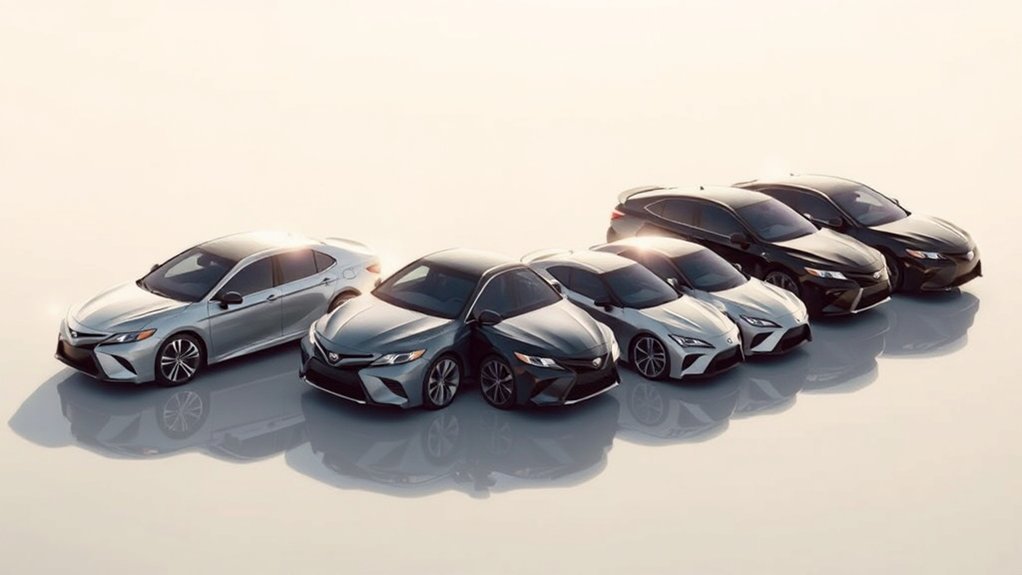
Camry design has moved from simple and boxy to sharper and more expressive. The earliest cars looked practical because that was the point. They gave drivers an efficient sedan without extra flash.
The 1990s Camry generations looked smoother and more mature. Toyota used softer lines, calmer cabins, and a more refined shape to appeal to families and commuters. The fourth and fifth generations leaned into that calm, dependable image.
The sixth and seventh generations brought more visual weight. They looked larger, more comfortable, and more mainstream. The eighth generation made a stronger style shift with a lower stance, bolder front end, and sportier trims.
The ninth generation keeps the sedan format but gives it a more modern hybrid-era identity. The current 2026 Camry offers trims such as LE, SE, Nightshade, XLE, and XSE, with different wheel designs, interior finishes, and comfort features.
| Era | Design Personality | Best Known For |
|---|---|---|
| 1980s | Simple, upright, efficient | Compact practicality and fuel economy |
| 1990s | Smoother and more refined | Mainstream midsize comfort |
| 2000s | Larger and softer | Ride comfort and cabin space |
| 2010s | Sharper and more aggressive | Sportier trims and better tech |
| 2020s | Modern, low, hybrid-focused | All-hybrid power and available AWD |
What Changed With the 2025 and 2026 Camry?
The 2025 Camry started the ninth generation, and the 2026 model continues that same era. The biggest change is simple: the U.S. Camry lineup is now hybrid-only. That means you no longer choose between a gas-only four-cylinder, V6, or hybrid. Every current Camry uses a hybrid system.
For 2026, Toyota lists up to 232 net combined horsepower and available Electronic On-Demand All-Wheel Drive. The LE trim is the fuel-economy leader, with Toyota listing up to an estimated 51 combined MPG. Higher trims focus more on style, larger screens, upgraded materials, and comfort features.
Technology also moved forward. Toyota lists Toyota Safety Sense 3.0 on the current Camry, along with features such as available 12.3-inch displays, available JBL premium audio, wireless charging, and standard Blind Spot Monitor on the current lineup.
Warning: Do not assume every used Camry has the same safety equipment. Features vary by model year, trim, package, and market, so check the original window sticker, owner’s manual, and recall history before buying.
How Camry Safety Has Changed Over Time
Older Camrys relied on simpler safety basics, while newer generations added stronger crash structures, more airbags, stability control, and driver-assistance features. That does not mean every newer Camry is automatically the right buy, but it does mean safety equipment changed a lot over the model’s life.
The current-generation Camry performs well in modern testing. The Insurance Institute for Highway Safety named the 2025 Toyota Camry a Top Safety Pick+, and several IIHS ratings apply to 2025–2026 models. IIHS also notes that the redesigned Camry is now available only as a hybrid.
If safety is your top priority, compare exact model years instead of relying only on generation labels. A newer trim with more driver-assistance features may suit you better than an older base model, even if both carry the Camry name.
Which Camry Generation Is Best for You?
The best Camry generation depends on what you want from the car. For a budget used car, the fifth and sixth generations can be appealing when they have strong maintenance records. For newer comfort and better tech, the seventh and eighth generations give you more modern interiors and safety features.
If fuel economy matters most, look closely at hybrid models. The sixth generation introduced the Camry Hybrid, but later hybrid versions are usually smoother, quicker, and more refined. The ninth generation is the easiest choice if you want a new Camry because every current U.S. trim is hybrid.
If you want V6 power, focus on older generations that offered it, especially the seventh and eighth generations. Just remember that fuel costs, insurance, condition, and maintenance history matter more than horsepower alone.
Related Guides
Frequently Asked Questions
What is the most popular Toyota Camry generation?
The fourth generation is historically important because the Camry became America’s best-selling passenger car for the first time in 1997. For used-car shoppers, the fifth, seventh, and eighth generations are also common because they sold in large numbers and remain easy to find.
How has the Camry’s safety rating changed over the years?
Camry safety improved as newer generations added stronger structures, more airbags, stability systems, and driver-assistance tech. The current generation has strong modern safety credentials, with IIHS naming the 2025 Camry a Top Safety Pick+ and applying several ratings to 2025–2026 models.
Which Camry generation offers the best fuel efficiency?
The newest hybrid-only generation is the strongest choice for fuel economy among current Camrys. Toyota lists the 2026 Camry at up to an EPA-estimated 51 combined MPG, depending on trim and drivetrain. Older Camry Hybrid models can also be efficient, but results vary by year and condition.
Are there known issues with specific Camry generations?
Yes, but problems depend on model year, engine, trim, mileage, and maintenance. Before buying any used Camry, check service records, inspect for leaks or warning lights, review open recalls, and get a pre-purchase inspection from a qualified mechanic.
What are resale values like for different Camry generations?
Camrys often hold value well because they have a long reliability reputation and broad used-car demand. Still, resale value depends on mileage, accident history, trim, hybrid battery condition, location, and maintenance records. A clean lower-mileage car usually beats a newer neglected one.
Conclusion
The Toyota Camry’s generation timeline shows how steadily the car has adapted. It started as a practical compact sedan, grew into a trusted midsize family car, added V6 power and hybrid options, then moved into its current hybrid-only era.
If you are shopping used, focus on the exact model year, trim, engine, and maintenance history. If you are looking at a new Camry, the ninth generation gives you the clearest break from the past because every current U.S. model is hybrid and available with modern safety and tech features.
Sources
- Toyota Camry official model page — current 2026 Camry powertrain, MPG, horsepower, drivetrain, trims, and technology details.
- IIHS 2025 Toyota Camry ratings — Top Safety Pick+ status and safety ratings applying to 2025–2026 models.
- Kelley Blue Book via MarketWatch: 2025 Toyota Camry — ninth-generation launch and hybrid-standard context.
- Car and Driver best-selling car history — Camry’s 1997 U.S. best-selling passenger car milestone.
