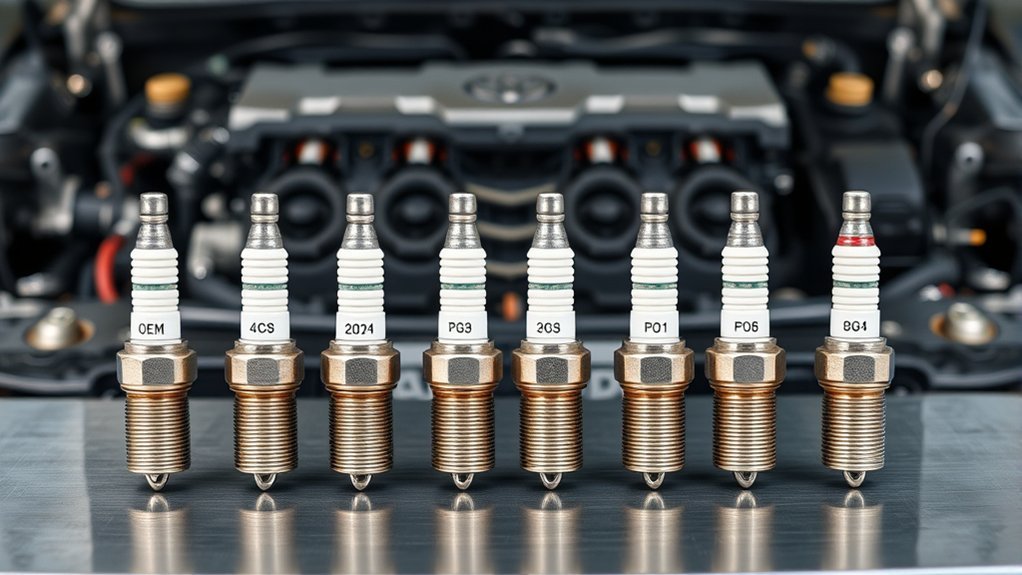
Choosing between OEM and aftermarket spark plugs for your Toyota Tacoma is less about the logo on the box and more about exact fitment. Your truck’s model year, engine, thread reach, seat design, heat range, resistance, gap, and maintenance schedule all matter. A correctly cataloged replacement can work well, while an incompatible “premium” plug can cause poor running or engine damage.
Quick Answer
For a stock Toyota Tacoma, use the exact Toyota-specified spark plug or a reputable DENSO or NGK equivalent cataloged for your year and engine. Don’t assume every Tacoma has a 30,000-mile interval. Check the maintenance guide and verify the part by VIN before buying or installing it.
Key Takeaways
- Toyota Tacoma spark-plug specifications and replacement intervals vary by model year and engine.
- Toyota Genuine plugs offer straightforward fitment, but a correctly cataloged OE-equivalent aftermarket plug can also be suitable.
- Match the complete specification, including thread reach, seat, heat range, resistance, gap, and electrode design.
- A different plug brand or material does not guarantee added horsepower or better fuel economy in a healthy stock engine.
- Install plugs in a cool, clean engine and follow the vehicle or plug manufacturer’s torque instructions.
Understanding OEM vs. Aftermarket Spark Plugs
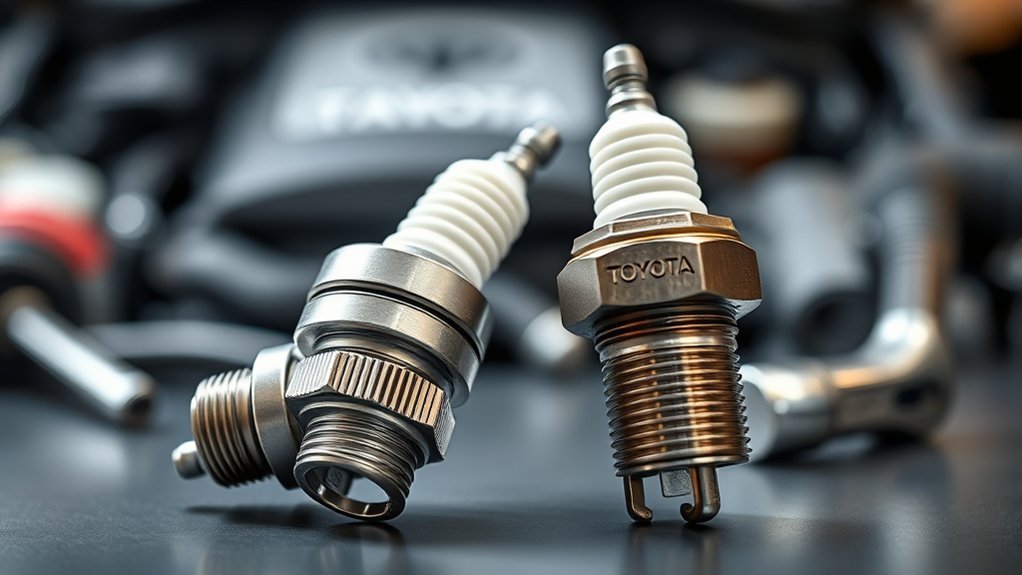
The terms OEM and aftermarket are often used too loosely. A Toyota Genuine spark plug comes through Toyota’s parts system. However, an original-equipment supplier such as DENSO or NGK may also sell a matching plug under its own brand.
An aftermarket plug is any replacement sold outside Toyota’s Genuine Parts packaging. That category includes basic replacement plugs, OE-equivalent plugs, long-life designs, and specialized racing products. Aftermarket does not automatically mean lower quality, and a familiar brand name does not automatically confirm fitment.
Note: Some factory-installed Toyota plugs may carry DENSO or NGK markings. The brand mix alone does not prove that the plugs are wrong. Compare the complete application and part specifications.
| Factor | Toyota Genuine / OEM | Aftermarket |
|---|---|---|
| Fitment | High confidence when selected by VIN through Toyota’s catalog. | Reliable when the manufacturer specifically catalogs the plug for your engine. |
| Packaging | Sold in Toyota Genuine Parts packaging. | Sold under the plug manufacturer’s or another replacement brand’s packaging. |
| Materials | Uses the electrode design specified for that application. | May use nickel alloy, platinum, iridium, or another design. Material alone does not confirm compatibility. |
| Service interval | Follow Toyota’s schedule for the model year and engine. | Follow Toyota’s schedule unless approved service information states otherwise. |
| Performance | Designed to provide the intended ignition and durability. | A correct replacement can restore lost performance, but it does not guarantee extra power. |
| Best use | Owners who want the simplest factory-specification choice. | Owners who verify the exact application and prefer a reputable equivalent. |
[Amazon Products Picked for You]

Genuine NGK Parts

This 6 pack DENSO Iridium Power Spark Plug is compatible with Toyota Tacoma 2015, 2014, 2013, 2012, 2011, 2010, 2009, 2008, 2007, 2006, 2005 4.0L V6

Iridium Spark Plugs
How to Choose the Right Spark Plug for Your Tacoma
Start with your Tacoma’s exact identity rather than a general model-year search. Two trucks sold in the same year may use different engines and spark-plug specifications.
- Confirm the model year and engine. Check the VIN, emissions label, owner records, or Toyota’s vehicle information.
- Search by VIN when possible. Toyota’s official parts catalog supports vehicle and VIN-based searches.
- Cross-check the application. Confirm the part through a reputable manufacturer catalog, such as the DENSO application catalog.
- Match every important specification. Verify thread diameter, reach, seat type, resistor design, heat range, factory gap, and electrode configuration.
- Check the maintenance schedule. Use Toyota’s manual and warranty portal to find the guide for your model year.
Pro Tip: Save the old plug’s part number and photograph its markings before buying replacements. Then verify that number against your VIN and engine instead of relying only on an online product title.
[Amazon Products Picked for You]

This 6 pack DENSO Standard Spark Plug is compatible with Toyota Tacoma 2004, 2003, 2002, 2001, 2000, 1999, 1998, 1997, 1996, 1995 3.4L V6

This 6 pack DENSO Iridium Long Life Spark Plug is compatible with Toyota Tacoma 2017, 2016 3.5L V6
How Often Should Tacoma Spark Plugs Be Replaced?
Your replacement interval depends on the model year, engine, and plug specification. The repeated 30,000-mile recommendation does not apply to every Tacoma.
For example, Toyota’s 2016 Tacoma Warranty and Maintenance Guide lists spark-plug replacement at 60,000 miles or 72 months for the 2GR-FKS engine. Its maintenance log also lists general spark-plug service at 120,000 miles or 144 months.
Older or newer Tacomas may have different requirements. Electrode material can affect durability, but a “100,000-mile” product description should not replace the schedule Toyota specifies for your truck.
Note: Mileage is not the only factor. Follow any time limit shown in your maintenance guide, especially when the truck accumulates mileage slowly.
Essential Features of OEM-Spec Spark Plugs
An OEM-spec plug is selected to work with the combustion chamber, ignition coils, engine controls, and expected operating temperature. Its most important features are not the logo or electrode material. They are its complete dimensions and electrical characteristics.
- Correct thread diameter and reach: The plug must seat at the intended depth without contacting internal components.
- Correct seat design: Gasket-seat and taper-seat plugs are not interchangeable.
- Correct heat range: The plug must transfer heat at the rate intended for the engine.
- Correct resistance: The resistor design must suit the ignition and electronic systems.
- Correct gap and electrode layout: These affect the voltage needed to fire the plug and ignite the mixture.
- Application-appropriate durability: Toyota may specify different electrode materials for different engines and service intervals.
A Toyota Genuine plug provides a straightforward way to obtain these features. A properly cross-referenced DENSO or NGK replacement may provide the same essential application specifications without Toyota packaging.
[Amazon Products Picked for You]

This 6 pack NGK V-Power Spark Plug is compatible with Toyota Tacoma 2004, 2003, 2002, 2001, 2000, 1999, 1998, 1997, 1996, 1995 3.4L V6

Why Consider Aftermarket Spark Plugs?
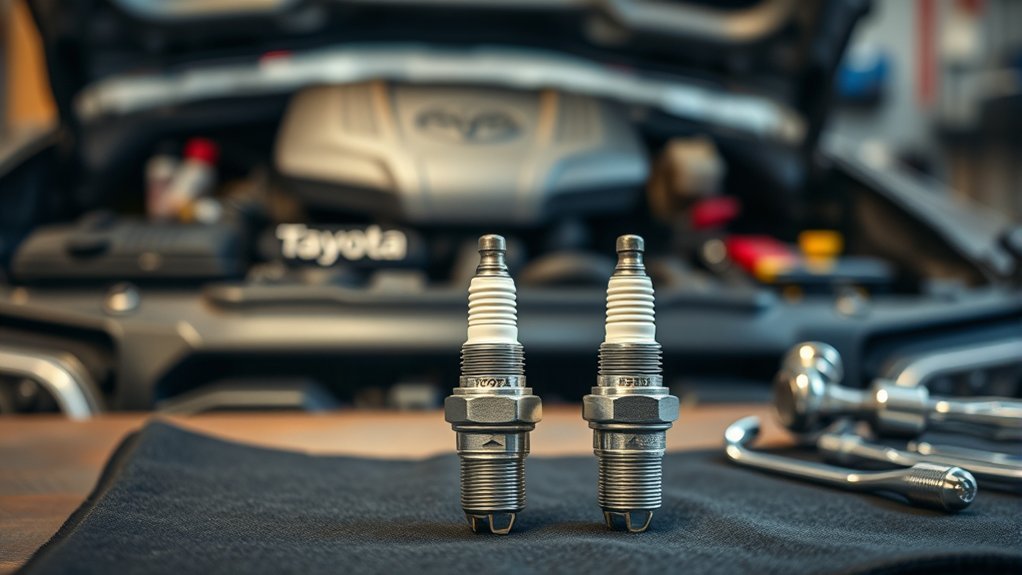
Aftermarket spark plugs can be a practical choice when they come from a reputable manufacturer and are specifically cataloged for your Tacoma. Brands that supply original equipment may also sell application-matched replacements under their own names.
A suitable aftermarket option may give you more purchasing choices and easier local availability. You may also find different product lines with varying electrode materials and durability ratings. However, those differences matter only after basic compatibility has been confirmed.
Avoid selecting plugs based only on words such as “racing,” “high performance,” “extra power,” or “long life.” A specialized plug with the wrong heat range, reach, seat, or resistance can perform worse than the correct standard replacement.
Do Performance Spark Plugs Add Power or Improve Fuel Economy?
A new set of correct plugs can improve how an engine runs when the old plugs are worn, fouled, cracked, or incorrectly gapped. In that case, the service restores performance that the engine had lost.
Changing from one healthy, correctly specified plug to another does not guarantee more horsepower, faster acceleration, or better fuel economy. A spark plug cannot add airflow or fuel, and your Tacoma’s engine controls are calibrated around a specific ignition requirement.
Modified, supercharged, turbocharged, or heavily tuned engines may need a different heat range or gap. Those choices should come from the tuner, engine builder, or verified calibration instructions. Towing and off-road driving alone are not good reasons to install an unapproved colder plug.
Signs Your Tacoma May Need Spark-Plug Inspection
Scheduled replacement is the safest guide, but worn or contaminated plugs may cause symptoms before the normal interval. Possible warning signs include:
- A flashing or steady check-engine light linked to misfire codes
- Rough or uneven idling
- Hard starting or extended cranking
- Hesitation during acceleration
- Reduced fuel economy
- Noticeable vibration or intermittent power loss
These symptoms do not prove that the spark plugs are faulty. Ignition coils, fuel injectors, wiring, intake leaks, compression problems, or contaminated fuel can produce similar behavior. Read the diagnostic codes and test the system before replacing parts repeatedly.
Warning: A flashing check-engine light can indicate an active misfire that may damage the catalytic converter. Reduce engine load and have the truck diagnosed promptly.
Common Mistakes to Avoid When Replacing Spark Plugs in Your Tacoma
Spark-plug replacement appears simple, but the plugs thread directly into the cylinder head. Careless installation can turn routine maintenance into an expensive repair.
Warning: Work only on a cool engine. Clean debris from each plug well, start every plug by hand, and use the specified torque. If a plug binds before seating, stop rather than forcing it into the cylinder head.
| Mistake | Possible Consequence | Safer Approach |
|---|---|---|
| Buying by model name alone | Wrong reach, seat, heat range, or resistance | Verify the year, engine, VIN, and complete part specification |
| Mixing different plug specifications | Uneven operation, fouling, overheating, or misfires | Use the complete application-matched set specified for the engine |
| Removing plugs from a hot engine | Increased risk of thread damage | Let the engine cool fully before beginning |
| Allowing dirt into the plug well | Debris may enter the cylinder or affect torque | Clean around the coils and plug wells before removal |
| Starting a plug with a ratchet | Cross-threaded cylinder-head threads | Thread the plug in by hand until it seats smoothly |
| Ignoring the torque specification | Poor heat transfer, gas leakage, broken plugs, or damaged threads | Use the Toyota or plug manufacturer’s applicable torque specification |
| Aggressively changing a fine-wire gap | Bent or broken iridium or platinum electrode | Measure carefully and follow the plug maker’s adjustment limits |
| Applying lubricant automatically | Altered torque and possible over-tightening | Follow the selected manufacturer’s instructions; NGK specifies dry installation for its plated plugs |
| Neglecting ignition coils and boots | A remaining misfire after plug replacement | Inspect connectors, boots, oil contamination, and visible coil damage |
| Not documenting the service | Uncertain maintenance history | Record the date, mileage, engine, plug number, gap, and torque used |
NGK’s spark-plug installation guidance explains that both under-tightening and over-tightening can interfere with heat transfer and damage the plug or engine. It also recommends clean plug holes and installation in a cool engine.
NGK also states that its plated plugs should be installed without anti-seize because lubricant changes the effective torque. Review the instructions for the exact plug brand instead of applying one rule to every product.
Sources
- Toyota 2016 Tacoma Warranty & Maintenance Guide — engine-specific spark-plug maintenance intervals.
- Toyota Manuals and Warranties — model-year owner and maintenance guide lookup.
- Toyota Official Parts Catalog — vehicle and VIN-based Genuine Toyota part lookup.
- DENSO Auto Parts Catalog — application lookup by year, model, engine, and part type.
- NGK Spark Plug Installation — torque, clean plug-hole, and cool-engine guidance.
- NGK: 5 Things You Should Know About Spark Plugs — anti-seize, fine-wire gap, and torque guidance.
Related Guides
Frequently Asked Questions
What are the best spark plugs for a Toyota Tacoma?
The best plugs are the exact Toyota-specified parts or reputable equivalents cataloged for your Tacoma’s model year and engine. Check fitment by VIN and match the original reach, seat, heat range, resistance, gap, and electrode design.
What spark-plug brands does Toyota use?
DENSO and NGK commonly supply ignition products for Toyota applications. However, the brand name alone is not enough. Confirm the exact Toyota or cross-referenced part number for your engine and VIN.
Do aftermarket spark plugs make a difference?
A correct aftermarket plug can provide dependable replacement service. New plugs may restore smooth running when the old ones are worn or fouled. A different brand or electrode material does not guarantee extra power or better fuel economy in a healthy stock engine.
Which spark-plug brand is best for Toyota?
Toyota Genuine, DENSO, and NGK are sensible starting points when the exact application is verified. Correct fitment and specification are more important than choosing one brand for every Toyota engine.
How often should Toyota Tacoma spark plugs be changed?
The interval varies by model year and engine. Do not use 30,000 miles as a universal rule. Check the Toyota maintenance guide for your truck. For example, Toyota’s 2016 guide lists 60,000-mile service for the 2GR-FKS engine and general plug service at 120,000 miles.
Should you use anti-seize on Tacoma spark plugs?
Follow the instructions for the exact plug you install. NGK advises installing its plated plugs dry because anti-seize changes the effective torque and may lead to over-tightening. Do not apply lubricant automatically.
Conclusion
For a stock Toyota Tacoma, the safest choice is the exact Toyota-specified spark plug or a reputable, application-matched equivalent. Verify the plug by model year, engine, and VIN, then follow Toyota’s maintenance interval instead of relying on a universal mileage claim.
Aftermarket plugs can work well when every specification matches. However, a premium label does not guarantee more power, longer service, or better fuel economy. Correct fitment, careful installation, and accurate diagnosis will do more for your Tacoma’s reliability than choosing a plug by marketing claims alone.