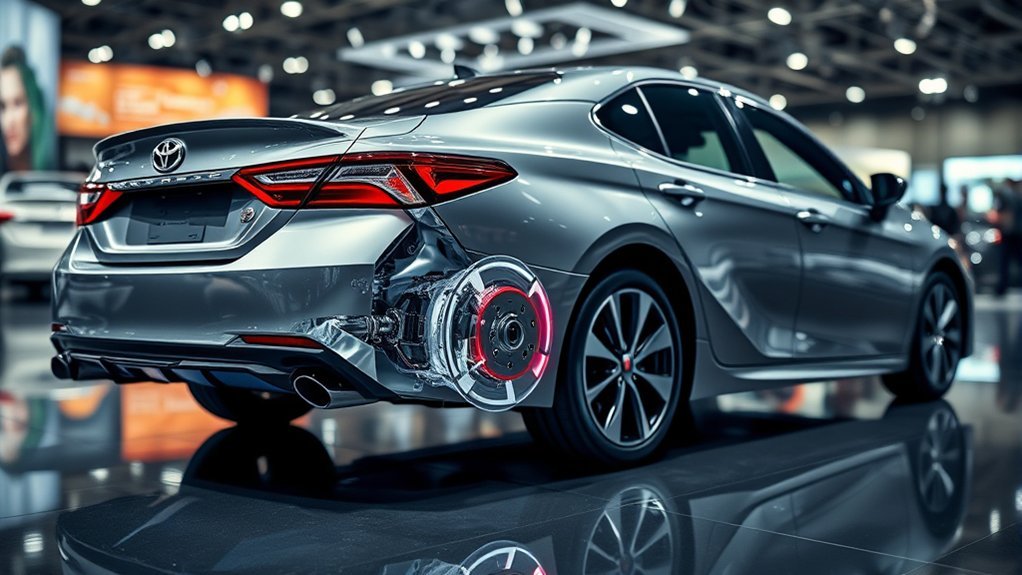
The Toyota Camry’s regenerative braking system recovers some of the energy normally lost when the car slows down. Instead of relying only on the brake pads and rotors, the hybrid system can use an electric motor-generator to help decelerate the vehicle and send electricity back to the traction battery. The result is more efficient energy use and less routine work for the friction brakes.
Quick Answer
Toyota Camry regenerative braking turns the electric drive motor into a generator while the car decelerates. The generated electricity is stored in the hybrid battery for later use. The system automatically blends this energy recovery with conventional hydraulic brakes whenever more stopping force is needed.
Key Takeaways
- Regenerative braking recovers only part of the vehicle’s kinetic energy; it cannot recycle all the energy used to accelerate.
- The Camry automatically blends regenerative and friction braking, so the driver normally uses the brake pedal just as in a conventional car.
- Friction brakes remain essential for strong stops, very low-speed braking, traction-control events, and other conditions that limit regeneration.
- Gradual deceleration and looking farther ahead can increase energy recovery without compromising safety.
- Brake operation, selector positions, displays, and normal sensations can vary by model year, so consult the owner’s manual for your exact Camry.
What Is Regenerative Braking in the Toyota Camry Hybrid?
Regenerative braking is an energy-recovery process used in Toyota Camry hybrid models. When the vehicle slows, an electric motor-generator can resist the rotation of the driven wheels. That resistance helps decelerate the car while producing electricity for the hybrid traction battery.
The U.S. Department of Energy explains that hybrid vehicles charge their batteries through regenerative braking as well as through the internal-combustion engine. The electric generator produces electricity from the rotating wheels during braking and transfers that energy to the traction battery.
Traditional friction brakes slow a vehicle by pressing brake pads against rotors and converting motion into heat. A Camry hybrid still has those brakes, but the hybrid system can handle part of routine deceleration electrically before or while the hydraulic brakes are applied.
Regenerative braking does not create free energy. It recovers a portion of the vehicle’s existing motion energy that conventional brakes would otherwise release mainly as heat.
Note: In the United States, the hybrid was sold as a separate Camry Hybrid model for many years. Beginning with the 2025 model year, Toyota made every U.S. Camry a hybrid, so newer vehicles may simply be called “Camry.”
How Does the Regenerative Braking System Work?
The Camry’s computers continuously decide how much deceleration can come from the motor-generator and how much must come from the hydraulic brakes. The driver does not need to switch between the two systems.
Energy Capture Mechanism
- You reduce accelerator pressure or press the brake pedal. The vehicle detects the requested deceleration.
- The drive motor operates as a generator. Rotation from the wheels turns the motor-generator instead of the battery driving it.
- The generator produces electrical energy. Power electronics regulate the electricity before it reaches the traction battery.
- The battery stores usable energy. The hybrid system can later use that energy to assist acceleration, operate the electric motor, or reduce engine workload.
Regeneration is most noticeable during planned, moderate deceleration. A sudden or forceful stop requires more braking force than the motor-generator alone may be able to provide, so the vehicle applies more friction braking.
Brake System Integration
The Camry uses an electronically controlled braking system to coordinate regenerative and hydraulic braking. Sensors monitor brake-pedal input, wheel behavior, vehicle speed, battery conditions, and available traction. The control system then calculates a suitable combination of electrical and hydraulic braking force.
For the 2025 Camry, Toyota describes an Electronically Controlled Braking system with on-demand pressurization from a pump motor in the brake actuator. Earlier Camry Hybrid generations use related brake-blending technology, although component names and control strategies can differ.
The transition between the two braking methods is designed to be controlled and predictable. A driver may still notice a slight change in pedal response when hydraulic braking increases, particularly near a complete stop, during firm braking, or when road conditions activate ABS or stability control.
What Does Camry Regenerative Braking Feel Like?
During normal driving, regenerative braking usually feels like smooth engine braking. The car may begin slowing when you ease off the accelerator, and pressing the brake pedal requests additional deceleration.
Normal sensations can include:
- A mild slowing effect after releasing the accelerator.
- A slight change in pedal feel as the vehicle approaches a complete stop.
- Soft electric-motor, pump, or actuator sounds during braking.
- Different deceleration strength when the traction battery is near its operating limits.
- More noticeable hydraulic-brake operation during firm or emergency braking.
A momentary change in feel does not automatically indicate a fault. However, a pedal that becomes unusually hard, sinks excessively, vibrates without an ABS event, requires much more stopping distance, or appears with a brake warning light should be inspected promptly.
Warning: Regenerative braking is an efficiency feature, not a substitute for normal braking. Always use the brake pedal as needed to maintain a safe following distance and stop the vehicle. Do not delay braking in an attempt to recover more energy.
Benefits of Regenerative Braking for Camry Drivers
Regenerative braking supports the Camry’s overall hybrid efficiency while reducing how often the friction brakes must handle the entire deceleration load.
| Benefit | What It Means |
|---|---|
| Energy recovery | Some motion energy is converted into electricity instead of being lost entirely as brake heat. |
| Hybrid-system efficiency | Recovered electricity can assist the electric motor and reduce the amount of fuel the engine must use later. |
| Reduced routine brake wear | Brake pads and rotors may perform less work during gentle, everyday stops. |
| Smooth deceleration | Electronic brake blending can provide controlled slowing during normal driving. |
Actual brake life varies with climate, road salt, traffic, terrain, driving style, vehicle load, maintenance, and the frequency of strong stops. Regenerative braking can reduce wear, but it does not eliminate brake inspections or repairs.
What Do Friction Brakes Do in a Hybrid?
The Camry’s friction brakes remain a primary safety system. Regenerative braking can contribute to deceleration, but the brake pads, rotors, calipers, hydraulic system, ABS, and stability-control functions are still required to stop the vehicle reliably under all expected conditions.
Role in Deceleration
During a light or moderate stop, the hybrid system may recover a substantial portion of the available braking energy. As the driver requests more deceleration, the vehicle progressively adds hydraulic braking force.
Friction brakes also provide the final holding force when the car is stopped. The motor-generator alone is not treated as the vehicle’s parking or stationary-holding brake.
When Friction Brakes Take Over
The vehicle may rely more heavily on friction brakes when:
- The driver brakes firmly or makes an emergency stop.
- The vehicle is moving too slowly for useful motor-generator braking.
- ABS, traction control, or stability control is actively managing wheel slip.
- The traction battery cannot accept the available charging power.
- The regenerative system is limited or temporarily unavailable.
- The vehicle must remain stationary after stopping.
These transitions happen automatically. The driver’s responsibility remains the same: press the pedal firmly enough to achieve the required stop.
Factors That Can Reduce Regenerative Braking
The amount of regeneration is not constant. The vehicle protects the battery, power electronics, tires, and braking system by adjusting energy recovery as conditions change.
- High battery charge: When the traction battery has limited room for additional energy, the system may reduce charging and use more friction or engine braking.
- Battery temperature: Very cold or hot battery conditions can temporarily limit the rate at which energy is accepted.
- Very low vehicle speed: Motor-generator braking becomes less useful near a complete stop.
- Hard braking: Friction brakes add the force required to meet the driver’s stopping request.
- Slippery surfaces: ABS and stability-control systems may change braking distribution to preserve traction.
- System protection or a fault: A warning light or diagnostic condition can reduce regenerative operation.
A temporary reduction does not necessarily mean the hybrid battery is failing. The Camry continuously manages charge level and temperature, so the energy-flow display may show less regeneration even when the vehicle is operating normally.
Common Regenerative-Braking Concerns
The Brake Pedal Feels Different
A hybrid brake pedal can feel less mechanically direct than a conventional system because the vehicle is interpreting pedal input and blending two braking methods. A small transition near low speed can be normal. A sudden major change, persistent vibration, warning light, or loss of stopping performance is not normal and requires service.
The Car Is Not Recovering Much Energy
Low indicated regeneration may occur when the battery is near its preferred charge limit, battery temperature is outside its ideal range, braking is too abrupt, the vehicle is nearly stopped, or road conditions require traction intervention.
Try observing the display over several normal trips rather than judging the system from one stop. If energy recovery remains absent and a warning light appears, arrange a diagnostic inspection.
Braking Feels Uneven on Rough or Slippery Roads
Wheel slip, potholes, loose gravel, snow, and ice can trigger ABS or stability-control adjustments. The vehicle may reduce regenerative braking and apply individual hydraulic brakes to maintain control. Continue steering toward a safe path and maintain firm pedal pressure during an emergency stop.
What to Check When Regeneration Seems Weak
- Check for red or amber brake, ABS, hybrid-system, or master-warning indicators.
- Confirm that the vehicle is in its normal drive range rather than Neutral.
- Consider whether the battery is highly charged or the weather is unusually cold or hot.
- Observe whether the concern occurs only near a stop, during hard braking, or on slippery pavement.
- Review the energy-flow display and owner’s manual for the exact model year.
- Have the vehicle inspected if braking performance changes materially or warning lights remain on.
Fuel-Efficiency Benefits of Regenerative Braking
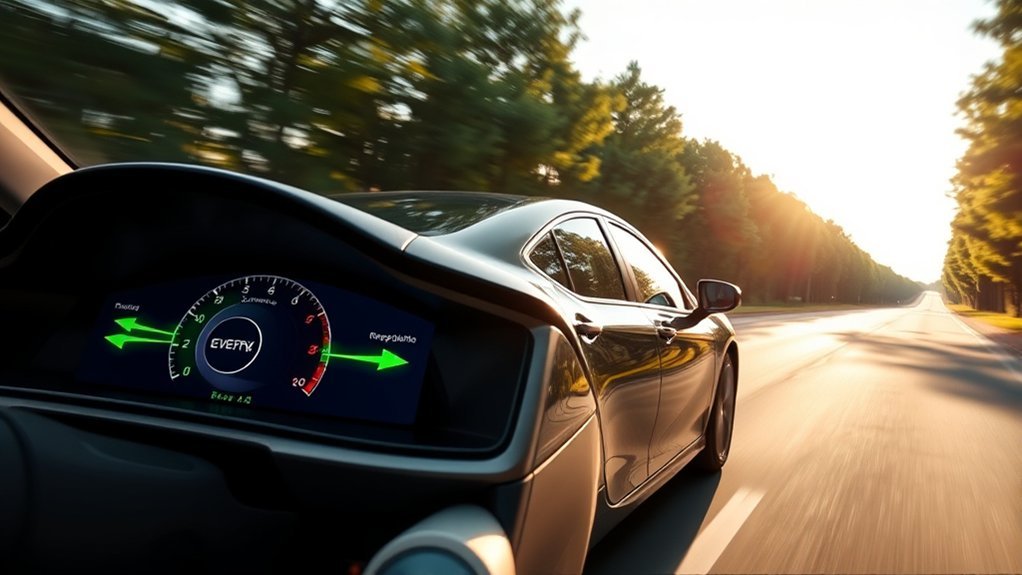
Regenerative braking contributes to fuel efficiency by returning some deceleration energy to the traction battery. The vehicle can reuse that stored electricity instead of obtaining all subsequent propulsion energy from gasoline.
The benefit is usually more relevant in traffic with repeated slowing and acceleration than during long periods of steady-speed highway driving. Even so, there is no single percentage by which regenerative braking improves every Camry’s fuel economy.
Toyota gave the 2025 Camry LE with front-wheel drive a manufacturer-estimated 51 mpg combined rating. That figure reflects the complete hybrid powertrain, vehicle design, grade, and test cycle—not regenerative braking by itself.
Ratings also vary by model year, trim, drivetrain, wheel and tire package, and market. Check the official label for the exact vehicle rather than assuming every Camry hybrid achieves the highest published figure.
Real-world results depend on temperature, speed, route, traffic, tire pressure, accessory use, vehicle load, terrain, and driving behavior. Energy recovered during braking also passes through the generator, power electronics, and battery, so only part of the vehicle’s original kinetic energy is available for reuse.
How to Maximize Regenerative-Braking Efficiency
You do not need to drive unusually slowly or delay necessary braking. The safest efficiency techniques are smooth, predictable habits that reduce avoidable acceleration and hard stops.
- Look farther ahead. Watch traffic lights, intersections, curves, and slowing vehicles so you can begin decelerating early.
- Ease off the accelerator gradually. This lets the vehicle reduce speed without immediately demanding heavy friction braking.
- Use steady brake pressure. Moderate, progressive pedal input generally gives the system more opportunity to blend regeneration smoothly.
- Leave adequate following distance. More space reduces abrupt braking and improves both safety and efficiency.
- Avoid unnecessary speed changes. Energy is lost every time the vehicle accelerates and decelerates, even when some energy is recovered.
- Keep the tires properly inflated. Follow the pressure label on the driver’s door jamb rather than the maximum pressure molded into the tire.
Pro Tip: The most efficient stop is often the one avoided through early observation. Regenerative braking recovers only part of the energy used to reach speed, so maintaining momentum safely is usually better than accelerating toward a red light and then trying to recover the energy.
Releasing the accelerator may create some regenerative deceleration, but the Camry should not be treated as a dedicated one-pedal-driving vehicle. Use the brake pedal whenever needed and do not depend on accelerator lift-off to produce a complete or timely stop.
How to Use B Mode or an Engine-Braking Range
Depending on the model year, a Camry hybrid may provide a B position, a sequential range, or another means of increasing engine braking on a long descent. This setting is intended to help control speed and reduce continuous friction-brake heating on extended downhill grades.
It is not normally the most efficient setting for routine level-road driving. Increased engine braking can dissipate energy through the engine rather than storing as much of it in the battery.
- Use the normal Drive position for ordinary driving unless the owner’s manual says otherwise.
- Select the available engine-braking range when descending a long or steep grade where repeated braking would otherwise be required.
- Continue using the brake pedal as necessary; the selected range does not replace the service brakes.
- Return to the normal Drive range after the descent.
Note: Selector labels and operating instructions vary across Camry generations. Confirm the correct procedure in the Toyota owner’s manual for your exact model year.
[Amazon Products Picked for You]

【HIGH QUALITY】12V Racing switch panel is made of aluminum alloy, carbon fiber material, strong and durable. Current & voltage: 30A & 12V.

Matches OE form, fit, and function
Regenerative vs. Traditional Braking
| Aspect | Regenerative Braking | Friction Braking |
|---|---|---|
| How it slows the car | Uses motor-generator resistance at the driven wheels. | Uses brake pads against rotating discs to create friction. |
| Energy result | Converts part of the motion energy into electricity. | Converts most braking energy into heat. |
| Best suited for | Moderate, planned deceleration when battery and traction conditions allow. | Strong stops, low-speed stopping, wheel-slip control, and stationary holding. |
| Wear | No brake-pad friction is required for the regenerative portion. | Pads and rotors wear and require regular inspection. |
| Driver control | Automatically managed by the hybrid and brake-control systems. | Automatically blended according to pedal input and operating conditions. |
The systems are complementary rather than competing designs. Regeneration improves energy use, while friction brakes provide the broad stopping capability required for safe everyday operation.
[Amazon Products Picked for You]

OE REPLACEMENT: Designed and engineered to OE specifications for fit, form, and function

PLEASE CONFIRM YOUR FITMENT: Using the Amazon Confirmed Fit bar at the top of the page or check the Product Description to confirm your vehicle fitment. This may be delivered in multiple boxes

Replacement for 2006-2007 Toyota Highlander (Hybrid, Hybrid Limited) - [2004-2006 Lexus RX330] - 2006-2008 Lexus RX400h - [2007-2009 Lexus RX350]
Real-World Effects in Daily Camry Driving
In city traffic, frequent deceleration gives the Camry repeated opportunities to recover energy. On an open highway, the vehicle may remain efficient for other reasons, but fewer braking events mean fewer opportunities for regeneration.
On rolling terrain, the system may capture energy while descending and use stored electricity during later acceleration. On a long descent, however, the battery can approach its preferred charge limit. The vehicle may then increase engine or friction braking to control speed.
| Driving Situation | What to Expect |
|---|---|
| Stop-and-go traffic | Frequent opportunities for moderate regeneration when stops are anticipated early. |
| Steady highway travel | Fewer regenerative events because the vehicle is not slowing as often. |
| Long downhill grade | Regeneration may be strong initially, then decrease as battery or system limits are reached. |
| Hard emergency stop | Hydraulic brakes provide the additional stopping force; ABS may pulse the brakes if needed. |
| Snow, ice, or gravel | Brake blending may change as stability and traction systems manage wheel grip. |
Brake Maintenance on a Camry Hybrid
Reduced brake-pad use does not make the friction-brake system maintenance-free. Pads, rotors, calipers, hoses, brake fluid, wheel-speed sensors, and the electronic brake-control system still require inspection.
In damp climates or areas that use road salt, rotors can develop surface rust because gentle regeneration sometimes leaves the friction brakes with less work to do. Occasional normal brake use usually cleans light surface film, but heavy corrosion, noise, vibration, pulling, or reduced braking performance requires inspection.
Follow Toyota’s maintenance schedule for your model year and have the brakes checked when:
- A brake, ABS, hybrid-system, or master-warning light remains illuminated.
- The pedal becomes unusually hard, soft, low, or inconsistent.
- The vehicle pulls to one side while braking.
- You hear persistent grinding, scraping, or metallic contact.
- The steering wheel or brake pedal vibrates during ordinary stops.
- Stopping distance increases noticeably.
- The parking brake does not hold the vehicle securely.
Brake fluid service intervals and inspection requirements differ by market and model year. Use the official manual and maintenance guide rather than applying a generic interval to every Camry.
[Amazon Products Picked for You]

Kit Includes: 1 Front Ceramic Brake Pad Set; 1 Rear Ceramic Brake Pad Set

PLEASE CONFIRM YOUR FITMENT: Using the Amazon Confirmed Fit bar at the top of the page or check the Product Description to confirm your vehicle fitment

COMPATIBLE VEHICLES - ATD1222C,D1222-8331 308.12120,EHT1212H,D1212-8332 Ceramic disc brake pad kit for 2013 2014 2015 2016 2017 2018 for Lexus ES300h, 2007-2018 for Lexus ES350, 2008-2018 for Toyota Avalon, 2007-2017 for Toyota Camry
Frequently Asked Questions
How does regenerative braking work on a Toyota Camry?
When the Camry slows, an electric motor-generator can use wheel rotation to produce electricity. The resulting resistance helps decelerate the car, while the generated power is regulated and stored in the hybrid traction battery. Hydraulic brakes are blended in whenever additional stopping force is required.
How does regenerative braking work in hybrid vehicles?
A hybrid’s traction motor can operate in reverse as a generator during deceleration. It converts part of the vehicle’s kinetic energy into electricity, which is stored in the battery. Because regeneration has operating limits, hybrid vehicles also retain a complete friction-brake system.
What is the simplest explanation of regenerative braking?
The electric motor that helps move the car can also help slow it. While slowing the car, the motor acts as a generator and sends some recovered electricity to the battery instead of allowing all braking energy to become heat.
How should I use regenerative braking correctly?
Look ahead, leave a safe following distance, release the accelerator early, and apply the brake pedal smoothly. Do not delay necessary braking to increase the charging display. The Camry manages the balance between regeneration and friction braking automatically.
Does regenerative braking replace the brake pads and rotors?
No. Regeneration can reduce routine pad and rotor use, but friction brakes are still required for hard stops, low-speed stopping, wheel-slip control, stationary holding, and conditions in which the battery cannot accept much energy.
Why does regenerative braking sometimes feel weaker?
Available regeneration can change with battery charge, battery temperature, vehicle speed, braking demand, traction, and system protection limits. The vehicle compensates by using more hydraulic braking. A persistent change accompanied by a warning light should be diagnosed.
Should I use B mode to charge the battery faster?
No. Where equipped, B mode or an engine-braking range is intended mainly for speed control on long descents. It may use the engine to dissipate energy and is not normally the most efficient choice for routine driving. Follow the instructions for your model year.
Conclusion
Regenerative braking helps a Toyota Camry hybrid use energy more efficiently by turning part of the vehicle’s motion into electricity during deceleration. The system works automatically with the hydraulic brakes, giving the vehicle both energy recovery and the dependable stopping force required for everyday driving.
For the best results, anticipate traffic, leave adequate space, and brake smoothly without sacrificing safety. Remember that regeneration changes with battery, speed, traction, and braking conditions. Continue inspecting the friction brakes as required, and consult the manual for model-year-specific controls, warnings, and maintenance guidance.
Sources
- U.S. Department of Energy Alternative Fuels Data Center: How Hybrid Electric Cars Work — explains regenerative charging, electric generators, traction motors, and hybrid-battery operation.
- Toyota USA Newsroom: 2025 Camry Hybrid System and Braking Technology — supports the hybrid-only model change, fifth-generation Toyota Hybrid System, fuel-economy estimate, and electronically controlled braking details.
- Toyota Owner’s Manuals and Warranty Guides — provides model-year-specific operating, warning, selector, and maintenance instructions.
- U.S. Department of Energy and EPA FuelEconomy.gov Vehicle Search — provides official model- and trim-specific fuel-economy ratings.
